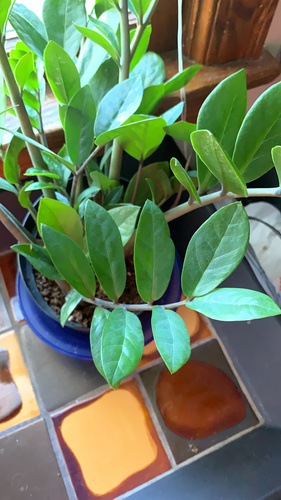
How to care for Zanzibar gem
Watering
Zanzibar gem stores water in its thick underground rhizomes and fleshy stems, so it prefers to dry out almost completely between drinks. Water thoroughly until it drains from the pot, then empty the saucer. Soggy roots are the main way this plant dies, so when in doubt, wait a few more days. Use a pot with a drainage hole and a chunky, fast-draining mix such as cactus compost with added perlite.
Does it need water today?
Push a finger about 5 cm (2 inches) into the soil. If it feels dry, water it. You can also lift the pot: if it feels surprisingly light compared with a recent watering, it is ready. The stems should feel firm and glossy; if they look wrinkled or soft, the plant is thirsty.
Water less in winter, when growth slows and indoor air is dry and warm near radiators. A cheap moisture meter helps beginners learn the rhythm of this plant.
Overwatering
Zanzibar gem evolved in the dry, sandy soils of eastern Africa, where its rhizomes rot quickly in waterlogged ground. Constantly wet compost deprives the roots of oxygen, so the rhizome becomes the first casualty.
Symptoms: Yellowing leaflets that drop easily, stems that turn mushy or black at the base, a sour smell from the soil, and fresh growth that never appears.
Solutions: Stop watering immediately. Tip the plant out, cut away any black or mushy rhizome and stems with a clean knife, and let the cut areas dry for a day. Repot into fresh, dry, gritty compost in a pot with a drainage hole, and wait at least two weeks before the first drink.
Underwatering
Thanks to its water-storing rhizome, this species tolerates drought far better than most houseplants. Problems appear only after a very long dry spell, when the plant starts drawing on its reserves and the leaflets lose firmness.
Symptoms: Wrinkled or limp stems, leaflets that look dull and slightly curled, and a dry, shrinking soil ball pulling away from the pot sides.
Solutions: Give a thorough soak using bottom watering so the dry compost rehydrates evenly. Let it drain well, then resume a normal schedule. Most plants recover within a few weeks, and any yellowed stems can be removed at the base.
Sunlight
Zanzibar gem grows naturally on the forest floor and in bright shade, so direct midday sun can scorch its glossy leaflets. It tolerates low light surprisingly well, but growth becomes slow and sparse. A bright spot without harsh rays gives the most compact, healthy plant.
- Ideal: Bright, indirect light · 4-6 hours of bright, filtered light daily
- Tolerates: Bright, indirect light, Partial sun, Shade
- Best spot in a room: Near the window
- Artificial light: A full-spectrum LED grow light placed 30 to 45 cm above the plant for 10 to 12 hours a day works well when natural light is weak, such as in winter or in north-facing rooms.
Too little light
In its native habitat this species grows under a canopy, so it has adapted to conserve energy in dim conditions. Without enough light it cannot build the starch reserves in its rhizome that keep stems firm and new leaves coming.
Symptoms: Long, leggy, pale stems reaching toward the light, small new leaflets, stalks that bend or lean, and very slow growth over a whole season.
Solutions: Move the plant closer to a bright window, ideally one facing east or west, or add an LED grow light. Rotate the pot a quarter turn each week so it grows evenly.
Too much sun
Direct afternoon sun, especially through glass, can overheat the thick leaflets of this species faster than they can transpire. Its waxy surface protects it somewhat, but intense sun still causes burns on leaves that have been moved suddenly from dim spots.
Symptoms: Bleached yellow or brown patches on the upper leaflets, crispy edges, and leaves that look faded or dry in the sunniest areas.
Solutions: Move the plant a metre or so back from the window or behind a sheer curtain. If it was moved from low light, acclimatise it over two weeks by gradually increasing its exposure. Remove badly scorched leaflets at the stalk base.
Temperature
Zanzibar gem (Zamioculcas zamiifolia) thrives in warm, stable indoor temperatures between 18 and 27 °C. It tolerates short dips and typical household conditions well, but it is not frost-hardy and should be kept away from cold drafts and hot direct heat sources.
- Ideal: 18–27 °C
- Tolerates: 10–35 °C
- Hardiness zones: 10-11
Fertilizing
Zanzibar gem grows slowly and stores water and nutrients in its thick rhizome, so it needs very little feeding. Fertilize only during the active growing season, and always apply to moist soil, never dry soil.
- Slow-release fertilizer: Once a year in early spring, when new growth begins, or not needed if the plant is repotted into fresh potting mix that year.
- Balanced liquid houseplant fertilizer (for example 10-10-10 or 20-20-20), Slow-release granular fertilizer formulated for indoor plants, Organic liquid fertilizer such as diluted fish emulsion or seaweed extract
Soil
Zanzibar gem needs soil that drains quickly and dries out between waterings, because its rhizomes rot in soggy conditions. Heavy garden soil or dense, moisture-retaining potting mix should be avoided.
- Cactus or succulent mix: About 60-70% mineral material such as pumice, perlite, or coarse sand, with 30-40% peat-free organic material such as coir or compost.
- Aroid mix: Roughly equal parts peat-free potting mix, perlite or pumice, and bark chips or coco chips.
- Homemade blend: Two parts peat-free potting mix, one part perlite, and one part coarse sand or pumice.
- pH 5.5–7
Repotting
Zanzibar gem (Zamioculcas zamiifolia) has tuberous, fleshy rhizomes that rot easily, so use a pot with drainage holes and a fast-draining mix. Repot only when needed; it tolerates being slightly root-bound far better than being overwatered.
- How often: Every 3-4 years, or when roots fill the pot
- New pot: Move up only one pot size, about 2-5 cm wider in diameter, because Zanzibar gem stores water in its thick rhizomes and sits wet in oversized pots.
- Repotting season: Spring, Summer
How to repot
- Lay the plant on its side and gently slide it out of the old pot, supporting the stems at the base.
- Knock off loose old soil and gently tease away compacted roots with your fingers.
- Inspect the rhizomes. Cut away any soft, mushy, or black parts with sterile tools and let cut areas dry for a day.
- Put a layer of fresh mix in the bottom of the new pot so the rhizomes will sit at the same depth they grew before.
- Center the plant, fill around the roots with mix, and firm it lightly with your hands.
- Leave about 2-3 cm of space below the rim for watering, then water thoroughly until it drains out the bottom.
- Empty the saucer and place the plant in bright, indirect light.
Pruning
Only remove leaves or stems that are clearly yellow, brown, or damaged. Each Zanzibar gem leaf is a long-lived compound leaf, so remove as little as possible at once, and never remove more than about a third of the foliage in a single session.
Pruning season: Spring, Summer
How to prune
- Inspect the plant and identify leaves that are fully yellow, brown, or mushy at the base.
- Follow each leaf stalk down to where it meets the soil or rhizome.
- Cut the stalk cleanly with sharp shears about 1 cm above the soil line, not flush with the rhizome.
- Remove any dead material from the pot surface so it does not rot or attract pests.
- Wipe the shears with rubbing alcohol between plants or after cutting any damaged leaves.
- Keep the plant in bright indirect light afterwards and avoid watering for a few days to let cut areas heal.
- Never cut into the rhizome itself, since this can open the plant to rot.
Propagation
Leaf cutting · Spring, Summer
- Choose a healthy, fully mature leaflet or whole leaf stalk from a Zanzibar gem that is at least a year old and free of rot.
- Cut the stalk close to the rhizome with a clean, sharp knife, or twist it firmly at the base so it snaps cleanly.
- Let the cut end dry and callus for 1 to 2 days in a shaded spot so it does not rot when planted.
- Fill a small pot with a free-draining mix of peat-free potting soil and perlite or coarse sand.
- Insert the cut end about 2 to 3 cm deep and firm the mix lightly around it.
- Keep the pot in bright, indirect light at 22 to 28 °C and water only when the mix is fully dry.
- Expect new tubers to form underground over several months; small new shoots signal success.
Division of rhizomes · Spring
- Wait until the plant is large and has several stems growing from a shared rhizome, usually after 3 or more years.
- Remove the plant from its pot and gently brush away loose soil to expose the rhizome.
- Use a clean knife to cut through the rhizome so each section has at least one stem and some healthy tuber tissue.
- Let the cut surfaces dry for a day, then pot each section in fresh, well-draining soil.
- Water lightly, then wait until the soil is dry before watering again, as the divisions can rot if kept wet.
Be patient: a Zanzibar gem can take several months to root and sprout, and the cutting may look unchanged for a long time. Overwatering is the most common cause of failure, so water sparingly.
About Zanzibar gem
Also known as: Zanzibar gem, ZZ plant, Eternity plant, Aroid palm
- Plant type: herb, geophyte, succulent-like perennial
- Lifespan: perennial
- Distribution: Native to the dry forests and bushland of eastern Africa, from Kenya south to Mozambique and northeastern South Africa.
- Mature height: 0.6-1.0 m
- Bloom time: Rarely flowers indoors; flowers are small spathes on the base in the wild, not visible as ornamental blooms.
Pets · People
Pets: Toxic · People: Toxic. Contains calcium oxalate crystals in all parts, causing oral irritation, drooling, vomiting and swelling if chewed; sap can irritate skin. Listed as toxic by the ASPCA.
Common problems
- Root and tuber rot: Caused by overwatering or heavy, poorly draining soil; stems turn mushy and yellow from the base.
- Yellowing leaflets: Usually a sign of too much water or cold drafts; lower leaves may yellow naturally as older stalks age.
- Leaf scorch: Brown patches on leaflets from hot direct sun through glass.
- Mealybugs: White cottony pests hiding in the leaf axils and under the stalks; wipe with alcohol on a cotton swab.
- Spider mites: Fine webbing and stippled leaves in dry, warm indoor air.
Uses
Mainly ornamental, grown as a houseplant and in offices and interiors for its durable, glossy foliage. It is sometimes used in landscaping in frost-free subtropical gardens.
Is it edible?
not edible
History & legends
The plant was first described by European botanists in the 1800s from specimens collected in eastern Africa, and it was later moved between genera before being recognized as Zamioculcas. It became widely known as a houseplant after introduction to European and American markets in the late twentieth century, where it earned nicknames such as Eternity plant for its longevity.
Did you know?
A single ZZ plant can survive for months without water because its rhizomes and tubers store moisture, and its leaflets are so waxy they shed dust and resist water loss.
Frequently asked questions
How often should I water Zanzibar gem?
every 21 days. Zanzibar gem stores water in its thick underground rhizomes and fleshy stems, so it prefers to dry out almost completely between drinks. Water thoroughly until it drains from the pot, then empty the saucer. Soggy roots are the main way this plant dies, so when in doubt, wait a few more days. Use a pot with a drainage hole and a chunky, fast-draining mix such as cactus compost with added perlite. Push a finger about 5 cm (2 inches) into the soil. If it feels dry, water it. You can also lift the pot: if it feels surprisingly light compared with a recent watering, it is ready. The stems should feel firm and glossy; if they look wrinkled or soft, the plant is thirsty.
How much light does Zanzibar gem need?
Bright, indirect light (4-6 hours of bright, filtered light daily). Zanzibar gem grows naturally on the forest floor and in bright shade, so direct midday sun can scorch its glossy leaflets. It tolerates low light surprisingly well, but growth becomes slow and sparse. A bright spot without harsh rays gives the most compact, healthy plant.
What temperature does Zanzibar gem like?
18–27 °C. Zanzibar gem (Zamioculcas zamiifolia) thrives in warm, stable indoor temperatures between 18 and 27 °C. It tolerates short dips and typical household conditions well, but it is not frost-hardy and should be kept away from cold drafts and hot direct heat sources.
Is Zanzibar gem toxic to cats and dogs?
It is toxic to cats and dogs: keep it out of their reach. Contains calcium oxalate crystals in all parts, causing oral irritation, drooling, vomiting and swelling if chewed; sap can irritate skin. Listed as toxic by the ASPCA.
What are the most common problems of Zanzibar gem?
Root and tuber rot: Caused by overwatering or heavy, poorly draining soil; stems turn mushy and yellow from the base. Yellowing leaflets: Usually a sign of too much water or cold drafts; lower leaves may yellow naturally as older stalks age. Leaf scorch: Brown patches on leaflets from hot direct sun through glass. Mealybugs: White cottony pests hiding in the leaf axils and under the stalks; wipe with alcohol on a cotton swab. Spider mites: Fine webbing and stippled leaves in dry, warm indoor air.
When should I repot Zanzibar gem?
Every 3-4 years, or when roots fill the pot. Zanzibar gem (Zamioculcas zamiifolia) has tuberous, fleshy rhizomes that rot easily, so use a pot with drainage holes and a fast-draining mix. Repot only when needed; it tolerates being slightly root-bound far better than being overwatered.
How do I propagate Zanzibar gem?
Leaf cutting, Division of rhizomes. Choose a healthy, fully mature leaflet or whole leaf stalk from a Zanzibar gem that is at least a year old and free of rot. Cut the stalk close to the rhizome with a clean, sharp knife, or twist it firmly at the base so it snaps cleanly. Let the cut end dry and callus for 1 to 2 days in a shaded spot so it does not rot when planted. Fill a small pot with a free-draining mix of peat-free potting soil and perlite or coarse sand. Insert the cut end about 2 to 3 cm deep and firm the mix lightly around it. Keep the pot in bright, indirect light at 22 to 28 °C and water only when the mix is fully dry. Expect new tubers to form underground over several months; small new shoots signal success.
How this guide was written
Verdiss writes each guide with AI from botanical references and checks the species against iNaturalist and Plants of the World Online (Kew). Readers can rate every guide in the app.
Sources
Verdiss's information is for general guidance. Never eat or use a plant as medicine based on an app: ask a professional.