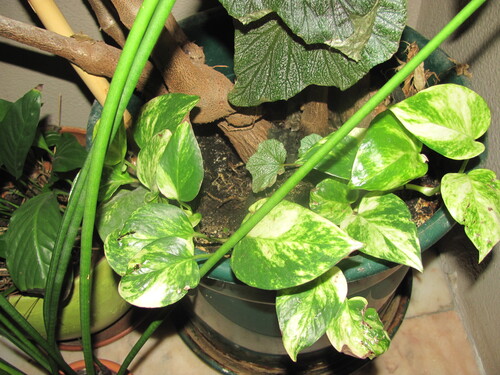
How to care for Golden Pothos
Watering
Golden Pothos (Epipremnum aureum) is a tropical vine that stores some water in its aerial roots and thick stems, so it tolerates a little dryness better than most houseplants. Water thoroughly when the top part of the soil has dried, then let excess drain fully from the pot. Pothos grows fastest in spring and summer, so it drinks more then; in winter, growth slows and the soil stays wet much longer. Always use a pot with drainage holes and a light, chunky mix such as aroid mix or houseplant mix with perlite.
Does it need water today?
Push a finger about 2–3 cm (1 inch) into the soil. If it feels dry, water now. If it still feels damp, wait a few days. You can also lift the pot: a pot that feels light and dry is ready for water, while a heavy pot can wait. Droopy, limp leaves that perk up again after watering are a clear sign of thirst.
Water the Golden Pothos less in winter than you think you need to. Most home pothos die from wet roots in cool months, not from drought. When in doubt, wait one more day.
Overwatering
Golden Pothos has thick, fleshy stems and roots that need air as well as moisture. When the soil stays soggy, the roots suffocate and rot, and the plant can no longer move water up to its leaves. This is the most common way pothos are lost indoors.
Symptoms: Yellow leaves, often starting with the lower ones; soft, mushy stems near the soil; a sour or musty smell from the pot; black or brown roots that come off easily; and leaves that wilt even though the soil is wet.
Solutions: Stop watering immediately and check the roots. Cut away any mushy, dark roots with clean scissors. Repot into fresh, dry, well-draining mix in a pot with drainage holes. Water only once the top few centimetres are dry, and move the plant to a brighter spot to help it dry out faster. Remove any stem sections that are fully rotten; a healthy node can often root in water to start a new plant.
Underwatering
Golden Pothos is forgiving, but its vines are thin at the tips and its pot is often small, so long dry spells quickly stress the plant. Without enough water, the plant cannot keep its leaves firm and will drop older foliage to save moisture.
Symptoms: Limp, drooping leaves that feel soft and thin; crispy brown leaf edges; yellowing leaves that drop; and dry, dusty soil that pulls away from the pot edges.
Solutions: Water thoroughly until water runs from the drainage holes. If the soil is very dry and hard, soak the whole pot in a basin of water for 30 minutes. Trim off completely brown leaves, which will not recover. Within a day or two, healthy new leaves and firm stems should return if the plant was only thirsty.
Sunlight
Golden Pothos (Epipremnum aureum) grows naturally under the canopy of tropical forests, where it climbs trees and receives dappled light. Indoors, it does best in bright, indirect light that is strong enough to read by comfortably at midday. Direct midday sun can scorch its leaves, while very dim corners cause slow growth and loss of the bright yellow variegation. Variegated cultivars such as 'Marble Queen' or 'Neon' need more light than the plain green forms to keep their patterns.
- Ideal: Bright, indirect light · 6–8 hours of bright, filtered or indirect light per day
- Tolerates: Partial sun, Shade
- Best spot in a room: Near the window
- Artificial light: If natural light is weak, a full-spectrum LED grow light placed 30–45 cm (12–18 inches) above the plant for 10–12 hours a day keeps the leaves compact and colourful. A simple desk lamp with a daylight bulb also helps pothos in windowless offices.
Too little light
The yellow or cream variegation in Golden Pothos depends on enough light to stay bright. In low light, the plant produces more plain green leaves to capture energy, and its vines grow long and leggy with large gaps between leaves.
Symptoms: Leggy stems with long spaces between leaves; leaves that become smaller and darker green; loss of yellow or white variegation; slow growth in spring and summer; and leaves that droop toward the pot.
Solutions: Move the plant closer to a bright window, ideally an east or west window with filtered light. Rotate the pot every week so all sides receive light. Prune leggy stems just above a node to encourage bushier growth, and root the cuttings in water. Add a grow light if the room stays dim.
Too much sun
Golden Pothos has thin, delicate leaves that are adapted to filtered forest light. Strong direct sun through a window, especially in summer, can burn the leaves quickly and fade their golden colour.
Symptoms: Pale, yellow or bleached patches on the leaves; brown, crispy scorched areas, usually on the side facing the window; curled or crispy leaf edges; and leaves that look washed out rather than bright.
Solutions: Move the plant a metre or more back from a south- or west-facing window, or place a sheer curtain between the plant and the sun. Damaged leaves will not recover their colour, so trim them off at the base. New growth should appear green and yellow in balance once the plant is in the right spot.
Temperature
Golden Pothos (Epipremnum aureum) thrives in warm, steady indoor conditions between about 18 and 29 °C. It is a tropical vine from the Solomon Islands, so it prefers warmth year-round and dislikes sudden swings. Keep it away from cold drafts, heating vents, and hot window glass in summer.
- Ideal: 18–29 °C
- Tolerates: 10–35 °C
- Hardiness zones: 10-12
Fertilizing
Golden Pothos is a fast-growing vine that uses feeding most during spring and summer, when it produces new leaves and long stems. Feed lightly and let the soil dry between waterings, because fertilizer salts build up quickly in pots. Pause feeding in fall and winter when growth slows.
- Slow-release fertilizer: Once a year in early spring, if you prefer slow-release granules, following the package rate for indoor foliage plants. Skip it if you already feed monthly with liquid.
- Balanced liquid houseplant fertilizer, such as an equal N-P-K formula (for example 10-10-10 or 20-20-20) diluted to half strength, Slow-release granular fertilizer for indoor foliage plants, Liquid seaweed or kelp fertilizer as a gentle, occasional supplement
Soil
Golden Pothos (Epipremnum aureum) grows in the wild as a climbing vine on tropical forest trees, where its roots sit in loose humus and bark. It needs a mix that holds some moisture but drains quickly and gives roots plenty of air.
- Chunky aroid mix: Mix two parts peat-free potting soil with one part perlite and one part orchid bark or coco chips
- Standard houseplant mix with perlite: Three parts all-purpose potting mix with one part perlite added for drainage
- Semi-hydroponic LECA setup: Expanded clay pebbles in a water-free container with a water level marker, suited to plants moved from soil
- pH 6.1–7.5
Repotting
Golden Pothos (Epipremnum aureum) is a fast-growing aroid with thick aerial roots and shallow roots, so repot into a pot only slightly larger than the root ball and use a well-draining mix.
- How often: Every 2-3 years, or when roots fill the pot
- New pot: Move up only one size, about 2-5 cm wider in diameter, with drainage holes. Golden Pothos prefers slightly snug pots and oversized pots hold wet soil that rots roots.
- Repotting season: Spring, Summer
How to repot
- Gently slide the plant out by tilting the pot and squeezing its sides. Avoid pulling on the vines, which can snap.
- Loosen the outer roots with your fingers and trim any brown, mushy, or hollow roots with clean shears.
- Add a layer of fresh mix to the bottom of the new pot so the root ball sits at the same depth it grew at before.
- Set the plant in the center, fill around the root ball with mix, and firm it gently with your hands without compacting it.
- Water thoroughly until it drains from the holes, then let excess drain away completely.
- Leave the plant in bright indirect light and wait about one week before fertilizing.
Pruning
Prune Golden Pothos in active growth, from spring through early autumn, and avoid heavy cutting in winter when growth slows. Use clean, sharp tools and cut just above a node, since new shoots emerge from these points. Remove no more than about one third of the vine at one time so the plant can recover.
Pruning season: Spring, Summer, Autumn
How to prune
- Inspect the plant and remove any yellow, brown, or damaged leaves by cutting the petiole close to the main stem.
- Trim long, leggy vines by cutting about 1 cm above a node, choosing a point where you want branching to start.
- To shape a fuller plant, pinch the growing tip of a vine so that side shoots develop below the cut.
- If the vine has grown too long for its space, cut it back to a node near the base, then root the trimmings as new plants.
- Remove aerial roots that grow into the air if they look unsightly, or guide them into the soil or onto a moss pole instead.
- After pruning, water lightly and keep the plant in bright, indirect light for a few weeks while it produces new leaves.
Propagation
Stem cutting in water · Spring, Summer
- Choose a healthy vine with at least two or three nodes, the small bumps on the stem where leaves and aerial roots emerge.
- Cut just below a node with clean scissors or a sharp knife, leaving a cutting about 10 to 15 cm long with two to four leaves.
- Remove the lowest leaf so that the node sits at the waterline, leaving no leaves submerged because they rot quickly.
- Place the cutting in a clear jar of room-temperature water, out of direct sun, in a bright spot with indirect light.
- Change the water every week or so, and keep the jar between 18 and 24 °C.
- Expect visible roots in roughly two to four weeks. Once the roots are 3 to 5 cm long, pot the cutting in well-draining potting mix.
Stem cutting in soil · Spring, Summer
- Take a node cutting as you would for water propagation, with two or three nodes and a few leaves.
- Fill a small pot with a light, well-draining mix such as peat-free potting mix blended with perlite.
- Insert the lowest node about 2 cm deep, and firm the soil gently around the stem.
- Water lightly so the mix is evenly moist but never soggy, then cover the pot with a clear plastic bag to hold humidity.
- Keep the pot in bright, indirect light and remove the bag for an hour every few days to prevent mould.
- Gentle tugs after about four weeks will show whether roots have formed. Then remove the bag and care for it as an established plant.
Air layering · Spring, Summer
- Pick a long, mature vine and find a node where you would like roots to form.
- Make a shallow upward cut about a third of the way through the stem just below that node, and insert a small piece of damp sphagnum moss into the cut to keep it open.
- Wrap the moss around the wounded area and secure it with plastic wrap, tying both ends tightly so moisture stays in.
- Check the moss every week and mist it when it begins to dry out.
- When roots are visible through the wrap, usually in four to six weeks, cut the stem just below the rooted section.
- Pot the new plant in fresh soil and keep it in bright, indirect light while it adjusts.
Golden Pothos roots very readily from nodes, so cuttings that include a node and at least one leaf almost always succeed. Rooting in water is the easiest way for beginners to watch progress. Cuttings taken in spring or early summer root fastest because the plant is growing actively.
About Golden Pothos
Also known as: Devil's Ivy, Golden Pothos, Hunter's Robe, Taro Vine
- Plant type: climber, vine, evergreen herb
- Lifespan: perennial
- Distribution: Native to the Solomon Islands and tropical forests of Southeast Asia and Oceania.
- Mature height: Up to 20 m climbing in the wild; 1-2 m indoors
- Bloom time: Rarely flowers indoors; wild flowers are a spathe with a spadix, not showy.
Pets · People
Pets: Toxic · People: Toxic. Contains calcium oxalate crystals (raphides) that cause oral irritation, drooling, swelling and vomiting if chewed; listed as toxic to cats and dogs by ASPCA.
Common problems
- Yellowing leaves: Usually caused by overwatering or poor drainage, leading to root rot.
- Brown leaf tips: Often due to low humidity, dry air or fluoride and salts in tap water.
- Fading variegation: Insufficient light causes leaves to revert to plain green.
- Mealybugs: Cottony pests in leaf joints that can be wiped off with alcohol on a cotton swab.
- Leggy growth: Long bare stems with small leaves appear when light is too low.
Uses
Grown mainly as an ornamental houseplant and hanging basket plant worldwide. In its native region, leaves are occasionally used in local folk remedies, though this is not well documented.
Is it edible?
Not edible; leaves and stems contain calcium oxalate and cause irritation if eaten.
History & legends
Introduced to Western horticulture in the 19th century and widely distributed as a houseplant from the 1960s onward. The common name Devil's Ivy is said to reflect how difficult it is to kill, though no single origin story is verified.
Did you know?
Epipremnum aureum is one of the few houseplants that can grow leaves with splits and holes (fenestration) when mature, a feature more typical of Monstera.
Frequently asked questions
How often should I water Golden Pothos?
every 7 days. Golden Pothos (Epipremnum aureum) is a tropical vine that stores some water in its aerial roots and thick stems, so it tolerates a little dryness better than most houseplants. Water thoroughly when the top part of the soil has dried, then let excess drain fully from the pot. Pothos grows fastest in spring and summer, so it drinks more then; in winter, growth slows and the soil stays wet much longer. Always use a pot with drainage holes and a light, chunky mix such as aroid mix or houseplant mix with perlite. Push a finger about 2–3 cm (1 inch) into the soil. If it feels dry, water now. If it still feels damp, wait a few days. You can also lift the pot: a pot that feels light and dry is ready for water, while a heavy pot can wait. Droopy, limp leaves that perk up again after watering are a clear sign of thirst.
How much light does Golden Pothos need?
Bright, indirect light (6–8 hours of bright, filtered or indirect light per day). Golden Pothos (Epipremnum aureum) grows naturally under the canopy of tropical forests, where it climbs trees and receives dappled light. Indoors, it does best in bright, indirect light that is strong enough to read by comfortably at midday. Direct midday sun can scorch its leaves, while very dim corners cause slow growth and loss of the bright yellow variegation. Variegated cultivars such as 'Marble Queen' or 'Neon' need more light than the plain green forms to keep their patterns.
What temperature does Golden Pothos like?
18–29 °C. Golden Pothos (Epipremnum aureum) thrives in warm, steady indoor conditions between about 18 and 29 °C. It is a tropical vine from the Solomon Islands, so it prefers warmth year-round and dislikes sudden swings. Keep it away from cold drafts, heating vents, and hot window glass in summer.
Is Golden Pothos toxic to cats and dogs?
It is toxic to cats and dogs: keep it out of their reach. Contains calcium oxalate crystals (raphides) that cause oral irritation, drooling, swelling and vomiting if chewed; listed as toxic to cats and dogs by ASPCA.
What are the most common problems of Golden Pothos?
Yellowing leaves: Usually caused by overwatering or poor drainage, leading to root rot. Brown leaf tips: Often due to low humidity, dry air or fluoride and salts in tap water. Fading variegation: Insufficient light causes leaves to revert to plain green. Mealybugs: Cottony pests in leaf joints that can be wiped off with alcohol on a cotton swab. Leggy growth: Long bare stems with small leaves appear when light is too low.
When should I repot Golden Pothos?
Every 2-3 years, or when roots fill the pot. Golden Pothos (Epipremnum aureum) is a fast-growing aroid with thick aerial roots and shallow roots, so repot into a pot only slightly larger than the root ball and use a well-draining mix.
How do I propagate Golden Pothos?
Stem cutting in water, Stem cutting in soil, Air layering. Choose a healthy vine with at least two or three nodes, the small bumps on the stem where leaves and aerial roots emerge. Cut just below a node with clean scissors or a sharp knife, leaving a cutting about 10 to 15 cm long with two to four leaves. Remove the lowest leaf so that the node sits at the waterline, leaving no leaves submerged because they rot quickly. Place the cutting in a clear jar of room-temperature water, out of direct sun, in a bright spot with indirect light. Change the water every week or so, and keep the jar between 18 and 24 °C. Expect visible roots in roughly two to four weeks. Once the roots are 3 to 5 cm long, pot the cutting in well-draining potting mix.
How this guide was written
Verdiss writes each guide with AI from botanical references and checks the species against iNaturalist and Plants of the World Online (Kew). Readers can rate every guide in the app.
Sources
Verdiss's information is for general guidance. Never eat or use a plant as medicine based on an app: ask a professional.