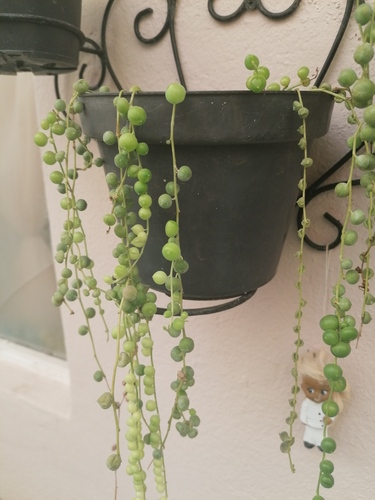
How to care for Senecio rowleyanus
Watering
String of pearls (Senecio rowleyanus) stores water in its bead-like leaves, so it is built for drought. Let the soil dry out almost completely between waterings, then soak the pot thoroughly and let all excess drain away. Water less in winter, when growth slows and cool, damp soil can rot the stems. Use a free-draining cactus or succulent mix in a pot with drainage holes.
Does it need water today?
Gently squeeze a bead. If it feels firm and plump, wait. If it looks wrinkled, flattened, or feels soft and shrivelled, water now. Also check the soil: push a finger 2-3 cm down; if it is dry and crumbly, the plant is ready for water. Lift the pot too; a light pot means it is dry.
Water at the soil level and avoid wetting the beads and stems, which can rot. When in doubt, wait a few more days, since an underwatered string of pearls recovers far more easily than an overwatered one.
Overwatering
String of pearls comes from the dry, rocky regions of southwestern Africa, so its roots and stems are adapted to brief wet spells followed by long dry periods. Constantly wet soil deprives the roots of oxygen and encourages fungal rot at the base of the stems, which the plant cannot easily recover from.
Symptoms: Beads turn mushy, translucent, or yellow and drop off easily. Stems blacken or turn soft at the soil line, and the soil smells sour or musty.
Solutions: Stop watering immediately and remove the plant from the pot. Cut away any black or mushy stems with clean scissors, let the roots dry for a day or two, then repot into fresh, dry cactus mix in a clean pot with drainage holes. Water sparingly for several weeks afterward.
Underwatering
The beads of a string of pearls are water reservoirs, so the plant shows thirst clearly and early. Long dry spells are natural for it, but if the soil stays bone-dry for too long, the plant uses its stored water and the beads start to shrink.
Symptoms: Beads look wrinkled, flattened, or grey-green and lose their plump, round shape. Strings may look thin, dry, and limp, and the soil pulls away from the pot edges.
Solutions: Soak the pot in a tray of water for 20-30 minutes, then let it drain fully. Keep the plant in bright light while it recovers, and water on your normal schedule afterward. Plump beads usually return within a week or two, though strings that have dried completely may need to be trimmed.
Sunlight
String of pearls (Senecio rowleyanus) grows naturally in the open, semi-desert hills of South Africa and Namibia, where it gets strong sun. Indoors, it needs the brightest spot you can give it. Too little light makes the strings long, pale, and sparse, with beads spaced far apart. Rotate the pot a quarter turn every couple of weeks so the trails grow evenly.
- Ideal: Bright, indirect light · 4-6 hours of bright light daily, ideally with some gentle direct morning or late-afternoon sun
- Tolerates: Full sun, Partial sun
- Best spot in a room: At the window
- Artificial light: If natural light is weak, use a full-spectrum LED grow light 15-30 cm above the plant for 12-14 hours a day. A south- or west-facing window is best in the Northern Hemisphere, with a sheer curtain on hot afternoons.
Too little light
Its beads are small, round, and sit on thin, stretched strings because it is adapted to bright, open sites. In low light, the plant stretches toward any source of light and invests less energy in making compact beads.
Symptoms: Strings grow long, thin, and pale, with wide gaps between beads. Growth slows, and older beads may shrivel and drop.
Solutions: Move the plant closer to a bright window or add a grow light for 12-14 hours a day. Trim leggy strings to encourage bushier growth, and propagate the cuttings to make a fuller plant.
Too much sun
Strong, reflected midday sun in hot, dry conditions can overheat the beads, which are sensitive to scorching despite the plant's native habitat. Sudden exposure after a period indoors is the most common cause of damage.
Symptoms: Beads turn white, pale yellow, or brown on the side facing the sun, and may look blistered or flattened. Growth may stall and the plant may look dry and stressed.
Solutions: Move the plant a metre back from the window or to a spot with bright, filtered light. Add a sheer curtain during midday and afternoon. If you need to move it into more sun, do so gradually over two weeks to let it adjust.
Temperature
String of pearls (Senecio rowleyanus) is a succulent from arid southwestern Africa. It prefers warm, dry air and bright conditions, and it is damaged by cold and by prolonged heat with poor airflow. Keep it between about 15 and 24°C for steady growth.
- Ideal: 15–24 °C
- Tolerates: 7–35 °C
- Hardiness zones: 10-11
Fertilizing
String of pearls grows slowly and needs little food. Feed it only during its active growing period from spring through early autumn, and never fertilize a plant that is dry, stressed, or resting in winter.
- Slow-release fertilizer: Once a year in early spring, if using a slow-release product, or not needed in a small pot with fresh potting mix.
- Balanced cactus and succulent fertilizer diluted to half strength, Low-nitrogen liquid fertilizer formulated for succulents, Slow-release granular fertilizer labeled for cacti and succulents
Soil
String of pearls needs a fast-draining mix that dries out between waterings. Its shallow roots sit in the soil for long periods, so soil that holds water leads quickly to rot. A gritty, open mix keeps the roots aerated and the pearls firm.
- Cactus and succulent mix: Commercial cactus mix or a blend of peat-free potting soil with added perlite or pumice, roughly one part soil to two parts grit.
- Homemade gritty mix: Equal parts potting soil, coarse sand or pumice, and perlite, with a small amount of composted bark for light structure.
- Trailing succulent mix: Peat-free potting mix blended with horticultural grit and a handful of fine bark, suited to shallow-rooted hanging plants.
- pH 6–7.5
Repotting
String of pearls (Senecio rowleyanus) has shallow, fibrous roots and fragile trailing stems that snap easily. Repot gently, in spring, when the plant is actively growing and can recover quickly.
- How often: Every 2-3 years, or when roots fill the pot and grow out of the drainage holes
- New pot: Choose a pot only 2-5 cm wider than the root ball. String of pearls dislikes wet soil in oversized pots and roots rot easily.
- Repotting season: Spring
How to repot
- Tip the pot on its side and gently ease the root ball out, supporting the trailing stems with your hand
- Shake off old soil and loosen the roots with your fingers. Trim any black, mushy roots with clean scissors
- Place a small layer of fresh mix in the new pot, then set the plant so the crown sits just below the rim
- Fill around the roots with mix, tapping the pot gently to settle it without packing it tight
- Arrange the trailing strands so they drape over the edge rather than tangling or lying flat on the soil
- Leave the soil dry for 2-3 days, then water thoroughly until it drains out the bottom
Pruning
Pruning String of pearls is mostly about trimming long, thin, or leggy strands and removing damaged beads. Cut only during the active growing season, and avoid cutting more than about a third of the plant at once.
Pruning season: Spring, Summer
How to prune
- Identify stems that are long, bare, or thinning, and those with brown, flattened, or shriveled beads.
- Cut each stem with clean scissors just above a node or a healthy cluster of beads.
- Remove dead or mushy beads entirely, cutting back to healthy tissue.
- Save trimmed healthy stems as cuttings for propagation rather than discarding them.
- Water lightly a few days after pruning and keep the plant out of harsh direct sun while it adjusts.
- Rotate the pot every few weeks so that growth stays balanced around all sides.
Propagation
Stem cuttings · Spring, Summer
- Cut a healthy trailing stem 8 to 10 cm long just below a node, where a bead-like leaf joins the stem.
- Remove the lowest pair of beads so the bare stem can sit in soil or water.
- Let the cut end dry and callus for one to two days in a shady spot.
- Lay the stem on top of a pot of moist, gritty cactus or succulent mix, or insert the cut end about 1 cm deep.
- Keep the pot in bright, indirect light at 18 to 24 °C and water only when the soil is fully dry.
- Roots usually form in three to five weeks; a gentle tug that meets resistance shows rooting has begun.
Leaf-bead cuttings · Spring, Summer
- Detach a single healthy bead from the stem with a clean twist, keeping a tiny bit of stalk attached if possible.
- Set the bead flat on the surface of a shallow tray of barely damp succulent mix.
- Mist lightly every few days to keep the surface moist but never soggy.
- Keep in bright, indirect light; new plantlets may emerge from the bead in several weeks.
- Once a small plant forms with its own stems, transplant it into its own pot.
Trailing stems of String of pearls root readily where they touch moist soil, so you can also pin a stem onto the surface of a pot and wait for roots to form before cutting it free. Avoid misting the beads themselves for long periods, as trapped water can cause rot.
About Senecio rowleyanus
Also known as: String of pearls, Necklace vine, Rosary vine
- Plant type: succulent, trailing herb
- Lifespan: perennial
- Distribution: Native to the arid southwestern parts of Namibia and adjacent southern Angola.
- Mature height: Trailing stems 30-90 cm (12-35 in) long
- Bloom time: Late summer to autumn in its native range; rarely blooms indoors
Pets · People
Pets: Toxic · People: Toxic. Listed by the ASPCA as toxic to cats and dogs; ingestion may cause vomiting and gastrointestinal upset. The sap can irritate skin. Keep out of reach of children and pets.
Common problems
- Root rot: Caused by overwatering in dense or poorly draining soil, turning the beads soft and mushy.
- Shriveled beads: Usually a sign of underwatering or prolonged heat; beads recover after a thorough soak.
- Leggy, sparse strands: Insufficient light causes long stems with few beads; move to a brighter spot.
- Mealybugs: Cottony pests that hide in the leaf crevices and along stems; treat with alcohol on a cotton swab.
- Sunburn: Sudden exposure to intense direct sun can bleach or scorch the beads.
Uses
Grown almost exclusively as an ornamental houseplant and in hanging baskets and rock gardens. It has no notable medicinal, culinary or industrial use in common practice.
Is it edible?
not edible
History & legends
The species was described in the nineteenth century from southwestern Africa and introduced to European horticulture, where it became a popular greenhouse and houseplant. Its beaded form has inspired many common names referring to jewelry and rosaries.
Did you know?
The bead-like leaves are not just decorative: the translucent tip lets light penetrate into the leaf interior, so most of the leaf can stay buried in sand while still photosynthesizing.
Frequently asked questions
How often should I water Senecio rowleyanus?
every 14 days. String of pearls (Senecio rowleyanus) stores water in its bead-like leaves, so it is built for drought. Let the soil dry out almost completely between waterings, then soak the pot thoroughly and let all excess drain away. Water less in winter, when growth slows and cool, damp soil can rot the stems. Use a free-draining cactus or succulent mix in a pot with drainage holes. Gently squeeze a bead. If it feels firm and plump, wait. If it looks wrinkled, flattened, or feels soft and shrivelled, water now. Also check the soil: push a finger 2-3 cm down; if it is dry and crumbly, the plant is ready for water. Lift the pot too; a light pot means it is dry.
How much light does Senecio rowleyanus need?
Bright, indirect light (4-6 hours of bright light daily, ideally with some gentle direct morning or late-afternoon sun). String of pearls (Senecio rowleyanus) grows naturally in the open, semi-desert hills of South Africa and Namibia, where it gets strong sun. Indoors, it needs the brightest spot you can give it. Too little light makes the strings long, pale, and sparse, with beads spaced far apart. Rotate the pot a quarter turn every couple of weeks so the trails grow evenly.
What temperature does Senecio rowleyanus like?
15–24 °C. String of pearls (Senecio rowleyanus) is a succulent from arid southwestern Africa. It prefers warm, dry air and bright conditions, and it is damaged by cold and by prolonged heat with poor airflow. Keep it between about 15 and 24°C for steady growth.
Is Senecio rowleyanus toxic to cats and dogs?
It is toxic to cats and dogs: keep it out of their reach. Listed by the ASPCA as toxic to cats and dogs; ingestion may cause vomiting and gastrointestinal upset. The sap can irritate skin. Keep out of reach of children and pets.
What are the most common problems of Senecio rowleyanus?
Root rot: Caused by overwatering in dense or poorly draining soil, turning the beads soft and mushy. Shriveled beads: Usually a sign of underwatering or prolonged heat; beads recover after a thorough soak. Leggy, sparse strands: Insufficient light causes long stems with few beads; move to a brighter spot. Mealybugs: Cottony pests that hide in the leaf crevices and along stems; treat with alcohol on a cotton swab. Sunburn: Sudden exposure to intense direct sun can bleach or scorch the beads.
When should I repot Senecio rowleyanus?
Every 2-3 years, or when roots fill the pot and grow out of the drainage holes. String of pearls (Senecio rowleyanus) has shallow, fibrous roots and fragile trailing stems that snap easily. Repot gently, in spring, when the plant is actively growing and can recover quickly.
How do I propagate Senecio rowleyanus?
Stem cuttings, Leaf-bead cuttings. Cut a healthy trailing stem 8 to 10 cm long just below a node, where a bead-like leaf joins the stem. Remove the lowest pair of beads so the bare stem can sit in soil or water. Let the cut end dry and callus for one to two days in a shady spot. Lay the stem on top of a pot of moist, gritty cactus or succulent mix, or insert the cut end about 1 cm deep. Keep the pot in bright, indirect light at 18 to 24 °C and water only when the soil is fully dry. Roots usually form in three to five weeks; a gentle tug that meets resistance shows rooting has begun.
How this guide was written
Verdiss writes each guide with AI from botanical references and checks the species against iNaturalist and Plants of the World Online (Kew). Readers can rate every guide in the app.
Sources
Verdiss's information is for general guidance. Never eat or use a plant as medicine based on an app: ask a professional.