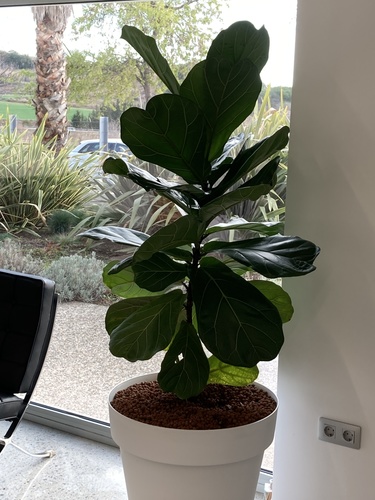
How to care for Fiddle-leaf Fig
Watering
Fiddle-leaf Fig (Ficus lyrata) prefers to dry out partially between drinks. Water thoroughly when the top 5 cm of soil is dry, letting water run out of the drainage holes, then empty the saucer. Soggy roots are the main way this tree dies indoors. Use a pot with drainage and a well-draining mix such as potting soil with added perlite or bark.
Does it need water today?
Push a finger 5 cm into the soil. If it feels dry and crumbly, water. If it feels cool or damp, wait. You can also lift the pot: a dry root ball feels noticeably light compared with one that was just watered. Check the soil at several depths because the top can dry while the bottom stays wet.
Water on a schedule only as a rough guide. Light, temperature and pot size change how fast the soil dries, so always check the soil first. Leaves that droop slightly in the morning often mean the plant is thirsty, but leaves that yellow and drop while the soil is wet point to overwatering.
Overwatering
Fiddle-leaf figs come from tropical West Africa, where their roots grow in fast-draining soil and dry out between rains. Their thick, fleshy root systems rot quickly in wet, airless soil, so this species is especially sensitive to too much water.
Symptoms: Brown or black spots on lower leaves, yellowing leaves that drop, a soft or sour-smelling trunk base, and soil that stays wet for more than a week.
Solutions: Stop watering and let the soil dry fully. Remove the plant from its pot, cut away any black, mushy roots with clean scissors, and repot into fresh, dry-draining mix in a pot with drainage holes. Water again only when the top 5 cm is dry.
Underwatering
Fiddle-leaf figs grow large, broad leaves that lose water quickly through their surface, especially in heated rooms. When the root ball dries out completely, the plant cannot move water up to its leaves fast enough and sheds them to conserve moisture.
Symptoms: Leaves that curl, droop, turn crispy at the edges, or develop brown patches, followed by leaf drop. Dry soil that pulls away from the pot sides is another sign.
Solutions: Water thoroughly using the bottom-watering method until moisture reaches the centre of the root ball. Mist the leaves lightly and move the plant away from radiators. Expect some recovery in new growth within a few weeks, but avoid overcorrecting with frequent shallow watering.
Sunlight
Fiddle-leaf figs need strong, consistent light to keep their large leaves healthy. Bright indirect light near a bright window suits them best. Direct afternoon sun through glass can scorch leaves, while deep shade causes slow growth and leaf drop. Rotate the pot a quarter turn every few weeks so the tree grows straight rather than leaning toward the window.
- Ideal: Bright, indirect light · 6-8 hours of bright, filtered light per day
- Tolerates: Bright, indirect light, Partial sun
- Best spot in a room: At the window
- Artificial light: If natural light is weak, use a full-spectrum LED grow light placed 30 to 60 cm above the canopy, running about 10 to 12 hours a day. Keep the light on a timer so the plant gets a steady routine through the winter months.
Too little light
Ficus lyrata evolved in the understory of tropical forests where light is bright but filtered, and it depends on steady energy to grow its large leaves. In dim rooms it cannot photosynthesise enough to replace older leaves, so it sheds them and stops producing new growth.
Symptoms: Small new leaves, leggy growth reaching toward the light, pale green colour, and older lower leaves yellowing and falling.
Solutions: Move the plant closer to a bright east, west or south-facing window, keeping it out of harsh midday sun. Clean dust from the leaves so they absorb more light, and add an LED grow light if needed.
Too much sun
Although fiddle-leaf figs enjoy bright light, their broad, thin leaves are adapted to filtered forest light and burn easily under intense direct sun, especially after being moved suddenly outdoors or behind glass that magnifies heat.
Symptoms: Pale, bleached patches or brown, crispy spots on the top leaves, leaves curling inward, and dry soil coming quickly after watering.
Solutions: Pull the plant back a metre from the window or use a sheer curtain during the strongest hours. When moving it outside, acclimatise it over two weeks, starting with an hour of morning sun each day.
Temperature
Fiddle-leaf Fig (Ficus lyrata) is a tropical tree from the rainforests of western Africa, so it thrives in warm, steady indoor conditions between 18 and 24°C and dislikes sudden swings. Keep it away from cold drafts, heating vents, and air conditioners, since abrupt temperature changes are a common reason it drops leaves.
- Ideal: 18–24 °C
- Tolerates: 10–30 °C
- Hardiness zones: 10-12
Fertilizing
Feed Fiddle-leaf Fig only during its active growing season, from spring through early autumn, when it is putting out new leaves. Dilute liquid fertilizer to half the label strength, and always water the plant first so the roots are not burned. Stop feeding in late autumn and winter, when growth slows and the roots cannot use the nutrients.
- Slow-release fertilizer: Once a year in early spring, if you are using a slow-release product, and only for plants in containers. Plants grown outdoors in the ground rarely need it.
- Balanced liquid houseplant fertilizer (for example 10-10-10 or 20-20-20), Slow-release granular fertilizer formulated for indoor foliage plants, Organic liquid fish or seaweed fertilizer diluted to half strength
Soil
Fiddle-leaf Fig (Ficus lyrata) needs a soil that drains fast but still holds some moisture between waterings. Heavy, dense soil that stays wet is the most common cause of root rot in this species, so always choose a loose, airy mix with drainage holes in the pot.
- Well-draining potting mix for indoor trees: Roughly 40-50% quality peat-free potting mix, 25-30% perlite or pumice, 15-20% coarse bark or coco coir, and a small amount of compost for nutrients.
- Chunky aroid-style mix: About 50% potting mix, 30% orchid bark, and 20% perlite or horticultural charcoal. Suitable for experienced growers who water carefully.
- Garden soil for outdoor Fiddle-leaf Fig (warm climates only): Native loam amended with coarse sand or compost to improve drainage. Avoid heavy clay, which holds water around the roots and encourages rot.
- pH 6–7
Repotting
Use a pot with drainage holes, never a decorative pot without one. Fiddle-leaf Fig (Ficus lyrata) has thick, sensitive roots that dislike disturbance, so repot only when roots are crowded, not on a schedule alone.
- How often: Every 2-3 years for young plants; older plants can often go 3-4 years, refreshing the top few centimetres of soil in between.
- New pot: Move up only one pot size (about 2-5 cm wider in diameter) each time. Fiddle-leaf Fig roots sit in wet soil longer than they should if the pot is too large, which invites root rot.
- Repotting season: Spring, Summer
How to repot
- Lay down the tarp and gently tip the pot on its side. Support the trunk with one hand and slide the root ball out by tapping the pot edges.
- Loosen the outer roots with your fingers. Trim only dead, mushy, or badly circling roots with clean pruners, and leave the healthy white or cream roots alone.
- Place a 3-5 cm layer of fresh soil in the bottom of the new pot, then set the root ball so the top of it sits about 2-3 cm below the pot rim.
- Fill in around the root ball with fresh soil, gently pressing it down with your fingers to remove large air pockets without compacting it.
- Water thoroughly until water drains from the bottom holes, then let the pot drain completely before returning it to its spot.
Pruning
Prune only during active growth in spring or early summer, when the plant can recover quickly. Cut back to just above a leaf node or branch junction, and never remove more than about a quarter of the plant's foliage in one session. Always use clean, sharp tools, because Ficus lyrata seals wounds slowly and is prone to infection.
Pruning season: Spring, Summer
How to prune
- Inspect the whole plant first and remove any dead or completely brown leaves by cutting the stalk close to the stem.
- Identify the height you want. Make cuts about 1 cm above a leaf node or outward-facing bud, angled slightly so water runs off.
- To encourage branching, cut the main stem just above a node in the upper third of the plant. New shoots will usually form below the cut over the following weeks.
- Wipe the latex from each cut immediately with a dry cloth, then leave the wounds exposed to air.
- Remove no more than about 25 percent of the foliage at once. If you need to reduce height more, spread the work over several weeks.
- Rotate the plant a quarter turn after pruning so the lighter side faces the window and growth stays balanced.
- Water lightly for the next few days and avoid fertilising until you see new leaves emerging.
Propagation
Stem cutting in water or moist medium · Spring, Summer
- Choose a healthy, semi-firm stem tip about 15 to 20 cm long with at least two or three leaves, taken from a mature plant of Ficus lyrata.
- Using clean, sharp secateurs, cut just below a leaf node at a slight angle.
- Immediately wipe the cut end with a paper towel to remove the milky latex, which can clog the stem and slow rooting.
- Remove the lowest leaves and cut the remaining large leaves in half to reduce water loss.
- Rinse the cut end under lukewarm water, then place the cutting in a glass of filtered or rainwater, keeping only the lower node submerged.
- Set the glass in bright, indirect light at about 20 to 25 °C and change the water every few days.
- Expect roots to appear in roughly four to eight weeks. Once they are 3 to 5 cm long, pot the cutting in well-draining soil and keep it evenly moist for the first month.
Air layering on a mature trunk · Spring, Summer
- Pick a healthy section of woody stem on a mature Fiddle-leaf Fig, ideally 30 to 60 cm below the top growth.
- Make a 2 to 3 cm long ring cut through the bark, then scrape away the thin green layer beneath to expose the wood.
- Dust the wound with rooting hormone and wrap a handful of damp sphagnum moss around it.
- Cover the moss with clear plastic wrap, sealing both ends with tape or twist ties, so the moss stays damp but not soggy.
- Check monthly. Roots usually form within two to four months and show as white growth through the plastic.
- When the root ball is well developed, cut the stem below the new roots, remove the wrapping, and pot the new plant in fresh, airy soil.
Leaf cutting · Spring
- Note that Ficus lyrata rarely roots from a single leaf alone, so this method has a low success rate and is best treated as an experiment.
- Take a leaf with a short piece of stem attached and let the cut end dry for an hour.
- Insert the stem into lightly moist seed-starting mix and cover loosely with a clear bag to hold humidity.
- Keep in bright, indirect light at around 22 to 25 °C and mist lightly when the surface feels dry.
- If new growth appears within a few months, gradually reduce humidity over two weeks before normal care.
Stem cuttings in water are the easiest way to multiply a Fiddle-leaf Fig at home. Keep the water clean and bright, and be patient, because the roots can take more than a month to appear.
About Fiddle-leaf Fig
Also known as: Fiddle-leaf fig, Banjo fig, Fiddle-leaf rubber tree
- Plant type: tree, houseplant
- Lifespan: perennial
- Distribution: Native to lowland tropical rainforests of west-central Africa, from Cameroon to Nigeria and the Democratic Republic of the Congo.
- Mature height: up to 12-15 m in the wild; 1.5-2 m indoors
Pets · People
Pets: Toxic · People: Toxic. Like other figs, all parts contain milky latex sap that can irritate skin and mouth and cause vomiting or drooling if chewed, according to ASPCA guidance on Ficus species.
Common problems
- Brown leaf edges: Usually caused by dry air, underwatering or fluctuating moisture; check soil depth before watering.
- Leaf drop after moving: The plant drops leaves when relocated or exposed to draughts; keep it in one stable spot.
- Brown spots on leaves: Overwatering or fungal leaf spot; let soil dry more between waterings and improve airflow.
- Root rot: Waterlogged soil and poor drainage cause black, mushy roots; repot into fresh, airy mix.
- Spider mites: Fine webbing and stippled leaves in dry indoor air; wipe leaves and raise humidity.
Uses
Primarily ornamental, grown as a large indoor specimen tree in homes, offices and atriums; in its native range local people use the bark and leaves in traditional remedies.
Is it edible?
Figs are edible when ripe, but the plant is rarely fruiting indoors; leaves and sap are not edible.
History & legends
Ficus lyrata was described by botanists in the 19th century and reached Western horticulture later as a foliage plant. It became a widespread interior decoration trend in the late 20th and early 21st centuries, and its fame in homes has made it one of the most recognised indoor trees.
Did you know?
In its native Africa, some Ficus species are keystone plants because their figs feed many birds and fruit bats during seasons when other food is scarce.
Frequently asked questions
How often should I water Fiddle-leaf Fig?
every 10 days. Fiddle-leaf Fig (Ficus lyrata) prefers to dry out partially between drinks. Water thoroughly when the top 5 cm of soil is dry, letting water run out of the drainage holes, then empty the saucer. Soggy roots are the main way this tree dies indoors. Use a pot with drainage and a well-draining mix such as potting soil with added perlite or bark. Push a finger 5 cm into the soil. If it feels dry and crumbly, water. If it feels cool or damp, wait. You can also lift the pot: a dry root ball feels noticeably light compared with one that was just watered. Check the soil at several depths because the top can dry while the bottom stays wet.
How much light does Fiddle-leaf Fig need?
Bright, indirect light (6-8 hours of bright, filtered light per day). Fiddle-leaf figs need strong, consistent light to keep their large leaves healthy. Bright indirect light near a bright window suits them best. Direct afternoon sun through glass can scorch leaves, while deep shade causes slow growth and leaf drop. Rotate the pot a quarter turn every few weeks so the tree grows straight rather than leaning toward the window.
What temperature does Fiddle-leaf Fig like?
18–24 °C. Fiddle-leaf Fig (Ficus lyrata) is a tropical tree from the rainforests of western Africa, so it thrives in warm, steady indoor conditions between 18 and 24°C and dislikes sudden swings. Keep it away from cold drafts, heating vents, and air conditioners, since abrupt temperature changes are a common reason it drops leaves.
Is Fiddle-leaf Fig toxic to cats and dogs?
It is toxic to cats and dogs: keep it out of their reach. Like other figs, all parts contain milky latex sap that can irritate skin and mouth and cause vomiting or drooling if chewed, according to ASPCA guidance on Ficus species.
What are the most common problems of Fiddle-leaf Fig?
Brown leaf edges: Usually caused by dry air, underwatering or fluctuating moisture; check soil depth before watering. Leaf drop after moving: The plant drops leaves when relocated or exposed to draughts; keep it in one stable spot. Brown spots on leaves: Overwatering or fungal leaf spot; let soil dry more between waterings and improve airflow. Root rot: Waterlogged soil and poor drainage cause black, mushy roots; repot into fresh, airy mix. Spider mites: Fine webbing and stippled leaves in dry indoor air; wipe leaves and raise humidity.
When should I repot Fiddle-leaf Fig?
Every 2-3 years for young plants; older plants can often go 3-4 years, refreshing the top few centimetres of soil in between.. Use a pot with drainage holes, never a decorative pot without one. Fiddle-leaf Fig (Ficus lyrata) has thick, sensitive roots that dislike disturbance, so repot only when roots are crowded, not on a schedule alone.
How do I propagate Fiddle-leaf Fig?
Stem cutting in water or moist medium, Air layering on a mature trunk, Leaf cutting. Choose a healthy, semi-firm stem tip about 15 to 20 cm long with at least two or three leaves, taken from a mature plant of Ficus lyrata. Using clean, sharp secateurs, cut just below a leaf node at a slight angle. Immediately wipe the cut end with a paper towel to remove the milky latex, which can clog the stem and slow rooting. Remove the lowest leaves and cut the remaining large leaves in half to reduce water loss. Rinse the cut end under lukewarm water, then place the cutting in a glass of filtered or rainwater, keeping only the lower node submerged. Set the glass in bright, indirect light at about 20 to 25 °C and change the water every few days. Expect roots to appear in roughly four to eight weeks. Once they are 3 to 5 cm long, pot the cutting in well-draining soil and keep it evenly moist for the first month.
How this guide was written
Verdiss writes each guide with AI from botanical references and checks the species against iNaturalist and Plants of the World Online (Kew). Readers can rate every guide in the app.
Sources
Verdiss's information is for general guidance. Never eat or use a plant as medicine based on an app: ask a professional.