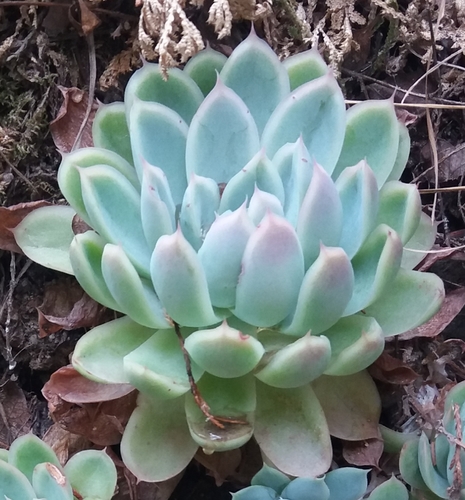
How to care for Mexican Snowball
Watering
Mexican Snowball (Echeveria elegans) is a thick-leafed succulent from central Mexico that stores water in its rosette. It needs deep, infrequent watering and very fast-draining soil, since its roots rot quickly in wet conditions. Water thoroughly until it runs out of the drainage hole, then let the soil dry out almost completely before watering again. In winter, water sparingly or not at all for weeks at a time.
Does it need water today?
Push a finger about 3 cm into the soil. If it feels dry and crumbly, it is time to water. You can also lift the pot: a dry pot feels noticeably lighter than one that was just watered. Look at the leaves too. Slightly wrinkled or soft leaves at the base mean it is thirsty, while plump, firm leaves mean it can wait.
Water the soil, not the rosette. Water that sits in the center of the rosette can cause rot and scarring. If you accidentally wet it, tilt the pot so the water drains out and place it where air moves freely.
Overwatering
Mexican Snowball stores water in its fleshy leaves, so it is adapted to dry periods and is very sensitive to soggy roots. Its compact rosette also traps moisture, which makes rot harder to spot until it is advanced.
Symptoms: Leaves turn soft, translucent, or mushy, especially near the base. The stem may darken or feel squishy, and the lower leaves can drop easily when touched. A sour or rotten smell from the soil is a warning sign.
Solutions: Stop watering immediately. Gently remove the plant from its pot and shake off the wet soil. Cut away any black or mushy tissue with a clean, sharp knife, then let the cut areas dry for several days. Repot in fresh, dry cactus or succulent mix in a pot with a drainage hole, and wait about a week before watering.
Underwatering
As a desert-adapted succulent, Mexican Snowball can go a long time without water, but its rosette will shrink when reserves run low. Prolonged drought stress weakens the plant and slows growth.
Symptoms: Lower leaves become wrinkled, thin, and papery, and the rosette may look slightly flattened or loose. Growth stalls, and older leaves may dry up and fall off.
Solutions: Water thoroughly using the soak-and-drain method, allowing all excess water to escape. Rehydration usually takes a few days to a week, and the leaves will plump up again. Do not increase watering frequency all at once, because a sudden change can cause the roots to rot.
Sunlight
Mexican Snowball grows best in bright light, ideally several hours of direct morning sun or a very bright location with filtered afternoon light. Strong, unfiltered summer sun can scorch its pale leaves, so introduce it gradually. Insufficient light causes the rosette to stretch and lose its tight, rounded form.
- Ideal: Bright, indirect light · 4-6 hours of bright light per day
- Tolerates: Full sun, Partial sun
- Best spot in a room: At the window
- Artificial light: A full-spectrum LED grow light placed 15 to 30 cm above the plant for 12 to 14 hours a day works well when natural light is limited. Keep the light close enough to prevent stretching.
Too little light
Echeveria elegans naturally grows in open, sunny rocky habitats in Mexico, so it needs strong light to keep its compact shape. Without enough light, its stems lengthen as it reaches for brightness.
Symptoms: The rosette becomes loose and leggy, with long pale gaps between leaves. Leaves may lose their powdery bloom and turn a dull green, and the plant grows slowly.
Solutions: Move the plant to the brightest window available, ideally south or west facing. Rotate the pot a quarter turn each week so growth stays even. Add a grow light if needed, and gradually increase exposure to avoid sunburn.
Too much sun
Mexican Snowball's powdery blue-white coating helps shield it from strong sun, but intense light can still overwhelm it, especially after a period indoors. Its leaves can burn quickly when exposed to hot afternoon sun behind glass.
Symptoms: Leaves develop brown, bleached, or crispy patches, often on the side facing the sun. The plant may take on a reddish or orange blush as a stress response, and the powdery coating can rub off.
Solutions: Move the plant to a spot with bright but filtered light, such as a few meters back from a south-facing window or behind a sheer curtain. Acclimate it slowly over one to two weeks when moving it to brighter conditions. Damaged leaves will not recover, but the plant will produce healthy new growth.
Temperature
Mexican Snowball (Echeveria elegans) is a rosette succulent from the high, dry grasslands of central Mexico. It thrives in warm days and cool nights, and it is sensitive to frost and to prolonged heat without airflow.
- Ideal: 15–27 °C
- Tolerates: -2–38 °C
- Hardiness zones: 9-11
Fertilizing
Mexican Snowball grows best in lean soil. Feed lightly during its active growing season from spring to early autumn, and avoid fertilizing when it is dormant in winter. Too much nitrogen makes rosettes soft and stretched.
- Slow-release fertilizer: Once a year in early spring, if the plant is in a container with fresh soil; otherwise not needed.
- Balanced cactus and succulent fertilizer diluted to half strength, Low-nitrogen liquid fertilizer formulated for succulents, Slow-release granular fertilizer labeled for cacti and succulents
Soil
Echeveria elegans needs a mineral-heavy mix that drains within a minute or two of watering. Dense, peaty potting soil holds water around the shallow roots and encourages rot, so always add grit.
- Cactus and succulent mix (commercial): Roughly 50-70% mineral grit such as pumice or perlite, with a small amount of peat or coir and no added moisture-retaining gel.
- Homemade succulent mix: Equal parts potting soil, coarse sand or pumice, and perlite or small lava rock, which keeps water moving past the roots.
- pH 6–7
Repotting
Mexican Snowball forms tight, pale blue-grey rosettes that slowly produce offsets. Repot when the plant is dry and actively growing, and never bury the lower leaves in fresh soil.
- How often: Every 2-3 years, or when the rosette outgrows its pot or the soil stays wet for days
- New pot: Choose a pot only 2-5 cm wider than the root ball, with at least one drainage hole. Echeveria elegans roots are shallow and fine, so a wide, shallow pot suits it better than a deep one.
- Repotting season: Spring, Summer
How to repot
- Gently tip the pot on its side and ease the plant out, supporting the rosette with your fingers at its base.
- Shake off loose old soil, then trim any black, mushy, or papery roots with clean scissors.
- Remove dead lower leaves and separate healthy offsets if you want new plants.
- Place a thin layer of dry mix in the bottom of the new pot, then set the rosette so the lowest leaves sit just above the soil line.
- Fill in around the roots with mix, firming lightly with your fingers. Do not press hard on the leaves.
- Leave the plant unwatered for 5-7 days so cut roots can callus over before you water again.
Pruning
Use only clean, sharp tools, and let cut surfaces dry before returning the plant to its usual place. Prune during active growth in spring or summer so the plant can heal quickly.
Pruning season: Spring, Summer
How to prune
- Inspect the rosette and identify yellowed, shriveled, or mushy lower leaves.
- Gently pull each dead leaf downward with a slight twist so it separates cleanly from the stem.
- If the stem has become stretched and leggy, cut it about 2 to 3 cm below the lowest healthy leaves with a sharp knife.
- Let cut surfaces dry in shade for 2 to 3 days before setting the plant back in bright light.
- Hold off on watering for about a week after pruning to reduce the risk of rot at the wound.
Propagation
Leaf cuttings · Spring, Summer
- Gently twist a healthy, plump lower leaf from the stem so the whole leaf base comes away cleanly.
- Leave the cut leaf on a dry paper towel in indirect light for 2 to 4 days until the broken end forms a dry, callused surface.
- Fill a shallow tray with a gritty cactus or succulent mix and lay the leaf on top, base touching the mix. Do not bury it.
- Mist the soil lightly only when it looks completely dry, roughly every 7 to 10 days, and keep the tray in bright, indirect light at 18 to 25°C.
- Expect tiny rosettes to form at the leaf base within 3 to 6 weeks. Once they have small roots, move them to their own pots.
Offsets (pups) · Spring, Summer
- Look for small rosettes growing at the base of the mother plant.
- When an offset is about one third the size of the parent, slide a knife between it and the main stem to cut it free, keeping some roots if present.
- Let the cut end dry for 1 to 2 days.
- Plant the offset in a small pot of dry succulent mix and water only after a week, once it begins to root.
Stem tip cuttings · Spring, Summer
- Use clean, sharp scissors or a knife to cut the top rosette off a leggy stem, leaving 2 to 3 cm of stem below the leaves.
- Remove the lowest leaves from the cutting and let it dry for 3 to 5 days until the cut end is firm.
- Insert the stem about 1 cm into dry, gritty cactus mix and wait about 10 days before the first light watering.
- Keep the pot in bright, filtered light. Roots usually form within 3 to 5 weeks.
Water sparingly. Mexican Snowball cuttings rot quickly when the soil stays wet, so wait until the mix is fully dry before the first watering and keep the leaves dry at the base of the rosette.
About Mexican Snowball
Also known as: Mexican Snowball, Hen and Chicks, White Mexican Rose, Mexican Snow Ball
- Plant type: succulent, rosette-forming perennial
- Lifespan: perennial
- Distribution: Native to central Mexico, mainly the states of Hidalgo, Puebla and Querétaro.
- Mature height: 10-20 cm tall, with stems rarely more than 15 cm
- Bloom time: Late spring to early summer
Pets · People
Pets: Safe · People: Safe. Echeveria elegans is not listed as toxic to cats or dogs by the ASPCA, and it is considered non-toxic to people. Eating large amounts may cause mild stomach upset, as with most succulents.
Common problems
- Overwatering and root rot: Soggy compost causes black, mushy stems and roots; allow the soil to dry fully between waterings.
- Etiolation: Insufficient light makes rosettes stretch and loose their compact form; move to brighter light gradually.
- Mealybugs: White cottony pests hide in leaf axils; remove with a cotton swab dipped in alcohol.
- Leaf scarring from sunburn: Sudden exposure to intense sun after indoor life causes brown or bleached patches; acclimatise slowly.
- Water on the rosette: Water trapped in the centre can cause crown rot; water the soil, not the leaves.
Uses
Mainly ornamental, grown in gardens, rock gardens, containers and as a popular houseplant; it is also used in succulent arrangements and living wall designs. It has no significant culinary or medicinal use.
Is it edible?
not edible
History & legends
Echeveria was named in honour of Atanasio Echeverría, a Mexican botanical illustrator who worked on the Royal Botanical Expedition to New Spain in the late eighteenth century. Echeveria elegans was described in the nineteenth century and has since become a staple of succulent collections worldwide, with many cultivars developed from it.
Did you know?
In its native habitat the rosettes can be covered in a white, waxy bloom, which reflects strong sunlight and reduces water loss; this powdery coating is what gives the plant its snowy look.
Frequently asked questions
How often should I water Mexican Snowball?
every 14 days. Mexican Snowball (Echeveria elegans) is a thick-leafed succulent from central Mexico that stores water in its rosette. It needs deep, infrequent watering and very fast-draining soil, since its roots rot quickly in wet conditions. Water thoroughly until it runs out of the drainage hole, then let the soil dry out almost completely before watering again. In winter, water sparingly or not at all for weeks at a time. Push a finger about 3 cm into the soil. If it feels dry and crumbly, it is time to water. You can also lift the pot: a dry pot feels noticeably lighter than one that was just watered. Look at the leaves too. Slightly wrinkled or soft leaves at the base mean it is thirsty, while plump, firm leaves mean it can wait.
How much light does Mexican Snowball need?
Bright, indirect light (4-6 hours of bright light per day). Mexican Snowball grows best in bright light, ideally several hours of direct morning sun or a very bright location with filtered afternoon light. Strong, unfiltered summer sun can scorch its pale leaves, so introduce it gradually. Insufficient light causes the rosette to stretch and lose its tight, rounded form.
What temperature does Mexican Snowball like?
15–27 °C. Mexican Snowball (Echeveria elegans) is a rosette succulent from the high, dry grasslands of central Mexico. It thrives in warm days and cool nights, and it is sensitive to frost and to prolonged heat without airflow.
Is Mexican Snowball toxic to cats and dogs?
It is safe for cats and dogs. Echeveria elegans is not listed as toxic to cats or dogs by the ASPCA, and it is considered non-toxic to people. Eating large amounts may cause mild stomach upset, as with most succulents.
What are the most common problems of Mexican Snowball?
Overwatering and root rot: Soggy compost causes black, mushy stems and roots; allow the soil to dry fully between waterings. Etiolation: Insufficient light makes rosettes stretch and loose their compact form; move to brighter light gradually. Mealybugs: White cottony pests hide in leaf axils; remove with a cotton swab dipped in alcohol. Leaf scarring from sunburn: Sudden exposure to intense sun after indoor life causes brown or bleached patches; acclimatise slowly. Water on the rosette: Water trapped in the centre can cause crown rot; water the soil, not the leaves.
When should I repot Mexican Snowball?
Every 2-3 years, or when the rosette outgrows its pot or the soil stays wet for days. Mexican Snowball forms tight, pale blue-grey rosettes that slowly produce offsets. Repot when the plant is dry and actively growing, and never bury the lower leaves in fresh soil.
How do I propagate Mexican Snowball?
Leaf cuttings, Offsets (pups), Stem tip cuttings. Gently twist a healthy, plump lower leaf from the stem so the whole leaf base comes away cleanly. Leave the cut leaf on a dry paper towel in indirect light for 2 to 4 days until the broken end forms a dry, callused surface. Fill a shallow tray with a gritty cactus or succulent mix and lay the leaf on top, base touching the mix. Do not bury it. Mist the soil lightly only when it looks completely dry, roughly every 7 to 10 days, and keep the tray in bright, indirect light at 18 to 25°C. Expect tiny rosettes to form at the leaf base within 3 to 6 weeks. Once they have small roots, move them to their own pots.
How this guide was written
Verdiss writes each guide with AI from botanical references and checks the species against iNaturalist and Plants of the World Online (Kew). Readers can rate every guide in the app.
Sources
Verdiss's information is for general guidance. Never eat or use a plant as medicine based on an app: ask a professional.