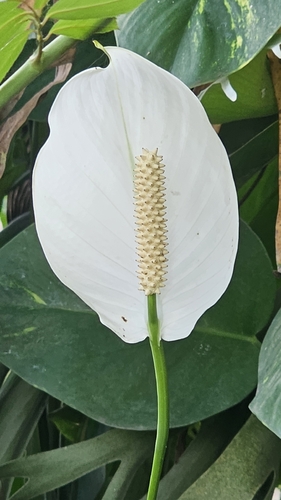
How to care for Peace Lily
Watering
Peace lily (Spathiphyllum wallisii) likes evenly moist soil that never dries out completely, yet it hates sitting in water. Water thoroughly until a little runs out of the drainage holes, then empty the saucer after 15 minutes. Its leaves droop dramatically when thirsty, which is a useful signal, but repeated wilting stresses the plant, so aim to water before that point. Use room-temperature water, ideally rainwater or filtered water, because peace lilies are sensitive to chlorine and fluoride, which can cause brown leaf tips.
Does it need water today?
Push a finger about 3 cm into the potting mix. If it feels dry at that depth, water now. If it still feels damp, wait a day or two. You can also lift the pot: a thirsty pot feels noticeably lighter than one that was recently watered.
Peace lilies show their needs clearly. Drooping leaves that perk up within hours after watering mean you waited a little too long, which is fine occasionally. Yellowing lower leaves and a soggy smell usually mean too much water.
Overwatering
Peace lily roots need oxygen as well as moisture, and its fleshy roots rot quickly in waterlogged soil. Because it is adapted to humid forest floors with fast-draining organic litter, it is prone to root rot when pots stay wet for days.
Symptoms: Yellowing lower leaves, black or mushy roots, a sour or rotten smell from the soil, and leaves that wilt even though the soil is wet.
Solutions: Stop watering and let the top 5 cm dry out. If the roots are mushy, slide the plant out, cut away black rotten roots with clean scissors, and repot into fresh, well-draining mix in a pot with drainage holes.
Underwatering
Peace lily leaves are large and thin, so they lose water quickly through transpiration. It signals thirst very clearly by drooping, but it does not tolerate prolonged dryness, and dry root balls can shrink away from the pot walls.
Symptoms: Leaves droop heavily and look limp, edges turn brown and crispy, and soil pulls away from the pot edge and feels hard and dry.
Solutions: Soak the pot in a tray of water for 30 minutes, then let it drain. Trim crispy leaves at the base with clean scissors and resume a regular schedule. Most plants recover within a day or two, though badly dried leaves will not regain their color.
Sunlight
Peace lily (Spathiphyllum wallisii) grows naturally under the canopy of tropical rainforests, where light is bright but filtered. Indoors it does best near a bright window with a sheer curtain between the sun and the leaves. It tolerates low light, but it will grow slowly and flower rarely. Direct midday sun, especially through glass, scorches its leaves.
- Ideal: Bright, indirect light · 6-8 hours of bright, filtered or indirect light per day
- Tolerates: Partial sun, Shade
- Best spot in a room: Near the window
- Artificial light: A full-spectrum LED grow light placed 30 to 45 cm above the foliage for 10 to 12 hours a day can keep peace lilies healthy in rooms without good natural light. Standard office fluorescent lighting can maintain foliage but rarely triggers flowering.
Too little light
Peace lily relies on steady light to produce its large, glossy leaves and white spathes. In dim corners it photosynthesizes too slowly to support new growth, so it stretches its stems and stops blooming.
Symptoms: Leaves become smaller and darker green, stems grow long and leaning toward light, no new flowers appear, and older leaves gradually yellow.
Solutions: Move the plant closer to a bright window, ideally east or north facing, or add a full-spectrum LED grow light. Rotate the pot a quarter turn every couple of weeks so growth stays even.
Too much sun
Peace lily leaves are thin and tender compared with succulents, so strong direct sun quickly damages the leaf tissue. Sunburn does not heal, and damaged leaves stay damaged.
Symptoms: Pale yellow or bleached patches on leaves, crispy brown edges or spots, and leaves that curl or look faded and washed out.
Solutions: Pull the plant back from south or west windows or add a sheer curtain. Cut off badly scorched leaves at the base; the plant will produce new, healthier foliage in the right spot.
Temperature
Peace Lily (Spathiphyllum wallisii) is a tropical understory plant that thrives in steady warmth between 18 and 24 °C. Keep it away from cold drafts, radiators, and hot window glass, and avoid sudden temperature swings, which cause drooping and leaf loss.
- Ideal: 18–24 °C
- Tolerates: 10–35 °C
- Hardiness zones: 11-12
Fertilizing
Peace Lily is a light feeder. It needs regular nitrogen for lush green leaves and steady micronutrients, but too much salt in the soil quickly burns its roots. Feed only while it is actively growing, from spring through early autumn, and dilute every product to half the label strength.
- Slow-release fertilizer: Once a year in early spring, using a light, balanced granular feed, or not needed if you repot into fresh potting mix.
- Balanced liquid houseplant fertilizer (such as 20-20-20), Slow-release balanced granular fertilizer, Foliage-friendly liquid feed with trace elements
Soil
Peace lilies grow best in a loose, organic mix that holds moisture yet drains quickly. Their roots rot in dense garden clay or compacted potting soil, so avoid heavy soils. Always use a pot with drainage holes.
- Peat-based potting mix: Sphagnum or peat moss blended with perlite or coarse sand for drainage. This is the best base for Peace lilies, which prefer consistently moist but never waterlogged roots.
- Aroid mix: Two parts peat-based potting mix, one part orchid bark or coco chips, and one part perlite. Good for Spathiphyllum wallisii if your home is warm and humid and you want the roots to breathe.
- Peat-free mix with coir: Coconut coir with perlite and a little compost. Works well for eco-conscious growers; rinse coir first to remove excess salts.
- pH 5.5–6.5
Repotting
Repot when roots fill the pot and circle the surface, or when roots grow out of the drainage holes. Peace lilies (Spathiphyllum wallisii) are fairly tolerant, but they droop dramatically when stressed, so keep disturbance small and water well afterward.
- How often: every 2-3 years
- New pot: Move up only one size, about 2-5 cm wider in diameter, into a pot with drainage holes. Peace lilies like being slightly snug and can sulk in oversized pots that hold wet soil.
- Repotting season: Spring, Summer
How to repot
- Tip the pot on its side and gently ease the plant out, supporting the base of the stems
- Loosen the outer roots with your fingers; trim any black, mushy roots with clean scissors
- Place a 3-5 cm layer of fresh mix in the new pot so the crown sits at the same depth as before
- Set the plant in the center, fill around the root ball with mix, and firmly press out air pockets
- Water thoroughly until it drains freely, then keep the plant out of direct sun for a week
Pruning
Use clean, sharp tools and remove only dead, damaged, or spent parts. Never remove more than about one third of the foliage at once, because the Peace Lily relies on its leaves to produce energy.
Pruning season: Spring, Summer, Autumn
How to prune
- Inspect the plant from the base upward and identify leaves that are fully yellow, brown, or crispy.
- Follow each leaf stalk down to the soil line, then cut it off cleanly at the base.
- Remove faded white spathes once they turn green or brown, cutting the flower stalk near the base.
- Trim any brown leaf tips with clean scissors, following the natural leaf shape.
- Wipe the remaining leaves with a damp cloth to remove dust and check for pests.
- Dispose of the cuttings, and wash your tools afterward.
Propagation
Division of mature clumps · Spring
- Wait until the Peace Lily (Spathiphyllum wallisii) has grown into a dense clump with several crowns, usually after two or more years in the same pot.
- Water the plant a day before, so the roots are moist and less likely to tear.
- Slide the plant out of its pot and gently shake off loose potting mix.
- Pull or cut the clump into sections, making sure each piece has roots and at least two or three leaves.
- Pot each section into a container only slightly larger than its root ball, using fresh peat-based potting mix.
- Keep the divisions in bright, indirect light and water lightly until new growth appears.
Stem cuttings in water · Spring, Summer
- Choose a healthy stem with at least one leaf and a visible node, where a leaf joins the stem.
- Cut the stem just below a node using clean, sharp scissors or a knife.
- Place the cutting in a clear jar of room-temperature water, keeping the leaf above the waterline.
- Set the jar somewhere warm and bright but out of direct sun.
- Change the water every few days to prevent rot.
- Once roots are two to three centimetres long, transplant the cutting into moist potting mix.
Offshoot separation · Spring, Summer
- Look for small plantlets forming at the base of the parent plant, which are the natural offshoots.
- Wait until an offshoot has several leaves of its own and some roots.
- Use a clean knife to cut between the offshoot and the parent plant, keeping as many roots as possible.
- Pot the offshoot in a small container with fresh, lightly moist potting mix.
Peace Lilies are generally easiest to propagate by division in spring. Expect cuttings to take several weeks to root, and keep them out of cold drafts, since the plant is sensitive to temperatures below about 15°C.
About Peace Lily
Also known as: Peace lily, White sail plant, Spath
- Plant type: herb, evergreen perennial
- Lifespan: perennial
- Distribution: Native to the rainforests of northern South America, chiefly Colombia and Venezuela.
- Mature height: 30-60 cm indoors
- Bloom time: Mostly spring and summer indoors, can flower intermittently year-round
Pets · People
Pets: Toxic · People: Toxic. Contains calcium oxalate raphides causing oral irritation, drooling, swelling and vomiting if chewed (ASPCA lists it as toxic to cats and dogs).
Common problems
- Brown leaf tips: Usually caused by low humidity, salt buildup from fertilizer, or tap water chemicals; flush the soil and raise humidity.
- Yellowing leaves: Often from overwatering or poor drainage; check roots and let soil dry slightly between waterings.
- No flowers: Typically caused by too little light or a pot that is too large; move to brighter indirect light.
- Drooping leaves: Normally underwatering; it recovers within hours of a thorough watering.
- Mealybugs and spider mites: Common pests in dry indoor air; wipe leaves and treat with insecticidal soap.
Uses
Widely grown as an ornamental houseplant and office plant for its glossy foliage and cut-flower spathes; it is also used in interior landscaping. It is valued by NASA-linked studies for indoor air cleaning, though effects in real rooms are modest.
Is it edible?
not edible
History & legends
Described in the 19th century and named after Gustav Wallis, a German plant collector who gathered plants in South America for European gardens. Its common name refers to the calm white spathe, which has become a symbol of peace in home décor.
Did you know?
The white spathe is not a petal but a modified leaf (bract) that surrounds the true flowers, which are tiny and clustered on the spadix.
Frequently asked questions
How often should I water Peace Lily?
every 7 days. Peace lily (Spathiphyllum wallisii) likes evenly moist soil that never dries out completely, yet it hates sitting in water. Water thoroughly until a little runs out of the drainage holes, then empty the saucer after 15 minutes. Its leaves droop dramatically when thirsty, which is a useful signal, but repeated wilting stresses the plant, so aim to water before that point. Use room-temperature water, ideally rainwater or filtered water, because peace lilies are sensitive to chlorine and fluoride, which can cause brown leaf tips. Push a finger about 3 cm into the potting mix. If it feels dry at that depth, water now. If it still feels damp, wait a day or two. You can also lift the pot: a thirsty pot feels noticeably lighter than one that was recently watered.
How much light does Peace Lily need?
Bright, indirect light (6-8 hours of bright, filtered or indirect light per day). Peace lily (Spathiphyllum wallisii) grows naturally under the canopy of tropical rainforests, where light is bright but filtered. Indoors it does best near a bright window with a sheer curtain between the sun and the leaves. It tolerates low light, but it will grow slowly and flower rarely. Direct midday sun, especially through glass, scorches its leaves.
What temperature does Peace Lily like?
18–24 °C. Peace Lily (Spathiphyllum wallisii) is a tropical understory plant that thrives in steady warmth between 18 and 24 °C. Keep it away from cold drafts, radiators, and hot window glass, and avoid sudden temperature swings, which cause drooping and leaf loss.
Is Peace Lily toxic to cats and dogs?
It is toxic to cats and dogs: keep it out of their reach. Contains calcium oxalate raphides causing oral irritation, drooling, swelling and vomiting if chewed (ASPCA lists it as toxic to cats and dogs).
What are the most common problems of Peace Lily?
Brown leaf tips: Usually caused by low humidity, salt buildup from fertilizer, or tap water chemicals; flush the soil and raise humidity. Yellowing leaves: Often from overwatering or poor drainage; check roots and let soil dry slightly between waterings. No flowers: Typically caused by too little light or a pot that is too large; move to brighter indirect light. Drooping leaves: Normally underwatering; it recovers within hours of a thorough watering. Mealybugs and spider mites: Common pests in dry indoor air; wipe leaves and treat with insecticidal soap.
When should I repot Peace Lily?
every 2-3 years. Repot when roots fill the pot and circle the surface, or when roots grow out of the drainage holes. Peace lilies (Spathiphyllum wallisii) are fairly tolerant, but they droop dramatically when stressed, so keep disturbance small and water well afterward.
How do I propagate Peace Lily?
Division of mature clumps, Stem cuttings in water, Offshoot separation. Wait until the Peace Lily (Spathiphyllum wallisii) has grown into a dense clump with several crowns, usually after two or more years in the same pot. Water the plant a day before, so the roots are moist and less likely to tear. Slide the plant out of its pot and gently shake off loose potting mix. Pull or cut the clump into sections, making sure each piece has roots and at least two or three leaves. Pot each section into a container only slightly larger than its root ball, using fresh peat-based potting mix. Keep the divisions in bright, indirect light and water lightly until new growth appears.
How this guide was written
Verdiss writes each guide with AI from botanical references and checks the species against iNaturalist and Plants of the World Online (Kew). Readers can rate every guide in the app.
Sources
Verdiss's information is for general guidance. Never eat or use a plant as medicine based on an app: ask a professional.