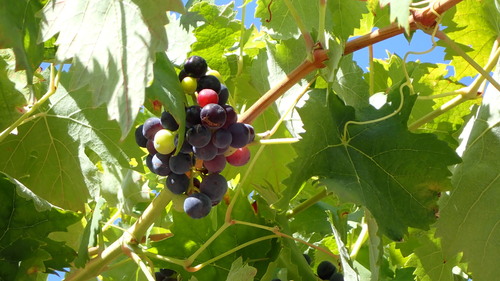
How to care for wine grape
Watering
Wine grape (Vitis vinifera) is a deep-rooted vine that handles dry spells well once established, but it needs steady moisture while it is young and during fruit swelling. Water deeply and less often rather than little and often, so roots grow down into the soil. Container vines need far more frequent watering than vines in the ground, because their root ball dries out quickly.
Does it need water today?
Push a finger 5 cm (2 inches) into the soil near the root zone. If it feels dry, water; if it is still moist, wait. For pots, lift the container: a light pot needs water, a heavy one does not. Leaves that droop in the afternoon and recover by evening are normal, but leaves that stay limp in the morning mean the vine needs water now.
Water in the early morning at the base of the vine, aiming for the top 30 to 45 cm (12 to 18 inches) of soil. Give the vine enough water that it soaks down, then let the surface dry before watering again.
Overwatering
Wine grape roots need air as well as water, and waterlogged soil quickly causes root rot and fungal disease. Vines in heavy clay or pots without drainage are especially at risk, and wet conditions also encourage downy mildew on the leaves.
Symptoms: Yellowing leaves, soft or blackened roots, a sour smell from the soil, mold on the soil surface, and fruit that cracks or splits after heavy rain or watering.
Solutions: Stop watering and let the soil dry to a depth of 5 cm (2 inches). Improve drainage by loosening the soil or repotting into a container with drainage holes and a gritty mix. Remove badly affected leaves and make sure air moves freely around the canopy.
Underwatering
Young vines have shallow roots and cannot draw on deep moisture, so they wilt quickly. Fruit set and berry swelling are the most water-sensitive stages, and a dry spell then can shrink the crop and sunburn the clusters.
Symptoms: Leaves that curl, turn brown at the edges, or droop and do not recover in the evening; shriveled, small berries; soil pulling away from the pot edge; and new shoots that stop growing.
Solutions: Water deeply and slowly until the soil is evenly damp to 30 cm (12 inches). For container vines, soak the pot in a tray for 30 minutes, then water again the next morning if the top is still dry. Mulch the soil with 5 to 8 cm (2 to 3 inches) of straw or bark to slow evaporation.
Sunlight
Wine grape (Vitis vinifera) needs full sun to ripen its fruit, produce sugar, and develop good wood for next year. Plants in shade grow long, weak shoots with few or no clusters. Partial sun, with at least 5 hours of direct light, is acceptable for leaves and growth, but fruit will be smaller and less sweet.
- Ideal: Full sun · 6-8 hours of direct sun
- Tolerates: Full sun, Partial sun
- Best spot in a room: At the window
- Artificial light: Wine grapes are not practical as indoor plants. If you must grow a young vine indoors for a short time, use a strong full-spectrum LED grow light set 15 to 30 cm (6 to 12 inches) above the canopy for 12 to 14 hours a day, and move it outside as soon as frost has passed.
Too little light
Grapevines convert sunlight into sugar that fills the berries and builds the woody canes that carry next year's crop. Without enough light, the vine diverts energy into stretching toward the light, which weakens it and reduces fruit.
Symptoms: Long, thin, pale shoots with large gaps between leaves; few or no flower clusters; sour, small berries that fail to color; and leaves that stay small and yellow-green.
Solutions: Move the vine to the sunniest spot available, ideally a south-facing wall or open ground. Prune back shading branches and remove weeds or nearby plants that block light. For container vines, rotate the pot weekly so all sides receive sun.
Too much sun
Wine grapes tolerate strong sun well, especially in warm climates, but fruit and leaves can be damaged in extreme heat. Intense afternoon sun on a young vine in a sudden heat wave can burn leaves and berries that have not been acclimated.
Symptoms: Brown, dry patches on leaves facing the sun; shriveled or sunburned berries that look white or bleached; leaves that wilt in the afternoon even when the soil is moist.
Solutions: Provide light afternoon shade with a shade cloth during heat waves above 35°C (95°F). Keep the soil moist with mulch so the vine can cool itself through its leaves. Leaf canopy managed by thinning can protect fruit clusters from direct sun.
Temperature
Wine grape (Vitis vinifera) grows best in warm summers and cool, dry winters. It needs a period of winter dormancy with temperatures near or below 7°C to set fruit well, and full sun with warm days during the growing season to ripen its berries. Protect young shoots from late spring frosts, which can kill new growth in a single night.
- Ideal: 15–30 °C
- Tolerates: -15–40 °C
- Hardiness zones: 6-9
Fertilizing
Wine grapes need only moderate feeding. Too much nitrogen produces lush leafy growth and poor fruit, so feed lightly and watch the vine's vigor. Potassium helps berries ripen and sugar develop, while boron and magnesium deficiencies show up as leaf and berry problems. Test your soil before adding any amendments.
- Slow-release fertilizer: Apply a balanced, slow-release granular fertilizer once a year in early spring, just as buds begin to swell. Established vines in fertile soil often need none at all, so check growth first.
- Balanced slow-release granular fertilizer (such as 10-10-10 or a similar formula), Compost or well-rotted manure, applied as mulch or topdressing, Low-nitrogen, potassium-rich liquid feed for fruiting vines in mid-summer, Balanced soluble fertilizer for young vines in their first two growing seasons
Soil
Wine grapes grow best in fertile, well-drained soil with a pH between about 6.0 and 7.5. They tolerate poor, stony soils better than most fruit plants, but waterlogging is their main enemy, as saturated roots invite rot and fungal disease. Good drainage matters more than richness.
- Loam-based potting mix: Blend of 40% good-quality topsoil or loam, 30% coarse perlite or grit, and 30% compost or well-rotted manure; a reliable all-round base for container vines
- Sandy loam garden soil: Mostly sand and loam with some organic matter; ideal for in-ground vines on slopes or in areas with heavy clay
- Gritty container mix: Two parts commercial potting mix to one part grit, pumice, or horticultural sand, with a small handful of slow-release organic fertilizer
- pH 6–7.5
Repotting
Wine grape vines (Vitis vinifera) have deep, fleshy roots that resent wet, compacted soil. Use a pot with several large drainage holes and never let it sit in standing water. Repotting is best done while the vine is dormant or just before bud break, so it suffers less root disturbance.
- How often: every 2-3 years for container-grown vines; young vines in small pots may need annual repotting in spring
- New pot: Increase by 5-10 cm (2-4 in) in diameter each time; mature container vines often sit in 40-60 L (10-16 gal) pots with good drainage holes
- Repotting season: Spring, Autumn
How to repot
- Lay the pot on its side and gently tap the sides, or slide a knife around the inner rim, to loosen the root ball
- Support the trunk near the base and ease the vine out. Never pull it by the stem
- Gently tease away the outer roots that circle the root ball, and trim any that are dead, black, or mushy with clean shears
- Set the vine in the new pot so the top of the root ball sits about 2-3 cm (1 in) below the rim, keeping the graft union (if present) above soil level
- Fill around the roots with fresh mix, firming gently with your hands to remove large air pockets but not compacting it
- Water thoroughly until it drains from the holes, then place the pot where it gets full sun
Pruning
Wine grapes fruit on one-year-old wood, so each winter you must remove most of the previous season's growth and retain a small number of well-placed canes or spurs. Prune while the vine is dormant, before the sap starts to rise and the buds swell, typically from late winter to early spring. Avoid pruning in late spring, when the vine will bleed heavily from cut ends; this is harmless but weakens the plant.
Pruning season: Winter, Spring
How to prune
- Remove all dead, diseased, or damaged wood first, cutting back to healthy tissue.
- Select the strongest, well-placed one-year-old cane on each arm, ideally pencil-thick and about the thickness of a pencil.
- For a Guyot system, retain one cane with 6 to 10 buds and a spur with 2 buds near the trunk for next year's renewal.
- For a cordon system, cut the spurs back to 2 or 3 buds each, spacing them about 15 to 20 cm apart along the permanent arm.
- Remove any suckers from the base of the trunk and any shoots growing from old wood where you do not want them.
- Tie the retained canes gently to the wires with soft twine or clips, arranging them so they are evenly spread and not crossing.
- Clear all pruned material from the vineyard or garden and dispose of it, since it can harbour fungal spores and pests.
Propagation
Hardwood cuttings · Winter
- In late winter, when the vine is dormant, cut 20 to 30 cm lengths of one-year-old, pencil-thick wood that has several healthy buds.
- Make a flat cut just above the top bud and a slanted cut just below the bottom bud so you remember which end is up.
- Bundle the cuttings with the top ends facing one direction and bury them sideways in moist sand or soil in a cool, sheltered spot, or keep them in a bag of damp sand in a fridge for about six weeks.
- Plant the cuttings upright in a nursery bed or pots with only one or two buds above the soil, keeping the soil moist and warm at about 18 to 22 °C.
- Roots form over the growing season; transplant the rooted cutting the following autumn or spring.
Green cuttings · Summer
- In early summer, take 10 to 15 cm tip cuttings from current-season shoots that have just begun to firm up at the base.
- Strip the lower leaves and cut any large leaves in half to reduce water loss.
- Dip the cut end in rooting hormone and insert it into a pot of moist, free-draining mix.
- Cover with a clear plastic bag or place in a propagator to hold humidity, and keep out of direct sun.
- Check for roots after about four weeks by a gentle tug; once rooted, gradually harden off the plant before moving it outdoors.
Layering · Spring, Summer
- Choose a flexible, healthy cane near the base of an established vine in spring.
- Bend the cane down to the ground and pin a section with a wire hook or stone, leaving the tip above soil.
- Scratch the underside of the buried section lightly with a knife to encourage root growth.
- Keep the buried section moist through summer. Roots usually form within a few months.
- In autumn, cut the rooted section free from the parent vine and move it to its new spot.
Grapevine cuttings root most reliably from the previous year's wood taken in winter. Keep the cutting orientation marked, because planting it upside down will delay or prevent rooting.
About wine grape
Also known as: Common grape vine, European grape, Wine grape, Vine
- Plant type: climber, vine, woody liana
- Lifespan: perennial
- Distribution: Native to the Caucasus, the Caspian region, Anatolia and the northern Mediterranean basin.
- Mature height: Up to 30 m in the wild when climbing trees; typically 3 to 10 m when trained on supports in gardens.
- Bloom time: Late spring to early summer
Pets · People
Pets: Safe · People: Safe. Ripe grapes are non-toxic to dogs and cats per ASPCA, but grapes and raisins are known to cause kidney failure in some dogs, so keep fruit and dried grapes out of reach of pets; unripe green berries, leaves and stems may cause mild stomach upset.
Common problems
- Powdery mildew: White powdery coating on leaves and berries, favored by humid, still conditions; improve airflow and use sulfur or resistant varieties.
- Downy mildew: Yellow oily spots on leaves's upper surface and white fuzz below, favored by wet spring weather; remove infected leaves and apply copper-based fungicide.
- Black rot: Dark sunken spots on leaves and shriveled black berries; remove mummified fruit and prune to open the canopy.
- Phylloxera: Root-feeding aphid-like insect that can kill vines on own roots; grafting onto resistant rootstock is the standard control.
- Berry splitting: Skins crack after heavy rain near ripeness, inviting rot and wasps; maintain steady watering and thin crowded clusters.
Uses
Vitis vinifera is grown worldwide for wine, which is its most famous use, and for fresh table grapes, raisins and grape juice. Its leaves are used in Mediterranean and Middle Eastern cooking as dolma wrappers, and it is widely planted as an ornamental climber for pergolas and walls.
Is it edible?
Ripe berries are edible fresh or dried, and young leaves are eaten as dolmades; unripe fruit and seeds are not recommended in quantity.
History & legends
Grapevines feature in Egyptian tomb paintings, Greek and Roman mythology through Dionysus and Bacchus, and in biblical accounts such as Noah planting a vineyard after the flood. Medieval monasteries preserved and selected many European wine varieties over centuries.
Did you know?
Grape seeds retrieved from archaeological sites in the Levant and Georgia show that Vitis vinifera was domesticated from wild Vitis vinifera subsp. sylvestris, and Georgian winemaking traditions with clay qvevri vessels date back roughly 8,000 years.
Frequently asked questions
How often should I water wine grape?
every 7 days. Wine grape (Vitis vinifera) is a deep-rooted vine that handles dry spells well once established, but it needs steady moisture while it is young and during fruit swelling. Water deeply and less often rather than little and often, so roots grow down into the soil. Container vines need far more frequent watering than vines in the ground, because their root ball dries out quickly. Push a finger 5 cm (2 inches) into the soil near the root zone. If it feels dry, water; if it is still moist, wait. For pots, lift the container: a light pot needs water, a heavy one does not. Leaves that droop in the afternoon and recover by evening are normal, but leaves that stay limp in the morning mean the vine needs water now.
How much light does wine grape need?
Full sun (6-8 hours of direct sun). Wine grape (Vitis vinifera) needs full sun to ripen its fruit, produce sugar, and develop good wood for next year. Plants in shade grow long, weak shoots with few or no clusters. Partial sun, with at least 5 hours of direct light, is acceptable for leaves and growth, but fruit will be smaller and less sweet.
What temperature does wine grape like?
15–30 °C. Wine grape (Vitis vinifera) grows best in warm summers and cool, dry winters. It needs a period of winter dormancy with temperatures near or below 7°C to set fruit well, and full sun with warm days during the growing season to ripen its berries. Protect young shoots from late spring frosts, which can kill new growth in a single night.
Is wine grape toxic to cats and dogs?
It is safe for cats and dogs. Ripe grapes are non-toxic to dogs and cats per ASPCA, but grapes and raisins are known to cause kidney failure in some dogs, so keep fruit and dried grapes out of reach of pets; unripe green berries, leaves and stems may cause mild stomach upset.
What are the most common problems of wine grape?
Powdery mildew: White powdery coating on leaves and berries, favored by humid, still conditions; improve airflow and use sulfur or resistant varieties. Downy mildew: Yellow oily spots on leaves's upper surface and white fuzz below, favored by wet spring weather; remove infected leaves and apply copper-based fungicide. Black rot: Dark sunken spots on leaves and shriveled black berries; remove mummified fruit and prune to open the canopy. Phylloxera: Root-feeding aphid-like insect that can kill vines on own roots; grafting onto resistant rootstock is the standard control. Berry splitting: Skins crack after heavy rain near ripeness, inviting rot and wasps; maintain steady watering and thin crowded clusters.
When should I repot wine grape?
every 2-3 years for container-grown vines; young vines in small pots may need annual repotting in spring. Wine grape vines (Vitis vinifera) have deep, fleshy roots that resent wet, compacted soil. Use a pot with several large drainage holes and never let it sit in standing water. Repotting is best done while the vine is dormant or just before bud break, so it suffers less root disturbance.
How do I propagate wine grape?
Hardwood cuttings, Green cuttings, Layering. In late winter, when the vine is dormant, cut 20 to 30 cm lengths of one-year-old, pencil-thick wood that has several healthy buds. Make a flat cut just above the top bud and a slanted cut just below the bottom bud so you remember which end is up. Bundle the cuttings with the top ends facing one direction and bury them sideways in moist sand or soil in a cool, sheltered spot, or keep them in a bag of damp sand in a fridge for about six weeks. Plant the cuttings upright in a nursery bed or pots with only one or two buds above the soil, keeping the soil moist and warm at about 18 to 22 °C. Roots form over the growing season; transplant the rooted cutting the following autumn or spring.
How this guide was written
Verdiss writes each guide with AI from botanical references and checks the species against iNaturalist and Plants of the World Online (Kew). Readers can rate every guide in the app.
Sources
Verdiss's information is for general guidance. Never eat or use a plant as medicine based on an app: ask a professional.