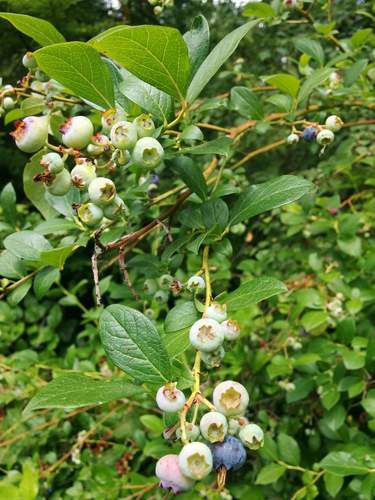
How to care for Northern highbush blueberry
Watering
Northern highbush blueberry (Vaccinium corymbosum) has shallow, fine roots that cannot take up water well from dry soil, and it grows in acidic, peaty conditions. Keep the root ball evenly moist, never soggy, and use rainwater or low-mineral water when possible, since tap water with lime slowly raises the pH and yellows the leaves. Water more in summer, when the plant is fruiting, and less in winter when it is dormant.
Does it need water today?
Push a finger 3 to 5 cm into the soil near the base of the plant. If it feels dry at that depth, water now. If it feels damp, wait a day or two. For containers, lift the pot: a dry pot feels noticeably light.
Mulch the surface with 5 to 8 cm of pine bark, pine needles or sawdust. This keeps roots cool and moist and helps keep the soil acidic.
Overwatering
Northern highbush blueberry roots need oxygen as well as moisture, and waterlogged peat quickly starves them. Its fine roots rot in standing water, which is one of the most common causes of death in container blueberries.
Symptoms: Yellowing or drooping leaves even though the soil is wet, a sour smell from the soil, soft brown roots, and leaves dropping in summer.
Solutions: Stop watering and let the top 5 cm dry out. Make sure the pot has drainage holes and empty any saucer after watering. If the roots are rotten, repot into fresh acidic ericaceous compost mixed with some perlite, trimming away brown, mushy roots.
Underwatering
Blueberry roots are shallow and sit close to the surface, so they dry out faster than many shrubs. Drought also reduces berry size and fruit set during the summer growing season.
Symptoms: Wilted or crispy leaf edges, leaves turning red or bronze early, dry and pulling-away soil from the pot edge, and small, shrivelled berries.
Solutions: Soak the root ball thoroughly using bottom watering until it feels moist again, then resume a regular schedule. Add mulch to slow evaporation. For a plant that is very dry, water slowly in several rounds so the peat rewets rather than running off the surface.
Sunlight
Northern highbush blueberry (Vaccinium corymbosum) produces the most flowers, fruit and vigorous new growth in full sun. In partial shade it still grows, but yields fewer berries and the leaves may be paler. Strong afternoon sun in very hot climates can scorch leaves, so provide light afternoon shade there.
- Ideal: Full sun · 6-8 hours of direct sun per day
- Tolerates: Full sun, Partial sun
- Best spot in a room: At the window
- Artificial light: Indoors, a south-facing window is best. If light is limited, use a full-spectrum LED grow light placed 20 to 30 cm above the plant for 12 to 14 hours a day during the growing season. Blueberries rarely fruit reliably indoors, so expect mainly leaf growth.
Too little light
Blueberry plants need strong light to build the energy for flower buds and berries. Too little light leads to leggy, weak stems and few or no berries the following season.
Symptoms: Long, thin stems that lean toward the light, sparse leaves, pale green foliage, and no flowers or fruit.
Solutions: Move the plant to the sunniest spot available, ideally outdoors in full sun. Prune out weak, crowded shoots in winter so light reaches the remaining stems. Indoors, add a grow light as described above.
Too much sun
Northern highbush blueberry leaves are thin and can burn when exposed to intense midday sun, especially in containers where roots heat up quickly. Heat stress is more of a problem in hot, dry summers than in cooler regions.
Symptoms: Bleached or brown patches on leaves, crispy leaf edges, leaves curling or dropping, and berries shrivelling on the sun-facing side.
Solutions: Provide light shade from 1 to 4 pm during heatwaves using a shade cloth or by placing the plant near taller plants. Keep the root zone mulched and watered, since hot roots make sun damage worse. Move containers into partial shade for the hottest days.
Temperature
Northern highbush blueberry needs a real winter chill, roughly 800 to 1,000 hours below 7°C, to set good flower buds and fruit the following spring. It is hardy in USDA zones 3 to 7 and copes with deep cold once dormant, but it is sensitive to late spring frost when buds and new shoots are soft. Keep it cool and moist in summer, not dried out by heat.
- Ideal: 5–27 °C
- Tolerates: -34–38 °C
- Hardiness zones: 3-7
Fertilizing
Northern highbush blueberry has shallow roots and needs acidic soil, ideally pH 4.5 to 5.5. Nitrogen is the main nutrient it needs, and it responds poorly to fertilizers that raise soil pH, such as lime or wood ash. Test your soil before feeding and adjust pH first if needed.
- Slow-release fertilizer: Apply once a year in early spring, just as buds begin to swell, using an acidic slow-release fertilizer formulated for blueberries or azaleas.
- Ammonium sulfate or other acid-forming nitrogen fertilizer, Sulfur-coated urea or a slow-release azalea and blueberry fertilizer, Acidifying organic fertilizers such as cottonseed meal or pine-needle mulch, Iron sulfate or chelated iron if leaves show yellowing between the veins
Soil
Northern highbush blueberry needs strongly acidic, humus-rich, well-drained soil with consistent moisture. Its roots lack the ability to take up nutrients well in alkaline soil, so a low pH is essential for healthy leaves and fruit.
- Peat-based ericaceous mix: Sphagnum peat with perlite or coarse sand added for drainage; the most reliable base for containers
- Pine bark soil mix: Equal parts composted pine bark and peat, with a little sand; helps keep roots aerated
- Garden bed amendment: Native topsoil mixed with generous amounts of peat moss and composted pine needles or bark, improving acidity and drainage
- pH 4.2–5.2
Repotting
Northern highbush blueberry has shallow, fine, acid-loving roots that rot easily in waterlogged soil and are sensitive to any soil disturbance. Use a container with drainage holes and handle the root ball gently.
- How often: Every 2-3 years for young container plants; repot when roots circle the pot or growth slows
- New pot: Move up only one pot size (about 3-5 cm wider) at each repotting, because oversized pots hold wet soil that blueberry roots cannot tolerate
- Repotting season: Spring
How to repot
- Lay the pot on its side and gently ease the plant out, supporting the base of the stem with one hand
- Loosen the outer roots with your fingers; trim any dead, black, or mushy roots with clean shears
- Place a 3-5 cm layer of fresh acidic mix in the bottom of the new pot
- Set the plant so the top of the root ball sits about 2 cm below the pot rim, matching its previous soil depth
- Fill around the root ball with fresh mix and firm it lightly with your hands to remove large air pockets
- Water thoroughly until water drains freely from the holes, then top up the soil level if it has settled
Pruning
Prune Vaccinium corymbosum while it is dormant, from late winter to early spring, before the buds swell. Remove about one-fifth of the oldest canes each year, cutting them at ground level, and keep five to eight strong canes of varying ages on each mature bush.
Pruning season: Winter, Spring
How to prune
- Start by removing all dead, broken, or diseased canes at the base, cutting cleanly just above the soil line.
- Cut out any thin, spindly canes that are thinner than a pencil, since they produce small, poor fruit.
- Identify the oldest canes, which are dark grey or brown and have fewer lateral buds. Remove about one-fifth of them at ground level each year.
- Shorten the remaining healthy canes that are too tall by cutting back to an outward-facing bud, leaving about 10 to 15 fruit buds per cane.
- Thin the centre of the bush so that you can see light through it, and keep the open shape like a vase.
- In the first two to three years, remove most flower buds on young plants to let them put energy into root and branch growth.
- Clean up all pruned material and remove it from the bed to reduce overwintering pests and disease.
Propagation
Softwood cuttings · Summer
- In early summer, take 10 to 15 cm tips from current-season green shoots of a healthy Vaccinium corymbosum bush.
- Strip the lower leaves, leaving two or three at the top.
- Dip the cut end in a rooting hormone powder labelled for woody plants.
- Insert the cutting into a pot of moist 1:1 mix of peat and perlite, and cover with a clear plastic bag or humidity dome.
- Keep it out of direct sun at about 20 to 25 °C and check that the medium stays damp but not soggy.
- Roots usually form in 6 to 10 weeks. Pot it on once it grows well, and keep it sheltered through its first winter.
Hardwood cuttings · Winter
- In late winter, while the bush is dormant, cut 20 to 25 cm lengths of last year's pencil-thick wood.
- Make each cut just below a bud, and keep the cuttings in damp sand or a bag in the refrigerator until planting.
- In early spring, push two-thirds of each cutting into a container of moist sandy soil or a mix of peat and sand, leaving one or two buds above the surface.
- Keep the pot outdoors in partial shade and water whenever the top layer dries.
- Leave the cuttings in the pot for a full growing season before moving them to a permanent spot.
Layering · Spring, Summer
- In early spring, choose a low, flexible stem of your Vaccinium corymbosum bush and bend it down to the ground.
- Scrape a small patch of bark off the underside where the stem touches the soil.
- Pin the wounded section into a shallow trench, about 10 cm deep, using a bent wire or stone, and leave the tip above the soil.
- Mound moist, acidic soil or pine bark over the pinned section and keep it damp through the season.
- By the following autumn or spring, roots should have formed. Cut the stem free from the parent plant and transplant it.
Blueberries root slowly from cuttings, so the layering method is the most reliable choice for home gardeners. Keep all growing media acidic, around pH 4.5 to 5.5, because this species will not thrive in neutral or alkaline soil.
About Northern highbush blueberry
Also known as: Swamp highbush blueberry, Highbush blueberry, Northern blueberry
- Plant type: shrub, fruiting shrub
- Lifespan: perennial
- Distribution: Native to eastern North America, from Florida and Texas north to southern Canada.
- Mature height: 1.5 to 3 m
- Bloom time: Early to late spring
Pets · People
Pets: Safe · People: Safe. The berries and leaves of Vaccinium corymbosum are not considered toxic to dogs, cats, or children according to ASPCA and standard horticultural references, and the fruit is widely eaten.
Common problems
- Iron chlorosis: Yellowing leaves with green veins, usually caused by soil that is too alkaline; lower the pH and feed with an acid fertilizer.
- Mummy berry: A fungus (Monilinia vaccinii-corymbosi) that turns berries into hard, mummified fruit in spring; remove and destroy affected fruit and prune for airflow.
- Stem blight and canker: Dieback of canes caused by fungal infection, often through wounds; prune out infected wood well below the damage.
- Birds eating the crop: Robins, catbirds and starlings strip ripening berries quickly; netting is the most reliable protection.
- Root rot in waterlogged soil: Poor drainage causes roots to decay; grow in raised beds or well-drained pots.
Uses
The berries are grown commercially and eaten fresh, frozen, dried, or made into jams, pies and juices. The shrubs are valued as ornamental plants for their spring flowers, edible fruit and striking autumn foliage, and they are used in wildlife gardens and hedging.
Is it edible?
The ripe blue-black berries are edible raw or cooked; unripe berries are sour and the leaves are not eaten.
History & legends
Native peoples of eastern North America gathered wild blueberries long before European settlement and used them fresh, dried and in pemmican. Cultivation of the highbush was pioneered in the early twentieth century through the work of Frederick Coville and Elizabeth White in New Jersey, transforming a wild bog plant into a commercial crop.
Did you know?
Blueberries are one of the few fruits native to North America that were domesticated on a large scale, and the northern highbush was bred by the USDA botanist Frederick Coville in the early 1900s with help from the cranberry grower Elizabeth White.
Frequently asked questions
How often should I water Northern highbush blueberry?
every 3 days. Northern highbush blueberry (Vaccinium corymbosum) has shallow, fine roots that cannot take up water well from dry soil, and it grows in acidic, peaty conditions. Keep the root ball evenly moist, never soggy, and use rainwater or low-mineral water when possible, since tap water with lime slowly raises the pH and yellows the leaves. Water more in summer, when the plant is fruiting, and less in winter when it is dormant. Push a finger 3 to 5 cm into the soil near the base of the plant. If it feels dry at that depth, water now. If it feels damp, wait a day or two. For containers, lift the pot: a dry pot feels noticeably light.
How much light does Northern highbush blueberry need?
Full sun (6-8 hours of direct sun per day). Northern highbush blueberry (Vaccinium corymbosum) produces the most flowers, fruit and vigorous new growth in full sun. In partial shade it still grows, but yields fewer berries and the leaves may be paler. Strong afternoon sun in very hot climates can scorch leaves, so provide light afternoon shade there.
What temperature does Northern highbush blueberry like?
5–27 °C. Northern highbush blueberry needs a real winter chill, roughly 800 to 1,000 hours below 7°C, to set good flower buds and fruit the following spring. It is hardy in USDA zones 3 to 7 and copes with deep cold once dormant, but it is sensitive to late spring frost when buds and new shoots are soft. Keep it cool and moist in summer, not dried out by heat.
Is Northern highbush blueberry toxic to cats and dogs?
It is safe for cats and dogs. The berries and leaves of Vaccinium corymbosum are not considered toxic to dogs, cats, or children according to ASPCA and standard horticultural references, and the fruit is widely eaten.
What are the most common problems of Northern highbush blueberry?
Iron chlorosis: Yellowing leaves with green veins, usually caused by soil that is too alkaline; lower the pH and feed with an acid fertilizer. Mummy berry: A fungus (Monilinia vaccinii-corymbosi) that turns berries into hard, mummified fruit in spring; remove and destroy affected fruit and prune for airflow. Stem blight and canker: Dieback of canes caused by fungal infection, often through wounds; prune out infected wood well below the damage. Birds eating the crop: Robins, catbirds and starlings strip ripening berries quickly; netting is the most reliable protection. Root rot in waterlogged soil: Poor drainage causes roots to decay; grow in raised beds or well-drained pots.
When should I repot Northern highbush blueberry?
Every 2-3 years for young container plants; repot when roots circle the pot or growth slows. Northern highbush blueberry has shallow, fine, acid-loving roots that rot easily in waterlogged soil and are sensitive to any soil disturbance. Use a container with drainage holes and handle the root ball gently.
How do I propagate Northern highbush blueberry?
Softwood cuttings, Hardwood cuttings, Layering. In early summer, take 10 to 15 cm tips from current-season green shoots of a healthy Vaccinium corymbosum bush. Strip the lower leaves, leaving two or three at the top. Dip the cut end in a rooting hormone powder labelled for woody plants. Insert the cutting into a pot of moist 1:1 mix of peat and perlite, and cover with a clear plastic bag or humidity dome. Keep it out of direct sun at about 20 to 25 °C and check that the medium stays damp but not soggy. Roots usually form in 6 to 10 weeks. Pot it on once it grows well, and keep it sheltered through its first winter.
How this guide was written
Verdiss writes each guide with AI from botanical references and checks the species against iNaturalist and Plants of the World Online (Kew). Readers can rate every guide in the app.
Sources
Verdiss's information is for general guidance. Never eat or use a plant as medicine based on an app: ask a professional.