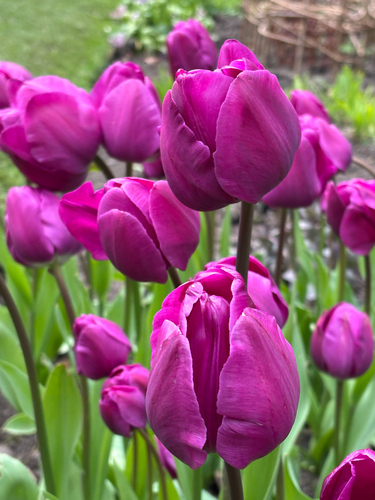
How to care for Garden Tulip
Watering
Garden Tulip (Tulipa gesneriana) is a bulb, so its main need is well-drained soil that never stays soggy. Water the bulbs deeply when you plant them in autumn, then rely mostly on rain. In spring, while the leaves and flower are growing, give a deep drink roughly every 10 to 14 days if there has been no rain. Once the petals drop and the leaves start to yellow, stop watering almost completely so the bulb can dry and rest until the next autumn.
Does it need water today?
Push a finger 5 cm into the soil near the bulb. If it feels dry, water deeply. If it feels damp, wait. For a potted tulip, lift the pot: a light pot is dry, a heavy pot is still wet. Always check the soil, not just the surface.
Water at the base of the plant, not over the leaves, and in the morning if you can. Wet foliage and cool damp soil invite bulb rot and fungal disease.
Overwatering
Garden Tulip bulbs store their own water and rot quickly in cold, saturated soil, especially in winter and early spring. Too much water is the most common reason tulips fail to flower or simply disappear.
Symptoms: Soft, mushy bulbs when dug up, grey or brown mould on the base, leaves that yellow and collapse, and a sour or rotten smell from the soil.
Solutions: Stop watering and improve drainage by mixing in grit or sand, or by lifting the bulbs and planting them in raised soil. Remove any soft bulbs, cut away rotten tissue, and dust the rest with sulphur before replanting. In pots, always use a container with drainage holes and empty saucers after watering.
Underwatering
Tulips need enough moisture during active growth to form strong leaves and a good flower bud, but they are adapted to dry summers. Drought during spring growth reduces flower size and bulb energy for next year.
Symptoms: Leaves that curl, wilt, or look grey-green and limp, short stems, small flowers that open poorly, and soil that is pale, dusty, and pulling away from the pot edge.
Solutions: Give a deep, slow watering to soak the root zone, then check again in two to three days. Mulch the soil surface with bark or straw in spring to slow evaporation. Never flood a dry pot quickly; soak it gradually so water reaches the centre.
Sunlight
Garden Tulip (Tulipa gesneriana) needs full sun to flower well. In spring, bright sun keeps stems short and sturdy and encourages large, vivid blooms. Partial shade is tolerated, but flowers will be smaller and may lean toward the light. Tulips grown in deep shade often produce leaves but no flowers, and the bulb weakens for the next season.
- Ideal: Full sun · 6-8 hours of direct sun
- Tolerates: Full sun, Partial sun
- Best spot in a room: At the window
- Artificial light: Tulips are rarely grown indoors for long, but forced bulbs can be placed under a full-spectrum LED grow light set about 15 to 30 cm above the flowers for 12 to 14 hours a day while they are blooming. Keep the light close to avoid tall, floppy stems.
Too little light
Garden Tulip stretches toward light when it does not get enough sun, because its stems and leaves are designed to reach open sky in spring. Weak light also means the bulb stores less energy for the following year.
Symptoms: Tall, thin, leaning stems, pale or yellowish leaves, small or no flowers, and blooms that open only partly.
Solutions: Move the pot or plant to the sunniest spot available, or rotate the pot every few days so all sides receive light. In the garden, choose a site with at least six hours of direct sun in spring, and remove or thin nearby shrubs that cast shade on the bulbs.
Too much sun
Tulips are well adapted to strong sun, but in hot, reflective conditions such as a south-facing wall or a paved area, the flowers and leaves can scorch and fade quickly. Indoors, intense direct sun through glass can overheat containers.
Symptoms: Brown or bleached edges on the leaves, petals that fade or wilt quickly, and dry, crisp soil that dries out faster than expected.
Solutions: Provide light shade during the hottest part of the afternoon, or move potted tulips slightly back from a south or west window. Mulch the soil and water a little more often in heat, and cut flowers once they start to fade to keep the bulb's energy focused on rest.
Temperature
Garden tulips (Tulipa gesneriana) are hardy spring bulbs that need a long, cold winter rest of roughly 12 to 16 weeks below about 10°C to flower well the following spring. They grow and bloom best in cool spring weather around 10 to 18°C, and they go dormant after flowering as the soil warms in early summer.
- Ideal: 5–18 °C
- Tolerates: -30–35 °C
- Hardiness zones: 3-8
Fertilizing
Garden tulips need phosphorus and potassium more than nitrogen, because these nutrients support strong roots, bulb formation, and sturdy stems. Feed while leaves are green and growing, and stop once foliage starts to yellow so the bulb can store nutrients for next year.
- Slow-release fertilizer: Apply once a year in autumn when planting, mixing bulb fertilizer into the planting hole; a light top-up in early spring as shoots emerge is optional.
- Bulb fertilizer with a balanced or slightly high phosphorus and potassium ratio, such as 5-10-10 or similar, Slow-release granular bulb food, Well-rotted compost or leaf mold worked into the soil, Low-nitrogen liquid tomato or bulb feed diluted to half strength
Soil
Garden tulips (Tulipa gesneriana) need soil that drains quickly, because their bulbs rot in wet, heavy ground. Sunny, fertile, well-drained beds with a neutral to slightly alkaline pH suit them best.
- Well-drained garden loam: Mostly loam mixed with compost, with sand added to improve drainage
- Container potting mix: Peat-free potting mix blended with about 30% horticultural grit or perlite
- Sandy garden soil: Sand with organic compost worked in to hold a little moisture
- pH 6–7.5
Repotting
Garden tulip (Tulipa gesneriana) grows from a bulb, not a root ball, so repotting means replanting fresh bulbs in autumn before the ground freezes. Tulips bloom once well and often weaken over time, so many gardeners treat them as annuals or replace bulbs every 1-2 years for the best flowers.
- How often: Every 1-2 years for container-grown bulbs; garden tulips in beds are usually lifted and replanted yearly or left to naturalize
- New pot: A container about 15-20 cm deep with drainage holes, sized so bulbs sit 2.5 cm apart and 1-2 cm below the rim
- Repotting season: Autumn
How to repot
- Remove old spent bulbs and soil from the container, or lift the bed bulbs with a garden fork in early summer after foliage yellows
- Discard any bulbs that are soft, moldy, or damaged
- Fill the bottom of the pot with 8-10 cm of soil mix and set bulbs pointed end up
- Space bulbs about 2.5 cm apart with tips facing up and just below the surface
- Cover with 8-10 cm of soil, water gently until moist but not soggy
- Store the pot in a cool, dark, unheated spot near 5-9°C or in the ground outdoors for winter chilling
Pruning
Deadhead Tulipa gesneriana flowers as soon as the petals fade, cutting the flower stem just below the flower head with clean secateurs. Leave all foliage in place until it turns yellow and dies back naturally, usually early summer. Do not tie leaves into knots or cut them green, as this weakens the bulb.
Pruning season: Spring, Summer
How to prune
- Wait until the petals have dropped or begun to fade, usually a few days after the bloom peaks.
- Hold the flower stem firmly and cut it just below the flower head, leaving the stem and leaves attached.
- Stop deadheading once the flowering period ends in late spring so the plant can direct energy into the bulb.
- Once the leaves turn yellow and dry in early summer, gently pull them away from the bulb or cut them at soil level.
- Dispose of removed flower stems and dead foliage in the green waste bin rather than the compost heap if you have seen any disease.
Propagation
Offsets (bulblets) separation · Summer, Autumn
- Wait until the foliage has yellowed and died back completely in early summer, which signals the bulb is dormant.
- Carefully lift the mother bulb from the soil with a garden fork, keeping well away from the bulb to avoid damage.
- Gently brush off the soil and look for small offsets (bulblets) attached to the base of the mother bulb.
- Separate the offsets by hand, twisting them away; discard any that are soft, mouldy, or damaged.
- Let the bulbs and offsets dry in a shaded, airy place for a few days, then store them in a paper bag or mesh tray at about 17°C until planting time.
- Replant the offsets in autumn at a depth of about 10 cm; expect them to take two to three years to reach flowering size.
Seed sowing · Summer, Autumn
- Allow flowers to fade and let seed pods dry on the plant in late summer until they split open.
- Collect the flat, papery seeds and sow them in a pot or seedbed filled with gritty, free-draining compost.
- Cover the seeds lightly and keep the container outdoors in a cool, sheltered spot so they experience winter chill.
- Keep the compost barely moist through spring; seedlings appear in early spring and remain small, grass-like leaves.
- Expect flowering only after five to seven years, so this method suits patient gardeners rather than quick results.
Dust cut or damaged bulb tissue with a little sulphur powder before storage to reduce rot. Many gardeners find that replanting bulbs deeply each autumn keeps the flower display strong, so offsets are often grown on in a separate nursery bed before moving them into borders.
About Garden Tulip
Also known as: Garden tulip, Didier's tulip, Florist's tulip
- Plant type: bulbous perennial, herb
- Lifespan: perennial
- Distribution: Native to the mountains of Central Asia, including the Tien Shan and Pamir ranges.
- Mature height: 20-60 cm
- Bloom time: Mid to late spring
Pets · People
Pets: Toxic · People: Toxic. Bulbs contain tulipalins and tulipósides that cause irritation, vomiting and drooling if eaten; contact may irritate sensitive skin. The ASPCA lists tulips as toxic to dogs, cats and horses. Bulbs are the most hazardous part.
Common problems
- Tulip fire: Fungal disease (Botrytis tulipae) causing grey spotting on leaves and flower buds; remove infected plant parts and avoid crowding.
- Bulb rot: Rot from waterlogged soil or damaged bulbs; plant in well-drained soil and discard soft bulbs.
- Tulip breaking virus: Viral streaking that can damage colour and weaken the plant; infected plants should be removed.
- Aphids: Sap-sucking pests on flower stems and leaves that spread viruses; check and remove them by hand.
- Squirrels and rodents: Dig up and eat bulbs in winter; protect planting areas with wire mesh.
Uses
Primarily ornamental in borders, containers and as a cut flower; the cultivated tulip is among the most widely grown bulb crops worldwide.
Is it edible?
Not edible; bulbs and other parts are toxic.
History & legends
The plant was described from Turkish and Central Asian material and carried to Europe in the 1500s, reaching Vienna and then the Low Countries. Tulips became symbols of wealth and speculation in seventeenth-century Holland, and the Ottoman court had long prized them, which gave rise to the name tulip from the Turkish word for turban.
Did you know?
Tulip bulbs were so valued in the Dutch Golden Age that tulip mania in the 1630s saw single bulbs trade for prices comparable to a house.
Frequently asked questions
How often should I water Garden Tulip?
every 14 days. Garden Tulip (Tulipa gesneriana) is a bulb, so its main need is well-drained soil that never stays soggy. Water the bulbs deeply when you plant them in autumn, then rely mostly on rain. In spring, while the leaves and flower are growing, give a deep drink roughly every 10 to 14 days if there has been no rain. Once the petals drop and the leaves start to yellow, stop watering almost completely so the bulb can dry and rest until the next autumn. Push a finger 5 cm into the soil near the bulb. If it feels dry, water deeply. If it feels damp, wait. For a potted tulip, lift the pot: a light pot is dry, a heavy pot is still wet. Always check the soil, not just the surface.
How much light does Garden Tulip need?
Full sun (6-8 hours of direct sun). Garden Tulip (Tulipa gesneriana) needs full sun to flower well. In spring, bright sun keeps stems short and sturdy and encourages large, vivid blooms. Partial shade is tolerated, but flowers will be smaller and may lean toward the light. Tulips grown in deep shade often produce leaves but no flowers, and the bulb weakens for the next season.
What temperature does Garden Tulip like?
5–18 °C. Garden tulips (Tulipa gesneriana) are hardy spring bulbs that need a long, cold winter rest of roughly 12 to 16 weeks below about 10°C to flower well the following spring. They grow and bloom best in cool spring weather around 10 to 18°C, and they go dormant after flowering as the soil warms in early summer.
Is Garden Tulip toxic to cats and dogs?
It is toxic to cats and dogs: keep it out of their reach. Bulbs contain tulipalins and tulipósides that cause irritation, vomiting and drooling if eaten; contact may irritate sensitive skin. The ASPCA lists tulips as toxic to dogs, cats and horses. Bulbs are the most hazardous part.
What are the most common problems of Garden Tulip?
Tulip fire: Fungal disease (Botrytis tulipae) causing grey spotting on leaves and flower buds; remove infected plant parts and avoid crowding. Bulb rot: Rot from waterlogged soil or damaged bulbs; plant in well-drained soil and discard soft bulbs. Tulip breaking virus: Viral streaking that can damage colour and weaken the plant; infected plants should be removed. Aphids: Sap-sucking pests on flower stems and leaves that spread viruses; check and remove them by hand. Squirrels and rodents: Dig up and eat bulbs in winter; protect planting areas with wire mesh.
When should I repot Garden Tulip?
Every 1-2 years for container-grown bulbs; garden tulips in beds are usually lifted and replanted yearly or left to naturalize. Garden tulip (Tulipa gesneriana) grows from a bulb, not a root ball, so repotting means replanting fresh bulbs in autumn before the ground freezes. Tulips bloom once well and often weaken over time, so many gardeners treat them as annuals or replace bulbs every 1-2 years for the best flowers.
How do I propagate Garden Tulip?
Offsets (bulblets) separation, Seed sowing. Wait until the foliage has yellowed and died back completely in early summer, which signals the bulb is dormant. Carefully lift the mother bulb from the soil with a garden fork, keeping well away from the bulb to avoid damage. Gently brush off the soil and look for small offsets (bulblets) attached to the base of the mother bulb. Separate the offsets by hand, twisting them away; discard any that are soft, mouldy, or damaged. Let the bulbs and offsets dry in a shaded, airy place for a few days, then store them in a paper bag or mesh tray at about 17°C until planting time. Replant the offsets in autumn at a depth of about 10 cm; expect them to take two to three years to reach flowering size.
How this guide was written
Verdiss writes each guide with AI from botanical references and checks the species against iNaturalist and Plants of the World Online (Kew). Readers can rate every guide in the app.
Sources
Verdiss's information is for general guidance. Never eat or use a plant as medicine based on an app: ask a professional.