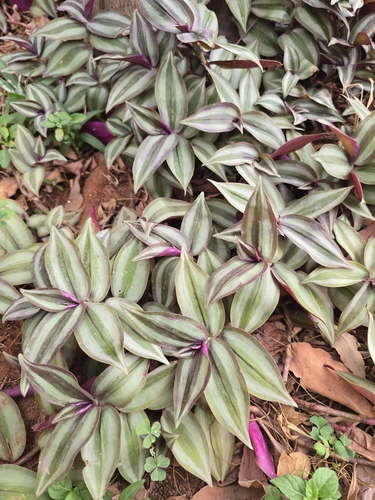
How to care for zebra plant
Watering
Tradescantia zebrina, the zebra plant (also called wandering jew), has thin, succulent-leaning stems that store some water, so it prefers to dry out a little between drinks. Water thoroughly until it drains from the pot, then empty the saucer. Use room-temperature water and keep the soil lightly moist, never soggy. Water less in winter, when growth slows and the soil stays wet longer.
Does it need water today?
Push a finger about 2 cm into the potting mix. If it feels dry, water. If it is still damp, wait a day or two. You can also lift the pot: a light pot means it is dry. Zebra plants also show thirst by slightly limp, wrinkled stems, but a little droop is fine if the soil is still moist.
Water at the soil line, not over the colorful leaves, which can rot if they stay wet. Slightly drier soil keeps the purple and silver stripes bright.
Overwatering
Zebra plant stems are fleshy and hold water, so soggy soil quickly causes rot at the base. Its thin roots need air around them to stay healthy, and waterlogged mix pushes out that oxygen.
Symptoms: Mushy, dark stems near the soil, yellowing leaves that drop easily, a sour smell from the pot, and fuzzy mold on the surface.
Solutions: Stop watering and let the soil dry out to the top 5 cm. Remove the plant, trim away black or mushy stem parts with clean scissors, and repot into fresh, well-draining mix in a pot with drainage holes. Cut back stems that are too far gone and root the healthy tips in water.
Underwatering
Because zebra plants store only a modest amount of water in their stems, they wilt and dry quickly in warm, bright rooms. Long dry spells cause the stems to lose their firmness and the leaves to lose their color.
Symptoms: Crispy leaf edges, flat or wrinkled stems, faded stripes, and soil that pulls away from the pot edges.
Solutions: Water thoroughly, using bottom watering if the soil has become hydrophobic and water runs straight through. Trim dead stems and keep the plant in brighter light so it uses water more evenly. Within a few days, healthy stems should firm up again.
Sunlight
Zebra plants grow compact and colorful in bright, indirect light. The purple, silver, and green stripes fade toward green when light is weak, and stems become long and sparse. Direct midday sun can scorch the leaves, especially through glass in summer. Rotate the pot every week or two so the plant grows evenly.
- Ideal: Bright, indirect light · 4-6 hours of bright, filtered light daily
- Tolerates: Partial sun, Bright, indirect light
- Best spot in a room: Near the window
- Artificial light: A full-spectrum LED grow light placed 30 to 45 cm above the plant for 12 to 14 hours a day works well if the room is dim. In winter, supplemental light helps keep the stripes vivid and stems from stretching.
Too little light
Tradescantia zebrina relies on bright light to produce its strong pigments. In low light it makes less of the purple and silver coloring and stretches its stems toward any available source.
Symptoms: Leggy, stretched stems with large gaps between leaves, faded or greenish leaves, and slower growth.
Solutions: Move the plant closer to a bright east or west window, or under a grow light. Pinch back long stems to encourage bushier growth, and rotate the pot regularly.
Too much sun
Zebra plant leaves are thin and delicate, so strong direct sun quickly bleaches and dries them. Its colors are pigments that break down under intense heat and light.
Symptoms: Pale, bleached patches on the leaves, crispy brown edges, and curling or shriveled leaves facing the window.
Solutions: Move the plant a metre back from a south or west window, or add a sheer curtain. Keep the soil moist during hot, bright spells, and move the plant outdoors only into shade.
Temperature
Tradescantia zebrina, the zebra plant (also called wandering jew), grows best in bright indirect light at room temperature, between 18 and 24 °C. It is a tender trailing plant from warm, humid Mexican and Central American forests, so it does not tolerate frost and dislikes long stretches of heat or cold drafts.
- Ideal: 18–24 °C
- Tolerates: 5–35 °C
- Hardiness zones: 10-12
Fertilizing
Tradescantia zebrina is a fast-growing trailing plant that uses nutrients quickly during its active spring and summer season. Feed it lightly and regularly during this period, then pause during winter when growth slows in low light. Always water before feeding so the roots are not shocked by concentrated fertilizer.
- Slow-release fertilizer: Once a year in early spring, if the plant is in a container, using a light application of slow-release granules. Not needed for plants that are only grown in water.
- Balanced liquid houseplant fertilizer, such as a 10-10-10 or 20-20-20 formula diluted to half strength, Liquid fertilizer with a slightly higher nitrogen ratio for leafy growth, Slow-release granular houseplant fertilizer applied lightly once a year
Soil
Tradescantia zebrina needs soil that is loose and drains freely, because its shallow roots rot in wet, dense soil. Good aeration matters as much as moisture, so always use a pot with drainage holes.
- Light potting mix with perlite: Two parts peat-free potting mix to one part perlite, which keeps the fibrous roots from sitting in water
- Chunky aroid or succulent mix: Commercial aroid or cactus mix with added bark chips or pumice, suitable if you water less often
- Peat-free all-purpose mix: Standard peat-free potting soil amended with extra perlite, about one part perlite to three parts mix
- pH 5.5–7
Repotting
Tradescantia zebrina has shallow, fibrous roots and forms dense trailing mats, so it prefers a slightly snug pot. Oversized pots hold wet soil around the roots and invite rot.
- How often: Every 1-2 years, as Tradescantia zebrina (wandering jew, zebra plant) grows fast and fills its pot quickly
- New pot: Move up only one size, about 2-5 cm wider in diameter, with drainage holes in the base
- Repotting season: Spring, Summer
How to repot
- Turn the pot on its side and gently tap the sides until the root ball loosens.
- Slide the plant out by holding the base of the stems, not by pulling the trailing stems.
- Shake off loose old soil and trim any black, mushy, or dead roots with clean scissors.
- Place a layer of fresh mix in the new pot so the top of the root ball sits about 2 cm below the rim.
- Set the plant in the center, fill around the sides with mix, and press gently to remove large air pockets.
- Water thoroughly until it drains from the holes, then let the top few centimeters dry before watering again.
- Optionally pinch back leggy stems to encourage a fuller, bushier shape.
Pruning
Use clean, sharp snips and cut just above a leaf node, since new shoots grow from there. Pinch or trim the growing tips regularly during the active growing season for a bushier plant.
Pruning season: Spring, Summer
How to prune
- Look over the plant and identify stems that are leggy, yellowing, or damaged.
- Cut each stem just above a leaf node, leaving a few leaves on the remaining stem.
- Pinch off the soft growing tips of long shoots to encourage side branching.
- Remove any dead or mushy leaves at the base of the plant.
- Keep the cut stems and use them as cuttings, then water the plant lightly and place it in bright, indirect light.
Propagation
Stem cuttings in water · Spring, Summer
- Cut a 8 to 10 cm piece of stem from a healthy trailing shoot, just below a leaf node.
- Strip the lowest pair of leaves so that at least one node sits under the water line.
- Place the cutting in a glass of room-temperature water on a bright windowsill, out of direct midday sun.
- Change the water every few days to prevent rot.
- Once roots are 2 to 3 cm long, usually within 1 to 2 weeks, pot the cutting in moist potting mix.
Stem cuttings in soil · Spring, Summer, Autumn
- Take a 8 to 10 cm tip cutting with at least three leaves, cutting just below a node.
- Remove the lower leaves and let the cut end dry for an hour.
- Insert the cutting 2 to 3 cm deep into a small pot of moist, well-draining mix such as peat-free potting soil with added perlite.
- Cover loosely with a clear plastic bag or place in a propagator to hold humidity, and keep it warm, around 18 to 24°C.
- Remove the cover once new growth appears, usually in 3 to 4 weeks, and water when the top centimetre of soil feels dry.
Division of an established plant · Spring
- Slide the plant out of its pot once it is crowded and has many trailing stems.
- Gently separate the root ball into two or three sections, keeping a few stems and roots with each.
- Repot each section into a container one size larger with fresh potting mix.
- Water lightly and keep out of strong sun for a week while the plant recovers.
Zebra plant cuttings root best when several nodes are in contact with moisture or soil. Taking extra cuttings is a good backup, since a few often fail.
About zebra plant
Also known as: Silver inch plant, Wandering jew, Striped inch plant, Zebra spiderwort
- Plant type: herb, trailing perennial, succulent-stemmed groundcover
- Lifespan: perennial
- Distribution: Native to southern Mexico and Central America, from Oaxaca to Guatemala.
- Mature height: 10-30 cm
- Bloom time: Mostly spring to summer outdoors; rarely flowers indoors
Pets · People
Pets: Toxic · People: Toxic. Contains calcium oxalate crystals and sap that can irritate the skin and cause mouth and stomach irritation, vomiting and drooling if chewed. Sap may also cause contact dermatitis in sensitive people. Listed as toxic by the ASPCA.
Common problems
- Leggy growth: Stems stretch and leaves become sparse when light is too low; move to brighter indirect light and pinch tips.
- Fading stripes: Too little light makes the silver and purple markings dull, while strong direct sun can bleach them.
- Root and stem rot: Waterlogged soil causes mushy stems and blackened roots; allow the top soil to dry and use a fast-draining mix.
- Spider mites: Dry, warm air encourages fine webbing and speckled leaves; wipe leaves and increase humidity.
- Cold damage: Exposure to temperatures below 10 °C causes blackened, mushy leaves; keep away from cold drafts and windows in winter.
Uses
Mainly ornamental, grown as a houseplant, hanging basket and groundcover in warm climates. In parts of Central America the sap has been used as a folk dye and the plant has minor use in traditional remedies for skin complaints, though these uses are local and not well documented.
Is it edible?
Not edible; the sap and leaves can irritate the mouth and stomach.
History & legends
Tradescantia was named by Linnaeus in honour of the English gardener John Tradescant the Elder and his son, who collected plants for English gardens in the seventeenth century. The name wandering jew is a folk name linked to legends of an eternally wandering figure, reflecting the plant's rambling habit.
Did you know?
The sap of Tradescantia zebrina is so distinctively coloured that it has been used by some growers as a natural dye, and the plant's striped leaves make it a favourite of model-railway and miniature garden enthusiasts.
Frequently asked questions
How often should I water zebra plant?
every 7 days. Tradescantia zebrina, the zebra plant (also called wandering jew), has thin, succulent-leaning stems that store some water, so it prefers to dry out a little between drinks. Water thoroughly until it drains from the pot, then empty the saucer. Use room-temperature water and keep the soil lightly moist, never soggy. Water less in winter, when growth slows and the soil stays wet longer. Push a finger about 2 cm into the potting mix. If it feels dry, water. If it is still damp, wait a day or two. You can also lift the pot: a light pot means it is dry. Zebra plants also show thirst by slightly limp, wrinkled stems, but a little droop is fine if the soil is still moist.
How much light does zebra plant need?
Bright, indirect light (4-6 hours of bright, filtered light daily). Zebra plants grow compact and colorful in bright, indirect light. The purple, silver, and green stripes fade toward green when light is weak, and stems become long and sparse. Direct midday sun can scorch the leaves, especially through glass in summer. Rotate the pot every week or two so the plant grows evenly.
What temperature does zebra plant like?
18–24 °C. Tradescantia zebrina, the zebra plant (also called wandering jew), grows best in bright indirect light at room temperature, between 18 and 24 °C. It is a tender trailing plant from warm, humid Mexican and Central American forests, so it does not tolerate frost and dislikes long stretches of heat or cold drafts.
Is zebra plant toxic to cats and dogs?
It is toxic to cats and dogs: keep it out of their reach. Contains calcium oxalate crystals and sap that can irritate the skin and cause mouth and stomach irritation, vomiting and drooling if chewed. Sap may also cause contact dermatitis in sensitive people. Listed as toxic by the ASPCA.
What are the most common problems of zebra plant?
Leggy growth: Stems stretch and leaves become sparse when light is too low; move to brighter indirect light and pinch tips. Fading stripes: Too little light makes the silver and purple markings dull, while strong direct sun can bleach them. Root and stem rot: Waterlogged soil causes mushy stems and blackened roots; allow the top soil to dry and use a fast-draining mix. Spider mites: Dry, warm air encourages fine webbing and speckled leaves; wipe leaves and increase humidity. Cold damage: Exposure to temperatures below 10 °C causes blackened, mushy leaves; keep away from cold drafts and windows in winter.
When should I repot zebra plant?
Every 1-2 years, as Tradescantia zebrina (wandering jew, zebra plant) grows fast and fills its pot quickly. Tradescantia zebrina has shallow, fibrous roots and forms dense trailing mats, so it prefers a slightly snug pot. Oversized pots hold wet soil around the roots and invite rot.
How do I propagate zebra plant?
Stem cuttings in water, Stem cuttings in soil, Division of an established plant. Cut a 8 to 10 cm piece of stem from a healthy trailing shoot, just below a leaf node. Strip the lowest pair of leaves so that at least one node sits under the water line. Place the cutting in a glass of room-temperature water on a bright windowsill, out of direct midday sun. Change the water every few days to prevent rot. Once roots are 2 to 3 cm long, usually within 1 to 2 weeks, pot the cutting in moist potting mix.
How this guide was written
Verdiss writes each guide with AI from botanical references and checks the species against iNaturalist and Plants of the World Online (Kew). Readers can rate every guide in the app.
Sources
Verdiss's information is for general guidance. Never eat or use a plant as medicine based on an app: ask a professional.