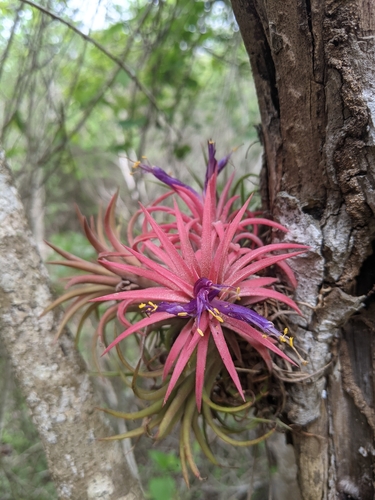
How to care for Blushing Bride Airplant
Watering
Tillandsia ionantha, the Blushing Bride Airplant, has no roots for drinking and absorbs water and nutrients through tiny scales on its leaves called trichomes. Soak it fully once a week in spring and summer, and less often in winter. Shake off excess water and let it dry upside down within 4 hours so water never sits in the leaf rosette, which can cause rot.
Does it need water today?
Gently pinch a leaf. If it feels firm and the leaves are wide open and silvery, it is fine. If the leaves look curled, grey, or feel papery and thin, it is thirsty and needs a soak today. Also check the base of the plant for soft or brown spots, which signal too much water.
Use rainwater, distilled water, or tap water that has been left out overnight. Soft water is best because minerals build up on the leaves. Blushing Bride turns its pink bracts more vividly when it is well lit and watered on schedule.
Overwatering
Tillandsia ionantha grows on trees and rocks in humid forests, where air moves freely around its leaves and they dry quickly. Leaving water trapped in the rosette or keeping it in a closed, humid space drowns the plant and lets fungus and bacteria attack the base. Blushing Bride is especially sensitive because its narrow leaves hold water in the centre.
Symptoms: Soft, mushy, or brown leaves at the base, a sour smell, leaves that pull out easily, or a rosette that turns black from the centre outward.
Solutions: Remove the plant from its container, shake out all water, and dry it upside down in bright indirect light for several hours. Cut away any soft, rotten leaves with clean scissors. Check that the air around the plant moves freely and reduce soaking time to 20 minutes or less.
Underwatering
Tillandsia ionantha has no water storage in roots or bulbs, so it dries out faster than many houseplants. Its silvery trichomes absorb moisture from the air and from soaking, and in hot rooms or near heaters it can lose that moisture within a few days. The leaves then fold inward to reduce water loss.
Symptoms: Leaves that curl tightly, turn grey or dull, feel stiff and brittle, or the plant stops producing new growth and its pink bracts fade.
Solutions: Soak the plant for 30 minutes today and let it dry upside down. Mist it daily for a week while it recovers. Move it away from radiators and check that you are soaking it weekly during the growing season.
Sunlight
Tillandsia ionantha grows in the bright, dappled light beneath forest canopies, so it prefers strong light that is not harsh. Good light keeps its leaves silvery-green and encourages the red and pink bracts that give Blushing Bride its name. Too little light makes the rosette pale and stretched, while direct midday sun in summer can scorch the leaves and turn them brown.
- Ideal: Bright, indirect light · 6-8 hours of bright, filtered light daily, with a few hours of gentle morning or evening sun
- Tolerates: Partial sun, Bright, indirect light
- Best spot in a room: At the window
- Artificial light: If natural light is weak, use a full-spectrum LED grow light 15 to 30 cm above the plant for 10 to 12 hours a day. Keep the light on a timer so the plant gets a consistent day length.
Too little light
In the wild, Tillandsia ionantha lives in open, bright branches where it receives plenty of light to photosynthesise. In a dim room, it cannot make enough energy to grow or to colour its bracts, so it becomes weak and pale.
Symptoms: Pale green leaves with little silver, a stretched or loose rosette, no pink colour in the centre, and slow or no new growth.
Solutions: Move the plant to a bright east or west window or to a spot near a bright south window with a sheer curtain. Add a full-spectrum LED grow light if winter days are short. Turn the plant weekly so all sides receive light.
Too much sun
Tillandsia ionantha is adapted to filtered forest light, not to the intense, direct sun of open deserts or south-facing windows. Strong direct sun dries its leaves quickly and heats the tissue, which can damage the cells and cause permanent browning.
Symptoms: Bleached, yellow, or white patches on the leaves, brown dry tips, or crispy edges that do not recover after watering.
Solutions: Move the plant a metre back from a south or west window, or place it behind a sheer curtain. Keep it out of direct midday sun in summer. Trim any badly burned leaves once they are fully brown.
Temperature
Tillandsia ionantha, the Blushing Bride airplant, grows best between 15 and 27°C in bright indirect light with good air movement. It is a tropical epiphyte that tolerates ordinary household temperatures well, but it does not like sudden swings. Keep it away from cold drafts, heating vents and hot windows, and mist or soak it regularly because it has no roots to draw water from soil.
- Ideal: 15–27 °C
- Tolerates: 5–35 °C
- Hardiness zones: 10-11
Fertilizing
Tillandsia ionantha absorbs nutrients through the fine scales on its leaves rather than through roots, so it needs only very weak feeding. Add a small amount of diluted fertilizer to the water used for soaking or misting during the active growing months. Never use undiluted fertilizer, because the salts build up on the leaves and can burn them.
- Slow-release fertilizer: not needed
- Bromeliad-specific liquid fertilizer diluted to one quarter strength, Tillandsia or air plant fertilizer at low concentration, Balanced liquid orchid fertilizer diluted to one quarter strength
Soil
Blushing Bride airplants take all their needs from air, rain-like mists, and occasional soaks, so soil should never be used. Any medium that holds moisture against the base, such as potting mix or moss, can cause rot in this species.
- No soil (recommended): Tillandsia ionantha is an air plant and grows without soil. Mount it on cork, driftwood, or a glass container, or place it in an open dish with air around the base.
- Inert grit or pumice (optional, for dish display): Pumice, small gravel, or horticultural grit lets the base rest without sitting in water. Use only if you want a dish base, and keep the material dry between waterings.
- pH 5.5–6.5
Repotting
Blushing Bride airplants anchor with tiny root-like structures and absorb water and nutrients through their leaves, so they need open air around the base, not a buried root ball.
- How often: Tillandsia ionantha is an epiphyte with no roots in soil; it rarely needs repotting. Move it to a new holder only when the mount or container is failing, roughly every 2-3 years.
- New pot: No soil pot is needed. Use a small open container, shallow dish, or wire/cork mount just large enough to hold the base without crowding the leaves.
- Repotting season: Spring, Summer
How to repot
- Gently lift the plant out of its old holder, supporting the base so the leaves do not snap.
- Brush away dry debris and any loose, dead material from around the base with a soft brush or cloth.
- If you are separating pups, pull them away only when they are about one-third the size of the parent or have their own small base; twist gently.
- Place the base on the new holder and secure it lightly with a small dab of non-toxic glue or by wedging it between wire or cork without wrapping tightly.
- Leave the plant unsecured for a few hours if you used glue, so the bond can set in a dry spot.
Pruning
Blushing Bride airplants do not need regular pruning. The only cutting you should do is removing fully brown, crispy leaves or spent flower parts, and separating pups when they are ready.
Pruning season: Spring, Summer
How to prune
- Look at the plant in bright, indirect light and identify leaves that are completely brown or papery.
- Hold the base of the dead leaf with one hand and pull it gently outward and downward; most will release easily.
- If a leaf resists, use clean scissors to cut it at the base, close to the rosette center, without cutting into green tissue.
- After a spent bloom has faded and dried, cut the flower stalk at its base once it is entirely brown.
- Wipe the scissors with rubbing alcohol before and after use, then let the plant dry upright for a few hours before returning it to its usual spot.
Propagation
Offsets (pups) separation · Spring, Summer
- Wait until a pup at the base of the mother plant is at least one-third the size of the parent and has developed its own small roots or firm base.
- Gently pull or cut the pup away from the mother plant using clean scissors or by twisting it free at the base.
- Let the cut end dry for a few hours on a paper towel before reattaching or mounting.
- Mount the pup on cork bark, driftwood, or a small piece of wire-and-wood holder, or place it in a shallow dish without soil.
- Mist the pup lightly every day or two for the first few weeks, then move to a soak-and-dry routine once it anchors.
Seed propagation · Spring, Summer
- Collect ripe seed pods from a flowering Tillandsia ionantha after the capsule turns brown and splits open.
- Sow the tiny, fluffy seeds on a damp sheet of sphagnum moss inside a clear container with a lid.
- Keep the container in bright, indirect light at about 20 to 25 °C, misting the moss to keep it moist but never soggy.
- Expect slow growth; seedlings take many months to reach a size where they can be transplanted to mounts.
Pups of Tillandsia ionantha grow best when they are left attached to the mother until they are about half her size. Separating them too early often leads to rot at the base.
About Blushing Bride Airplant
Also known as: Blushing Bride, Ionantha airplant, Sky plant
- Plant type: epiphyte, bromeliad, air plant
- Lifespan: perennial
- Distribution: Native to Mexico and Central America, from southern Mexico through Guatemala, Honduras and Costa Rica, growing on trees and rocks at moderate elevations.
- Mature height: 5-8 cm tall; rosette 5-10 cm across
- Bloom time: Spring to summer, often lasting several weeks
Pets · People
Pets: Safe · People: Safe. Non-toxic to cats, dogs and children according to ASPCA listings for Tillandsia; the sharp leaf tips can scratch skin, so handle carefully.
Common problems
- Root rot: Water sitting in the rosette or on the base rots the plant; dry it upside down and avoid leaving it wet overnight.
- Brown leaf tips: Usually caused by dry air, mineral buildup from hard water, or too little soaking; use rainwater or filtered water.
- Sunburn: Direct midday sun bleaches and scorches the silver leaves; move to bright indirect light.
- Pale, stretched growth: Too little light makes the rosette loose and green; increase bright indirect light gradually.
- Failure to bloom: Plants need enough light and maturity; a mature plant can be encouraged with brighter light and regular feeding.
Uses
Ornamental only. Tillandsia ionantha is grown as a decorative houseplant, in terrariums, wall displays and vertical gardens, and is valued by collectors for its colour changes.
Is it edible?
not edible
History & legends
Tillandsia ionantha was described by Otto Guido Wittmack in 1888 and later became a horticultural favourite once air plants gained popularity in Europe and North America. Its name recalls the Tillandsia genus named after Swedish botanist Elias Tillandz, and the Blushing Bride nickname was popularised by growers who sold it for weddings and home décor.
Did you know?
Tillandsia ionantha has no functional root system for drinking; it absorbs water and nutrients through tiny scale-like trichomes on its leaves, and the leaves change color to pink-red at flowering time to attract pollinators.
Frequently asked questions
How often should I water Blushing Bride Airplant?
every 7 days. Tillandsia ionantha, the Blushing Bride Airplant, has no roots for drinking and absorbs water and nutrients through tiny scales on its leaves called trichomes. Soak it fully once a week in spring and summer, and less often in winter. Shake off excess water and let it dry upside down within 4 hours so water never sits in the leaf rosette, which can cause rot. Gently pinch a leaf. If it feels firm and the leaves are wide open and silvery, it is fine. If the leaves look curled, grey, or feel papery and thin, it is thirsty and needs a soak today. Also check the base of the plant for soft or brown spots, which signal too much water.
How much light does Blushing Bride Airplant need?
Bright, indirect light (6-8 hours of bright, filtered light daily, with a few hours of gentle morning or evening sun). Tillandsia ionantha grows in the bright, dappled light beneath forest canopies, so it prefers strong light that is not harsh. Good light keeps its leaves silvery-green and encourages the red and pink bracts that give Blushing Bride its name. Too little light makes the rosette pale and stretched, while direct midday sun in summer can scorch the leaves and turn them brown.
What temperature does Blushing Bride Airplant like?
15–27 °C. Tillandsia ionantha, the Blushing Bride airplant, grows best between 15 and 27°C in bright indirect light with good air movement. It is a tropical epiphyte that tolerates ordinary household temperatures well, but it does not like sudden swings. Keep it away from cold drafts, heating vents and hot windows, and mist or soak it regularly because it has no roots to draw water from soil.
Is Blushing Bride Airplant toxic to cats and dogs?
It is safe for cats and dogs. Non-toxic to cats, dogs and children according to ASPCA listings for Tillandsia; the sharp leaf tips can scratch skin, so handle carefully.
What are the most common problems of Blushing Bride Airplant?
Root rot: Water sitting in the rosette or on the base rots the plant; dry it upside down and avoid leaving it wet overnight. Brown leaf tips: Usually caused by dry air, mineral buildup from hard water, or too little soaking; use rainwater or filtered water. Sunburn: Direct midday sun bleaches and scorches the silver leaves; move to bright indirect light. Pale, stretched growth: Too little light makes the rosette loose and green; increase bright indirect light gradually. Failure to bloom: Plants need enough light and maturity; a mature plant can be encouraged with brighter light and regular feeding.
When should I repot Blushing Bride Airplant?
Tillandsia ionantha is an epiphyte with no roots in soil; it rarely needs repotting. Move it to a new holder only when the mount or container is failing, roughly every 2-3 years.. Blushing Bride airplants anchor with tiny root-like structures and absorb water and nutrients through their leaves, so they need open air around the base, not a buried root ball.
How do I propagate Blushing Bride Airplant?
Offsets (pups) separation, Seed propagation. Wait until a pup at the base of the mother plant is at least one-third the size of the parent and has developed its own small roots or firm base. Gently pull or cut the pup away from the mother plant using clean scissors or by twisting it free at the base. Let the cut end dry for a few hours on a paper towel before reattaching or mounting. Mount the pup on cork bark, driftwood, or a small piece of wire-and-wood holder, or place it in a shallow dish without soil. Mist the pup lightly every day or two for the first few weeks, then move to a soak-and-dry routine once it anchors.
How this guide was written
Verdiss writes each guide with AI from botanical references and checks the species against iNaturalist and Plants of the World Online (Kew). Readers can rate every guide in the app.
Sources
Verdiss's information is for general guidance. Never eat or use a plant as medicine based on an app: ask a professional.