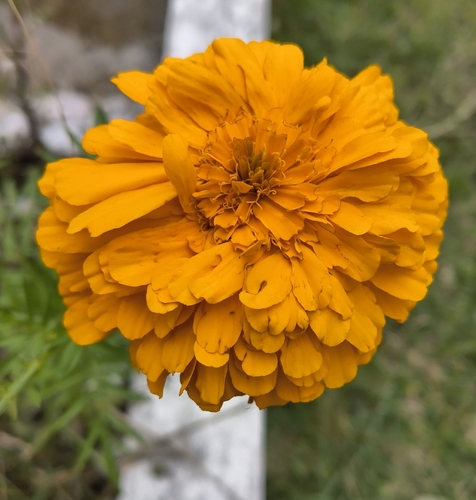
How to care for Mexican Marigold
Watering
Mexican Marigold (Tagetes erecta) likes evenly moist soil that is allowed to dry slightly between drinks. Its fleshy stems and dense root ball are prone to rot if the pot stays soggy, yet a plant that dries out completely will wilt and stop flowering. Water deeply at the soil line, let the top 2-3 cm dry, and empty any saucer after 15 minutes. Use a well-draining potting mix with some perlite.
Does it need water today?
Push a finger 2-3 cm into the soil. If it feels dry, water thoroughly until it drains from the bottom holes. If it feels cool and damp, wait a day or two. Lift the pot too: a light pot means it is thirsty, a heavy pot means it can wait. Slight leaf droop in the afternoon is normal in heat, but droopiness in the morning signals real thirst.
Water in the morning so foliage dries before evening, which helps prevent powdery mildew and stem rot. In summer heat, plants in terracotta pots may need water every day.
Overwatering
Mexican Marigold has thick, succulent-like stems and fine roots that cannot tolerate waterlogged soil for long. Constantly wet compost cuts off oxygen to the roots, and the plant quickly becomes vulnerable to fungal pathogens like Pythium and Rhizoctonia.
Symptoms: Yellowing lower leaves, soft or blackened stem bases, a sour smell from the soil, and sudden wilting even though the soil is wet.
Solutions: Stop watering and let the soil dry to the top 3-4 cm. Tip the plant out, trim any mushy roots with clean scissors, and repot into fresh, gritty mix in a pot with drainage holes. Reduce watering frequency going forward.
Underwatering
Mexican Marigold is a sun-loving annual that transpires heavily during flowering. Once its compost dries out, the plant cannot move water to its leaves fast enough, which halts bud production and causes rapid wilting.
Symptoms: Limp, drooping leaves that perk up after watering, crispy brown leaf edges, dried-out buds that drop without opening, and soil pulling away from the pot edges.
Solutions: Water thoroughly and slowly, then wait for the water to soak in. If the root ball is very dry, submerge the pot in a bucket of water for 20 minutes. Check frequency during heat waves and consider mulching outdoor beds to hold moisture.
Sunlight
Mexican Marigold (Tagetes erecta) is a sun-lover native to warm regions of Mexico. Strong direct light produces compact, sturdy plants and the most flowers. In partial sun, with about 4-5 hours of direct light, plants still bloom but grow taller and floppier. Deep shade will cause spindly stems and very few blooms.
- Ideal: Full sun · 6-8 hours of direct sun daily
- Tolerates: Full sun, Partial sun
- Best spot in a room: At the window
- Artificial light: If growing indoors, use a full-spectrum LED grow light 15-30 cm above the plant for 12-14 hours a day. Without supplemental light, a bright south-facing window is the minimum for flowering.
Too little light
Mexican Marigold stretches toward light when it lacks enough sun, because its stems are soft and its flower production depends on strong radiation. Insufficient light weakens the plant and stops it blooming, making it more open to pests and mildew.
Symptoms: Leggy, pale, stretched stems, leaves spaced far apart, flopping over, and few or no flower buds.
Solutions: Move the plant to the sunniest spot available, ideally outdoors in full sun after frost danger has passed. Indoors, add a grow light and rotate the pot weekly so growth stays even. Pinch stems to encourage bushier growth.
Too much sun
Although Mexican Marigold loves sun, extreme afternoon heat above about 35°C combined with reflected light from walls or pavement can scorch its foliage and dry the soil very fast. Heat stress makes flowers fade quickly.
Symptoms: Bleached or brown patches on leaves, crispy leaf margins, wilting at midday, and buds that open and fade within a day.
Solutions: Provide light afternoon shade with a shade cloth during heat waves, and water more often to offset evaporation. Move containers a little away from hot south or west walls if scorching occurs.
Temperature
Mexican marigold (Tagetes erecta) is a warm-season annual that thrives in mild sunny weather. It is killed by the first hard frost, so plant it after the last frost date and enjoy it until autumn cold arrives.
- Ideal: 15–27 °C
- Tolerates: 0–38 °C
- Hardiness zones: Annual in all zones; frost-tender, best planted outdoors after last frost
Fertilizing
Mexican marigold is a light feeder that blooms best in moderately fertile soil. Too much nitrogen produces lush leaves but few flowers, so keep feeding moderate and focus on balanced nutrients.
- Slow-release fertilizer: Once at planting time in spring, mix in a balanced slow-release granular fertilizer according to the package directions. No further slow-release feeding is needed for a single season.
- Balanced liquid fertilizer such as 10-10-10 or 20-20-20 diluted to half strength, Slow-release granular fertilizer with balanced N-P-K, Fish emulsion for a gentle organic boost, Compost worked into the planting bed
Soil
Mexican marigolds need soil that drains quickly yet holds some moisture. They grow best in neutral to slightly acidic conditions and do not tolerate soggy roots, which are the main cause of failure.
- Potting mix with added perlite: Peat-free or peat-based potting mix blended roughly 3 parts mix to 1 part perlite or coarse sand
- Garden loam with compost: Two parts garden loam, one part compost, and one part coarse sand, suited to in-ground beds
- Sandy garden soil: Native sandy soil enriched with a few centimetres of well-rotted compost before planting
- pH 6–7.5
Repotting
Tagetes erecta has a fibrous, shallow root system that dislikes sitting in wet soil. Repot gently and keep the root ball intact, since it recovers quickly when disturbed carefully.
- How often: Every year or two for container plants; African marigolds are usually grown as annuals and are rarely repotted, so new plants are often started fresh each season.
- New pot: Choose a pot 2-5 cm wider than the root ball, with drainage holes. Go up one size at a time to avoid waterlogged soil.
- Repotting season: Spring, Summer
How to repot
- Tip the pot on its side and gently tap the edges to loosen the root ball
- Slide the plant out by holding the base of the stem, not the stems or flower heads
- Loosen any tightly circling roots with your fingers and trim dead or mushy roots with clean scissors
- Set the plant in the new pot so the top of the root ball sits about 1 cm below the rim
- Fill around the roots with fresh mix and press lightly to remove large air pockets
- Water thoroughly until it drains from the holes, then let the top 2 cm dry before watering again
Pruning
Mexican marigold blooms on the tips of new growth, so regular pinching and deadheading keep the display going from midsummer until the first autumn frost. Remove flowers as soon as they fade, and cut back leggy stems when needed.
Pruning season: Spring, Summer, Autumn
How to prune
- Pinch out the growing tip of young plants when they reach about 15 cm tall to encourage side branching.
- Deadhead spent flowers every few days by snapping or cutting the stem just above a leaf node or side bud.
- In midsummer, cut back leggy stems by about one third to a healthy leaf node to promote compact regrowth.
- Remove yellowing or diseased leaves at the base of the plant as soon as you see them.
- In late autumn, after the first frost has killed the plants, cut them off at soil level and add healthy material to the compost pile.
Propagation
Seed sowing · Spring
- Wait until the last spring frost has passed and night temperatures stay above 10 °C.
- Sow seeds of Tagetes erecta about 5 mm deep in loose, well-drained soil in a sunny spot, spacing them 20 to 30 cm apart.
- Keep the soil evenly moist but not soggy until seedlings appear, usually within 5 to 10 days.
- Thin seedlings to the strongest plant every 25 to 30 cm once they have two sets of true leaves.
Seed starting indoors · Spring
- Sow seeds in trays or small pots about 4 to 6 weeks before your last frost date.
- Place the containers in a bright window or under grow lights at around 18 to 24 °C.
- Harden off seedlings over 7 to 10 days by moving them outdoors for a few hours each day, then leave them out permanently once frost risk is gone.
- Transplant carefully so the root ball stays intact, as Mexican marigold roots dislike disturbance.
Stem cuttings · Summer
- Take 8 to 10 cm cuttings from healthy, non-flowering tips of a mature plant in early summer.
- Remove the lower leaves and dip the cut end in rooting hormone if you have it.
- Insert the cutting into a pot of moist potting mix or perlite and keep it in bright, indirect light at about 20 to 25 °C.
- Expect roots in roughly 2 to 3 weeks; then transplant the young plant into the garden.
Mexican marigold seeds are large and easy to handle, so sowing them directly in the garden is often the simplest option. Seeds usually stay viable for about 2 to 3 years when stored cool and dry in a sealed envelope.
About Mexican Marigold
Also known as: Mexican marigold, Aztec marigold, Big marigold, African marigold
- Plant type: herb, annual
- Lifespan: annual
- Distribution: Native to Mexico, where it grows in open, sunny places from lowland fields to mountain slopes.
- Mature height: 30 to 100 cm
- Bloom time: Mid-summer until the first autumn frost
Pets · People
Pets: Mildly toxic · People: Mildly toxic. Tagetes species are listed by the ASPCA as toxic to dogs, cats and horses, mainly causing vomiting, diarrhea and skin irritation from the sap. Ingestion is rarely serious, but keep plants out of reach of pets and children and contact a vet if large amounts are eaten.
Common problems
- Spider mites: Tiny mites cause stippled, bronzed leaves and fine webbing, especially in hot, dry conditions. Spray leaves with water and use insecticidal soap.
- Root rot: Waterlogged soil causes blackened roots and wilting. Let the soil dry between waterings and use a free-draining mix.
- Powdery mildew: White powdery patches form on leaves in humid, crowded conditions. Improve air flow and water at the base.
- Whiteflies: Small white flying insects cluster under leaves and weaken plants. Use yellow sticky traps and insecticidal soap.
- Leggy growth: Plants grown in too little light become tall and sparse with few flowers. Move them to a sunnier spot and pinch tips early.
Uses
Tagetes erecta is one of the most widely grown ornamental annuals for borders, beds and containers, valued for its long-lasting, showy blooms. Its petals are a major commercial source of lutein, used as a natural colourant in poultry feed and food. In Mexico the flowers are central to Day of the Dead altars, and they are used in traditional medicine as a mild remedy for digestive complaints.
Is it edible?
The petals are edible and used as a garnish or mild flavouring, but leaves and stems are not recommended as food. Eat only in small amounts, and avoid plants treated with pesticides.
History & legends
The Aztecs grew marigolds for ceremonial purposes, and the flowers were offered to the dead in Mexican tradition. Spanish explorers carried the plant to Europe in the 16th century, where it was wrongly labelled African, and it spread across the world as a garden ornamental.
Did you know?
The bright orange and yellow flower heads are rich in lutein and zeaxanthin, pigments that are extracted from marigold petals and used to colour egg yolks and poultry skin.
Frequently asked questions
How often should I water Mexican Marigold?
every 3 days. Mexican Marigold (Tagetes erecta) likes evenly moist soil that is allowed to dry slightly between drinks. Its fleshy stems and dense root ball are prone to rot if the pot stays soggy, yet a plant that dries out completely will wilt and stop flowering. Water deeply at the soil line, let the top 2-3 cm dry, and empty any saucer after 15 minutes. Use a well-draining potting mix with some perlite. Push a finger 2-3 cm into the soil. If it feels dry, water thoroughly until it drains from the bottom holes. If it feels cool and damp, wait a day or two. Lift the pot too: a light pot means it is thirsty, a heavy pot means it can wait. Slight leaf droop in the afternoon is normal in heat, but droopiness in the morning signals real thirst.
How much light does Mexican Marigold need?
Full sun (6-8 hours of direct sun daily). Mexican Marigold (Tagetes erecta) is a sun-lover native to warm regions of Mexico. Strong direct light produces compact, sturdy plants and the most flowers. In partial sun, with about 4-5 hours of direct light, plants still bloom but grow taller and floppier. Deep shade will cause spindly stems and very few blooms.
What temperature does Mexican Marigold like?
15–27 °C. Mexican marigold (Tagetes erecta) is a warm-season annual that thrives in mild sunny weather. It is killed by the first hard frost, so plant it after the last frost date and enjoy it until autumn cold arrives.
Is Mexican Marigold toxic to cats and dogs?
It is mildly toxic to cats and dogs. Tagetes species are listed by the ASPCA as toxic to dogs, cats and horses, mainly causing vomiting, diarrhea and skin irritation from the sap. Ingestion is rarely serious, but keep plants out of reach of pets and children and contact a vet if large amounts are eaten.
What are the most common problems of Mexican Marigold?
Spider mites: Tiny mites cause stippled, bronzed leaves and fine webbing, especially in hot, dry conditions. Spray leaves with water and use insecticidal soap. Root rot: Waterlogged soil causes blackened roots and wilting. Let the soil dry between waterings and use a free-draining mix. Powdery mildew: White powdery patches form on leaves in humid, crowded conditions. Improve air flow and water at the base. Whiteflies: Small white flying insects cluster under leaves and weaken plants. Use yellow sticky traps and insecticidal soap. Leggy growth: Plants grown in too little light become tall and sparse with few flowers. Move them to a sunnier spot and pinch tips early.
When should I repot Mexican Marigold?
Every year or two for container plants; African marigolds are usually grown as annuals and are rarely repotted, so new plants are often started fresh each season.. Tagetes erecta has a fibrous, shallow root system that dislikes sitting in wet soil. Repot gently and keep the root ball intact, since it recovers quickly when disturbed carefully.
How do I propagate Mexican Marigold?
Seed sowing, Seed starting indoors, Stem cuttings. Wait until the last spring frost has passed and night temperatures stay above 10 °C. Sow seeds of Tagetes erecta about 5 mm deep in loose, well-drained soil in a sunny spot, spacing them 20 to 30 cm apart. Keep the soil evenly moist but not soggy until seedlings appear, usually within 5 to 10 days. Thin seedlings to the strongest plant every 25 to 30 cm once they have two sets of true leaves.
How this guide was written
Verdiss writes each guide with AI from botanical references and checks the species against iNaturalist and Plants of the World Online (Kew). Readers can rate every guide in the app.
Sources
Verdiss's information is for general guidance. Never eat or use a plant as medicine based on an app: ask a professional.