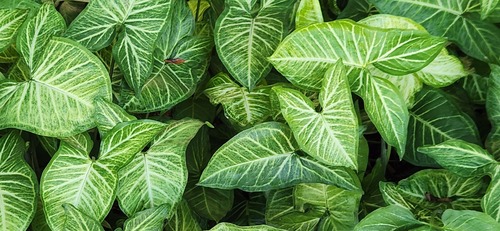
How to care for Goosefoot-plant
Watering
Syngonium podophyllum, the arrowhead vine or goosefoot plant, has thin, fleshy roots that rot quickly in soggy soil, yet it wilts visibly when bone dry. Aim for soil that is evenly moist, never wet or dry to the bone. Water thoroughly until it drains from the pot, empty the saucer, and use a loose, peat-based or aroid mix with perlite or bark. Water less in winter and more in the active growing season from spring to early autumn.
Does it need water today?
Push a finger about 3 cm (1 inch) into the soil. If it feels dry, water. If it feels damp, wait. Lift the pot too: a light pot means it is thirsty, a heavy pot means it can wait. Leaves that droop slightly and then recover after watering are a good sign of timing, but chronic droop with yellow leaves usually means overwatering.
Water in the morning at room temperature, and use filtered or rested tap water if your water is very hard, since this plant can show brown leaf edges from salts.
Overwatering
Goosefoot plant roots are fine and fleshy, and they need oxygen as much as water. In constantly wet soil they suffocate and begin to rot, which quickly spreads to the stems and leaves. Because the plant is leafy and lush, the damage is often hidden until the stems turn soft.
Symptoms: Yellowing lower leaves, leaves that droop even when the soil is wet, a sour or musty smell from the pot, black or mushy stem bases, and mould on the soil surface.
Solutions: Stop watering and check the root zone. Tip the plant out, cut away any black, mushy roots with clean scissors, and let the rest air dry for an hour. Repot into fresh, well-draining mix in a pot with drainage holes, and water only when the top 3 cm is dry.
Underwatering
Syngonium podophyllum has a shallow root system that dries out faster than many houseplants, especially in small pots or warm rooms. Its large, thin leaves lose water quickly, so it signals thirst clearly through drooping.
Symptoms: Leaves curl downward and look limp, edges turn crisp and brown, new leaves unfurl small or not at all, and soil pulls away from the pot edges.
Solutions: Water thoroughly until it drains, or use bottom watering if the soil is very dry and compacted. Within a day or two the leaves should firm up again. Trim crisp brown leaves at the base, and consider a slightly larger pot or a moisture-retaining mix with extra peat or coco coir.
Sunlight
Goosefoot plant grows naturally under the canopy of tropical forests, where light is bright but filtered through taller trees. Strong direct sun can scorch its leaves, causing pale or brown patches, while very low light makes the plant leggy and causes the arrow-shaped leaves to lose their variegation and shrink. Variegated cultivars such as 'Neon' or 'Pink Allusion' need more light than solid green ones to keep their colour.
- Ideal: Bright, indirect light · 6-8 hours of bright, filtered light per day
- Tolerates: Partial sun, Shade
- Best spot in a room: Near the window
- Artificial light: If natural light is weak, use a full-spectrum LED grow light placed 30 to 45 cm above the foliage for 10 to 12 hours a day. Plants under artificial light still need a regular rest period, so switch the lamp off at night.
Too little light
This vine climbs and stretches toward light, so when it lacks brightness it grows long, weak stems with widely spaced leaves. Variegated forms are especially prone to losing their cream and pink markings, because the plant produces more chlorophyll-rich green tissue to capture what light it can.
Symptoms: Long, leggy stems with large gaps between leaves, small new leaves, fading or fully green leaves on variegated types, and slow growth overall.
Solutions: Move the plant closer to a bright east or north-facing window, or a few steps back from a south or west window. Rotate the pot a quarter turn every week so growth stays even, and prune leggy stems just above a leaf node to encourage bushier growth.
Too much sun
Syngonium podophyllum has thin, delicate leaves that are adapted to filtered forest light, not to intense sun. Direct midday sun, especially through glass, can overheat and bleach the leaves within a few hours, and the damage does not heal on those leaves.
Symptoms: Pale, washed-out or yellowish patches, crispy brown scorched edges, leaves that curl or look bleached, and soil that dries out much faster than usual.
Solutions: Move the plant out of direct sun to a spot a metre or more from a south or west window, or add a sheer curtain to soften the light. Remove badly scorched leaves at the base, since they will not recover, and new growth will come in healthy once the light is gentler.
Temperature
Syngonium podophyllum, commonly called goosefoot plant or arrowhead vine, is a tropical aroid from Central and South American rainforest understories. It grows best in warm, steady, humid conditions and avoids sudden swings. Keep it away from drafts, radiators, and cold windows.
- Ideal: 18–27 °C
- Tolerates: 10–35 °C
- Hardiness zones: 10-12
Fertilizing
Goosefoot plant is a moderate feeder that grows fast in its rainforest habitat, so it benefits from regular nutrients during spring and summer. Feed only when the plant is actively growing, and always apply fertilizer to moist soil to protect the roots.
- Slow-release fertilizer: Apply once a year in early spring, just before the main growing season begins. Not needed if you repot into fresh potting mix that already contains slow-release granules.
- Balanced liquid houseplant fertilizer (such as 20-20-20 or 10-10-10), Slow-release granular fertilizer formulated for foliage plants, Organic options such as diluted fish emulsion or worm castings
Soil
Syngonium podophyllum (Goosefoot-plant) needs a well-draining, airy mix that stays evenly moist without becoming waterlogged. Its roots need oxygen, so heavy, dense soil leads to rot quickly.
- Aroid potting mix: Mix of peat or coco coir, fine bark, perlite, and a little charcoal, which lets air reach the roots.
- Peat-based houseplant mix with added perlite: About 2 parts peat or coco coir to 1 part perlite, with a handful of orchid bark or pumice mixed in.
- Garden soil mix for outdoor planting: Equal parts loam, compost, and coarse sand or grit, with a layer of mulch on top to keep moisture even.
- pH 5.5–6.5
Repotting
Syngonium podophyllum (Goosefoot-plant) grows fast and fine roots fill a pot quickly. Repot in the active growing season so it recovers quickly, and use a pot with drainage holes.
- How often: Every 1-2 years, as the plant becomes root-bound; young plants may need it yearly.
- New pot: Move up only one size, about 2-5 cm wider in diameter, so the soil does not stay wet around unused roots.
- Repotting season: Spring, Summer
How to repot
- Turn the pot on its side and gently ease the plant out, supporting the base of the stems.
- Loosen the outer roots with your fingers. Trim any roots that are black, mushy, or smell bad.
- Place a layer of fresh mix in the new pot so the root ball sits with its top about 2 cm below the rim.
- Set the plant in the center, fill in around the roots with mix, and firm it gently with your hands.
- Water thoroughly until water drains out the bottom, then let the pot drain fully.
- Keep the plant out of direct sun for a few days while it settles.
Pruning
Use clean, sharp scissors and cut just above a node. Remove no more than about one third of the plant at one time. Goosefoot-plant produces milky sap that can irritate skin and is toxic if swallowed, so wear gloves if needed and wash your hands afterward.
Pruning season: Spring, Summer
How to prune
- Remove yellow, brown, or damaged leaves first by cutting the stalk close to the main stem.
- To shape a trailing plant, cut the stem about 1 cm above a leaf node that faces the direction you want new growth to go.
- To make a plant bushier, pinch or cut back long, bare stems to just above a node lower on the stem.
- If the plant has become very leggy, cut the main stems back by about half in spring, then keep the trimmed pieces for propagation.
- Cut back only lightly in autumn and winter, when growth slows, and never prune more than a third of the plant at once.
- After pruning, move the plant to bright, indirect light and water normally so it can recover quickly.
Propagation
Stem cutting in water · Spring, Summer
- Choose a healthy stem that has at least one node, the small bump where a leaf or aerial root attaches.
- Cut 2 to 3 cm below the node with clean scissors or a sharp knife.
- Place the cutting in a clear glass of room-temperature water so the node sits just below the surface.
- Keep the glass in bright, indirect light and change the water every 3 to 5 days.
- Once roots are 3 to 5 cm long, usually in 2 to 4 weeks, pot the cutting into a light, well-draining mix.
Stem cutting in moist soil · Spring, Summer, Autumn
- Take a node cutting as described for water propagation.
- Fill a small pot with a peat-perlite mix or a standard indoor potting mix with extra perlite.
- Make a small hole with a pencil and insert the node about 1 cm deep.
- Firm the soil gently and water lightly so it is moist but not soggy.
- Cover the pot with a clear plastic bag held up with a stick to raise humidity, and open it daily to let fresh air in.
- Keep at 21 to 27 °C in bright indirect light. New leaves usually show within 3 to 4 weeks.
Division of a mature plant · Spring
- Wait until the plant is well established and has several clumps or stems growing from the same base.
- Slide the plant out of its pot and gently loosen the roots with your fingers.
- Pull or cut the clumps apart, making sure each section has roots and at least two or three leaves.
- Pot each division into its own container with fresh, airy potting mix.
- Water lightly and keep out of direct sun for about a week while the roots recover.
Goosefoot-plant roots readily from nodes, so every cutting should include at least one node. Leaves without a node will not root. For a fuller, bushier plant, pot three or four cuttings together in one container.
About Goosefoot-plant
Also known as: Arrowhead vine, Arrowhead plant, Nephthytis, Goosefoot plant
- Plant type: climber, vine, aroid, houseplant
- Lifespan: perennial
- Distribution: Native to tropical rainforests from southern Mexico through Central America to Bolivia and southern Brazil.
- Mature height: Climbing to 2-3 m indoors or on a support; trailing when unsupported
- Bloom time: Late spring to summer in its native habitat; rare indoors
Pets · People
Pets: Toxic · People: Toxic. Contains calcium oxalate raphides in all parts; chewing causes intense burning of the mouth, drooling, swelling of lips and tongue, and vomiting. Listed as toxic to cats and dogs by the ASPCA.
Common problems
- Yellowing leaves from overwatering: Soggy soil leads to root rot and yellow lower leaves; let the soil dry between waterings and check roots.
- Loss of variegation: Insufficient light causes new leaves to turn fully green; move the plant to brighter indirect light.
- Brown leaf edges: Dry air or low humidity causes crispy edges; raise humidity and avoid heaters and drafts.
- Leggy growth: Weak light stretches stems with sparse leaves; prune back and give more light.
- Spider mites: Dry, dusty conditions invite mites that cause speckled leaves; rinse foliage and treat with insecticidal soap.
Uses
Mainly ornamental, grown as a houseplant, hanging basket or interior landscape plant in offices and shops. In its native range it is used locally in traditional remedies, though these uses are not standardised.
Is it edible?
Not edible; all parts contain calcium oxalate crystals and must not be eaten.
History & legends
The species was described in the nineteenth century from Central American specimens and spread to European greenhouses in the Victorian era as a decorative aroid. Its common name nephthytis was used for a time, and in some cultures it is grown for its air-cleaning reputation, a claim with limited scientific support.
Did you know?
Juvenile leaves of Syngonium podophyllum look so different from adult foliage that early growers often think they have two different plants, which is why it is sometimes called the arrowhead vine.
Frequently asked questions
How often should I water Goosefoot-plant?
every 7 days. Syngonium podophyllum, the arrowhead vine or goosefoot plant, has thin, fleshy roots that rot quickly in soggy soil, yet it wilts visibly when bone dry. Aim for soil that is evenly moist, never wet or dry to the bone. Water thoroughly until it drains from the pot, empty the saucer, and use a loose, peat-based or aroid mix with perlite or bark. Water less in winter and more in the active growing season from spring to early autumn. Push a finger about 3 cm (1 inch) into the soil. If it feels dry, water. If it feels damp, wait. Lift the pot too: a light pot means it is thirsty, a heavy pot means it can wait. Leaves that droop slightly and then recover after watering are a good sign of timing, but chronic droop with yellow leaves usually means overwatering.
How much light does Goosefoot-plant need?
Bright, indirect light (6-8 hours of bright, filtered light per day). Goosefoot plant grows naturally under the canopy of tropical forests, where light is bright but filtered through taller trees. Strong direct sun can scorch its leaves, causing pale or brown patches, while very low light makes the plant leggy and causes the arrow-shaped leaves to lose their variegation and shrink. Variegated cultivars such as 'Neon' or 'Pink Allusion' need more light than solid green ones to keep their colour.
What temperature does Goosefoot-plant like?
18–27 °C. Syngonium podophyllum, commonly called goosefoot plant or arrowhead vine, is a tropical aroid from Central and South American rainforest understories. It grows best in warm, steady, humid conditions and avoids sudden swings. Keep it away from drafts, radiators, and cold windows.
Is Goosefoot-plant toxic to cats and dogs?
It is toxic to cats and dogs: keep it out of their reach. Contains calcium oxalate raphides in all parts; chewing causes intense burning of the mouth, drooling, swelling of lips and tongue, and vomiting. Listed as toxic to cats and dogs by the ASPCA.
What are the most common problems of Goosefoot-plant?
Yellowing leaves from overwatering: Soggy soil leads to root rot and yellow lower leaves; let the soil dry between waterings and check roots. Loss of variegation: Insufficient light causes new leaves to turn fully green; move the plant to brighter indirect light. Brown leaf edges: Dry air or low humidity causes crispy edges; raise humidity and avoid heaters and drafts. Leggy growth: Weak light stretches stems with sparse leaves; prune back and give more light. Spider mites: Dry, dusty conditions invite mites that cause speckled leaves; rinse foliage and treat with insecticidal soap.
When should I repot Goosefoot-plant?
Every 1-2 years, as the plant becomes root-bound; young plants may need it yearly.. Syngonium podophyllum (Goosefoot-plant) grows fast and fine roots fill a pot quickly. Repot in the active growing season so it recovers quickly, and use a pot with drainage holes.
How do I propagate Goosefoot-plant?
Stem cutting in water, Stem cutting in moist soil, Division of a mature plant. Choose a healthy stem that has at least one node, the small bump where a leaf or aerial root attaches. Cut 2 to 3 cm below the node with clean scissors or a sharp knife. Place the cutting in a clear glass of room-temperature water so the node sits just below the surface. Keep the glass in bright, indirect light and change the water every 3 to 5 days. Once roots are 3 to 5 cm long, usually in 2 to 4 weeks, pot the cutting into a light, well-draining mix.
How this guide was written
Verdiss writes each guide with AI from botanical references and checks the species against iNaturalist and Plants of the World Online (Kew). Readers can rate every guide in the app.
Sources
Verdiss's information is for general guidance. Never eat or use a plant as medicine based on an app: ask a professional.