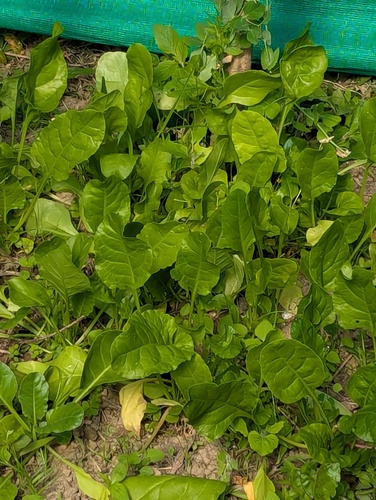
How to care for Spinach
Watering
Spinach (Spinacia oleracea) has shallow roots and large, thin leaves that lose water quickly, so it needs consistently moist soil rather than long dry spells followed by heavy watering. Aim to keep the top 3-5 cm of soil evenly damp at all times. Water at the base of the plants in the morning so leaves dry before evening. In hot weather, or when plants are growing fast, you may need to water every day or two in containers. Cool, mild weather in spring and autumn needs much less water.
Does it need water today?
Push a finger 3-5 cm into the soil next to the plant. If it feels dry and crumbly, water now. If it feels cool and slightly damp, wait a day. For containers, lift the pot: a light pot means the soil is drying out. Limp, dull leaves in the afternoon are a sign of thirst, but check the soil first because overwatering can cause similar wilting.
Mulch around spinach with straw or shredded leaves to keep the soil moist and cool. This is especially helpful in late spring when the weather starts to warm and spinach is prone to bolting, which is when it flowers and turns bitter.
Overwatering
Spinach roots need oxygen, and soggy soil quickly causes rot. Because spinach is a leafy crop grown in cool conditions, waterlogged soil in cool, cloudy weather is a common cause of failure.
Symptoms: Yellowing lower leaves, soft or blackened stems at soil level, a sour smell from the soil, and wilting even though the soil is wet.
Solutions: Stop watering and let the top few centimetres dry before watering again. Make sure containers have drainage holes. In garden beds, improve drainage by adding compost and avoid planting in low spots. Remove any rotting plants to stop the problem spreading.
Underwatering
Spinach has shallow roots and large leaves that lose moisture quickly, so dry soil stresses the plant within a few days in warm weather. Dry spells also make spinach bolt sooner and taste bitter.
Symptoms: Limp, drooping leaves, crisp brown leaf edges, slow growth, small leaves, and early flower stalks forming.
Solutions: Water deeply and evenly until the soil is moist to about 5 cm. Mulch to slow evaporation. Water a little more often during hot spells, and harvest outer leaves regularly so the plant keeps producing.
Sunlight
Spinach (Spinacia oleracea) grows best in cool weather with bright light. In full summer sun it wilts, bolts early, and turns bitter, so light shade in the hottest part of the day helps it stay sweet and productive. In winter, give it as much direct sun as possible, since short days slow growth.
- Ideal: Partial sun · 4-6 hours of direct sun in spring and autumn; 3-4 hours of afternoon shade in summer
- Tolerates: Full sun, Partial sun, Bright, indirect light
- Best spot in a room: At the window
- Artificial light: A full-spectrum LED grow light set 15-30 cm above the leaves for 12-14 hours a day works well for indoor spinach. Use a timer so plants get a steady daily rhythm. Rotate the pot every few days so the plant grows evenly.
Too little light
Spinach needs strong light to build the dense, dark green leaves that make it nutritious. Without enough light, growth becomes weak and the plant stretches toward any available light source.
Symptoms: Tall, thin stems with small pale leaves, long gaps between leaves, slow growth, and leaves that stay small even after weeks.
Solutions: Move the plant to the brightest window available, ideally facing south in the Northern Hemisphere. Add a grow light for 12-14 hours a day during short winter days. Thin crowded seedlings so the remaining plants receive more light.
Too much sun
Spinach leaves are thin and tender, and intense midday sun in warm weather stresses the plant, causing it to wilt and flower early. Strong heat and bright light together are the main reasons spinach bolts.
Symptoms: Scorched, bleached or brown patches on leaves, leaves that curl or wilt by midday, faded colour, and early flower stalks.
Solutions: Move containers to a spot with afternoon shade, or use shade cloth rated around 30-50% in summer. Water well during hot weather. Harvest mature leaves promptly and sow new seed in cooler months or in partial shade.
Temperature
Spinach (Spinacia oleracea) is a cool-season leafy crop that grows best between 7 and 18°C. It bolts (flowers and turns bitter) once days get long and warm, so plan sowing around the cool months.
- Ideal: 7–18 °C
- Tolerates: -10–27 °C
- Hardiness zones: 5-9
Fertilizing
Spinach grows quickly and feeds heavily on nitrogen, which drives leaf growth. Rich, well-drained soil with good organic matter gives the best harvest.
- Slow-release fertilizer: Mix a balanced slow-release granular fertilizer into the soil once before sowing in early spring. Spinach is a fast crop, so one application is usually enough.
- Compost or well-rotted manure, Balanced slow-release granular fertilizer (e.g. 10-10-10), Nitrogen-rich liquid fertilizer such as fish emulsion, Fertilizer with higher nitrogen for leafy growth
Soil
Spinach (Spinacia oleracea) grows best in fertile, moisture-retaining soil that drains freely. Heavy wet clay causes roots to rot, while very sandy soil dries out too quickly and encourages bolting.
- Loamy garden soil enriched with compost: About 50% loam, 30% compost or well-rotted manure, and 20% coarse sand or perlite.
- Peat-free potting mix for containers: A general-purpose peat-free potting compost mixed with about 20% perlite or grit for drainage.
- pH 6–7
Repotting
Spinach (Spinacia oleracea) dislikes root disturbance and tends to bolt when stressed, so move it as early as possible and handle the roots gently.
- How often: Spinach is an annual that is usually sown directly where it will grow, so repotting every 2-3 years is not needed; transplant only once, when seedlings are young.
- New pot: For container spinach, use a pot at least 20 cm wide and 15-20 cm deep, which gives the shallow taproot room to develop.
- Repotting season: Spring, Autumn
How to repot
- Gently loosen the seedling from the tray by pushing the base of the cell from underneath.
- Hold the plant by its leaves, never by the stem, and lower the root ball into the hole.
- Set the plant at the same depth it was growing before, then firm the soil lightly around it.
- Water thoroughly to settle the soil and remove air pockets around the roots.
- Place the pot in a spot with morning sun and afternoon shade until new growth appears.
Pruning
Spinach needs no formal pruning. Instead, harvest the outer leaves while the plant is young and remove any flower stalks as soon as they appear.
Pruning season: Spring, Autumn
How to prune
- Once the plant has about six to eight leaves, pick the largest outer leaves first, cutting or pinching them at the base of the stalk.
- Leave the small inner leaves in the centre so the plant keeps growing.
- Harvest no more than about one third of the leaves at a time to avoid stressing the plant.
- Check the plant every few days and pinch out any flower stalk as soon as it appears in the centre.
- Pull out the whole plant once it has bolted and the leaves turn bitter, and add it to your compost.
Propagation
Spring direct sowing · Spring
- Wait until the soil is workable and has warmed to about 7 to 10°C, usually late March to April in most of the Northern Hemisphere.
- Loosen the top 15 cm of soil and rake it smooth, mixing in compost if the bed is poor.
- Sow Spinacia oleracea seeds 1 to 2 cm deep, spaced about 5 cm apart in rows 30 cm apart.
- Water gently so the soil stays evenly moist but not soggy until seedlings appear in 7 to 14 days.
- When seedlings have two or three true leaves, thin them to about 10 cm apart and eat the thinnings.
Autumn sowing for winter and early spring harvest · Autumn
- Sow seeds in late August to September, about 6 to 8 weeks before your first hard frost.
- Choose a sunny spot with well-drained soil, since spinach roots rot in waterlogged ground.
- Sow 1 to 2 cm deep and keep the soil moist while seeds germinate in cooling weather.
- Thin seedlings to about 10 cm apart once they are established.
- In colder regions, cover the bed with a cloche or row cover when temperatures drop below about 0°C to protect the leaves.
Succession sowing · Spring, Autumn
- Make a note of your first sowing date for the Spinacia oleracea bed.
- Sow a small new row every 2 to 3 weeks during the cool months to keep a steady supply of tender leaves.
- Stop sowing once daytime temperatures regularly exceed about 24°C, because heat encourages bolting.
- Choose bolt-resistant varieties for later sowings if your summers are warm.
Soak seeds in water overnight before sowing to speed germination, and sow in the cool hours of the day so the soil stays cool.
About Spinach
Also known as: Garden spinach, Common spinach, Spinach greens
- Plant type: herb, leafy vegetable
- Lifespan: annual
- Distribution: Native to Central and Western Asia, likely the region of ancient Persia; it is no longer found wild and has been cultivated for millennia.
- Mature height: 15-30 cm
- Bloom time: Late spring to early summer, usually triggered by long days and heat
Pets · People
Pets: Safe · People: Safe. Not listed as toxic by ASPCA. Leaves contain oxalates, so large amounts may irritate the mouth or kidneys in sensitive people, and pets should not be fed large quantities.
Common problems
- Bolting: Plants send up a flower stalk in long days or heat, turning leaves bitter; sow in cooler seasons or choose slow-bolt varieties.
- Downy mildew: Grey-white fuzzy growth on leaf undersides, worse in damp, cool weather; improve airflow and water at the base.
- Leaf miners: Pale tunnels in leaves caused by fly larvae; remove affected leaves and cover young plants with fine mesh.
- Aphids: Clusters of small insects on new growth that distort leaves; wash off with water or use insecticidal soap.
- Yellowing from nitrogen or iron deficiency: Pale leaves with green veins in alkaline or poorly drained soil; feed with balanced fertilizer and check soil pH.
Uses
Spinach is one of the most widely eaten leafy vegetables, served raw in salads, cooked in soups, sauces, pies and stir-fries, and frozen or canned for storage. It is valued both as a nutritious food and as a cool-season crop in home and commercial gardens. Leaves and extracts are also used in dietary supplements and food processing, and the plant has a long history as a food for maintaining iron and vitamin intake.
Is it edible?
Leaves and young stems are edible raw or cooked; the flower buds and seeds are not commonly eaten. Cooking reduces oxalate content somewhat.
History & legends
Spinach was cultivated in ancient Persia and reached China by about the seventh century, where it was known as the Persian vegetable. It spread through the Arab world to Spain and then across Europe, becoming popular in medieval and early modern kitchens. Its fame as a source of strength was boosted in the twentieth century by the cartoon character Popeye.
Did you know?
Spinach contains so much oxalic acid that it binds much of its iron, so the famous iron content is less absorbable than legend suggested; the myth partly arose from a decimal-point error in 1870s German data.
Frequently asked questions
How often should I water Spinach?
every 3 days. Spinach (Spinacia oleracea) has shallow roots and large, thin leaves that lose water quickly, so it needs consistently moist soil rather than long dry spells followed by heavy watering. Aim to keep the top 3-5 cm of soil evenly damp at all times. Water at the base of the plants in the morning so leaves dry before evening. In hot weather, or when plants are growing fast, you may need to water every day or two in containers. Cool, mild weather in spring and autumn needs much less water. Push a finger 3-5 cm into the soil next to the plant. If it feels dry and crumbly, water now. If it feels cool and slightly damp, wait a day. For containers, lift the pot: a light pot means the soil is drying out. Limp, dull leaves in the afternoon are a sign of thirst, but check the soil first because overwatering can cause similar wilting.
How much light does Spinach need?
Partial sun (4-6 hours of direct sun in spring and autumn; 3-4 hours of afternoon shade in summer). Spinach (Spinacia oleracea) grows best in cool weather with bright light. In full summer sun it wilts, bolts early, and turns bitter, so light shade in the hottest part of the day helps it stay sweet and productive. In winter, give it as much direct sun as possible, since short days slow growth.
What temperature does Spinach like?
7–18 °C. Spinach (Spinacia oleracea) is a cool-season leafy crop that grows best between 7 and 18°C. It bolts (flowers and turns bitter) once days get long and warm, so plan sowing around the cool months.
Is Spinach toxic to cats and dogs?
It is safe for cats and dogs. Not listed as toxic by ASPCA. Leaves contain oxalates, so large amounts may irritate the mouth or kidneys in sensitive people, and pets should not be fed large quantities.
What are the most common problems of Spinach?
Bolting: Plants send up a flower stalk in long days or heat, turning leaves bitter; sow in cooler seasons or choose slow-bolt varieties. Downy mildew: Grey-white fuzzy growth on leaf undersides, worse in damp, cool weather; improve airflow and water at the base. Leaf miners: Pale tunnels in leaves caused by fly larvae; remove affected leaves and cover young plants with fine mesh. Aphids: Clusters of small insects on new growth that distort leaves; wash off with water or use insecticidal soap. Yellowing from nitrogen or iron deficiency: Pale leaves with green veins in alkaline or poorly drained soil; feed with balanced fertilizer and check soil pH.
When should I repot Spinach?
Spinach is an annual that is usually sown directly where it will grow, so repotting every 2-3 years is not needed; transplant only once, when seedlings are young.. Spinach (Spinacia oleracea) dislikes root disturbance and tends to bolt when stressed, so move it as early as possible and handle the roots gently.
How do I propagate Spinach?
Spring direct sowing, Autumn sowing for winter and early spring harvest, Succession sowing. Wait until the soil is workable and has warmed to about 7 to 10°C, usually late March to April in most of the Northern Hemisphere. Loosen the top 15 cm of soil and rake it smooth, mixing in compost if the bed is poor. Sow Spinacia oleracea seeds 1 to 2 cm deep, spaced about 5 cm apart in rows 30 cm apart. Water gently so the soil stays evenly moist but not soggy until seedlings appear in 7 to 14 days. When seedlings have two or three true leaves, thin them to about 10 cm apart and eat the thinnings.
How this guide was written
Verdiss writes each guide with AI from botanical references and checks the species against iNaturalist and Plants of the World Online (Kew). Readers can rate every guide in the app.
Sources
Verdiss's information is for general guidance. Never eat or use a plant as medicine based on an app: ask a professional.