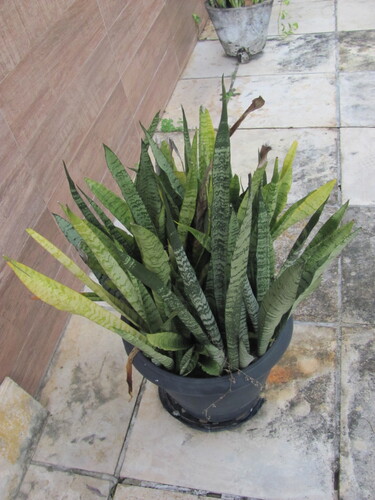
How to care for Dracaena trifasciata
Watering
Snake plant (Dracaena trifasciata) stores water in its thick, upright leaves and rhizome, so it copes far better with drying out than with staying wet. Water thoroughly until it runs from the drainage holes, then let the soil dry out almost completely before watering again. Use a pot with drainage holes and a fast-draining cactus or succulent mix. In winter, cut back sharply, because growth slows and wet roots rot quickly.
Does it need water today?
Push a finger about 5 cm (2 inches) into the soil. If it feels dry and crumbly, water. If it feels cool or damp, wait. You can also lift the pot: a very light pot means it is time to water. Firm, plump leaves are healthy; wrinkled or curling leaves are a sign of thirst, though only after the soil is already dry.
When in doubt, wait a few more days. Snake plants forgive a little dryness much more easily than a soggy pot.
Overwatering
Snake plant evolved in dry, rocky regions of West Africa, so its roots are adapted to brief moisture followed by long dry spells. Constantly wet compost deprives roots of oxygen, and the rhizome quickly begins to rot.
Symptoms: Soft, mushy, yellowing leaves starting at the base, a sour or foul smell from the soil, black or brown mushy roots, and a wobbly plant that pulls loose from the pot.
Solutions: Stop watering immediately. Remove the plant from its pot, shake off wet soil, and cut away any soft or black roots and rot with clean, sterile scissors. Let the plant dry for a few days, then repot into fresh, dry, fast-draining mix in a pot just slightly larger than the root ball.
Underwatering
Snake plant is one of the most drought-tolerant houseplants because its thick leaves store water. However, prolonged drought still causes stress, especially in bright, warm rooms or during summer growth.
Symptoms: Leaves that look wrinkled, shriveled, or creased, dull or faded colour, and tips that turn brown and crisp. Growth halts and the leaves may feel papery rather than firm.
Solutions: Water thoroughly until it drains from the holes. Repeat more often during warm months. If the plant is severely dehydrated, soak the pot in water for 30 minutes, then drain. Leaves usually firm up within a week or two, though creased leaves may stay permanently marked.
Sunlight
Snake plant grows best in bright, indirect light, but it tolerates a wide range of conditions, from a sunny window to a dim corner. In low light, it grows very slowly and its variegated patterns may fade to plain green. Strong, direct afternoon sun can scorch the leaves, leaving pale or brown patches, especially if the plant has been moved suddenly from a darker spot.
- Ideal: Bright, indirect light · 4-6 hours of bright, filtered light daily
- Tolerates: Partial sun, Bright, indirect light, Shade
- Best spot in a room: Near the window
- Artificial light: A full-spectrum LED grow light placed 20 to 30 cm (8 to 12 inches) above the plant for 10 to 12 hours a day works well in dark rooms. Ordinary ceiling lights are usually too weak to keep it healthy over the long term.
Too little light
Snake plant is a slow grower that adapts to dim conditions, but very low light forces it to use its stored energy without making enough new growth. Over months, this weakens the plant and makes it more prone to rot when watered.
Symptoms: Pale or fading variegation, thin and floppy leaves that lean toward the light, very slow or no new growth, and soil that stays wet for long periods.
Solutions: Move the plant closer to a bright window, ideally an east or west-facing one. Rotate it a quarter turn every few weeks so it grows evenly. Reduce watering while light is low, since the plant uses less water in dim conditions.
Too much sun
Snake plant handles bright light well, but intense direct sun, especially through glass in summer, can overheat and burn the leaves. Plants moved abruptly from low light to a hot, sunny spot are particularly vulnerable.
Symptoms: Bleached, yellowish or white patches on the leaves, brown, crispy spots or scorched edges, and leaves that look faded or dried out on the sun-facing side.
Solutions: Move the plant a metre (about 3 feet) back from the window or add a sheer curtain to filter the sun. Gradually acclimatise it over two weeks if you are moving it into brighter light. Damaged leaves will not recover their colour, but healthy new growth will appear once the plant adjusts.
Temperature
Snake plant (Dracaena trifasciata) thrives in warm, steady indoor temperatures between 18 and 27 °C. It tolerates dry air and cooler rooms better than most houseplants, but it stops growing when temperatures fall below about 15 °C and suffers lasting damage near freezing. Keep it away from drafts, heaters, and radiators.
- Ideal: 18–27 °C
- Tolerates: 10–35 °C
- Hardiness zones: 9-11
Fertilizing
Snake plant grows slowly and needs little feeding. It stores water and nutrients in its thick leaves and rhizome, so too much fertilizer is far more likely to harm it than too little. Feed only during the active growing season from spring to early autumn, and never feed a plant that is dry, cold, or recently repotted.
- Slow-release fertilizer: Once a year in spring, if the plant is in a pot with fresh soil, or not needed for plants in the same pot for years.
- Balanced liquid houseplant fertilizer (for example 10-10-10 or 20-20-20), Cactus and succulent fertilizer with a lower nitrogen content, Slow-release granular fertilizer for houseplants
Soil
Snake plant (Dracaena trifasciata) needs a porous, fast-draining mix so water never sits around its rhizome. Soil that stays damp for days is the most common reason this tough plant fails indoors.
- Cactus and succulent mix: Commercial cactus mix, roughly 60-70% mineral material such as pumice, perlite, or coarse sand, with a small portion of peat or coir
- Homemade snake plant mix: Two parts standard potting soil, one part perlite or pumice, and one part coarse sand or horticultural grit
- Peat-heavy potting soil (avoid): Standard houseplant potting mix with high peat content, which holds water too long and suits this plant poorly unless amended heavily
- pH 6–7.5
Repotting
Snake plant (Dracaena trifasciata) has thick, fleshy rhizomes that store water. It tolerates being pot-bound far better than it tolerates soggy soil, so repot only when needed.
- How often: Every 2-3 years, or when roots fill the pot
- New pot: Move up only one size, about 2-5 cm wider in diameter, with drainage holes. Snake plants prefer a snug pot; oversized pots hold wet soil that rots roots.
- Repotting season: Spring, Summer
How to repot
- Slide the plant out of its old pot, supporting the base of the leaves with one hand
- Gently shake or tease away old soil from the roots and rhizome
- Cut away any black, mushy, or hollow roots with clean, sharp scissors
- Let the roots air-dry for one to two days in a shaded spot if you cut away rot
- Place a thin layer of fresh mix in the new pot, set the plant so the rhizome sits just below the rim, and fill around it
- Firm the soil lightly so the leaves stay upright, leaving about 2 cm of space below the rim
- Do not water for one week to let any root damage heal
Pruning
Dracaena trifasciata rarely needs pruning. Its upright, sword-shaped leaves grow from the base, so remove only leaves that are damaged, dead, or badly discolored. Cut each leaf at its base, close to the soil, rather than leaving a stub. Avoid cutting the growing point at the center of the rosette, because that can stop new leaf growth.
Pruning season: Spring, Summer
How to prune
- Inspect the plant in bright light and identify leaves that are fully yellow, brown, soft, or split.
- Hold the leaf at its base and cut it cleanly with sharp pruners or a knife, as close to the soil line as possible.
- If you want a shorter plant, you can cut an entire leaf about 2 to 3 cm above the soil, but never remove more than one-third of the foliage at one time.
- Discard cut leaves or use them for propagation if they are healthy.
- Water lightly after pruning and keep the plant in bright, indirect light while it recovers.
Propagation
Stem cutting in water or soil · Spring, Summer
- Choose a healthy, firm stem section from a mature Dracaena trifasciata (snake plant), about 7 to 10 cm long, with at least one or two leaf rosettes if possible.
- Let the cut end dry and callous for one to two days in a shaded spot so it resists rot.
- Place the cutting upright in a jar of water so only the bottom 2 to 3 cm sit below the surface, or insert the dry, callused end about 2 cm deep into a well-draining cactus or succulent mix.
- Keep the cutting in bright, indirect light at about 18 to 27 °C. Change the water weekly if using water.
- Roots usually form in a few weeks to a couple of months. Once roots are 2 to 3 cm long or the cutting feels anchored in soil, pot it in a small container with drainage holes.
Leaf cutting · Spring, Summer
- Cut a full, healthy leaf close to the soil line using a clean, sharp knife.
- Let the cut end dry and callous for two to three days in a shaded place.
- Note which end is the bottom: the end that was nearest the soil. Insert that end about 2 to 3 cm deep into dry, gritty cactus mix, keeping the leaf upright.
- Water sparingly, only when the soil is fully dry, and keep the leaf in bright, indirect light.
- New pups typically appear at the base of the leaf after several weeks to months. The mother leaf can be left in place or removed once the pup is established.
Division of rhizome offsets · Spring
- When the plant has outgrown its pot, slide it out and look for pups (offsets) growing from the rhizome, the underground stem.
- Use a clean knife to separate a pup that has its own roots and at least a few leaves.
- Let the cut surfaces dry for a day, then pot the pup in fresh, well-draining mix.
- Water lightly after a few days and keep the pot in bright, indirect light while it settles.
Roots from a snake plant cutting form most reliably in spring and summer, when the plant is actively growing. Mix leaf sections in water only if you want to watch roots form; soil-rooted cuttings are less likely to rot.
About Dracaena trifasciata
Also known as: Snake plant, Mother-in-law's tongue, Good luck plant
- Plant type: succulent, perennial herb
- Lifespan: perennial
- Distribution: Native to tropical West Africa, from Nigeria east to the Democratic Republic of the Congo.
- Mature height: 0.6-1.2 m indoors, up to 2 m in the wild
- Bloom time: Late winter to spring, rarely indoors
Pets · People
Pets: Toxic · People: Toxic. Contains saponins and calcium oxalate raphides; ingestion causes vomiting, drooling, and diarrhea in cats, dogs, and children. Sap may irritate the skin. Listed as toxic by the ASPCA.
Common problems
- Root rot: Caused by overwatering and soggy soil, leading to mushy, dark rhizomes and yellowing leaves.
- Leaf yellowing at base: Often a sign of too much water or cold, wet roots.
- Leaf tip browning: Usually caused by water sitting in the crown or low humidity combined with salt buildup from fertilizer.
- Mealybugs: White cottony pests that hide in leaf bases and between leaves; wipe with alcohol on a cotton swab.
- Leaf scorch: Brown patches appear when plants are moved abruptly into strong direct sun.
Uses
Mainly ornamental, grown as an indoor houseplant and in landscaping in frost-free regions. In West Africa, fibers from the leaves have been used to make bowstrings, ropes, and fishing lines, and the plant is used in traditional medicine for various remedies.
Is it edible?
Not edible; saponins and oxalates make it toxic.
History & legends
Snake plant has long been grown in West Africa, where its fibrous leaves were valued for cordage and bowstrings. It spread to Europe in the 18th century as an exotic ornamental and became a Victorian parlor favorite. Its nickname 'mother-in-law's tongue' is said to reflect the sharp, pointed leaves, and it is often considered a symbol of protection and good fortune.
Did you know?
Snake plants release oxygen mainly at night because they use CAM photosynthesis, which makes them a popular choice for bedrooms.
Frequently asked questions
How often should I water Dracaena trifasciata?
every 14 days. Snake plant (Dracaena trifasciata) stores water in its thick, upright leaves and rhizome, so it copes far better with drying out than with staying wet. Water thoroughly until it runs from the drainage holes, then let the soil dry out almost completely before watering again. Use a pot with drainage holes and a fast-draining cactus or succulent mix. In winter, cut back sharply, because growth slows and wet roots rot quickly. Push a finger about 5 cm (2 inches) into the soil. If it feels dry and crumbly, water. If it feels cool or damp, wait. You can also lift the pot: a very light pot means it is time to water. Firm, plump leaves are healthy; wrinkled or curling leaves are a sign of thirst, though only after the soil is already dry.
How much light does Dracaena trifasciata need?
Bright, indirect light (4-6 hours of bright, filtered light daily). Snake plant grows best in bright, indirect light, but it tolerates a wide range of conditions, from a sunny window to a dim corner. In low light, it grows very slowly and its variegated patterns may fade to plain green. Strong, direct afternoon sun can scorch the leaves, leaving pale or brown patches, especially if the plant has been moved suddenly from a darker spot.
What temperature does Dracaena trifasciata like?
18–27 °C. Snake plant (Dracaena trifasciata) thrives in warm, steady indoor temperatures between 18 and 27 °C. It tolerates dry air and cooler rooms better than most houseplants, but it stops growing when temperatures fall below about 15 °C and suffers lasting damage near freezing. Keep it away from drafts, heaters, and radiators.
Is Dracaena trifasciata toxic to cats and dogs?
It is toxic to cats and dogs: keep it out of their reach. Contains saponins and calcium oxalate raphides; ingestion causes vomiting, drooling, and diarrhea in cats, dogs, and children. Sap may irritate the skin. Listed as toxic by the ASPCA.
What are the most common problems of Dracaena trifasciata?
Root rot: Caused by overwatering and soggy soil, leading to mushy, dark rhizomes and yellowing leaves. Leaf yellowing at base: Often a sign of too much water or cold, wet roots. Leaf tip browning: Usually caused by water sitting in the crown or low humidity combined with salt buildup from fertilizer. Mealybugs: White cottony pests that hide in leaf bases and between leaves; wipe with alcohol on a cotton swab. Leaf scorch: Brown patches appear when plants are moved abruptly into strong direct sun.
When should I repot Dracaena trifasciata?
Every 2-3 years, or when roots fill the pot. Snake plant (Dracaena trifasciata) has thick, fleshy rhizomes that store water. It tolerates being pot-bound far better than it tolerates soggy soil, so repot only when needed.
How do I propagate Dracaena trifasciata?
Stem cutting in water or soil, Leaf cutting, Division of rhizome offsets. Choose a healthy, firm stem section from a mature Dracaena trifasciata (snake plant), about 7 to 10 cm long, with at least one or two leaf rosettes if possible. Let the cut end dry and callous for one to two days in a shaded spot so it resists rot. Place the cutting upright in a jar of water so only the bottom 2 to 3 cm sit below the surface, or insert the dry, callused end about 2 cm deep into a well-draining cactus or succulent mix. Keep the cutting in bright, indirect light at about 18 to 27 °C. Change the water weekly if using water. Roots usually form in a few weeks to a couple of months. Once roots are 2 to 3 cm long or the cutting feels anchored in soil, pot it in a small container with drainage holes.
How this guide was written
Verdiss writes each guide with AI from botanical references and checks the species against iNaturalist and Plants of the World Online (Kew). Readers can rate every guide in the app.
Sources
Verdiss's information is for general guidance. Never eat or use a plant as medicine based on an app: ask a professional.