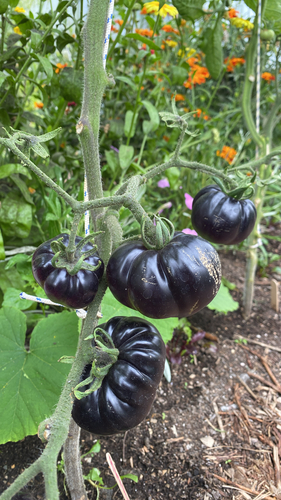
How to care for tomato
Watering
Tomato plants (Solanum lycopersicum) need deep, even moisture, especially once flowering and fruiting begin. Water at the base of the plant, aiming for the soil rather than the leaves, and keep the soil consistently moist but never soggy. Uneven watering is the most common cause of split fruit and blossom end rot, so a steady routine matters more than any single watering. In containers, expect to water more often than the interval suggests during hot weather.
Does it need water today?
Push a finger 5 cm (2 inches) into the soil near the stem. If it feels dry at that depth, water thoroughly until it runs out of the drainage holes. For a container, lift the pot: a light pot means it is thirsty. Wilting in the afternoon that recovers by evening is normal in hot weather, but wilting in the morning means the plant needs water now.
Mulch around the base with straw or shredded leaves to keep soil moisture steady and reduce splashing that can spread blight. Water early in the day so foliage dries before evening.
Overwatering
Tomato roots need oxygen as well as water, and waterlogged soil quickly causes root rot. Heavy clay or pots without drainage holes make this worse, and the plant's sensitivity to soggy roots means it can decline rapidly after a few days of excess water.
Symptoms: Yellowing lower leaves, wilting even when the soil is wet, a sour or musty smell from the soil, and sudden leaf drop. Fruit may crack when the plant takes up water after a dry spell.
Solutions: Stop watering and let the top few centimetres dry out. Improve drainage by loosening the soil or moving the container to a site with better drainage. Remove any leaves that have yellowed, and check that the pot has open drainage holes.
Underwatering
Tomatoes are deep-rooted, but their large leaves lose a lot of water in heat and wind. Fruit is especially sensitive, because the plant diverts water away from developing fruit when it is stressed, which affects size and quality.
Symptoms: Leaves that droop, curl inward, or look dull and leathery. Soil pulling away from the pot edge, and blossoms dropping without setting fruit. Fruit may be small and may develop blossom end rot.
Solutions: Water deeply and slowly until the soil is moist to about 30 cm. Add mulch to slow evaporation. In containers, use a larger pot and check daily in summer heat. Avoid giving a large drink after a long drought all at once, since this can crack fruit; instead, water in steady steps over a couple of days.
Sunlight
Tomatoes are sun-loving plants that need strong, direct light to grow sturdy stems, set flowers, and ripen fruit. Plants in too little light grow tall and thin, flower poorly, and produce small, late-ripening fruit with less flavour. At least six hours of direct sun is the target for a good harvest.
- Ideal: Full sun · 6-8 hours of direct sun per day
- Tolerates: Full sun, Partial sun
- Best spot in a room: At the window
- Artificial light: Indoor tomatoes need a strong grow light, such as a full-spectrum LED or fluorescent light, for 14-16 hours a day. Hang the light 15-30 cm (6-12 inches) above the top of the plant and raise it as the plant grows. Dwarf or patio varieties are the most practical choices for indoor growing.
Too little light
Tomatoes depend on strong sunlight to make the sugars that build fruit and flavour. Their stems stretch toward weak light, which makes them weak and prone to falling over, and low light also reduces flowering.
Symptoms: Leggy, spindly stems with long gaps between leaves, pale green foliage, few or no flowers, and fruit that stays small or ripens slowly.
Solutions: Move the plant to the sunniest spot available, ideally a south-facing site outdoors. Indoors, add a grow light for 14-16 hours a day. Stake or cage the plant to support weak stems, and avoid over-fertilizing, which encourages leafy growth over fruit.
Too much sun
Tomatoes do well in full sun, but in very hot climates intense afternoon light and heat can damage leaves and fruit. The fruit is particularly exposed because it has less protective foliage than the leaves do.
Symptoms: White or bleached patches on fruit (sunscald), scorched or papery leaves, and flowers that drop when temperatures stay above about 32°C.
Solutions: Provide light shade during the hottest part of the afternoon with shade cloth, or move containers to a spot with afternoon shade. Keep plants well watered so they can cool themselves, and leave leaves on the plant to shade the fruit.
Temperature
Tomato (Solanum lycopersicum) is a warm-season crop that grows best between 18 and 29 °C. Growth slows sharply below about 15 °C, and fruit set often fails when day temperatures stay above 32 °C or nights stay above 24 °C. Plant out only after the last frost, when nights stay above 10 °C.
- Ideal: 18–29 °C
- Tolerates: 2–35 °C
- Hardiness zones: 10-12
Fertilizing
Tomatoes need steady nutrition, especially phosphorus for root and flower development and potassium for fruit quality. Too much nitrogen gives lush leaves and few tomatoes. Start feeding when the first fruit sets, not at transplanting, and stop once the main harvest is finished.
- Slow-release fertilizer: Mix a balanced slow-release granular fertilizer into the planting hole or soil once at planting time in spring. Do not repeat it during the season unless the plants are in very poor soil.
- Balanced slow-release granular fertilizer (for example 5-5-5 or 10-10-10), Balanced liquid fertilizer for vegetables, Compost or well-rotted manure as a soil amendment, Tomato-specific feed with higher potassium once fruit begins to form
Soil
Tomatoes grow best in rich, loose, well-drained soil that holds moisture without becoming soggy. Dense or waterlogged soil invites root rot and blossom end rot problems, so aim for a crumbly texture and steady moisture.
- Peat-free potting mix with added compost: Blend of coir or peat-free compost, perlite, and well-rotted compost, roughly 60:20:20 by volume.
- Garden loam enriched with compost: Two parts topsoil, one part compost, and one part well-rotted manure, with added sand if the soil is heavy clay.
- Raised bed mix: Equal parts topsoil and compost, with a handful of slow-release organic fertilizer mixed in before planting.
- pH 6–6.8
Repotting
Tomato (Solanum lycopersicum) roots are vigorous and fibrous, so they fill a container fast. Use a deep pot with drainage holes, and always keep the root ball intact when moving the plant.
- How often: Repot tomato seedlings once into a larger container; established container tomatoes usually need fresh soil every year rather than a repot to a bigger pot.
- New pot: Start seedlings in 8-10 cm pots, then move to a 30-50 litre container (at least 40 cm wide and deep) for a single determinate or indeterminate plant.
- Repotting season: Spring, Summer
How to repot
- Lay the plant on its side and gently slide it out of the old container, supporting the stem near the base.
- Loosen the outer roots with your fingers. Trim any dead or mushy roots with clean scissors.
- Place a 5 cm layer of fresh mix in the new pot and set the plant so the soil line sits at the same depth as before, or slightly deeper.
- Tomatoes can root along buried stems, so you may bury up to two-thirds of a leggy stem.
- Fill around the root ball with mix, firm it lightly, and water until it drains freely.
- Insert the stake or cage close to the stem, then tie the stem loosely with soft ties.
Pruning
Tomato plants are either indeterminate, which grow and fruit all season and benefit most from pruning, or determinate (bush) types, which set fruit in one flush and need little or no suckering. Check the plant tag before pruning. Remove suckers, the shoots that grow in the leaf axils, while they are small, ideally when they are 5 to 10 cm long.
Pruning season: Spring, Summer
How to prune
- Set up a sturdy stake, cage or trellis at planting time so you are not forced to tie stems later.
- Pinch out suckers on indeterminate plants weekly, snapping them off by hand at the base while they are small.
- Keep one to three main stems (leaders) on indeterminate plants and remove the rest of the suckers.
- Remove leaves growing on the lowest 30 cm of the stem to prevent soil splash from carrying disease onto the plant.
- Cut off any yellowing, spotted or dead leaves promptly, and dispose of them in the trash rather than the compost.
- In late summer, remove the top growth above the last cluster of fruit that is likely to ripen before the first autumn frost, so the plant directs energy into ripening existing fruit.
- Avoid removing more than about one third of the foliage at once, since the leaves are needed to ripen the fruit.
Propagation
Seed sowing indoors · Winter, Spring
- Sow tomato seeds 6 to 8 weeks before your last expected frost date, about 0.5 cm deep in seed-starting mix.
- Keep the mix consistently warm, ideally 21 to 27 °C, since tomato seeds germinate poorly below about 15 °C.
- Keep the tray moist but not soggy and place it under a bright grow light or on a very sunny windowsill.
- When seedlings have two to three true leaves, transplant each into its own 9 to 10 cm pot.
- Harden off seedlings over 7 to 10 days, moving them outdoors for a few hours a day and extending the time gradually, before planting out after frost danger has passed.
Stem cuttings in water · Summer, Autumn
- Choose a healthy, non-flowering side shoot about 10 to 15 cm long from a vigorous plant.
- Cut just below a leaf node and remove the lower leaves so at least two nodes are bare.
- Place the cutting in a glass of room-temperature water so the bare nodes are submerged and the top leaves stay above water.
- Set the glass in bright, indirect light and change the water every few days.
- Once white roots are 2 to 5 cm long, usually in 7 to 14 days, pot the cutting in moist potting mix and keep it humid until it establishes.
Air layering · Summer
- Select a healthy stem about 1 cm thick and make a shallow upward slit about 2 cm long just below a node.
- Dust the cut with rooting hormone, then wrap it in damp sphagnum moss.
- Enclose the moss in clear plastic wrap, sealing both ends with tape, and check that it stays moist.
- After roots fill the moss, usually 3 to 6 weeks, cut the stem below the roots and pot the new plant.
- Keep the new plant shaded and watered for a week before moving it to full sun.
Tomato plants root readily along buried stems, so when transplanting seedlings you can bury the stem up to the first set of true leaves for a stronger root system. Start tomato seed indoors in a warm spot, since cold soil and cool air are the most common reasons seeds fail to sprout.
About tomato
Also known as: Love apple, Garden tomato, Tomate
- Plant type: herb, vine
- Lifespan: Tender perennial, usually grown as an annual
- Distribution: Native to western South America, in the Andean region of Peru, Ecuador and Bolivia.
- Mature height: 1-3 m when staked or caged; indeterminate types can reach 3 m or more
- Bloom time: Summer, from late spring to early autumn in temperate gardens
Pets · People
Pets: Toxic · People: Toxic. Per ASPCA, the green stems, leaves and unripe fruit contain solanine and tomatine, which can cause vomiting, diarrhea and drowsiness; ripe fruit is generally low risk in small amounts.
Common problems
- Blossom end rot: Dark, leathery patch on the blossom end of fruit, usually caused by uneven watering and calcium uptake problems.
- Early blight: Fungus Alternaria solani causing brown concentric rings on lower leaves; spread by splashing water.
- Tomato hornworm: Large green caterpillar that strips leaves and chews into fruit.
- Fruit cracking: Splits in the skin caused by sudden swings between dry and wet soil.
- Blossom drop: Flowers fall without setting fruit when temperatures are above about 32°C or below 10°C.
Uses
Tomatoes are one of the most important vegetable crops worldwide, eaten fresh in salads, cooked into sauces, soups, stews and preserves, and processed into paste, juice and ketchup. The fruit is a major source of lycopene and vitamin C. Ornamental varieties with colorful fruit are also grown in gardens and containers.
Is it edible?
The ripe fruit is edible raw or cooked; leaves, stems and unripe green fruit are not edible because they contain solanine and tomatine.
History & legends
Domesticated in Mesoamerica, the tomato traveled to Europe in the 16th century, where it was first grown as an ornamental and viewed with suspicion. In Italy it became a culinary staple by the 18th century, and it is now one of the most widely cultivated vegetables in the world.
Did you know?
Tomatoes were once called love apples in Europe and were long considered poisonous because they belong to the nightshade family.
Frequently asked questions
How often should I water tomato?
every 2 days. Tomato plants (Solanum lycopersicum) need deep, even moisture, especially once flowering and fruiting begin. Water at the base of the plant, aiming for the soil rather than the leaves, and keep the soil consistently moist but never soggy. Uneven watering is the most common cause of split fruit and blossom end rot, so a steady routine matters more than any single watering. In containers, expect to water more often than the interval suggests during hot weather. Push a finger 5 cm (2 inches) into the soil near the stem. If it feels dry at that depth, water thoroughly until it runs out of the drainage holes. For a container, lift the pot: a light pot means it is thirsty. Wilting in the afternoon that recovers by evening is normal in hot weather, but wilting in the morning means the plant needs water now.
How much light does tomato need?
Full sun (6-8 hours of direct sun per day). Tomatoes are sun-loving plants that need strong, direct light to grow sturdy stems, set flowers, and ripen fruit. Plants in too little light grow tall and thin, flower poorly, and produce small, late-ripening fruit with less flavour. At least six hours of direct sun is the target for a good harvest.
What temperature does tomato like?
18–29 °C. Tomato (Solanum lycopersicum) is a warm-season crop that grows best between 18 and 29 °C. Growth slows sharply below about 15 °C, and fruit set often fails when day temperatures stay above 32 °C or nights stay above 24 °C. Plant out only after the last frost, when nights stay above 10 °C.
Is tomato toxic to cats and dogs?
It is toxic to cats and dogs: keep it out of their reach. Per ASPCA, the green stems, leaves and unripe fruit contain solanine and tomatine, which can cause vomiting, diarrhea and drowsiness; ripe fruit is generally low risk in small amounts.
What are the most common problems of tomato?
Blossom end rot: Dark, leathery patch on the blossom end of fruit, usually caused by uneven watering and calcium uptake problems. Early blight: Fungus Alternaria solani causing brown concentric rings on lower leaves; spread by splashing water. Tomato hornworm: Large green caterpillar that strips leaves and chews into fruit. Fruit cracking: Splits in the skin caused by sudden swings between dry and wet soil. Blossom drop: Flowers fall without setting fruit when temperatures are above about 32°C or below 10°C.
When should I repot tomato?
Repot tomato seedlings once into a larger container; established container tomatoes usually need fresh soil every year rather than a repot to a bigger pot.. Tomato (Solanum lycopersicum) roots are vigorous and fibrous, so they fill a container fast. Use a deep pot with drainage holes, and always keep the root ball intact when moving the plant.
How do I propagate tomato?
Seed sowing indoors, Stem cuttings in water, Air layering. Sow tomato seeds 6 to 8 weeks before your last expected frost date, about 0.5 cm deep in seed-starting mix. Keep the mix consistently warm, ideally 21 to 27 °C, since tomato seeds germinate poorly below about 15 °C. Keep the tray moist but not soggy and place it under a bright grow light or on a very sunny windowsill. When seedlings have two to three true leaves, transplant each into its own 9 to 10 cm pot. Harden off seedlings over 7 to 10 days, moving them outdoors for a few hours a day and extending the time gradually, before planting out after frost danger has passed.
How this guide was written
Verdiss writes each guide with AI from botanical references and checks the species against iNaturalist and Plants of the World Online (Kew). Readers can rate every guide in the app.
Sources
Verdiss's information is for general guidance. Never eat or use a plant as medicine based on an app: ask a professional.