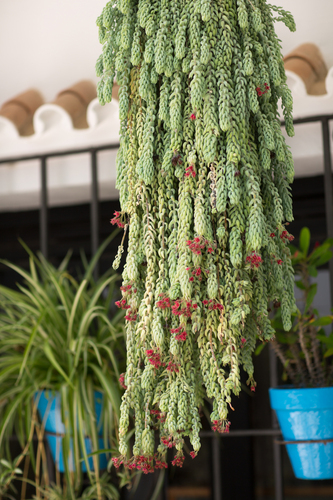
How to care for Burro's-tail
Watering
Burro's-tail (Sedum morganianum) stores water in its plump, bead-like leaves and trailing stems, so it needs deep drinks followed by long dry spells. Water thoroughly until it runs out of the drainage holes, then let the soil dry out almost completely before the next watering. Use a pot with a drainage hole and a gritty cactus or succulent mix. In winter, when growth slows, water very sparingly.
Does it need water today?
Gently squeeze a few leaves. If they feel firm and plump, wait. If they look wrinkled, shrivelled, or feel soft and limp, it is time to water. You can also push a finger or wooden skewer 3-4 cm into the soil; if it comes out completely dry, water. Lifting the pot is another good check: a dry pot feels noticeably light.
Water at the base of the plant and keep water off the leaves and stem bases, because wet leaves can rot and fall off easily. Burro's-tail leaves detach with little pressure, so handle the plant by the pot rather than the trailing stems.
Overwatering
Burro's-tail evolved in dry, rocky slopes of southern Mexico, where its roots are adapted to brief soakings and then drying. Constantly wet soil suffocates the roots and invites fungal rot, which is the most common way this species is lost indoors.
Symptoms: Leaves turn mushy, translucent, or yellow and drop off at the slightest touch. Stems look dark and soft at the base, and the soil may smell sour or musty.
Solutions: Stop watering immediately. Tip the plant out, cut away any black or mushy roots and stems with clean scissors, and let the cut ends dry for a day or two. Repot into fresh, dry gritty mix in a pot with a drainage hole. Water only once the soil is completely dry again. Propagate healthy leaves and stem tips if the main plant is badly damaged.
Underwatering
Because its leaves are its water reserve, Burro's-tail shows thirst clearly, but going too long without water drains those reserves. Prolonged drought leaves the plant weak, and it will shed leaves to conserve moisture.
Symptoms: Leaves look wrinkled, shrivelled, or flattened, and the stems may appear thinner. The plant may drop leaves easily, and new growth stops.
Solutions: Water thoroughly and allow the excess to drain. Plump leaves usually recover within a few days. Resume a regular schedule based on the soil check, and avoid giving small, frequent sips, which encourage shallow roots.
Sunlight
Burro's-tail grows best in strong, bright light that keeps its leaves plump and its trailing stems compact. Indoors, too little light causes stretched, leggy growth with widely spaced leaves. Gradually increase light exposure in spring, because sudden direct sun can scorch leaves that have grown in lower light.
- Ideal: Bright, indirect light · 4-6 hours of bright light daily, with some direct morning sun tolerated
- Tolerates: Full sun, Partial sun
- Best spot in a room: At the window
- Artificial light: If natural light is weak, use a full-spectrum LED grow light placed 20-30 cm above the plant for 12-14 hours a day during the darker months. Hanging baskets can be placed close to a bright south- or west-facing window.
Too little light
In its native habitat, Burro's-tail grows in open, sunny spots on cliffs and rocky outcrops, so it is adapted to strong light. Insufficient light makes it reach for brightness, weakening stems and reducing leaf density.
Symptoms: Stems stretch out and bend, leaves become spaced apart and smaller, and colour turns pale green. Growth becomes weak and the plant may lean toward the light source.
Solutions: Move the plant closer to a bright window or add a grow light. Turn the pot a quarter turn each week for even growth. Trim leggy stems in spring and use the cuttings to propagate new plants.
Too much sun
Although Burro's-tail tolerates sun, its leaves are thin-skinned and filled with water, and very intense afternoon sun, especially through glass, can overheat and scorch them.
Symptoms: Leaves develop pale, bleached, or brown patches, or look crispy at the edges. Plants may look dull or greyish, and leaves may shrivel quickly.
Solutions: Move the plant back from the window or filter the light with a sheer curtain during the hottest part of the day. Acclimatise it gradually when moving it into stronger sun. Remove scorched leaves, which will not recover, and keep watering on schedule.
Temperature
Burro's-tail is a Mexican succulent that thrives in warm, dry conditions similar to its native highland cliffs. Keep it between 15 and 24°C for steady growth, and avoid letting it sit below about 7°C for long. Its trailing stems are fragile, so keep it out of drafts and away from sudden temperature swings.
- Ideal: 15–24 °C
- Tolerates: 4–35 °C
- Hardiness zones: 10-11
Fertilizing
Burro's-tail grows slowly in its native rocky soils, where nutrients are scarce. It needs only light feeding during its active growing season, from spring to early autumn. Too much fertilizer produces weak, stretched stems and can burn the fragile roots.
- Slow-release fertilizer: Once a year in early spring, if the plant is in potting mix, or not needed if it has been freshly repotted into rich soil within the past year.
- Balanced cactus and succulent fertilizer, Low-nitrogen liquid fertilizer diluted to half strength, Slow-release granular succulent fertilizer
Soil
Burro's-tail needs soil that drains quickly and dries out between waterings, because its water-storing stems rot in wet, dense soil. Its native habitat in the mountains of southern Mexico has rocky, well-drained ground, so the mix should feel gritty rather than rich and spongy.
- Cactus and succulent mix: Roughly 50-60% mineral grit such as pumice, perlite or coarse sand, with the rest a light peat-free organic base
- Homemade gritty mix: Equal parts standard potting mix, perlite or pumice, and coarse horticultural sand
- Free-draining bark-based mix: Mostly fine bark or coco coir with added perlite, suitable for hanging baskets where air circulation is good
- pH 6–7
Repotting
Burro's-tail stems are fragile and the leaves detach easily, so handle the plant by its root ball or gently by the stem base, never by the trailing tips. Repot only when the plant is dry and in active growth, and avoid repotting in autumn or winter when it grows slowly.
- How often: Every 2-3 years, or when the plant has outgrown its pot or the soil stays wet for too long
- New pot: Choose a pot only 2-5 cm wider than the root ball, with at least one drainage hole. Burro's-tail has shallow roots and dislikes deep, oversized pots that hold moisture.
- Repotting season: Spring, Summer
How to repot
- Lay the pot on its side and gently ease the plant out, supporting the stems with one hand
- Shake off old soil and gently loosen any compacted roots with your fingers; trim dead or mushy roots with clean scissors
- Place a 2-3 cm layer of fresh mix in the new pot and set the plant so the top of the root ball sits about 1 cm below the rim
- Fill around the roots with mix, tapping the pot gently to settle it without packing the soil hard
- Lift and arrange the trailing stems so they fall over the edge of the pot instead of being crushed under it
Pruning
Prune Burro's-tail only when it is actively growing, and always use clean, sharp tools. Because the leaves drop so easily, cut stems with care and avoid pulling on them.
Pruning season: Spring, Summer
How to prune
- Choose a stem that is too long, damaged, or crowded.
- Cut it cleanly just above a node or leaf cluster with sterilized scissors.
- Remove any loose leaves that fall off during handling and let them dry for propagation or discard them.
- Trim damaged or rotted tissue back to firm, green stem so no soft parts remain.
- Let the cut ends dry for a day or two before returning the plant to bright, indirect light.
- Water sparingly for the next week, since the plant will be more vulnerable to rot while the cuts heal.
Propagation
Leaf cuttings · Spring, Summer
- Gently twist a healthy leaf off the stem so the base comes away cleanly; a little of the stem attached is fine.
- Leave the leaf on a dry paper towel in a shaded spot for two to four days until the broken end callouses over.
- Lay the leaf on top of dry cactus or succulent mix, or press the end lightly into it. Do not bury it.
- Mist the soil lightly only once every week or two until tiny roots and a new rosette appear, usually within three to six weeks.
- Once the new plant has a few leaves, transplant it into a small pot with drainage holes.
Stem cuttings · Spring, Summer
- Cut a trailing stem of at least 5 cm with clean scissors, just below a node where leaves join.
- Remove the lowest few leaves and let the cut end dry for two to three days.
- Set the cutting upright in barely damp succulent mix, or lay it on top and secure the tip with a small stone.
- Keep it in bright, indirect light at about 18 to 24 °C and water only when the soil is fully dry.
- New roots form in about four to six weeks. Water a little more regularly after that.
Burro's-tail is best propagated in late spring or early summer, when it is actively growing. Too much water is the usual cause of rot, so let the cutting dry out between light misting. Many gardeners place a few leaves on the soil surface and wait for roots to form; this is a low-effort way to grow extra plants.
About Burro's-tail
Also known as: Donkey's tail, Horse's tail, Lamb's tail
- Plant type: succulent, trailing plant
- Lifespan: perennial
- Distribution: Native to the mountains of southern Mexico, mainly Oaxaca.
- Mature height: Stems trailing to 60-100 cm (about 2-3 ft)
- Bloom time: Late spring to early summer, on mature plants
Pets · People
Pets: Mildly toxic · People: Mildly toxic. Not listed as highly toxic, but the succulent leaves can cause mild stomach upset if chewed or swallowed by cats, dogs, or children. Keep it out of reach and wash hands after handling broken leaves.
Common problems
- Leaf drop: Leaves fall off with light touch or sudden watering changes; usually harmless, but repeated losses suggest stress.
- Root rot: Overwatering in cold or poorly draining soil causes soft, blackened stems and roots.
- Mealybugs: White cottony pests hide between the tightly packed leaves and stems.
- Sunburn: Sudden exposure to strong direct sun turns leaves reddish-brown or scorched.
- Etiolation: Too little light makes stems stretch and leaves space out, losing the dense look.
Uses
Mainly ornamental, grown in hanging baskets, windowsills, and rock gardens. In its native Mexico it is occasionally cultivated locally for decoration; it has no major medicinal or industrial use.
Is it edible?
Not edible in a meaningful sense; the leaves are mildly irritant and not eaten.
History & legends
Sedum morganianum has been grown as a curiosity in European and North American gardens since the late nineteenth century, when cultivated succulents became popular. Its trailing form made it a favourite in Victorian conservatories and later in modern indoor plant collections. Its common name refers to the resemblance of the hanging stems to a donkey's tail.
Did you know?
Its leaves fall off very easily, and each fallen leaf can root and grow into a new plant.
Frequently asked questions
How often should I water Burro's-tail?
every 14 days. Burro's-tail (Sedum morganianum) stores water in its plump, bead-like leaves and trailing stems, so it needs deep drinks followed by long dry spells. Water thoroughly until it runs out of the drainage holes, then let the soil dry out almost completely before the next watering. Use a pot with a drainage hole and a gritty cactus or succulent mix. In winter, when growth slows, water very sparingly. Gently squeeze a few leaves. If they feel firm and plump, wait. If they look wrinkled, shrivelled, or feel soft and limp, it is time to water. You can also push a finger or wooden skewer 3-4 cm into the soil; if it comes out completely dry, water. Lifting the pot is another good check: a dry pot feels noticeably light.
How much light does Burro's-tail need?
Bright, indirect light (4-6 hours of bright light daily, with some direct morning sun tolerated). Burro's-tail grows best in strong, bright light that keeps its leaves plump and its trailing stems compact. Indoors, too little light causes stretched, leggy growth with widely spaced leaves. Gradually increase light exposure in spring, because sudden direct sun can scorch leaves that have grown in lower light.
What temperature does Burro's-tail like?
15–24 °C. Burro's-tail is a Mexican succulent that thrives in warm, dry conditions similar to its native highland cliffs. Keep it between 15 and 24°C for steady growth, and avoid letting it sit below about 7°C for long. Its trailing stems are fragile, so keep it out of drafts and away from sudden temperature swings.
Is Burro's-tail toxic to cats and dogs?
It is mildly toxic to cats and dogs. Not listed as highly toxic, but the succulent leaves can cause mild stomach upset if chewed or swallowed by cats, dogs, or children. Keep it out of reach and wash hands after handling broken leaves.
What are the most common problems of Burro's-tail?
Leaf drop: Leaves fall off with light touch or sudden watering changes; usually harmless, but repeated losses suggest stress. Root rot: Overwatering in cold or poorly draining soil causes soft, blackened stems and roots. Mealybugs: White cottony pests hide between the tightly packed leaves and stems. Sunburn: Sudden exposure to strong direct sun turns leaves reddish-brown or scorched. Etiolation: Too little light makes stems stretch and leaves space out, losing the dense look.
When should I repot Burro's-tail?
Every 2-3 years, or when the plant has outgrown its pot or the soil stays wet for too long. Burro's-tail stems are fragile and the leaves detach easily, so handle the plant by its root ball or gently by the stem base, never by the trailing tips. Repot only when the plant is dry and in active growth, and avoid repotting in autumn or winter when it grows slowly.
How do I propagate Burro's-tail?
Leaf cuttings, Stem cuttings. Gently twist a healthy leaf off the stem so the base comes away cleanly; a little of the stem attached is fine. Leave the leaf on a dry paper towel in a shaded spot for two to four days until the broken end callouses over. Lay the leaf on top of dry cactus or succulent mix, or press the end lightly into it. Do not bury it. Mist the soil lightly only once every week or two until tiny roots and a new rosette appear, usually within three to six weeks. Once the new plant has a few leaves, transplant it into a small pot with drainage holes.
How this guide was written
Verdiss writes each guide with AI from botanical references and checks the species against iNaturalist and Plants of the World Online (Kew). Readers can rate every guide in the app.
Sources
Verdiss's information is for general guidance. Never eat or use a plant as medicine based on an app: ask a professional.