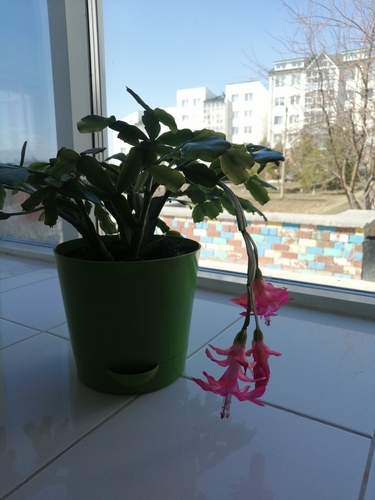
How to care for Crab Cactus
Watering
Crab cactus (Schlumbergera truncata) is an epiphytic cactus from the Brazilian rainforest, so it is not a desert plant. Its roots are fine and rot easily in soggy soil, but it needs more water than typical cacti. Use a well-draining mix, such as a peat-free potting mix with added perlite or orchid bark, and a pot with drainage holes. Water thoroughly until water runs out the bottom, then empty the saucer after 15 minutes. Use room-temperature water, ideally rainwater or filtered water, since it is sensitive to salts. Water more during flowering and new growth in spring and summer, and reduce watering after blooming in late winter when the plant rests.
Does it need water today?
Push a finger about 2-3 cm into the soil. If it feels dry at that depth, water thoroughly. If it still feels damp, wait a few days. The stem segments should look plump and firm. Wrinkled or limp segments mean the plant needs water. You can also lift the pot: a dry pot feels noticeably lighter than a freshly watered one.
Crab cactus blooms best when its soil is allowed to dry slightly between waterings, but never fully dry out during bud formation. Dropping buds are often caused by sudden changes in watering or temperature rather than by too little water.
Overwatering
Crab cactus has thin, fleshy roots that cannot tolerate waterlogged soil, and in cool winter rooms wet mix stays cold and airless for longer. Standing water quickly leads to root rot, which is the most common cause of death for this plant.
Symptoms: Soft, mushy, or translucent segments, especially near the base; yellowing segments; a sour or musty smell from the soil; black or brown roots that come away easily when touched; and a sudden collapse of the whole plant.
Solutions: Stop watering and check the roots. Remove the plant from the pot, cut away any black, soft, or smelly roots and mushy segments with clean scissors, and let the cut parts dry for a day or two. Repot into fresh, dry, well-draining mix in a pot with drainage holes, and wait about a week before watering lightly.
Underwatering
Crab cactus has shallow roots and stores some water in its flat segments, but it dries out faster than desert cacti, particularly in heated rooms during winter. Long dry spells cause the segments to shrivel and can stop flower buds from forming.
Symptoms: Wrinkled, limp, or thin segments that look shrunken; a soil surface that pulls away from the pot edges; buds that drop before opening; and dry, brittle segment edges.
Solutions: Water thoroughly using bottom watering for 20 minutes to rehydrate the root ball, then drain well. Water more often for a few weeks while the plant recovers, keeping the soil lightly moist but never soggy. Move it away from radiators or heating vents, which dry the air and soil quickly.
Sunlight
Crab cactus grows naturally under the filtered light of tree canopies, so it prefers bright but indirect light. Strong midday sun can scorch its flat segments, turning them reddish or yellowish and bleached. Deep shade is too dark for good growth and flowering. For blooms in late autumn and winter, the plant needs about 12-14 hours of darkness each night and cool temperatures of 13-18°C, so keep it away from lamps and artificial light at night.
- Ideal: Bright, indirect light · Bright indirect light most of the day, with 2-4 hours of gentle morning or late afternoon sun
- Tolerates: Bright, indirect light, Partial sun
- Best spot in a room: Near the window
- Artificial light: If natural light is weak, use a full-spectrum LED grow light placed 30-40 cm above the plant for 10-12 hours per day during autumn and winter. Switch it off at night so the plant gets the long dark period it needs to set buds.
Too little light
Crab cactus needs enough bright light to build energy for growth and flower production. Without it, the plant becomes weak and leggy, and it will not bloom well even if its watering and temperature are correct.
Symptoms: Pale, thin, elongated segments that lean toward the light; few or no flower buds in autumn; slow growth with small new segments; and dark green segments that look flat and dull.
Solutions: Move the plant closer to a bright east or west window, or to a north window in a bright room. Rotate the pot a quarter turn every week so growth stays even. In darker months, add a full-spectrum LED grow light for 10-12 hours a day, but keep the plant in a dark place at night during bud formation.
Too much sun
Crab cactus can handle some direct morning or evening sun, but strong midday sun through glass is too intense. Its segments are thin and heat up quickly, which leads to sunburn and dehydration.
Symptoms: Reddish, purple-brown, or yellow patches on the segments; bleached or white spots; dry, crispy edges; and wilting even though the soil is still moist.
Solutions: Move the plant a metre or more back from a south or west window, or place a sheer curtain between the plant and the glass. Gradually reintroduce it to brighter light over two weeks. Damaged segments will not recover, but healthy new growth will appear if the light is adjusted.
Temperature
Crab Cactus (Schlumbergera truncata) is a forest cactus from the humid mountain forests of southeastern Brazil, so it prefers cool, steady indoor temperatures of about 15 to 21°C. It needs a noticeable drop in temperature in autumn, roughly 10 to 15°C at night for about six weeks, to set flower buds for winter blooms.
- Ideal: 15–21 °C
- Tolerates: 10–27 °C
- Hardiness zones: 10-12
Fertilizing
Crab Cactus is a forest cactus, not a desert one, so it needs more regular feeding than typical desert cacti. Feed it only while it is actively growing and forming buds, from spring through summer. Stop feeding in autumn and winter, when it is resting and setting flower buds, and do not feed it during or just before its bloom period.
- Slow-release fertilizer: not needed
- Balanced liquid houseplant fertilizer diluted to half strength, Liquid fertilizer for flowering plants with a lower nitrogen ratio, Cactus and succulent fertilizer diluted to half strength
Soil
The Crab Cactus, Schlumbergera truncata, needs a loose, fast-draining mix that holds some moisture without staying wet. Its roots are shallow and sensitive to waterlogging, so dense garden soil or plain potting mix alone will cause rot. A slightly acidic medium around pH 5.5-6.5 suits this forest epiphyte well.
- Epiphytic cactus mix: About 40% peat-free potting mix, 30% coarse perlite, 20% fine orchid bark, and 10% horticultural charcoal or pumice
- Peat-free holiday cactus mix: Commercial peat-free potting mix blended with about one-third perlite and a small handful of coconut coir
- Orchid bark and sphagnum blend: Roughly half fine orchid bark and half chopped sphagnum moss, with a little perlite added for extra drainage
- pH 5.5–6.5
Repotting
Repot the Crab Cactus right after it finishes flowering, in spring or early summer, when new growth begins. Avoid repotting while it is in bud or bloom, because stress can make buds drop.
- How often: Every 3-4 years, or when roots fill the pot tightly
- New pot: Only 2-5 cm wider than the current pot; Schlumbergera truncata prefers snug roots and shallow containers
- Repotting season: Spring, Summer
How to repot
- Lay the pot on its side and gently tug the base of the stems to slide the root ball out
- Brush away old, compacted soil and trim any black, mushy, or dead roots with clean scissors
- Let the root ball air-dry for a few hours so cut areas can callus over
- Place a 2-3 cm layer of fresh mix in the new pot and set the plant so the top of the root ball sits about 1 cm below the rim
- Fill around the roots with mix, firm it gently with your fingers, and leave the stem segments above the soil surface
- Wait about 3-5 days before the first watering to let any root damage heal
Pruning
Crab Cactus is pruned by twisting off whole segments at their joints, not by trimming with shears. Most pruning is simply removing unwanted or damaged segments.
Pruning season: Spring, Summer
How to prune
- Inspect the plant and identify segments that are shriveled, mushy, discolored, or growing awkwardly.
- Hold the segment at its base joint and gently twist it until it separates from the stem.
- For a bushier shape, remove the tips of long, thin segments by twisting them off at a joint.
- Dispose of removed segments or let them root as cuttings, and avoid leaving broken tissue exposed.
- Water lightly over the next week and keep the plant in bright, indirect light while it recovers.
Propagation
Stem cutting · Spring, Summer
- Choose a healthy, plump stem segment of 2 to 3 segments with no shriveling or soft spots.
- Twist the segment gently at its joint to separate it cleanly from the parent plant rather than cutting it with a knife.
- Let the cutting dry in a shaded, airy spot for 2 to 3 days until the broken end forms a callus.
- Insert the base about 1 cm deep into a pot of slightly moist, well-draining cactus or succulent mix.
- Keep the pot in bright, indirect light at 18 to 24 °C and water only lightly until new growth appears in 3 to 4 weeks.
Division of a mature plant · Spring
- Wait until the plant has finished flowering and is putting out new growth in spring.
- Gently remove the Crab Cactus from its pot and loosen the root ball with your fingers.
- Pull or cut apart clumps that each have several segments and a healthy set of roots.
- Repot each division in its own small pot with fresh mix, and water lightly after a few days.
- Keep divisions out of direct hot sun for the first two weeks while roots re-establish.
Crab Cactus segments often root more reliably when you let them callus fully and avoid misting them, since moisture on the cut end invites rot.
About Crab Cactus
Also known as: Christmas cactus, Yoke cactus, Crab cactus
- Plant type: epiphytic cactus, succulent
- Lifespan: perennial
- Distribution: Native to the Atlantic Forest of southeastern Brazil, in the coastal mountains of Rio de Janeiro and São Paulo states.
- Mature height: 20-40 cm when hanging
- Bloom time: Late autumn to winter, typically November to January in the Northern Hemisphere
Pets · People
Pets: Safe · People: Safe. Schlumbergera species are listed as non-toxic to cats, dogs and humans by the ASPCA. Eating large amounts may still cause mild stomach upset in pets.
Common problems
- Bud drop: Flower buds fall off when the plant is moved, exposed to draughts, or kept too dry or too warm during bud formation.
- Root and stem rot: Overwatering and poorly draining compost cause soft, brown, mushy segments and root decay.
- Mealybugs: White cottony insects gather at segment joints and in leaf axils; remove them with a cotton swab dipped in diluted alcohol.
- No flowers: Plants often fail to bloom when they get too much light at night, or when they are fed too heavily in autumn.
- Shrivelled segments: Segments wrinkle when the plant is underwatered for long periods or when roots are cramped and cannot take up water.
Uses
Schlumbergera truncata is grown almost entirely as an ornamental houseplant, valued for its winter flowering and its trailing habit in hanging baskets. It is widely sold in florist and garden centres during the Christmas season. Its hybrids are among the most commercially important flowering houseplants in Europe and North America.
Is it edible?
Not edible. The segments are not used as food, and the plant is not grown for consumption.
History & legends
The species was described in the nineteenth century from plants collected in Brazil and was widely distributed through European horticulture as a winter-flowering houseplant. Growers across Europe and the United States developed many hybrids and cultivars, and the plant became strongly associated with Christmas, where it is often sold as a seasonal gift. Folk tradition in some regions links the plant with household good fortune.
Did you know?
Its flowers are often pollinated by hummingbirds in the wild, and the plant's bloom timing is controlled by day length, so it can be encouraged to flower at Christmas or Thanksgiving by adjusting darkness.
Frequently asked questions
How often should I water Crab Cactus?
every 7 days. Crab cactus (Schlumbergera truncata) is an epiphytic cactus from the Brazilian rainforest, so it is not a desert plant. Its roots are fine and rot easily in soggy soil, but it needs more water than typical cacti. Use a well-draining mix, such as a peat-free potting mix with added perlite or orchid bark, and a pot with drainage holes. Water thoroughly until water runs out the bottom, then empty the saucer after 15 minutes. Use room-temperature water, ideally rainwater or filtered water, since it is sensitive to salts. Water more during flowering and new growth in spring and summer, and reduce watering after blooming in late winter when the plant rests. Push a finger about 2-3 cm into the soil. If it feels dry at that depth, water thoroughly. If it still feels damp, wait a few days. The stem segments should look plump and firm. Wrinkled or limp segments mean the plant needs water. You can also lift the pot: a dry pot feels noticeably lighter than a freshly watered one.
How much light does Crab Cactus need?
Bright, indirect light (Bright indirect light most of the day, with 2-4 hours of gentle morning or late afternoon sun). Crab cactus grows naturally under the filtered light of tree canopies, so it prefers bright but indirect light. Strong midday sun can scorch its flat segments, turning them reddish or yellowish and bleached. Deep shade is too dark for good growth and flowering. For blooms in late autumn and winter, the plant needs about 12-14 hours of darkness each night and cool temperatures of 13-18°C, so keep it away from lamps and artificial light at night.
What temperature does Crab Cactus like?
15–21 °C. Crab Cactus (Schlumbergera truncata) is a forest cactus from the humid mountain forests of southeastern Brazil, so it prefers cool, steady indoor temperatures of about 15 to 21°C. It needs a noticeable drop in temperature in autumn, roughly 10 to 15°C at night for about six weeks, to set flower buds for winter blooms.
Is Crab Cactus toxic to cats and dogs?
It is safe for cats and dogs. Schlumbergera species are listed as non-toxic to cats, dogs and humans by the ASPCA. Eating large amounts may still cause mild stomach upset in pets.
What are the most common problems of Crab Cactus?
Bud drop: Flower buds fall off when the plant is moved, exposed to draughts, or kept too dry or too warm during bud formation. Root and stem rot: Overwatering and poorly draining compost cause soft, brown, mushy segments and root decay. Mealybugs: White cottony insects gather at segment joints and in leaf axils; remove them with a cotton swab dipped in diluted alcohol. No flowers: Plants often fail to bloom when they get too much light at night, or when they are fed too heavily in autumn. Shrivelled segments: Segments wrinkle when the plant is underwatered for long periods or when roots are cramped and cannot take up water.
When should I repot Crab Cactus?
Every 3-4 years, or when roots fill the pot tightly. Repot the Crab Cactus right after it finishes flowering, in spring or early summer, when new growth begins. Avoid repotting while it is in bud or bloom, because stress can make buds drop.
How do I propagate Crab Cactus?
Stem cutting, Division of a mature plant. Choose a healthy, plump stem segment of 2 to 3 segments with no shriveling or soft spots. Twist the segment gently at its joint to separate it cleanly from the parent plant rather than cutting it with a knife. Let the cutting dry in a shaded, airy spot for 2 to 3 days until the broken end forms a callus. Insert the base about 1 cm deep into a pot of slightly moist, well-draining cactus or succulent mix. Keep the pot in bright, indirect light at 18 to 24 °C and water only lightly until new growth appears in 3 to 4 weeks.
How this guide was written
Verdiss writes each guide with AI from botanical references and checks the species against iNaturalist and Plants of the World Online (Kew). Readers can rate every guide in the app.
Sources
Verdiss's information is for general guidance. Never eat or use a plant as medicine based on an app: ask a professional.