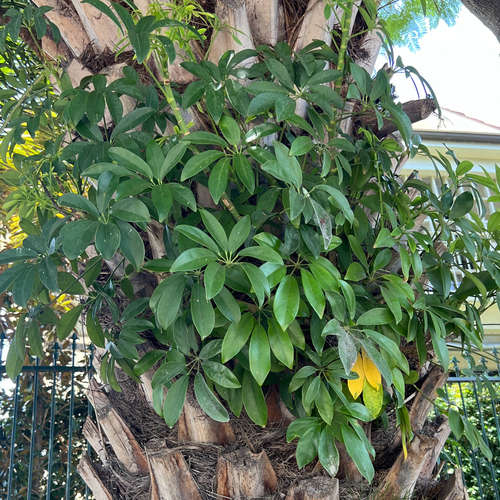
How to care for Schefflera arboricola
Watering
Dwarf umbrella tree (Schefflera arboricola) likes its soil to dry out on the top few centimetres between drinks, then get a thorough soak. Its leaves are leathery and hold some water, so it tolerates a short dry spell better than constant wet feet. Pour water until it runs freely out of the drainage holes, empty the saucer after 15 minutes, and use a pot with drainage. Water less in winter, when growth slows and the roots use less moisture. Lukewarm, room-temperature water is ideal.
Does it need water today?
Push a finger about 3 cm into the soil. If it feels dry, water now. If it feels cool and damp, wait a few days. You can also lift the pot: a light pot means it is thirsty, a heavy pot means it still has water. Drooping leaves that perk up after watering are a clear sign it was dry.
Water in the morning so the top layer can dry through the day, which discourages fungus gnats and root rot. Check the soil before every watering rather than watering on a fixed calendar, because indoor conditions change with temperature and light.
Overwatering
Dwarf umbrella tree is a tropical shrub from forest understories, where roots are used to moist but well-aerated soil. Soggy, airless soil quickly causes root rot, which is the most common reason this plant declines indoors. Because its roots cannot take in oxygen when waterlogged, damage can start before the leaves show any problem.
Symptoms: Yellowing lower leaves that drop easily, soft or mushy stem bases, a sour or musty smell from the soil, dark brown or black roots, and new leaves that are smaller than usual. Fungus gnats hovering over the soil are a common warning sign.
Solutions: Stop watering and let the soil dry out for several days. Remove the plant from its pot, cut away any black or mushy roots with clean scissors, and repot into fresh, well-draining mix in a pot with drainage holes. Trim any badly damaged leaves. Only water again once the top few centimetres are dry.
Underwatering
Dwarf umbrella tree stores some moisture in its leaves, but it still needs regular water to keep new growth and leaf structure healthy. When the root ball dries completely, the soil can pull away from the pot wall and water runs straight through without soaking in. Prolonged drought causes leaf loss.
Symptoms: Drooping or limp leaves, crispy brown leaf edges, leaves dropping from the lower stems, dry and crumbly soil that shrinks from the pot sides, and slow or stalled growth.
Solutions: Water thoroughly using the bottom-watering method for 30 minutes so the root ball rehydrates. If the soil has pulled away from the edge, soak the pot for longer. Once the plant perks up, return to the regular check-the-soil routine. Avoid giving a large amount of water all at once to a very dry plant, as it may recover more slowly if it is repeatedly soaked and dried.
Sunlight
Dwarf umbrella tree grows best in bright light that is not direct. In its native forest understory it gets dappled light from taller trees, so strong midday sun can scorch its leathery leaves. It tolerates lower light than many houseplants, but growth becomes leggy, sparse, and leaves get smaller the darker it gets. Variegated cultivars need more light than the plain green types to keep their patterns.
- Ideal: Bright, indirect light · 4-6 hours of bright, filtered light per day
- Tolerates: Partial sun, Bright, indirect light, Shade
- Best spot in a room: Near the window
- Artificial light: A full-spectrum LED grow light placed 30 to 45 cm above the foliage for 10 to 12 hours a day works well in dim rooms or winter. Use a timer so the plant gets consistent light, and move it gradually closer to the light if leaves begin to fade.
Too little light
Dwarf umbrella tree relies on light to make the food that fuels its leaves and stem growth. In low light it stretches toward the source, produces fewer and smaller leaves, and can lose its lower foliage. Variegated forms are especially affected because they need more light to maintain their colour.
Symptoms: Long, thin stems with large gaps between leaves, small new leaves, pale or dull leaf colour, loss of variegation so leaves turn plain green, and lower leaves dropping over time.
Solutions: Move the plant closer to a bright east, west, or north-facing window, or supplement with a grow light. Rotate the pot a quarter turn every week so growth stays even. Cut back leggy stems in spring to encourage bushier growth, and avoid a sudden move to very bright light, which can scorch leaves.
Too much sun
Direct sun, especially through south or west-facing windows in summer, can overheat and burn the thin leaves of this forest-edge shrub. Its foliage is adapted to filtered light, so direct rays damage the tissue faster than the plant can repair it. Glass can also magnify heat, making the damage worse.
Symptoms: Bleached or yellowish patches on the sun-facing leaves, brown dry scorched spots or crispy edges, leaves curling or wilting in the afternoon, and faded leaf colour.
Solutions: Move the plant a metre or more back from the window or place a sheer curtain between it and the glass. Do not leave it in a sunny spot during the hottest part of the day. Damaged leaves will not recover, so remove them with clean scissors, and let new growth replace them in the filtered light.
Temperature
Dwarf umbrella tree (Schefflera arboricola) is a tropical plant from Taiwan and southern China that grows best in warm, steady indoor conditions. Keep it between 18 and 27°C, away from drafts and sudden temperature swings, which cause leaf drop more often than the temperature itself.
- Ideal: 18–27 °C
- Tolerates: 10–35 °C
- Hardiness zones: 10-11
Fertilizing
Dwarf umbrella tree is a moderate feeder that grows fastest from spring through summer. It needs regular feeding during active growth, but little or none in short winter days when growth slows.
- Slow-release fertilizer: Once a year in early spring, mix a light dose of slow-release granules into the top few centimetres of soil. Skip this if you repotted the plant recently with fresh potting mix.
- Balanced liquid houseplant fertilizer (such as 20-20-20), Slow-release granular fertilizer for indoor plants, Organic liquid fertilizer such as diluted fish emulsion
Soil
Dwarf umbrella plant grows best in a loose, well-draining mix that stays lightly moist but never waterlogged. Its fine roots need air as well as water, so heavy, dense soil leads quickly to rot. A soil that drains freely and holds a little moisture between waterings suits it well.
- Peat-free potting mix with added perlite: Roughly 2 parts peat-free potting compost to 1 part perlite, which keeps the mix loose while still holding some moisture
- Chunky aroid or houseplant mix: Mix of potting compost, bark chips, and perlite or pumice, so water drains quickly through the root zone
- Standard all-purpose potting compost with extra grit: Potting compost blended with about one-third coarse sand or perlite to improve drainage if the plant is kept in a smaller pot
- pH 5.5–7
Repotting
Dwarf umbrella plant (Schefflera arboricola) has fast, dense, fibrous roots that quickly fill a container. Repot in warm weather when growth is active so the plant recovers quickly, and always choose a pot with a drainage hole.
- How often: Every 2-3 years for young plants; every 3-4 years once mature, or only when roots fill the pot
- New pot: Move up only 2-5 cm in diameter at a time, into a pot with drainage holes. Oversized pots hold wet soil and invite root rot.
- Repotting season: Spring, Summer
How to repot
- Turn the pot on its side and gently ease the root ball out, tapping the sides if it sticks
- Loosen the outer roots with your fingers and trim any that are brown, mushy, or smell sour
- Place a layer of fresh soil in the bottom of the new pot so the root ball sits at the same depth it grew at before
- Set the plant in the centre, fill around the sides with soil, and firm gently to remove large air pockets
- Water thoroughly until it drains from the bottom, then leave the pot in bright, indirect light
Pruning
Schefflera arboricola grows quickly and responds well to pruning, but it should be trimmed mainly in spring or early summer, when it is actively growing and recovers fastest. Never remove more than about a third of the plant at one time, and avoid heavy cuts in late autumn or winter, when growth slows and wounds heal slowly.
Pruning season: Spring, Summer
How to prune
- Look over the plant and identify any dead, damaged, or crossing stems first, and remove them completely.
- To encourage branching, cut the main stem just above a leaf node, about 1 cm above where you want a new shoot.
- Trim long, leggy stems back to a point where healthy leaves still grow, rather than cutting into bare wood.
- Remove individual yellowing or spotted leaves at the base of their stalks.
- Turn the pot a quarter turn each time you prune to keep growth even on all sides.
- After pruning, keep the plant in bright, indirect light and water lightly until you see new growth, usually within a few weeks.
Propagation
Stem cutting in water · Spring, Summer
- Choose a healthy, non-flowering stem of Schefflera arboricola (dwarf umbrella tree) about 10 to 15 cm long with at least two or three leaves.
- Cut just below a leaf node with clean, sharp scissors or a knife.
- Remove the lower leaves so that only the top one or two remain, and cut any large leaves in half to reduce moisture loss.
- Place the cutting in a glass of room-temperature water so the bottom node is submerged and the leaves stay above the water.
- Set the glass in bright, indirect light, away from direct midday sun, and change the water every few days.
- Roots usually appear within three to five weeks. Pot the cutting in a well-draining potting mix once the roots are 3 to 5 cm long.
Stem cutting in soil · Spring, Summer
- Take a 10 to 15 cm semi-ripe stem cutting from a healthy Schefflera arboricola plant, cutting below a node.
- Dip the cut end in rooting hormone powder if you have it, then tap off the excess.
- Make a hole in a pot of moist, peat-based or perlite-rich mix and insert the cutting about 3 cm deep.
- Cover the pot loosely with a clear plastic bag or place it in a propagator to hold humidity, and keep it out of direct sun.
- Keep the mix lightly moist, not soggy. Check for resistance after about four to six weeks by giving the stem a gentle tug.
- Once roots have formed, remove the cover gradually over a week and then care for it like an adult plant.
Air layering · Spring, Summer
- Pick a woody, healthy stem on a mature Schefflera arboricola that is at least as thick as a pencil.
- Make a 2 to 3 cm upward cut or remove a thin ring of bark just below a node, and dust the wound with rooting hormone.
- Wrap a handful of damp sphagnum moss around the wounded area and cover it with clear plastic, tying both ends firmly with twine.
- Keep the moss damp by checking it every week or two and adding water when it feels dry.
- After six to ten weeks, roots should be visible through the plastic. Cut the stem just below the new roots and pot the new plant.
Dwarf umbrella tree cuttings root most reliably when taken from firm, current-season growth and kept warm, around 20 to 25 °C. Keeping the cutting out of cold drafts speeds up rooting.
About Schefflera arboricola
Also known as: Dwarf umbrella tree, Umbrella plant, Hong Kong schefflera
- Plant type: tree, shrub, houseplant
- Lifespan: perennial
- Distribution: Native to Taiwan, southern China and Hainan, growing in forest understory and mountain slopes.
- Mature height: 1-3 m indoors; up to 6 m outdoors
Pets · People
Pets: Toxic · People: Toxic. Listed by the ASPCA as toxic to cats and dogs. Contains calcium oxalate crystals that cause oral irritation, drooling, vomiting and difficulty swallowing if chewed.
Common problems
- Leaf drop: Sudden loss of leaflets often follows cold drafts, overwatering or a move to a darker spot.
- Brown leaf tips: Usually caused by dry air, uneven watering or fertilizer salt buildup.
- Root rot: Waterlogged soil and poor drainage cause yellowing leaves and soft, dark roots.
- Spider mites: Fine webbing and speckled leaves appear in dry indoor air; wipe leaves and raise humidity.
- Leggy growth: Stretching stems and sparse leaves result from insufficient light.
Uses
Widely grown as an ornamental houseplant and in offices and interiors for its glossy foliage. In its native range it is used in local landscaping and as a shade-tolerant garden shrub in warm climates.
Is it edible?
not edible
History & legends
Introduced to Western horticulture in the twentieth century and popularized as a houseplant through the global nursery trade. It is valued in East Asian gardens as a symbol of resilience and good fortune.
Did you know?
Schefflera arboricola is named for its tree-like habit, since arboricola means 'tree-dwelling', and its leaflets spread like the ribs of an umbrella.
Frequently asked questions
How often should I water Schefflera arboricola?
every 10 days. Dwarf umbrella tree (Schefflera arboricola) likes its soil to dry out on the top few centimetres between drinks, then get a thorough soak. Its leaves are leathery and hold some water, so it tolerates a short dry spell better than constant wet feet. Pour water until it runs freely out of the drainage holes, empty the saucer after 15 minutes, and use a pot with drainage. Water less in winter, when growth slows and the roots use less moisture. Lukewarm, room-temperature water is ideal. Push a finger about 3 cm into the soil. If it feels dry, water now. If it feels cool and damp, wait a few days. You can also lift the pot: a light pot means it is thirsty, a heavy pot means it still has water. Drooping leaves that perk up after watering are a clear sign it was dry.
How much light does Schefflera arboricola need?
Bright, indirect light (4-6 hours of bright, filtered light per day). Dwarf umbrella tree grows best in bright light that is not direct. In its native forest understory it gets dappled light from taller trees, so strong midday sun can scorch its leathery leaves. It tolerates lower light than many houseplants, but growth becomes leggy, sparse, and leaves get smaller the darker it gets. Variegated cultivars need more light than the plain green types to keep their patterns.
What temperature does Schefflera arboricola like?
18–27 °C. Dwarf umbrella tree (Schefflera arboricola) is a tropical plant from Taiwan and southern China that grows best in warm, steady indoor conditions. Keep it between 18 and 27°C, away from drafts and sudden temperature swings, which cause leaf drop more often than the temperature itself.
Is Schefflera arboricola toxic to cats and dogs?
It is toxic to cats and dogs: keep it out of their reach. Listed by the ASPCA as toxic to cats and dogs. Contains calcium oxalate crystals that cause oral irritation, drooling, vomiting and difficulty swallowing if chewed.
What are the most common problems of Schefflera arboricola?
Leaf drop: Sudden loss of leaflets often follows cold drafts, overwatering or a move to a darker spot. Brown leaf tips: Usually caused by dry air, uneven watering or fertilizer salt buildup. Root rot: Waterlogged soil and poor drainage cause yellowing leaves and soft, dark roots. Spider mites: Fine webbing and speckled leaves appear in dry indoor air; wipe leaves and raise humidity. Leggy growth: Stretching stems and sparse leaves result from insufficient light.
When should I repot Schefflera arboricola?
Every 2-3 years for young plants; every 3-4 years once mature, or only when roots fill the pot. Dwarf umbrella plant (Schefflera arboricola) has fast, dense, fibrous roots that quickly fill a container. Repot in warm weather when growth is active so the plant recovers quickly, and always choose a pot with a drainage hole.
How do I propagate Schefflera arboricola?
Stem cutting in water, Stem cutting in soil, Air layering. Choose a healthy, non-flowering stem of Schefflera arboricola (dwarf umbrella tree) about 10 to 15 cm long with at least two or three leaves. Cut just below a leaf node with clean, sharp scissors or a knife. Remove the lower leaves so that only the top one or two remain, and cut any large leaves in half to reduce moisture loss. Place the cutting in a glass of room-temperature water so the bottom node is submerged and the leaves stay above the water. Set the glass in bright, indirect light, away from direct midday sun, and change the water every few days. Roots usually appear within three to five weeks. Pot the cutting in a well-draining potting mix once the roots are 3 to 5 cm long.
How this guide was written
Verdiss writes each guide with AI from botanical references and checks the species against iNaturalist and Plants of the World Online (Kew). Readers can rate every guide in the app.
Sources
Verdiss's information is for general guidance. Never eat or use a plant as medicine based on an app: ask a professional.