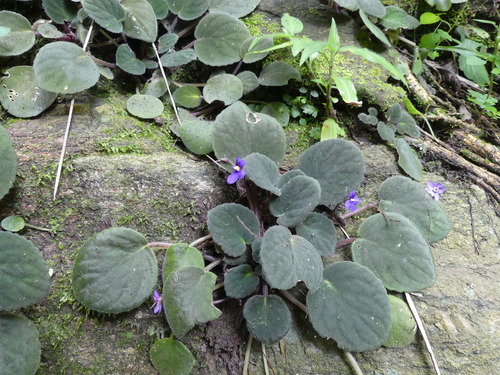
How to care for Saintpaulia ionantha
Watering
African violets (Saintpaulia ionantha) have thin, fuzzy leaves that mark easily and rot readily at the crown, so water the soil, never the foliage. Use room-temperature water, ideally left to stand overnight or filtered, because cold or chlorinated water can leave pale spots on the leaves. Keep the soil evenly moist like a wrung-out sponge, not soggy. Empty the saucer within 30 minutes so the roots never sit in water. A pot with drainage holes and a light, airy mix containing peat or coir with perlite suits this species well.
Does it need water today?
Push a finger about 1 cm (half an inch) into the potting mix. If it feels dry, water now. Also lift the pot: a light pot means the soil has dried out. If the soil is still damp, wait a day and check again.
African violets prefer slightly under-watered to over-watered. Water in the morning so the top of the soil and any droplets dry by evening, and rotate the pot a quarter turn each time so the rosette grows evenly.
Overwatering
African violets have shallow, fine roots that need air as well as moisture. When the mix stays wet, the roots suffocate and rot, and the crown can soften, because this species is native to humid, well-drained rocky sites in Tanzania and Kenya.
Symptoms: Yellowing lower leaves, wilting despite wet soil, a mushy or black base at the crown, a sour smell from the pot, and a green film on the soil surface.
Solutions: Stop watering and let the top 2 cm dry out. Repot into fresh, airy mix in a pot with drainage holes, trimming any black, mushy roots with clean scissors. Remove rotten leaves, and check that the saucer is emptied after each watering.
Underwatering
The thin leaves of this species lose water quickly through their large surface area. African violets wilt fast when the mix dries out, and dry peat-based mix can repel water, so the moisture does not reach the roots.
Symptoms: Limp, drooping leaves that stand up again after watering, dry crispy leaf edges, a soil ball pulling away from the pot wall, and slow flowering.
Solutions: Soak the pot from below for 30 minutes until the soil is evenly damp. If the mix has shrunk and is hydrophobic, gently loosen the top and add water slowly. Then resume a regular schedule and check the soil with a finger each time.
Sunlight
African violets need strong light to bloom but direct sun scorches their leaves, leaving pale or brown patches. Indoors, a bright east-facing window is ideal, and a west or south window works if the plant sits a little back from the glass or behind a sheer curtain. Leaves that grow flat and pale suggest too little light, while leaves that curl up and turn yellow-green suggest too much. Rotate the pot every week so the rosette stays symmetrical.
- Ideal: Bright, indirect light · 12 to 14 hours of bright, indirect light daily, or 14 to 16 hours under grow lights
- Tolerates: Partial sun, Bright, indirect light
- Best spot in a room: Near the window
- Artificial light: A full-spectrum LED grow light or fluorescent tube placed 20 to 30 cm (8 to 12 inches) above the leaves works very well. Run it for 14 to 16 hours a day on a timer, and raise the light as the plant grows. Keep the lamp on the same schedule each day so flowering stays regular.
Too little light
African violets evolved under the filtered light of forest edges and rocky shade in East Africa. Without enough light they stretch, produce long leafstalks, and stop flowering, because flower buds need steady brightness to form.
Symptoms: Leggy growth with long stalks, flat dark green leaves that lie down, few or no flowers, and a loose, open rosette.
Solutions: Move the plant closer to a bright east or north window, or add a grow light for 14 to 16 hours a day. Turn the pot weekly so growth stays even, and avoid dark corners in winter.
Too much sun
The leaves of this species are thin and easily damaged, so strong sun heats and bleaches them quickly. Because African violets are woodland plants, they cannot tolerate the intense midday light that a south or west window can deliver.
Symptoms: Pale yellow or bleached patches, brown scorched edges, leaves that curl upward or cup, and faded flowers that wilt sooner than usual.
Solutions: Pull the plant back from the window or hang a sheer curtain between the glass and the leaves. Move it to an east-facing spot if possible, and remove badly scorched leaves at the stalk base.
Temperature
African violet (Saintpaulia ionantha) thrives in steady warmth between 18 and 24 °C, out of drafts and direct sun. Keep it away from cold windows and heating vents, because sudden swings stress its soft leaves and stop flowering.
- Ideal: 18–24 °C
- Tolerates: 10–30 °C
- Hardiness zones: 11-12
Fertilizing
African violet (Saintpaulia ionantha) is a light feeder with delicate roots, so it needs small, frequent doses of fertilizer rather than strong amounts. Use a low-nitrogen or balanced formula when the plant is blooming; too much nitrogen gives lush leaves but few flowers. Always water first, then feed, to protect the roots.
- Slow-release fertilizer: Once a year in early spring, mix a small amount of slow-release fertilizer into fresh potting mix when repotting, or not needed if you feed with liquid fertilizer regularly.
- Balanced liquid fertilizer labeled for African violets (for example, a 14-12-14 or similar formula), Balanced houseplant fertilizer diluted to half strength, Slow-release granules formulated for flowering houseplants, used sparingly
Soil
African violets need a light, well-aerated mix that stays evenly moist but never soggy. Their fine roots suffocate in dense garden soil, so avoid heavy garden soil or soil with loam-heavy content. A slightly acidic mix suits them best.
- Commercial African violet mix: Peat or coir base blended with perlite, vermiculite, and sometimes composted bark for aeration
- Homemade African violet mix: Two parts peat or coir, one part perlite, and one part fine orchid bark or vermiculite
- Standard houseplant potting mix: All-purpose potting soil mixed with about one-third perlite to reduce compaction and waterlogging
- pH 5.8–6.5
Repotting
African violets have fine, shallow, fibrous roots that rot in cold, soggy soil. Use a pot with a drainage hole or a self-watering insert with a wick, and repot only when the plant is actively growing.
- How often: Every 1-2 years, or when roots fill the pot and crowd the surface
- New pot: Choose a shallow pot only 2.5-5 cm wider than the root ball, since African violets (Saintpaulia ionantha) flower best when slightly root-bound and dislike deep, wet pots
- Repotting season: Spring, Summer, Autumn
How to repot
- Water the plant lightly an hour before repotting so the root ball holds together and does not tear
- Tip the pot on its side and ease the root ball out, supporting the leaves with one hand
- Brush away old, compacted soil with your fingers and trim any brown, mushy, or dead roots with clean scissors
- Place a small layer of fresh mix in the new pot and set the plant so the lowest leaves rest just above the soil line
- Fill around the root ball with fresh mix, tapping the pot gently to settle it without packing the soil hard
- Water from below by standing the pot in lukewarm water for 15-20 minutes, then let it drain fully
- Keep the plant out of direct sun for about a week while the roots settle
Pruning
Saintpaulia ionantha, the African violet, does not need heavy pruning. Its growth is naturally compact, so only remove plant material that is damaged, dying, or past its best. Always cut rather than tear, so the plant heals quickly.
Pruning season: Spring, Summer, Autumn
How to prune
- Look at the rosette from above and identify any leaves that are yellow, brown, or limp.
- Cut each old leaf at its base, close to the crown, using a sharp knife or scissors, without damaging the surrounding leaves.
- Remove faded flowers by cutting the flower stalk back to the base of the plant or to a leaf node.
- Remove any dead flower stalks or spent blooms, which can rot and invite disease if left in place.
- Turn the pot a quarter turn every week so the rosette grows evenly toward the light.
- Keep the crown dry after pruning and avoid overwatering for a few days so the cut areas can heal.
Propagation
Leaf cuttings in water or soil · Spring, Summer
- Choose a healthy, mature leaf from the middle of the rosette, not an old yellow leaf or a very young inner one.
- Cut the leaf stalk (petiole) about 3 cm long with a clean, sharp knife or scissors.
- Insert the stalk about 2 cm deep into a small pot of moist, light African violet mix, or stand it in a glass of room-temperature water so the base is covered.
- Keep the cutting in bright, indirect light at about 20 to 24 °C, away from cold draughts.
- Roots usually appear in 3 to 6 weeks; plantlets form at the base of the stalk within 2 to 3 months.
- When the plantlets have two or three small leaves and roots of about 2 cm, separate them gently and pot them up.
Division of crowns · Spring
- Wait until a mature plant has several crowns, or has produced offsets (small side plants) at its base.
- Remove the plant from its pot and gently tease the root ball apart with your fingers.
- Use a clean knife to split the crown only where each section has its own roots and healthy leaves.
- Pot each section in fresh, fine potting mix and water lightly.
- Keep the new divisions out of direct sun for the first two weeks while they settle.
Water from below by setting the pot in a tray of water for 20 to 30 minutes, then pour off the excess. Keeping water off the leaves prevents the spots and rot that African violets often develop.
About Saintpaulia ionantha
Also known as: African violet, Usambara violet, Cape violet, Violet of Saintpaul
- Plant type: herb, perennial houseplant
- Lifespan: perennial
- Distribution: Native to the Usambara Mountains of northeastern Tanzania in eastern Africa.
- Mature height: 5-15 cm
- Bloom time: Mostly spring to autumn indoors, often nearly year-round with good light
Pets · People
Pets: Safe · People: Safe. Saintpaulia ionantha is non-toxic to cats, dogs, and children according to ASPCA listings; eating it may cause mild stomach upset in some animals.
Common problems
- Crown rot: Water settling in the center of the rosette causes the crown to rot; water from below and keep the center dry.
- Leaf spotting: Cold water or water on leaves leaves brown or water-ring spots; use room-temperature water at the soil level.
- Lack of flowers: Too little light, overpotting, or too much nitrogen fertilizer prevents blooms; adjust light, pot size, and feed.
- Powdery mildew: White powdery patches appear in poor airflow; space plants and improve ventilation.
- Root and leaf mealybugs: Small white cottony insects hide at the leaf bases; remove by hand or treat with insecticidal soap.
Uses
Grown almost entirely as an ornamental houseplant, valued for its long flowering and compact size; thousands of cultivars and hybrids have been bred since its introduction to European horticulture in 1892.
Is it edible?
not edible
History & legends
Saintpaulia ionantha was discovered in 1892 by Baron Walter von Saint Paul-Illaire, a German district governor, who sent seeds to his father in Germany, where the botanist Hermann Wendland described it. Its rapid spread through European and American greenhouses made it a Victorian-era favorite and a lasting symbol of home gardening.
Did you know?
Despite the name, African violets are not true violets; they belong to the family Gesneriaceae, which also includes gloxinia and the streptocarpus.
Frequently asked questions
How often should I water Saintpaulia ionantha?
every 7 days. African violets (Saintpaulia ionantha) have thin, fuzzy leaves that mark easily and rot readily at the crown, so water the soil, never the foliage. Use room-temperature water, ideally left to stand overnight or filtered, because cold or chlorinated water can leave pale spots on the leaves. Keep the soil evenly moist like a wrung-out sponge, not soggy. Empty the saucer within 30 minutes so the roots never sit in water. A pot with drainage holes and a light, airy mix containing peat or coir with perlite suits this species well. Push a finger about 1 cm (half an inch) into the potting mix. If it feels dry, water now. Also lift the pot: a light pot means the soil has dried out. If the soil is still damp, wait a day and check again.
How much light does Saintpaulia ionantha need?
Bright, indirect light (12 to 14 hours of bright, indirect light daily, or 14 to 16 hours under grow lights). African violets need strong light to bloom but direct sun scorches their leaves, leaving pale or brown patches. Indoors, a bright east-facing window is ideal, and a west or south window works if the plant sits a little back from the glass or behind a sheer curtain. Leaves that grow flat and pale suggest too little light, while leaves that curl up and turn yellow-green suggest too much. Rotate the pot every week so the rosette stays symmetrical.
What temperature does Saintpaulia ionantha like?
18–24 °C. African violet (Saintpaulia ionantha) thrives in steady warmth between 18 and 24 °C, out of drafts and direct sun. Keep it away from cold windows and heating vents, because sudden swings stress its soft leaves and stop flowering.
Is Saintpaulia ionantha toxic to cats and dogs?
It is safe for cats and dogs. Saintpaulia ionantha is non-toxic to cats, dogs, and children according to ASPCA listings; eating it may cause mild stomach upset in some animals.
What are the most common problems of Saintpaulia ionantha?
Crown rot: Water settling in the center of the rosette causes the crown to rot; water from below and keep the center dry. Leaf spotting: Cold water or water on leaves leaves brown or water-ring spots; use room-temperature water at the soil level. Lack of flowers: Too little light, overpotting, or too much nitrogen fertilizer prevents blooms; adjust light, pot size, and feed. Powdery mildew: White powdery patches appear in poor airflow; space plants and improve ventilation. Root and leaf mealybugs: Small white cottony insects hide at the leaf bases; remove by hand or treat with insecticidal soap.
When should I repot Saintpaulia ionantha?
Every 1-2 years, or when roots fill the pot and crowd the surface. African violets have fine, shallow, fibrous roots that rot in cold, soggy soil. Use a pot with a drainage hole or a self-watering insert with a wick, and repot only when the plant is actively growing.
How do I propagate Saintpaulia ionantha?
Leaf cuttings in water or soil, Division of crowns. Choose a healthy, mature leaf from the middle of the rosette, not an old yellow leaf or a very young inner one. Cut the leaf stalk (petiole) about 3 cm long with a clean, sharp knife or scissors. Insert the stalk about 2 cm deep into a small pot of moist, light African violet mix, or stand it in a glass of room-temperature water so the base is covered. Keep the cutting in bright, indirect light at about 20 to 24 °C, away from cold draughts. Roots usually appear in 3 to 6 weeks; plantlets form at the base of the stalk within 2 to 3 months. When the plantlets have two or three small leaves and roots of about 2 cm, separate them gently and pot them up.
How this guide was written
Verdiss writes each guide with AI from botanical references and checks the species against iNaturalist and Plants of the World Online (Kew). Readers can rate every guide in the app.
Sources
Verdiss's information is for general guidance. Never eat or use a plant as medicine based on an app: ask a professional.