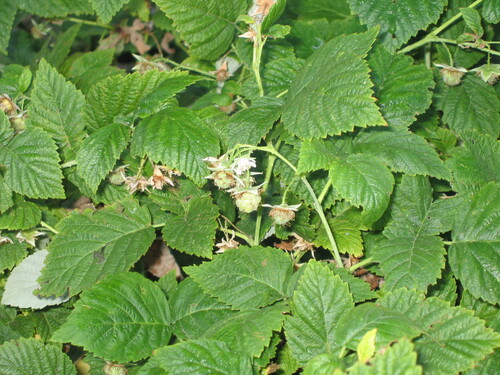
How to care for red raspberry
Watering
Red raspberry (Rubus idaeus) has shallow, fibrous roots and cane-type growth that loses water quickly through large leaves, so it needs steady moisture rather than occasional deep drinks. Keep the root zone evenly damp during fruit set and ripening, when a lack of water shrinks berries and causes crumbling. Good drainage matters as much as moisture, because waterlogged soil quickly rots the roots and crown. Container plants need the most attention and should never sit in standing water.
Does it need water today?
Push a finger 5 cm into the soil near the canes. If it feels dry, water now. For potted raspberries, lift the pot: a light pot is thirsty, a heavy one is still wet. In the ground, a thick layer of mulch means you can check less often, but the soil under the mulch should still feel slightly moist.
Water at the base of the canes in the morning so the foliage dries quickly and fungal diseases such as cane blight have less chance to take hold. A slow soak of 10 to 15 litres per plant once a week in summer is better than a light sprinkle every day.
Overwatering
Red raspberry roots need oxygen as well as moisture, and its shallow root system is especially vulnerable to waterlogging. Heavy clay soil, compacted beds and pots without drainage all keep the root zone soggy, which quickly leads to root and crown rot.
Symptoms: Yellowing leaves that drop, wilting even when the soil is wet, a sour or rotten smell from the soil, dark brown or mushy roots, and new canes that die back from the tip.
Solutions: Stop watering and let the soil dry to a depth of 5 cm. Improve drainage by mixing in compost or grit, or by raising the bed on a mound. For potted plants, repot into fresh, free-draining compost with extra perlite and trim any rotten roots. Remove dead canes and avoid replanting raspberries in the same spot for a season.
Underwatering
Red raspberry has large leaves and shallow roots that dry out quickly in heat and wind. When water runs short during flowering or fruit swelling, the plant diverts moisture away from the berries, so the fruit suffers first.
Symptoms: Limp, drooping leaves in the afternoon, leaves turning brown and crisp at the edges, small or crumbly berries that fail to fill out, and dry, hard soil pulling away from the pot edge.
Solutions: Water deeply and slowly until moisture reaches 20 to 30 cm down, then mulch with straw or bark to slow evaporation. In containers, soak the pot in a tray of water for 30 minutes if the compost has shrunk away from the sides. Water more often during hot spells and when canes are fruiting.
Sunlight
Red raspberry (Rubus idaeus) fruits best in full sun, where the canes ripen wood properly and produce the sweetest berries. In partial shade it still grows, but yields drop and the fruit is smaller and less flavourful. Deep shade leads to weak, leggy canes that flop over and rarely fruit. Good light also keeps the foliage dry, which helps prevent grey mould on the berries.
- Ideal: Full sun · 6-8 hours of direct sun a day, with morning sun being especially helpful for drying leaves
- Tolerates: Full sun, Partial sun
- Best spot in a room: At the window
- Artificial light: Indoor raspberries are hard to fruit without help. Use a full-spectrum grow light for 12 to 14 hours a day, placed 20 to 30 cm above the canopy, and rotate the pot weekly so the canes grow evenly. Dwarf or everbearing cultivars are the most realistic choice for a bright sunroom.
Too little light
Red raspberry needs strong sunlight to build the sugars that make its fruit sweet and its canes sturdy. In low light the plant stretches toward any available brightness, producing thin, weak canes that cannot support a crop.
Symptoms: Long, pale, leggy canes with wide gaps between leaves, few or no flowers, small sour berries, and canes that bend or flop over.
Solutions: Move the plant to the sunniest spot available, ideally a south- or west-facing site outdoors. Prune out weak, thin canes so energy goes into sturdier growth. If indoors, add a grow light for 12 to 14 hours a day and rotate the pot regularly.
Too much sun
In hot climates or on exposed sites, the intense afternoon sun of midsummer can scorch red raspberry leaves and dry out the fruit. Container plants on south-facing balconies are particularly at risk because their roots heat up quickly.
Symptoms: Brown, crispy patches on leaves that face the sun, berries that dry, sunburn on the fruit, and wilting in the afternoon even when the soil is moist.
Solutions: Provide light afternoon shade with a shade cloth during heatwaves, or plant behind taller crops. Mulch well to keep the roots cool and water more often in hot weather. Move containers to a spot with morning sun and afternoon shade.
Temperature
Red raspberry (Rubus idaeus) is a hardy cane fruit that needs a real winter chill to rest and set a good crop, and it prefers cool summers. Plant it where it gets cold winters and mild, moist summers.
- Ideal: 10–25 °C
- Tolerates: -35–35 °C
- Hardiness zones: 3-8
Fertilizing
Red raspberry is a heavy feeder for nitrogen in spring, but too much nitrogen late in the season produces soft, leafy canes that winter-kill. Feed it early, then taper off by midsummer. Raspberries also have shallow roots, so keep fertilizer off the bare soil around them and work it into the mulch zone.
- Slow-release fertilizer: Apply once a year in early spring, just as new growth begins, around the base of the canes.
- Balanced organic compost or well-rotted manure, Slow-release granular fertilizer with a balanced or slightly nitrogen-heavy formula (e.g. 10-10-10), Liquid seaweed or fish emulsion for a gentle, quick boost, Sulfate of potash or a potassium-rich feed in summer to support fruiting
Soil
Red raspberry prefers slightly acidic, fertile, well-drained soil that stays moist through summer. Waterlogged roots rot quickly, so good drainage matters as much as moisture retention.
- Loamy garden soil: Roughly 40% topsoil, 30% well-rotted compost, 20% sharp sand or perlite, 10% leaf mould
- Container raspberry mix: Two parts peat-free multipurpose compost, one part loam, one part perlite or coarse grit
- pH 5.5–6.5
Repotting
Red raspberry (Rubus idaeus) is a cold-hardy, suckering perennial whose roots are shallow and spread widely. Container plants need room for roots and a drainage hole, and they dry out faster than ground-planted canes.
- How often: Every 2-3 years for container-grown red raspberry canes, or when roots fill the pot
- New pot: Choose a container at least 40 cm wide and 40 cm deep for a single cane; move up one size of about 10 cm wider at each repot
- Repotting season: Spring, Autumn
How to repot
- Cut the canes back to about 30 cm above soil level to make handling easier
- Tip the pot on its side and gently ease out the root ball, loosening the outer roots with your fingers
- Trim away any dead, black or mushy roots with clean secateurs
- Place the plant in the new pot so the crown sits about 2 cm below the rim
- Fill around the roots with fresh soil, firm lightly, and leave a 3 cm gap at the top for watering
- Water thoroughly until water drains from the base
Pruning
Red raspberry fruits on two-year-old canes (floricanes). First-year canes (primocanes) grow leaves and then flower and fruit on their tips in autumn in everbearing types, or in the following year in summer-fruiting types. The key rule is to remove canes that have already fruited, since they will not produce again, and to keep a manageable number of healthy new canes.
Pruning season: Winter, Summer
How to prune
- After summer-fruiting varieties finish harvesting in late summer, cut all canes that bore fruit right down to ground level.
- Tie up the remaining new green canes, which are first-year growth, to a support wire, spacing them about 10 cm apart within the row.
- In late winter or early spring, while the plant is still dormant, remove any weak, thin, or damaged canes and cut back the tips of the remaining canes to a healthy bud, leaving roughly 1 to 1.5 m of cane.
- For fall-bearing red raspberries, cut all canes down to ground level in late winter. The plant will fruit on new canes that grow in spring and produce their crop in autumn.
- Burn or bin all cut canes that show signs of disease, such as cankers or discolored lesions. Do not compost them.
- Keep your pruning shears clean between plants and when moving from a diseased area to a healthy one.
Propagation
Suckering root cuttings · Winter, Spring
- In late winter, while the plant is dormant, dig carefully around the base of an established red raspberry patch to find healthy, pencil-thick roots.
- Cut 10 to 15 cm lengths of root, keeping track of which end was nearer the crown.
- Lay the root pieces horizontally in a tray of moist potting mix or directly into prepared soil, covering them with about 2 to 3 cm of soil.
- Keep the soil lightly moist and wait for new shoots to emerge in spring, typically within three to six weeks.
- Transplant the new canes once they reach about 15 cm tall and have a few leaves.
Tip layering · Summer, Autumn
- In late summer, choose a vigorous first-year cane that is bending toward the soil.
- Bury the growing tip 8 to 10 cm deep in a small hole, leaving the tip end above the surface or just under it.
- Secure the tip with a bent wire or a stone and keep the soil moist through the autumn.
- In the following spring, new roots will have formed at the buried tip. Cut the cane free from the mother plant and move the rooted tip to its new position.
Stem tip cuttings · Summer
- In early to mid summer, take 8 to 10 cm tip cuttings from healthy, current-season green canes, cutting just below a leaf node.
- Remove the lower leaves and keep the top two or three leaves.
- Dip the cut end in rooting hormone if you have it, then insert it into a pot of moist, sandy mix.
- Place the pot in bright, indirect light and keep the mix damp but not soggy. Roots usually form in three to four weeks.
- Keep the cuttings protected through their first winter before planting them out in spring.
Red raspberry spreads naturally by suckers, so the simplest method is to dig up the new shoots that appear beyond the row in spring. Only take material from plants you know are disease-free, because viruses and cane blight can pass to new plants through cuttings and roots.
About red raspberry
Also known as: European raspberry, Wild raspberry, Red raspberry bush
- Plant type: shrub, bramble
- Lifespan: perennial (canes are biennial)
- Distribution: Native to Europe, northern and central Asia, and northern North America, growing in cool temperate forests and clearings.
- Mature height: 1–2.5 m
- Bloom time: Late spring to early summer
Pets · People
Pets: Safe · People: Safe. Fruit and leaves are non-toxic to cats, dogs and children according to ASPCA-type sources; thorns can cause scratches, and seeds may irritate the digestive tract if eaten in large amounts.
Common problems
- Cane blight (Leptosphaeria coniothyrium): Fungal disease causing dieback of canes; prune out infected wood and improve airflow.
- Raspberry cane borer: Larvae tunnel into canes, causing wilting tips; remove and destroy affected shoots.
- Spur blight: Purple spots on canes and leaves in wet weather; avoid overhead watering and thin canes.
- Root rot: Caused by waterlogged soil; ensure good drainage and avoid planting in heavy clay.
- Raspberry mosaic virus: Spread by aphids, causing mottled leaves and weak yields; buy certified virus-free stock.
Uses
Widely grown for its fruit, eaten fresh or made into jams, syrups, desserts and wines; leaves are used to make herbal teas, and the root and leaves have traditional medicinal uses in folk remedies.
Is it edible?
The ripe fruits are edible raw or cooked; young leaves can be steeped as tea, and young shoots are sometimes eaten cooked.
History & legends
Red raspberries have been gathered since prehistoric times, with seeds found at Neolithic sites in Europe. In Greek mythology the fruit is linked to the Idaean Mountain on Crete, which gave the species its name.
Did you know?
Each red raspberry fruit is actually a cluster of tiny drupelets, each containing its own seed, and the fruit separates from its core when ripe, leaving a hollow inside.
Frequently asked questions
How often should I water red raspberry?
every 3 days. Red raspberry (Rubus idaeus) has shallow, fibrous roots and cane-type growth that loses water quickly through large leaves, so it needs steady moisture rather than occasional deep drinks. Keep the root zone evenly damp during fruit set and ripening, when a lack of water shrinks berries and causes crumbling. Good drainage matters as much as moisture, because waterlogged soil quickly rots the roots and crown. Container plants need the most attention and should never sit in standing water. Push a finger 5 cm into the soil near the canes. If it feels dry, water now. For potted raspberries, lift the pot: a light pot is thirsty, a heavy one is still wet. In the ground, a thick layer of mulch means you can check less often, but the soil under the mulch should still feel slightly moist.
How much light does red raspberry need?
Full sun (6-8 hours of direct sun a day, with morning sun being especially helpful for drying leaves). Red raspberry (Rubus idaeus) fruits best in full sun, where the canes ripen wood properly and produce the sweetest berries. In partial shade it still grows, but yields drop and the fruit is smaller and less flavourful. Deep shade leads to weak, leggy canes that flop over and rarely fruit. Good light also keeps the foliage dry, which helps prevent grey mould on the berries.
What temperature does red raspberry like?
10–25 °C. Red raspberry (Rubus idaeus) is a hardy cane fruit that needs a real winter chill to rest and set a good crop, and it prefers cool summers. Plant it where it gets cold winters and mild, moist summers.
Is red raspberry toxic to cats and dogs?
It is safe for cats and dogs. Fruit and leaves are non-toxic to cats, dogs and children according to ASPCA-type sources; thorns can cause scratches, and seeds may irritate the digestive tract if eaten in large amounts.
What are the most common problems of red raspberry?
Cane blight (Leptosphaeria coniothyrium): Fungal disease causing dieback of canes; prune out infected wood and improve airflow. Raspberry cane borer: Larvae tunnel into canes, causing wilting tips; remove and destroy affected shoots. Spur blight: Purple spots on canes and leaves in wet weather; avoid overhead watering and thin canes. Root rot: Caused by waterlogged soil; ensure good drainage and avoid planting in heavy clay. Raspberry mosaic virus: Spread by aphids, causing mottled leaves and weak yields; buy certified virus-free stock.
When should I repot red raspberry?
Every 2-3 years for container-grown red raspberry canes, or when roots fill the pot. Red raspberry (Rubus idaeus) is a cold-hardy, suckering perennial whose roots are shallow and spread widely. Container plants need room for roots and a drainage hole, and they dry out faster than ground-planted canes.
How do I propagate red raspberry?
Suckering root cuttings, Tip layering, Stem tip cuttings. In late winter, while the plant is dormant, dig carefully around the base of an established red raspberry patch to find healthy, pencil-thick roots. Cut 10 to 15 cm lengths of root, keeping track of which end was nearer the crown. Lay the root pieces horizontally in a tray of moist potting mix or directly into prepared soil, covering them with about 2 to 3 cm of soil. Keep the soil lightly moist and wait for new shoots to emerge in spring, typically within three to six weeks. Transplant the new canes once they reach about 15 cm tall and have a few leaves.
How this guide was written
Verdiss writes each guide with AI from botanical references and checks the species against iNaturalist and Plants of the World Online (Kew). Readers can rate every guide in the app.
Sources
Verdiss's information is for general guidance. Never eat or use a plant as medicine based on an app: ask a professional.