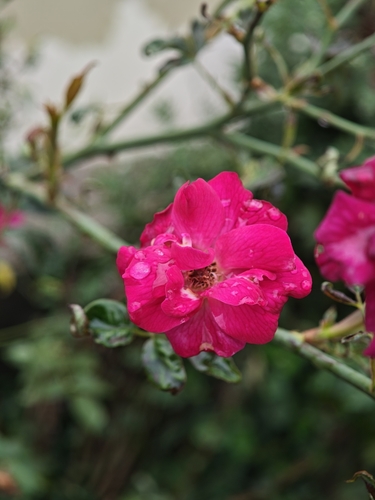
How to care for China Rose
Watering
China Rose (Rosa chinensis) likes evenly moist soil that is never soggy. Water deeply at the base of the plant so the root zone soaks through, then let the top few centimetres dry before the next watering. Blooming plants use more water, so increase frequency during flowering in late spring and summer. Reduce watering in winter when growth slows. Avoid wetting the leaves and flowers, since damp foliage invites black spot and mildew.
Does it need water today?
Push a finger 3 cm into the soil. If it feels dry, water. If it feels cool and moist, wait a day or two. For a container, lift the pot: a light pot means it is dry and needs water. Wilting leaves that perk up after watering are also a sign.
Water in the morning so foliage dries quickly during the day. Pour slowly so water soaks in rather than running off the surface.
Overwatering
China Rose roots need air as well as water. Constantly wet soil suffocates the roots and encourages rot fungi, which is a common cause of decline in container plants.
Symptoms: Yellowing lower leaves, leaves dropping while the soil is still wet, black or soft stems at the base, and a sour smell from the soil.
Solutions: Stop watering and let the soil dry to a depth of 5 cm. Make sure the pot has drainage holes and empty saucers. Repot into fresh, gritty soil if roots look brown and mushy, trimming any rotten roots first.
Underwatering
China Rose is a fairly thirsty shrub during flowering, and its shallow, fine roots dry out quickly in hot weather and in small pots. Repeated drying stresses the plant and causes bud drop.
Symptoms: Drooping or crisp leaves, buds falling before opening, dry soil pulling away from the pot edge, and flowers that open small and short-lived.
Solutions: Water thoroughly until it drains, then check again the next morning. For very dry soil, soak the pot in a bucket of water for 30 minutes. Mulch the soil surface to slow evaporation during summer.
Sunlight
China Rose is a sun-loving shrub that blooms most freely when it receives at least six hours of direct sunlight. In full sun it grows sturdy stems and produces the most flowers. In partial shade it still grows, but with fewer blooms and weaker, leggier stems. Deep shade will make it fail to flower.
- Ideal: Full sun · 6-8 hours of direct sun per day
- Tolerates: Full sun, Partial sun, Bright, indirect light
- Best spot in a room: At the window
- Artificial light: If grown indoors, use a strong full-spectrum LED grow light for 12 to 14 hours a day, placed 30 to 45 cm above the plant. Rotate the pot weekly so all sides receive light and the plant grows evenly.
Too little light
China Rose depends on strong light to make the energy needed for flower buds. In low light its stems stretch toward the light source and its buds fail to develop.
Symptoms: Long, thin, pale stems, small leaves spaced far apart, few or no flower buds, and a lean, one-sided shape.
Solutions: Move the plant to the sunniest spot available, ideally a south- or west-facing location outdoors or by a bright window. Prune back leggy stems in early spring to encourage bushier growth.
Too much sun
While China Rose loves sun, intense afternoon light in very hot climates can scorch its leaves, especially when the plant is newly moved outdoors or is in a light-coloured pot that reflects heat.
Symptoms: Bleached or brown crispy patches on leaves, wilting in the afternoon even when the soil is moist, and flowers that fade quickly.
Solutions: Provide light afternoon shade with a sheer curtain or shade cloth during summer heatwaves. Acclimatise new plants gradually over one to two weeks, and water more often in hot weather.
Temperature
China Rose (Rosa chinensis) is a tender, repeat-blooming rose native to warm southern China. It grows best in mild to warm conditions and blooms almost continuously through the warm season. Most cultivars tolerate only light frost, so protect plants in cold winters.
- Ideal: 15–30 °C
- Tolerates: -5–38 °C
- Hardiness zones: 7-10
Fertilizing
China Rose blooms repeatedly, so it needs steady feeding through the growing season. Avoid heavy nitrogen late in summer, since it pushes soft growth that cold weather can kill. Feed only when the soil is moist to avoid burning roots.
- Slow-release fertilizer: Apply once a year in early spring, as new growth begins, to support the first flush of blooms.
- Balanced rose fertilizer (for example 8-8-8 or 10-10-10), Slow-release granular rose food, Well-rotted compost or aged manure, Fertilizer with added iron and magnesium for deeper leaf color
Soil
China Rose grows best in slightly acidic to neutral soil, with a pH between 6.0 and 7.5. It needs rich organic matter to feed its heavy flowering, but its roots will rot if water sits around them. The ideal mix is moisture-retentive yet loose enough that excess water drains away within minutes of watering.
- Loamy garden soil amended with compost: About 60% good topsoil or loam, 30% well-rotted compost or leaf mould, and 10% coarse sand or grit to keep the structure open.
- Container rose mix: A quality peat-free potting compost blended with about 20-25% perlite or pumice, with a few handfuls of well-rotted compost added for nutrients.
- Free-draining loam for raised beds: Equal parts topsoil and compost, plus up to 15% grit, which keeps water moving so roots receive both moisture and air.
- pH 6–7.5
Repotting
China Rose (Rosa chinensis) is a vigorous, repeat-flowering shrub that is quick to become root-bound in a pot. Repot in early spring just as new growth begins, or in early autumn once flowering has finished. Avoid repotting during bloom or in hot midsummer, when the plant is under stress.
- How often: every 2-3 years for container-grown China Rose; refresh the top layer of soil yearly
- New pot: Move up only one pot size (about 2-5 cm wider in diameter) at each repot, using a container with drainage holes, ideally 30-40 cm across for a mature shrub.
- Repotting season: Spring, Autumn
How to repot
- Tip the pot on its side and gently ease the root ball out, tapping the rim if it sticks
- Loosen the outer roots with your fingers and tease apart any tight circling roots
- Trim away any black, mushy, or dead roots with clean shears and cut back about one-third of very long roots to encourage fine feeder roots
- Lightly prune the top growth by a few centimetres if the plant has become top-heavy, which helps it adjust to the reduced root mass
- Add a layer of fresh mix to the bottom of the new pot so the crown will sit about 2-3 cm below the rim
- Set the plant in the centre, spread the roots outward, and fill around them with mix while gently firming as you go
- Water thoroughly until water drains from the holes, then add more soil if the level has settled
- Keep the plant in partial shade for a week before returning it to full sun
Pruning
China Rose is a repeat-flowering shrub that blooms on the current season's growth, so regular light pruning matters more than one hard cut. Prune to an outward-facing bud, leaving the cut about 5 mm above it at a slant so water runs off.
Pruning season: Winter, Spring, Summer
How to prune
- In late winter or early spring, once frost is over and buds begin to swell, remove all dead, damaged or diseased wood back to healthy green tissue or to the base.
- Cut out any crossing or inward-growing stems so the centre stays open.
- Reduce the remaining main stems by about one third, cutting just above an outward-facing bud.
- Through summer, deadhead spent flowers by cutting just above the first leaf with five leaflets below the bloom. This encourages new flowers.
- In late summer, stop deadheading so that the plant can begin to harden its stems before winter. Avoid heavy pruning after midsummer.
- In a mild climate, you may take out one or two of the oldest canes each year to renew the plant. In colder regions, leave most of the framework intact until spring to protect the stems from cold.
Propagation
Softwood cuttings · Spring, Summer
- Take 10 to 15 cm tips from healthy new growth of a China Rose in late spring or early summer, when the stems are flexible but not limp.
- Cut just below a leaf node with clean, sharp secateurs, then strip the lower leaves so that two or three leaves remain at the top.
- Dip the cut end in rooting hormone powder, tapping off any excess.
- Push the cutting about 5 cm deep into a pot of moist mix of equal parts perlite and peat-free compost.
- Cover the pot with a clear plastic bag held up on stakes, keep it bright but out of direct sun, and check that the mix stays damp.
- Roots usually form within four to six weeks. Give a gentle tug to test; resistance means roots have formed, and the plant can then be potted on.
Semi-hardwood cuttings · Summer, Autumn
- In late summer, choose side shoots of the current season's growth that have begun to firm up and snap cleanly when bent.
- Cut 15 cm lengths just below a leaf node, and remove the lowest leaves.
- Dip the cut end in rooting hormone and insert the cutting into a free-draining pot of gritty compost.
- Water once, then place the pot in a sheltered spot with light shade, such as a cold frame or the north side of a wall.
- Keep the mix lightly moist through autumn. Rooted cuttings can be moved to individual pots in spring.
Layering · Spring, Summer
- Choose a long, flexible low stem of a healthy plant in spring.
- Scrape a small patch of bark, about 2 cm long, from the underside of the stem at a point that will touch the soil.
- Bend the stem gently down into a shallow trench and pin it with a wire hoop or a stone.
- Cover the wounded section with 5 cm of compost and keep the soil moist.
- After roots develop, usually within a season, sever the stem from the parent plant and transplant the new plant.
Budding · Summer
- Use this method mainly for grafting named cultivars onto vigorous rootstock, because China Rose seedlings can vary.
- In mid to late summer, when the bark slips easily, take a dormant bud with a small shield of bark from a healthy stem.
- Make a T-shaped cut in the bark of the rootstock, lift the flaps gently, and slide the bud shield underneath.
- Bind the union with grafting tape, leaving the bud itself exposed.
- Check after two weeks. If the bud is green and plump, remove the tape and cut back the rootstock above the bud in the following spring.
China Rose cuttings root most reliably when taken from non-flowering shoots, because flowering stems divert energy from root formation. Keep the cuttings warm at about 18 to 22 °C at the base for faster rooting.
About China Rose
Also known as: China rose, Bengal rose, Monthly rose, Chinese rose
- Plant type: shrub
- Lifespan: perennial
- Distribution: Native to southwestern and central China and adjacent parts of Southeast Asia, where it grows in thickets and at forest edges.
- Mature height: 1-2 m
- Bloom time: Late spring through autumn, in repeated flushes
Pets · People
Pets: Safe · People: Safe. Rose petals and hips are not considered toxic by ASPCA; the plant has small thorns that can cause scratches, so supervise young children and animals around it.
Common problems
- Black spot: Dark circular spots on leaves caused by Diplocarpon rosae, favoured by wet foliage and humidity; remove affected leaves and water at the base.
- Powdery mildew: White powdery coating on new shoots and leaves in dry, humid conditions; improve airflow and avoid overhead watering.
- Aphids: Clusters of sap-sucking insects on new growth and flower buds; wash off with water or use insecticidal soap.
- Rose rosette disease: Viral disease causing distorted, red-tinged growth and witches' broom; infected plants should be removed and destroyed.
- Chlorosis: Yellowing leaves with green veins in alkaline soil due to iron deficiency; correct with chelated iron and acidifying mulch.
Uses
Widely grown as an ornamental shrub in gardens, borders and containers, and a key parent of many modern garden roses. Flowers and petals are used in perfumery and tea, and hips are used in syrups and infusions in some cultures.
Is it edible?
Petals are edible and used in teas and jams; hips are edible when cooked and strained, but seeds and hairs should be removed.
History & legends
Cultivated in China for more than a thousand years, the China rose was grown in imperial gardens and monasteries and was prized for its continuous flowering. When plants reached Europe, they were crossed with European roses and gave rise to the tea and Bourbon groups.
Did you know?
Rosa chinensis was one of the first roses to reach Europe in quantity in the late 18th century, where its ability to bloom almost continuously reshaped rose breeding.
Frequently asked questions
How often should I water China Rose?
every 4 days. China Rose (Rosa chinensis) likes evenly moist soil that is never soggy. Water deeply at the base of the plant so the root zone soaks through, then let the top few centimetres dry before the next watering. Blooming plants use more water, so increase frequency during flowering in late spring and summer. Reduce watering in winter when growth slows. Avoid wetting the leaves and flowers, since damp foliage invites black spot and mildew. Push a finger 3 cm into the soil. If it feels dry, water. If it feels cool and moist, wait a day or two. For a container, lift the pot: a light pot means it is dry and needs water. Wilting leaves that perk up after watering are also a sign.
How much light does China Rose need?
Full sun (6-8 hours of direct sun per day). China Rose is a sun-loving shrub that blooms most freely when it receives at least six hours of direct sunlight. In full sun it grows sturdy stems and produces the most flowers. In partial shade it still grows, but with fewer blooms and weaker, leggier stems. Deep shade will make it fail to flower.
What temperature does China Rose like?
15–30 °C. China Rose (Rosa chinensis) is a tender, repeat-blooming rose native to warm southern China. It grows best in mild to warm conditions and blooms almost continuously through the warm season. Most cultivars tolerate only light frost, so protect plants in cold winters.
Is China Rose toxic to cats and dogs?
It is safe for cats and dogs. Rose petals and hips are not considered toxic by ASPCA; the plant has small thorns that can cause scratches, so supervise young children and animals around it.
What are the most common problems of China Rose?
Black spot: Dark circular spots on leaves caused by Diplocarpon rosae, favoured by wet foliage and humidity; remove affected leaves and water at the base. Powdery mildew: White powdery coating on new shoots and leaves in dry, humid conditions; improve airflow and avoid overhead watering. Aphids: Clusters of sap-sucking insects on new growth and flower buds; wash off with water or use insecticidal soap. Rose rosette disease: Viral disease causing distorted, red-tinged growth and witches' broom; infected plants should be removed and destroyed. Chlorosis: Yellowing leaves with green veins in alkaline soil due to iron deficiency; correct with chelated iron and acidifying mulch.
When should I repot China Rose?
every 2-3 years for container-grown China Rose; refresh the top layer of soil yearly. China Rose (Rosa chinensis) is a vigorous, repeat-flowering shrub that is quick to become root-bound in a pot. Repot in early spring just as new growth begins, or in early autumn once flowering has finished. Avoid repotting during bloom or in hot midsummer, when the plant is under stress.
How do I propagate China Rose?
Softwood cuttings, Semi-hardwood cuttings, Layering, Budding. Take 10 to 15 cm tips from healthy new growth of a China Rose in late spring or early summer, when the stems are flexible but not limp. Cut just below a leaf node with clean, sharp secateurs, then strip the lower leaves so that two or three leaves remain at the top. Dip the cut end in rooting hormone powder, tapping off any excess. Push the cutting about 5 cm deep into a pot of moist mix of equal parts perlite and peat-free compost. Cover the pot with a clear plastic bag held up on stakes, keep it bright but out of direct sun, and check that the mix stays damp. Roots usually form within four to six weeks. Give a gentle tug to test; resistance means roots have formed, and the plant can then be potted on.
How this guide was written
Verdiss writes each guide with AI from botanical references and checks the species against iNaturalist and Plants of the World Online (Kew). Readers can rate every guide in the app.
Sources
Verdiss's information is for general guidance. Never eat or use a plant as medicine based on an app: ask a professional.