How to care for Peach
Watering
Peach trees (Prunus persica) need deep, regular water, especially during fruit set and the final swell of the fruit before harvest. Water slowly so moisture reaches 30-45 cm down into the root zone, and avoid wetting the trunk and leaves. Container peaches need more frequent watering than trees in the ground, and their pots must drain freely because peach roots rot quickly in soggy soil.
Does it need water today?
Push a finger 5 cm into the soil. If it feels dry, water the peach. For a potted peach, lift the pot: if it feels light, it is ready for water. Outdoors, a soil probe or a trowel dug 30 cm deep shows whether moisture is reaching the deeper roots.
Water deeply once rather than lightly every day. Shallow watering encourages surface roots that suffer during summer heat and drought.
Overwatering
Peach trees (Prunus persica) have fine roots that need oxygen, so waterlogged soil quickly leads to root rot and gumming on the trunk. Heavy clay soil and pots without drainage holes make this problem worse.
Symptoms: Yellowing leaves that drop early, wilting even when the soil is wet, a sour smell from the soil, dark mushy roots, and amber gum oozing from the bark.
Solutions: Stop watering and let the soil dry to a depth of 5 cm. Improve drainage by repotting into a container with drainage holes, or by mounding soil around the planting site. Remove badly rotted roots with clean pruners and avoid fertilizing until new growth appears.
Underwatering
Young peach trees and fruiting trees are especially sensitive to drought, because water is needed to swell the fruit and build next year's flower buds. Shallow roots in containers dry out much faster than those in the ground.
Symptoms: Leaves curl, turn pale, and drop; fruit stays small, shrivels, or drops early; and the tree looks wilted in the afternoon.
Solutions: Water deeply and slowly until the soil is moist 30 cm down. Apply 5-8 cm of mulch around the root zone, keeping it away from the trunk, to slow evaporation. Water container peaches thoroughly until water runs out of the drainage holes.
Sunlight
Peach trees (Prunus persica) need strong, direct sunlight to ripen their fruit and develop sweet flavor. Sunlight also keeps the canopy dry, which reduces fungal diseases such as brown rot and leaf curl. Partial shade is tolerated but results in fewer and less flavorful peaches.
- Ideal: Full sun · 6-8 hours of direct sun per day
- Tolerates: Full sun, Partial sun
- Best spot in a room: At the window
- Artificial light: Indoor peaches need a bright south-facing window or a full-spectrum grow light running 12-14 hours a day for several hours of direct light. Keep the light 20-30 cm above the canopy and raise it as the plant grows.
Too little light
Peach trees (Prunus persica) rely on strong light to produce the sugars that build fruit and flower buds. Too little sun leads to weak growth and poor harvests, especially in the first years after planting.
Symptoms: Long, thin, pale shoots with wide spaces between leaves, few or no flowers, small and sour fruit, and leaves that stay pale green or fall early.
Solutions: Move the tree or pot to the sunniest spot available, ideally where it gets 6-8 hours of direct sun. Prune overhanging branches of nearby trees or shrubs that block the light. Add a full-spectrum grow light during winter or in cloudy regions.
Too much sun
Peach trees (Prunus persica) can handle full sun, but in very hot climates and reflective locations, intense light combined with heat can scorch young leaves and fruit. Container peaches are more exposed because their roots heat up quickly.
Symptoms: Brown, papery patches on leaves facing the sun, sunburned fruit with pale or dried skin, and leaves that wilt in the afternoon even when the soil is moist.
Solutions: Provide light afternoon shade with shade cloth during heatwaves above about 35°C. Move container peaches to a spot with morning sun and afternoon shade. Keep the soil moist and mulched so the roots stay cool.
Temperature
Peach trees need a real winter chill to set fruit well, usually 300 to 900 hours below about 7°C depending on variety, and warm, sunny summers to ripen fruit. Hardy peach varieties tolerate winter lows near -20°C when dormant, but open flowers are killed by a few degrees of frost, so timing matters more than the absolute cold.
- Ideal: 15–28 °C
- Tolerates: -25–38 °C
- Hardiness zones: 5-9
Fertilizing
Peaches are heavy feeders on nitrogen during active growth, but excess nitrogen in late summer produces soft wood that is more prone to winter injury and fewer, poorer-tasting fruit. Feed lightly and stop feeding by midsummer so new growth can harden off before winter.
- Slow-release fertilizer: Once a year in early spring, just as buds begin to swell, work a balanced slow-release granular fertilizer around the drip line, not against the trunk.
- Balanced slow-release granular fertilizer such as 10-10-10 or 12-6-6, Compost or well-rotted manure applied as a top dressing, Fertilizer high in nitrogen only in early spring for young trees
Soil
Peach (Prunus persica) grows best in deep, well-drained soil that never stays waterlogged, because its roots suffer quickly in standing water and are prone to rot. Soil should be slightly acidic to neutral, with good oxygen flow around the roots.
- Loamy garden soil (in-ground): Roughly 40% sand, 40% silt, and 20% clay, with added organic matter such as well-rotted compost
- Container mix for fruit trees: Peat-free potting mix blended with about 30% perlite or pumice and a little coarse bark or compost
- Sandy-loam blend (for raised beds): Equal parts topsoil and coarse sand with 20% compost, mixed thoroughly
- pH 6–7
Repotting
Peach (Prunus persica) has a fairly shallow, fibrous root system that is sensitive to disturbance and soggy conditions. Repot only when roots are circling the pot or emerging from drainage holes, and always make sure the new container has several large drainage holes.
- How often: Every 2-3 years for container-grown dwarf peach trees; young trees may need repotting annually while they establish.
- New pot: Move up only one pot size (about 5 cm wider in diameter) each time, since peach roots resent oversized pots that hold wet soil.
- Repotting season: Spring
How to repot
- Gently tip the pot on its side and ease the peach tree out, supporting the trunk at the base.
- Loosen the outer roots with your fingers, teasing apart any tightly circling ones; trim dead or mushy roots with clean shears.
- Place a layer of fresh mix in the new pot so the top of the root ball sits about 2 cm below the rim.
- Set the tree centrally, spread the roots outward, and fill around them with mix, firming gently to remove large air pockets.
- Water thoroughly until it drains freely from the base, then top up the soil if it has settled.
Pruning
Peach trees fruit on wood that grew the previous year, so each season you should remove some old, unproductive branches and keep vigorous one-year shoots. Prune in late winter while the tree is dormant, and make a lighter summer pass to remove water sprouts.
Pruning season: Winter, Spring, Summer
How to prune
- In late winter, before buds swell, remove all dead, diseased, or broken wood first.
- Thin out crowded branches so that the center of the tree is open and light can reach inside.
- Choose strong one-year shoots about 20 to 30 cm long, spaced around the tree, and cut back to a healthy bud.
- Remove branches that are thinner than a pencil, since they rarely produce good fruit.
- Shorten the main leaders to keep the tree at a height you can reach from the ground, usually 2 to 2.5 m.
- In late spring or early summer, after fruit set, remove vertical water sprouts and overcrowded new growth.
- After harvest in summer, remove any branches that fruited and are now spent, to make room for next year's wood.
Propagation
Seed (stone) propagation · Autumn, Winter
- Choose a ripe peach and save the stone (pit) after eating the fruit.
- Scrub off all flesh and let the stone dry in a shaded spot for a few days.
- Place the stone in a bag of damp sand or peat and refrigerate it at about 2 to 5 °C for 8 to 12 weeks to break dormancy (cold stratification).
- In early spring, crack the hard shell gently with a vise or nutcracker, taking care not to damage the kernel inside.
- Plant the kernel 2 cm deep in a pot of well-draining potting mix and keep it in a bright spot at 18 to 24 °C.
- Note that seedlings rarely grow true to type, so expect fruit that may differ from the parent peach.
Softwood cutting · Summer
- In early summer, take 10 to 15 cm cuttings from the current season's green shoots of a healthy peach tree.
- Remove the lower leaves and dip the cut end in rooting hormone.
- Insert the cutting into a moist mix of perlite and peat, and cover loosely with a clear plastic bag to hold humidity.
- Keep it out of direct sun at about 20 to 25 °C and mist lightly when the surface dries.
- Roots usually form in 4 to 8 weeks; pot up once you feel resistance when tugging gently.
Budding (T-budding) · Summer
- In mid to late summer, select a healthy bud from the current season's growth on your preferred peach variety.
- Make a T-shaped cut in the bark of a young rootstock, such as a peach or plum seedling, about 30 cm above the soil.
- Slide a bud shield cut from the scion into the T and wrap it firmly with grafting tape, leaving the bud exposed.
- Check after 2 to 3 weeks; a green bud means success. Remove the tape and cut the rootstock just above the bud the following spring.
- Budding is the standard commercial method because it keeps the named variety's fruit quality true.
For reliable fruit that matches the parent, use budding or grafting rather than seed. Peaches grown from stones are a fun experiment, but the fruit can be quite different.
About Peach
Also known as: Peach tree, Common peach, Nectarine (a glabrous variety)
- Plant type: tree, fruit tree
- Lifespan: perennial
- Distribution: Native to northwest China, where its wild ancestors still grow in the mountains of Gansu, Shaanxi and Sichuan.
- Mature height: 3-5 m in cultivation (up to 8 m wild)
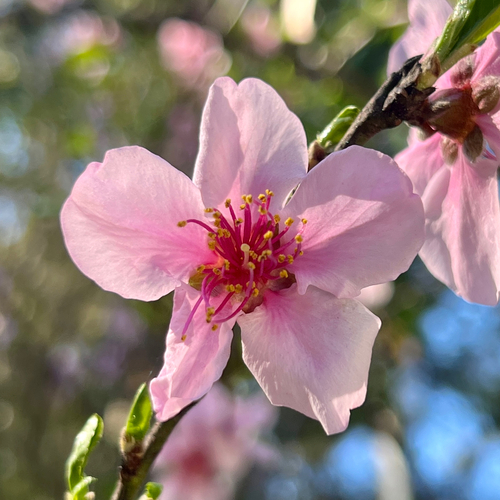
- Bloom time: Late winter to early spring, before the leaves
Pets · People
Pets: Toxic · People: Toxic. Leaves, stems, bark and seeds (kernels) in the stones contain cyanogenic glycosides that release hydrogen cyanide when chewed or crushed; the ripe fleshy fruit flesh is safe in small amounts, but stones must never be swallowed or chewed. Keep pets and children away from fallen leaves and pits.
Common problems
- Peach leaf curl: Fungus (Taphrina deformans) that thickens and reddens leaves in spring; control with a copper spray in late winter before buds open.
- Brown rot: Monilinia fungus that rots blossoms and fruit, especially in wet weather; remove mummified fruit and thin fruit for airflow.
- Peach twig borer: Caterpillar that tunnels into shoot tips and fruit; monitor with pheromone traps and prune out infested shoots.
- Bacterial canker: Pseudomonas bacteria cause gummy cankers on branches, most often in cold, wet conditions; prune in dry weather and remove affected wood.
Uses
Fruit is eaten fresh, dried, canned, frozen or made into jams, juices and desserts; peach kernel oil is used in cosmetics and the flowers appear in traditional Chinese medicine. The wood is valued by woodworkers for carving and smoking, and the tree is widely grown as an ornamental for its spring blossom.
Is it edible?
The sweet, juicy flesh of ripe fruit is edible; the skin is edible and the stone is not, and the kernels contain cyanogenic compounds, so they should not be eaten raw in quantity.
History & legends
The peach was domesticated in China at least 8000 years ago and was prized in ancient Chinese poetry and myth, where the Queen Mother of the West was said to grow immortal peaches. It travelled to Persia, from which the Romans named it Persian apple, and reached Europe and the Americas through trade and colonisation.
Did you know?
Peach blossoms were once so admired in China that the peach came to symbolize longevity, and the Chinese name for the tree is linked to the word for the fruit 'tao'.
Frequently asked questions
How often should I water Peach?
every 7 days. Peach trees (Prunus persica) need deep, regular water, especially during fruit set and the final swell of the fruit before harvest. Water slowly so moisture reaches 30-45 cm down into the root zone, and avoid wetting the trunk and leaves. Container peaches need more frequent watering than trees in the ground, and their pots must drain freely because peach roots rot quickly in soggy soil. Push a finger 5 cm into the soil. If it feels dry, water the peach. For a potted peach, lift the pot: if it feels light, it is ready for water. Outdoors, a soil probe or a trowel dug 30 cm deep shows whether moisture is reaching the deeper roots.
How much light does Peach need?
Full sun (6-8 hours of direct sun per day). Peach trees (Prunus persica) need strong, direct sunlight to ripen their fruit and develop sweet flavor. Sunlight also keeps the canopy dry, which reduces fungal diseases such as brown rot and leaf curl. Partial shade is tolerated but results in fewer and less flavorful peaches.
What temperature does Peach like?
15–28 °C. Peach trees need a real winter chill to set fruit well, usually 300 to 900 hours below about 7°C depending on variety, and warm, sunny summers to ripen fruit. Hardy peach varieties tolerate winter lows near -20°C when dormant, but open flowers are killed by a few degrees of frost, so timing matters more than the absolute cold.
Is Peach toxic to cats and dogs?
It is toxic to cats and dogs: keep it out of their reach. Leaves, stems, bark and seeds (kernels) in the stones contain cyanogenic glycosides that release hydrogen cyanide when chewed or crushed; the ripe fleshy fruit flesh is safe in small amounts, but stones must never be swallowed or chewed. Keep pets and children away from fallen leaves and pits.
What are the most common problems of Peach?
Peach leaf curl: Fungus (Taphrina deformans) that thickens and reddens leaves in spring; control with a copper spray in late winter before buds open. Brown rot: Monilinia fungus that rots blossoms and fruit, especially in wet weather; remove mummified fruit and thin fruit for airflow. Peach twig borer: Caterpillar that tunnels into shoot tips and fruit; monitor with pheromone traps and prune out infested shoots. Bacterial canker: Pseudomonas bacteria cause gummy cankers on branches, most often in cold, wet conditions; prune in dry weather and remove affected wood.
When should I repot Peach?
Every 2-3 years for container-grown dwarf peach trees; young trees may need repotting annually while they establish.. Peach (Prunus persica) has a fairly shallow, fibrous root system that is sensitive to disturbance and soggy conditions. Repot only when roots are circling the pot or emerging from drainage holes, and always make sure the new container has several large drainage holes.
How do I propagate Peach?
Seed (stone) propagation, Softwood cutting, Budding (T-budding). Choose a ripe peach and save the stone (pit) after eating the fruit. Scrub off all flesh and let the stone dry in a shaded spot for a few days. Place the stone in a bag of damp sand or peat and refrigerate it at about 2 to 5 °C for 8 to 12 weeks to break dormancy (cold stratification). In early spring, crack the hard shell gently with a vise or nutcracker, taking care not to damage the kernel inside. Plant the kernel 2 cm deep in a pot of well-draining potting mix and keep it in a bright spot at 18 to 24 °C. Note that seedlings rarely grow true to type, so expect fruit that may differ from the parent peach.
How this guide was written
Verdiss writes each guide with AI from botanical references and checks the species against iNaturalist and Plants of the World Online (Kew). Readers can rate every guide in the app.
Sources
Verdiss's information is for general guidance. Never eat or use a plant as medicine based on an app: ask a professional.