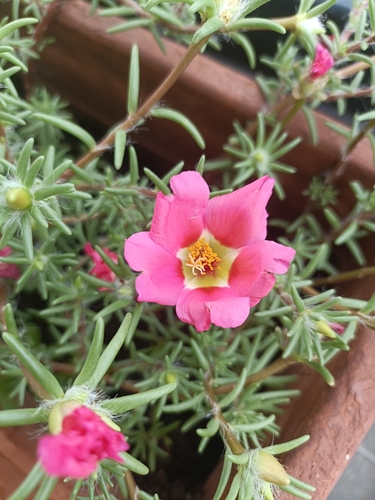
How to care for moss rose
Watering
Moss rose (Portulaca grandiflora) is a succulent-like annual from dry, sandy soils in South America, so it stores water in its fleshy leaves and stems and prefers to dry out between drinks. Let the top 2-3 cm of soil dry completely, then water deeply until it drains from the pot. Always use a pot or bed with excellent drainage, because soggy roots are the most common cause of failure. In cooler, low-light months, water much less often.
Does it need water today?
Push a finger 2-3 cm into the soil. If it feels dry and crumbly, it needs water. You can also lift the pot: if it feels very light compared with the last watering, the soil is dry. If the soil is still damp or the stems look soft, wait several more days.
Water at the base of the plant in the morning so the foliage dries quickly. Moss rose tolerates drought far better than too much water, so when in doubt, wait one more day.
Overwatering
Moss rose comes from arid, sandy ground where roots never sit in wet soil, so its fleshy stems store water and its roots are poorly equipped to handle saturation. Constantly damp soil quickly leads to root and stem rot.
Symptoms: Yellowing leaves, soft or mushy stems near the soil line, a sour smell from the soil, black or brown roots, and sudden wilting even though the soil is wet.
Solutions: Stop watering immediately and let the soil dry out. Remove the plant, cut away any soft or black roots with clean scissors, and replant in fresh, gritty, fast-draining mix in a pot with drainage holes. Water only when the soil is dry, and make sure the pot is not sitting in a saucer of water.
Underwatering
Moss rose is drought tolerant, but it still needs enough water to keep its succulent stems and leaves plump, especially when it is flowering and growing in full sun. Long dry spells during hot weather stress the plant and reduce blooming.
Symptoms: Wrinkled or limp leaves, stems that look thin and shrivelled, flower buds that drop before opening, and soil that pulls away from the edges of the pot.
Solutions: Water thoroughly until it drains from the bottom, then keep the soil lightly moist for the next few days as the plant recovers. If the soil has shrunk away from the pot, soak the whole pot in a tray of water for 20 minutes. Increase watering frequency only during hot, sunny weather.
Sunlight
Moss rose is a sun-loving plant native to open, sunny grasslands and sandy plains, and its flowers open fully only in strong sunlight. Give it the brightest, sunniest spot you have. Flowers tend to close on cloudy days and in the evening, which is normal behaviour for this species.
- Ideal: Full sun · 6-8 hours of direct sun per day
- Tolerates: Full sun, Partial sun
- Best spot in a room: At the window
- Artificial light: Moss rose rarely does well indoors without strong light. If your room is dim, use a full-spectrum LED grow light about 15-30 cm above the plant for 10-12 hours a day. Without enough light, stems stretch, leaves become sparse, and flowering stops.
Too little light
Moss rose needs intense sunlight to build the sturdy, compact growth and large flowers it is known for. In shade, its stems stretch toward any available light and it produces few or no blooms.
Symptoms: Leggy, weak stems that lean toward the light, pale small leaves spaced far apart, few or no flowers, and slow growth.
Solutions: Move the plant to the sunniest location available, such as a south- or west-facing window or a sunny spot outdoors. Rotate the pot every week so growth stays even. Add a full-spectrum LED grow light if natural light is limited, and trim leggy stems to encourage branching.
Too much sun
Moss rose handles strong sun well, so true sunburn is uncommon. However, a sudden move from shade into intense midday sun, or very hot reflected heat from walls and paving, can scorch its leaves and dry out the soil quickly.
Symptoms: Bleached or brown patches on leaves, crispy leaf edges, wilting during the hottest part of the day, and soil drying out much faster than usual.
Solutions: Acclimatise the plant gradually over one to two weeks when moving it to brighter sun. During heatwaves, water a little more often and provide light afternoon shade with a sheer curtain or shade cloth if temperatures climb above about 35°C.
Temperature
Moss rose (Portulaca grandiflora) is a warm-season annual from subtropical South America that thrives in heat and full sun. It opens its flowers only in bright sunshine and closes them in cloud or evening, so keep it somewhere warm and sunny for the best display. Frost kills it, so plant outdoors only after the last frost date has passed and nights stay above about 10°C.
- Ideal: 18–32 °C
- Tolerates: 2–40 °C
- Hardiness zones: 10-11 (grown as an annual elsewhere)
Fertilizing
Moss rose blooms best in poor to average soil and does not need rich feeding. Too much nitrogen produces lush leaves and few flowers. Feed lightly during the growing season and let the plant rest through cooler months.
- Slow-release fertilizer: Once at planting time in spring, mix in a slow-release granular fertilizer, or skip it if the soil is already fertile.
- Low-nitrogen, high-phosphorus liquid fertilizer such as a 5-10-5 or bloom-booster formula, Slow-release granular fertilizer with balanced or phosphorus-rich nutrients, Compost worked lightly into the soil before planting
Soil
Moss rose needs sharp drainage and lean, sandy soil. Rich, heavy, or moisture-retaining mixes cause stem rot and weak, floppy growth, so avoid standard potting soil used alone.
- Cactus or succulent mix: Roughly 60-70% mineral grit such as perlite or coarse sand, with a smaller share of peat-free potting compost
- Sandy garden loam: Mixed sand and loam with some compost, suitable for in-ground planting in sunny, well-drained beds
- Homemade blend: Two parts potting compost, one part perlite, and one part coarse sand, mixed thoroughly before planting
- pH 6–7.5
Repotting
Choose a pot with drainage holes. Moss rose (Portulaca grandiflora) is a succulent-like annual-type plant that hates soggy roots, so drainage matters more than pot material. Terracotta is ideal because it dries evenly.
- How often: Every 1-2 years, or when roots fill the pot or the plant dries out within a day of watering
- New pot: Move up only one size, about 2-3 cm wider than the current pot. Moss roses have shallow roots and sit poorly in oversized pots, where wet soil stays cold and can rot the stems.
- Repotting season: Spring, Summer
How to repot
- Tip the pot on its side and gently ease the plant out by its base, never pulling on the stems
- Loosen the outer roots with your fingers and shake off old, compacted soil
- Trim any brown, mushy roots with clean scissors and leave healthy white or pale roots intact
- Place a layer of fresh mix in the new pot so the top of the root ball sits about 1 cm below the rim
- Fill around the roots with mix, pressing lightly to remove large air pockets
- Water lightly to settle the soil, then let the top 2 cm dry before the next full watering
Pruning
Moss rose is a fleshy, succulent-stemmed annual that tolerates pinching well but does not recover from hard cuts into old, woody growth. Pinch or trim only the soft green tips, and never cut back below the leafy part of the stem.
Pruning season: Spring, Summer
How to prune
- In late spring, when the plant is about 10 cm tall, pinch off the top 2 to 3 cm of each main stem just above a leaf node to encourage side branching.
- Through summer, deadhead faded flowers every few days by snipping or pinching them off at the base of the flower stalk.
- If the plant becomes leggy or sprawls over a path, cut back long stems by about one third, cutting just above a leaf node.
- Remove any yellowed, mushy, or diseased stems at the base, and dispose of them in the trash rather than the compost.
- In autumn, after frost has killed the plant, pull it out and compost the healthy material, since moss rose does not overwinter outdoors in most climates.
Propagation
Stem cuttings · Spring, Summer
- Take 8 to 10 cm cuttings from healthy, non-flowering shoot tips of the moss rose in late spring or early summer.
- Strip the lower leaves so one or two nodes are bare, and let the cut end dry for an hour or so.
- Fill a small pot with a gritty mix of sand and peat or perlite, and water it lightly.
- Insert the cutting about 2 cm deep, firm the mix around it, and keep it in bright, indirect light at 20 to 25 °C.
- Roots usually form in one to two weeks. Once you feel resistance when gently tugging, move the plant to full sun.
Seed sowing · Spring
- Wait until frost has passed and night temperatures stay above 10 °C, since moss rose seedlings are very frost-tender.
- Scatter the tiny seeds on the surface of moist, sandy soil in a sunny bed or a tray. Do not cover them deeply; they need light to germinate.
- Mist the surface gently and keep it lightly moist until seedlings appear, usually within 7 to 14 days.
- Thin seedlings to about 15 cm apart once they have a few true leaves.
- Expect blooms about 8 to 10 weeks after sowing, as the plant flowers through summer.
Root division of self-sown clumps · Spring
- Choose a mature moss rose clump that has spread in early spring, before new heavy growth starts.
- Dig gently around the clump and lift it with a fork, keeping as many fine roots as possible.
- Pull or cut the clump into sections, each with several shoots and roots.
- Replant the sections at the same depth they grew before, and water them well.
- Shade them lightly for a few days while they recover.
Moss rose seeds and cuttings root readily, but both fail in cold, wet soil. Waiting for warm weather matters more than any special technique.
About moss rose
Also known as: Moss rose, Sun rose, Rose moss, Eleven o'clock
- Plant type: annual herb, succulent
- Lifespan: annual
- Distribution: Native to southern Brazil, Uruguay and northern Argentina in South America.
- Mature height: 10-20 cm
- Bloom time: Summer to early autumn
Pets · People
Pets: Safe · People: Safe. Not listed as toxic to dogs, cats or humans by the ASPCA; the succulent leaves are edible and mildly tart, though not normally eaten in quantity.
Common problems
- Root and stem rot: Caused by overwatering or heavy, wet soil; leads to wilting and blackened stem bases.
- Aphids: Cluster on young shoots and flower buds, sometimes distorting growth.
- Closed flowers in shade: Insufficient sunlight keeps blooms shut and plants leggy.
- Spider mites: Appear in hot, dry conditions as fine stippling and webbing on leaves.
Uses
Grown mainly as an ornamental for bedding, edging, containers, hanging baskets and rock gardens. Breeding has produced many double-flowered cultivars prized in summer displays. Its leaves are occasionally used in salads and as a cooked vegetable in parts of its native range.
Is it edible?
Leaves and young stems are edible raw or cooked, with a mild, slightly sour taste; flowers are also edible as a garnish.
History & legends
Portulaca grandiflora was introduced to European gardens in the 1800s after collection in South America and quickly became a popular bedding plant. Its name recalls the Latin portula, a little gate, possibly referring to the way the fleshy leaves and stems seem to guard moisture within. Gardeners in the nineteenth century prized its ability to flourish in dry, sunny spots where many flowers failed.
Did you know?
Each moss rose flower opens only in bright sunshine and closes by late afternoon, so a sunny bed can look very different at dusk than at noon.
Frequently asked questions
How often should I water moss rose?
every 7 days. Moss rose (Portulaca grandiflora) is a succulent-like annual from dry, sandy soils in South America, so it stores water in its fleshy leaves and stems and prefers to dry out between drinks. Let the top 2-3 cm of soil dry completely, then water deeply until it drains from the pot. Always use a pot or bed with excellent drainage, because soggy roots are the most common cause of failure. In cooler, low-light months, water much less often. Push a finger 2-3 cm into the soil. If it feels dry and crumbly, it needs water. You can also lift the pot: if it feels very light compared with the last watering, the soil is dry. If the soil is still damp or the stems look soft, wait several more days.
How much light does moss rose need?
Full sun (6-8 hours of direct sun per day). Moss rose is a sun-loving plant native to open, sunny grasslands and sandy plains, and its flowers open fully only in strong sunlight. Give it the brightest, sunniest spot you have. Flowers tend to close on cloudy days and in the evening, which is normal behaviour for this species.
What temperature does moss rose like?
18–32 °C. Moss rose (Portulaca grandiflora) is a warm-season annual from subtropical South America that thrives in heat and full sun. It opens its flowers only in bright sunshine and closes them in cloud or evening, so keep it somewhere warm and sunny for the best display. Frost kills it, so plant outdoors only after the last frost date has passed and nights stay above about 10°C.
Is moss rose toxic to cats and dogs?
It is safe for cats and dogs. Not listed as toxic to dogs, cats or humans by the ASPCA; the succulent leaves are edible and mildly tart, though not normally eaten in quantity.
What are the most common problems of moss rose?
Root and stem rot: Caused by overwatering or heavy, wet soil; leads to wilting and blackened stem bases. Aphids: Cluster on young shoots and flower buds, sometimes distorting growth. Closed flowers in shade: Insufficient sunlight keeps blooms shut and plants leggy. Spider mites: Appear in hot, dry conditions as fine stippling and webbing on leaves.
When should I repot moss rose?
Every 1-2 years, or when roots fill the pot or the plant dries out within a day of watering. Choose a pot with drainage holes. Moss rose (Portulaca grandiflora) is a succulent-like annual-type plant that hates soggy roots, so drainage matters more than pot material. Terracotta is ideal because it dries evenly.
How do I propagate moss rose?
Stem cuttings, Seed sowing, Root division of self-sown clumps. Take 8 to 10 cm cuttings from healthy, non-flowering shoot tips of the moss rose in late spring or early summer. Strip the lower leaves so one or two nodes are bare, and let the cut end dry for an hour or so. Fill a small pot with a gritty mix of sand and peat or perlite, and water it lightly. Insert the cutting about 2 cm deep, firm the mix around it, and keep it in bright, indirect light at 20 to 25 °C. Roots usually form in one to two weeks. Once you feel resistance when gently tugging, move the plant to full sun.
How this guide was written
Verdiss writes each guide with AI from botanical references and checks the species against iNaturalist and Plants of the World Online (Kew). Readers can rate every guide in the app.
Sources
Verdiss's information is for general guidance. Never eat or use a plant as medicine based on an app: ask a professional.