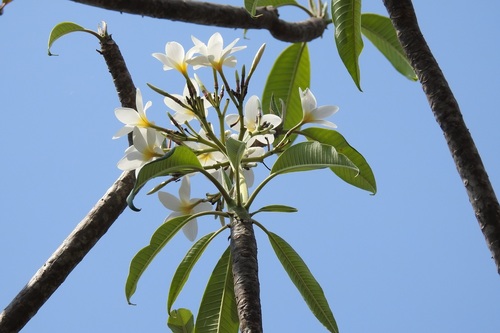
How to care for Mexican Plumeria
Watering
Mexican Plumeria (Plumeria rubra) is a succulent-stemmed tree that stores water in its thick trunk and branches, so it prefers to dry out fully between waterings. Water deeply when the top 5 cm of soil is dry, then let the excess drain freely. In winter, when the plant is dormant and often leafless indoors, water only very sparingly, perhaps once a month, to keep the stems from shriveling. Never let the pot sit in water, because soggy roots quickly lead to rot at the base.
Does it need water today?
Push a finger 5 cm into the soil. If it feels dry, water. You can also lift the pot: a dry pot feels noticeably light. Check the trunk too; firm, plump stems mean the plant has enough water, while wrinkled or soft stems mean it is thirsty or, if the soil is wet, possibly rotting.
Plumeria rubra hates wet feet more than drought. When in doubt, wait a few extra days. A pot with a large drainage hole and a gritty, fast-draining mix, such as cactus soil with perlite, makes watering far easier to get right.
Overwatering
Mexican Plumeria stores water in its trunk and fleshy stems, so it is far more vulnerable to rot than most flowering plants. Constantly wet soil deprives its roots of oxygen, and a stem that has lost its firmness is a sign the damage is already advanced.
Symptoms: Soft, mushy or blackened trunk near the soil line, yellowing leaves that drop, a sour smell from the soil, and fungus gnats hovering around the pot.
Solutions: Stop watering immediately and let the soil dry out. Remove the plant from its pot, cut away any soft or dark tissue with a clean knife, and let the cut surfaces callus for a few days in shade. Repot into fresh, fast-draining soil in a clean pot with drainage holes.
Underwatering
Plumeria rubra is adapted to dry seasons, so it tolerates drought better than overwatering. However, a long dry spell during the growing season causes the stems to lose their plumpness and the plant to stop flowering.
Symptoms: Wrinkled or shriveled stems, crispy brown leaf edges, leaves dropping in the growing season, and buds that fall off before opening.
Solutions: Water thoroughly until it drains, then resume a regular schedule as soil dries. Increase the frequency gradually over a week rather than soaking the plant all at once. Stems should firm up within a few weeks of consistent watering.
Sunlight
Mexican Plumeria (Plumeria rubra) is a sun-loving tropical tree that blooms best with full, direct sunlight. In too little light it grows leggy, produces few flowers, and its leaves may stay small and pale. Give it the brightest, sunniest spot you have, and move it gradually into full sun in spring to avoid leaf scorch.
- Ideal: Full sun · 6-8 hours of direct sun daily
- Tolerates: Full sun, Partial sun, Bright, indirect light
- Best spot in a room: At the window
- Artificial light: If you grow it indoors without enough natural sun, use a strong full-spectrum grow light placed 30 to 60 cm above the canopy for 12 to 14 hours a day during the growing season. Standard household bulbs are generally too weak to keep Plumeria rubra healthy.
Too little light
Plumeria rubra needs strong sunlight to build the energy reserves for flowering. Without it, the plant stretches toward any available light, its trunk stays thin, and it may skip blooming altogether.
Symptoms: Long, weak stems with large gaps between leaves, pale or small leaves, no flower buds, and leaves dropping from the lower branches.
Solutions: Move the plant to the sunniest location available, ideally a south-facing window or outdoors in full sun. Acclimatize it over one to two weeks to avoid sunburn. Add a grow light if sunlight is limited.
Too much sun
Although Mexican Plumeria thrives in intense sun, a plant grown in shade or indoors and then suddenly placed in strong midday sun can burn. Its leaves have a waxy surface, but they are still vulnerable when moved abruptly.
Symptoms: Bleached or brown scorched patches on leaves, wilting during hot afternoons even when the soil is moist, and crispy leaf edges.
Solutions: Introduce the plant to full sun gradually, starting with a few hours of morning sun. Provide light afternoon shade during heat waves if the leaves show stress, and keep watering consistent so the plant can cope with the heat.
Temperature
Plumeria rubra, the Mexican Plumeria, is a tropical tree that thrives in warm air and full sun. It grows best when days stay above 20°C and nights do not drop below about 15°C. Frost kills it, so in most of the Northern Hemisphere it lives outdoors only in summer and must be moved indoors before the first cold nights.
- Ideal: 18–32 °C
- Tolerates: 10–40 °C
- Hardiness zones: 10-11
Fertilizing
Mexican Plumeria flowers best when it gets more phosphorus than nitrogen. Too much nitrogen gives lush green leaves and very few blooms. Feed mainly during the active growing season, from spring to early autumn, and stop feeding before cool weather arrives so new growth does not get damaged by frost.
- Slow-release fertilizer: Apply once a year in early spring, just before new growth begins, following the label rate for trees and shrubs.
- Low-nitrogen, high-phosphorus liquid fertilizer such as a 10-30-10 or bloom booster formula, Slow-release granular fertilizer with a balanced or phosphorus-rich formula, Bone meal or rock phosphate as a supplement for flowering
Soil
Mexican Plumeria needs soil that drains freely and holds air around its fleshy roots. Heavy garden clay or dense all-purpose soil stays wet too long and causes trunk and root rot, so always use a gritty, well-aerated mix in pots and raised beds.
- Cactus and succulent mix: About 50% potting mix, 30% perlite or pumice, and 20% coarse sand or fine bark
- Amended tropical potting mix: Two parts peat-free potting soil, one part perlite, and one part orchid bark chips
- Free-draining container mix for trees: Equal parts coarse pumice, pine bark fines, and quality potting soil
- pH 6–7.5
Repotting
Use a pot with at least one large drainage hole. Terracotta is ideal because it dries quickly. Repot in late spring once night temperatures stay above 15°C, because Mexican Plumeria roots are slow to recover in cold, damp soil.
- How often: Every 2-3 years, or when roots fill the pot or a young plant outgrows it
- New pot: Choose a pot only 2-5 cm wider than the root ball. Plumeria rubra hates wet feet, so a pot that is too big holds moisture around the roots and invites rot.
- Repotting season: Spring, Summer
How to repot
- Gently tip the plant out of its pot, supporting the trunk at the base with one hand
- Loosen the outer roots with your fingers and trim any roots that are black, mushy, or smell sour, using sterilized shears
- Add a 3-5 cm layer of fresh mix to the bottom of the new pot and set the plant so the top of the root ball sits about 2 cm below the rim
- Fill around the roots with mix, tapping the pot lightly to remove large air pockets without packing the soil down hard
- Water thoroughly until it drains out the bottom, then let the pot drain completely
- Wait about a week before watering again so any small root damage can heal
Pruning
Prune Plumeria rubra while it is leafless or just beginning to leaf out in late winter or early spring, before strong new growth starts. Light trimming in autumn, after flowering, is also fine. Avoid heavy pruning during active summer growth or when temperatures drop below 10°C, since fresh cuts heal slowly in cold, wet conditions.
Pruning season: Spring, Autumn
How to prune
- Remove any dead, dried, or shriveled branches first, cutting back to healthy green or firm tissue.
- Thin out crossing or rubbing branches so that light can reach the centre of the plant.
- Shorten long, leggy branches by cutting just above a leaf node or bud, angled slightly so water runs off.
- Limit cuts to no more than about one-third of the plant in a single season to avoid stress.
- Clean up fallen leaves and debris, and dispose of diseased material rather than composting it.
- Wipe the cut surfaces lightly with a fungicide paste on large wounds, and keep the plant out of heavy rain until the cuts have dried.
Propagation
Stem cutting · Spring, Summer
- Choose a healthy, firm, non-flowering branch about 30-45 cm long with several leaf nodes, taken in late spring or early summer when the plant is actively growing.
- Cut the stem just below a node using clean, sharp pruners, then let the cut end, which exudes milky latex, drip for a few minutes and dry in shade for 5-7 days until a callus forms.
- Dip the calloused end in rooting hormone if you like, then insert it about 5 cm deep into a free-draining mix of perlite and coarse sand or cactus soil.
- Keep the pot in bright, indirect light at 24-30°C and water only when the mix is fully dry, since wet cuttings rot quickly.
- Roots usually form within 4-8 weeks. Gently tug the cutting to check for resistance before moving it into a larger pot.
Air layering · Summer
- Pick a mature, woody branch of at least 1 cm diameter and make a 2-3 cm ring cut through the bark down to the wood, removing the ring of bark completely.
- Dust the exposed wood with rooting hormone and wrap the cut with damp sphagnum moss, then cover the moss with clear plastic and tape both ends shut.
- Keep the moss moist but not soaking, and check it every couple of weeks during warm weather.
- When white roots are visible through the plastic, usually within 2-4 months, cut the branch below the rooted section and pot it in well-draining mix.
Seed · Spring
- Collect mature seed pods in late autumn or winter, since Mexican Plumeria seeds are often sterile or slow to germinate in home conditions.
- Soak the winged seeds in warm water for 12-24 hours, then sow them shallowly in a seed tray of moist, sandy mix.
- Keep the tray at 25-30°C in bright light and mist lightly to keep the surface damp.
- Germination may take several weeks. Transplant seedlings once they have true leaves, and expect flowering to take several years.
Cuttings from the previous season's mature wood root more reliably than soft green shoots. Allowing the cut end to callus fully before planting is the single most important step for preventing rot.
About Mexican Plumeria
Also known as: Mexican frangipani, Red frangipani, Nosegay
- Plant type: tree, shrub
- Lifespan: perennial
- Distribution: Native to Mexico and Central America, from southern Mexico through to Honduras and Nicaragua.
- Mature height: 3-8 m in the wild, 1.5-3 m in containers
- Bloom time: Late spring to autumn in frost-free regions; indoors, mostly summer
Pets · People
Pets: Toxic · People: Mildly toxic. The milky latex in all parts is irritating to skin and eyes and causes vomiting and diarrhea if swallowed. ASPCA lists the genus Plumeria as toxic to dogs, cats and horses. Keep out of reach of children and pets, and wear gloves when pruning.
Common problems
- Root and stem rot: Caused by waterlogged soil and poor drainage. Stems turn soft and black at the base; reduce watering and repot into fresh, gritty mix.
- Leaf drop in autumn: Normal deciduous behavior as days shorten, not a sign of disease. Water less and keep the plant in a bright, cool spot until spring.
- Plumeria rust: A fungal disease causing yellow-to-brown spots with orange-brown powder on the undersides of leaves. Remove affected leaves and avoid overhead watering.
- Scale insects: Brown bumps on stems and leaf undersides that suck sap and leave sticky honeydew. Wipe off with alcohol on a cotton swab or use horticultural oil.
- Failure to flower: Usually caused by too little sun, too much nitrogen or a cold winter rest period. Give full sun and a low-nitrogen, higher-phosphorus feed.
Uses
Widely grown as an ornamental tree and container plant in warm regions for its fragrant flowers. The flowers are used in leis, perfumes, and in religious and ceremonial garlands in parts of Asia and the Pacific. In Mexico and Central America the plant has long been used in folk medicine, and the latex has traditional uses, though it is toxic.
Is it edible?
not edible
History & legends
Plumeria is named after the French botanist Charles Plumier, who traveled the Caribbean in the late 1600s and described the genus. Spanish colonists carried plumerias from the Americas to Asia and the Pacific, where they became central to temple gardens and lei-making traditions. In many Asian cultures the flowers are placed on graves and shrines, and in Hawaii they are a symbol of hospitality.
Did you know?
Plumeria flowers are traditionally woven into leis in Hawaii, and a flower worn behind the left ear is said to signal a relationship, while the right ear means single.
Frequently asked questions
How often should I water Mexican Plumeria?
every 10 days. Mexican Plumeria (Plumeria rubra) is a succulent-stemmed tree that stores water in its thick trunk and branches, so it prefers to dry out fully between waterings. Water deeply when the top 5 cm of soil is dry, then let the excess drain freely. In winter, when the plant is dormant and often leafless indoors, water only very sparingly, perhaps once a month, to keep the stems from shriveling. Never let the pot sit in water, because soggy roots quickly lead to rot at the base. Push a finger 5 cm into the soil. If it feels dry, water. You can also lift the pot: a dry pot feels noticeably light. Check the trunk too; firm, plump stems mean the plant has enough water, while wrinkled or soft stems mean it is thirsty or, if the soil is wet, possibly rotting.
How much light does Mexican Plumeria need?
Full sun (6-8 hours of direct sun daily). Mexican Plumeria (Plumeria rubra) is a sun-loving tropical tree that blooms best with full, direct sunlight. In too little light it grows leggy, produces few flowers, and its leaves may stay small and pale. Give it the brightest, sunniest spot you have, and move it gradually into full sun in spring to avoid leaf scorch.
What temperature does Mexican Plumeria like?
18–32 °C. Plumeria rubra, the Mexican Plumeria, is a tropical tree that thrives in warm air and full sun. It grows best when days stay above 20°C and nights do not drop below about 15°C. Frost kills it, so in most of the Northern Hemisphere it lives outdoors only in summer and must be moved indoors before the first cold nights.
Is Mexican Plumeria toxic to cats and dogs?
It is toxic to cats and dogs: keep it out of their reach. The milky latex in all parts is irritating to skin and eyes and causes vomiting and diarrhea if swallowed. ASPCA lists the genus Plumeria as toxic to dogs, cats and horses. Keep out of reach of children and pets, and wear gloves when pruning.
What are the most common problems of Mexican Plumeria?
Root and stem rot: Caused by waterlogged soil and poor drainage. Stems turn soft and black at the base; reduce watering and repot into fresh, gritty mix. Leaf drop in autumn: Normal deciduous behavior as days shorten, not a sign of disease. Water less and keep the plant in a bright, cool spot until spring. Plumeria rust: A fungal disease causing yellow-to-brown spots with orange-brown powder on the undersides of leaves. Remove affected leaves and avoid overhead watering. Scale insects: Brown bumps on stems and leaf undersides that suck sap and leave sticky honeydew. Wipe off with alcohol on a cotton swab or use horticultural oil. Failure to flower: Usually caused by too little sun, too much nitrogen or a cold winter rest period. Give full sun and a low-nitrogen, higher-phosphorus feed.
When should I repot Mexican Plumeria?
Every 2-3 years, or when roots fill the pot or a young plant outgrows it. Use a pot with at least one large drainage hole. Terracotta is ideal because it dries quickly. Repot in late spring once night temperatures stay above 15°C, because Mexican Plumeria roots are slow to recover in cold, damp soil.
How do I propagate Mexican Plumeria?
Stem cutting, Air layering, Seed. Choose a healthy, firm, non-flowering branch about 30-45 cm long with several leaf nodes, taken in late spring or early summer when the plant is actively growing. Cut the stem just below a node using clean, sharp pruners, then let the cut end, which exudes milky latex, drip for a few minutes and dry in shade for 5-7 days until a callus forms. Dip the calloused end in rooting hormone if you like, then insert it about 5 cm deep into a free-draining mix of perlite and coarse sand or cactus soil. Keep the pot in bright, indirect light at 24-30°C and water only when the mix is fully dry, since wet cuttings rot quickly. Roots usually form within 4-8 weeks. Gently tug the cutting to check for resistance before moving it into a larger pot.
How this guide was written
Verdiss writes each guide with AI from botanical references and checks the species against iNaturalist and Plants of the World Online (Kew). Readers can rate every guide in the app.
Sources
Verdiss's information is for general guidance. Never eat or use a plant as medicine based on an app: ask a professional.