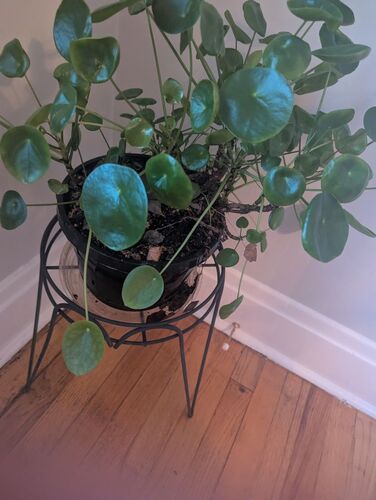
How to care for Chinese money plant
Watering
Chinese money plant (Pilea peperomioides) stores water in its thick, round-leafed stems and rhizomatous roots, so it tolerates drying out far better than it tolerates soggy soil. Water thoroughly until it drains from the pot, then let the top 2-3 cm of compost dry before watering again. Use a pot with drainage holes and empty the saucer after 15 minutes so the roots never sit in water. Water less in winter, when growth slows and the soil stays wet for longer.
Does it need water today?
Push a finger 2-3 cm into the compost. If it feels dry, water. If it still feels cool or damp, wait a few days. You can also lift the pot: a freshly watered pot feels heavy, while a dry one feels light. Pale, slightly soft leaf stalks can be an early sign of thirst, but check the soil first.
Water at the soil level, not over the leaves, and keep the rosette centre dry to avoid rot. Rotating the pot each time you water keeps the plant growing evenly toward the light.
Overwatering
Chinese money plant grows from fleshy stems and shallow roots that are easily damaged by waterlogged compost. Constantly wet soil cuts off oxygen to the roots, and the stems soften and rot.
Symptoms: Yellowing lower leaves, soft or translucent stem bases, a sour smell from the compost, and black or mushy roots. Leaves may drop even though the soil feels wet.
Solutions: Stop watering immediately and let the compost dry out. Remove the plant from its pot, cut away any black or mushy roots with clean scissors, and repot into fresh, fast-draining compost with a pot that has drainage holes. If the crown is rotten, take healthy stem cuttings to propagate.
Underwatering
Chinese money plant stores water in its stems and leaves, so it copes with short dry spells. Prolonged drought, however, drains these reserves and makes the leaves lose firmness.
Symptoms: Leaves that curl, droop, or feel thin and papery, with wrinkled stems and compost pulling away from the pot edges. Lower leaves may yellow and drop.
Solutions: Water thoroughly, then leave the pot to drain. If the compost has shrunk away from the sides or is hydrophobic, soak the pot in a tray of water for 20 minutes. Once the plant rehydrates over several days, the leaves should firm up again. Trim any dead, crispy leaves.
Sunlight
Chinese money plant (Pilea peperomioides) grows best in bright, indirect light, similar to the dappled light under a tree canopy. Direct midday sun can scorch its thin, round leaves, turning them pale or brown at the edges. Too little light makes the plant stretch toward the window with long stems and small, widely spaced leaves. Rotate the pot a quarter turn every week or two for an even, compact shape.
- Ideal: Bright, indirect light · 4-6 hours of bright, filtered light per day
- Tolerates: Bright, indirect light, Partial sun
- Best spot in a room: Near the window
- Artificial light: A full-spectrum LED grow light placed 30-45 cm above the plant for 10-12 hours a day works well in dark rooms or during short winter days. Use a timer to keep the schedule consistent.
Too little light
Chinese money plant needs enough light to make the energy it uses to produce its thick stems and dense rosette. In low light, growth becomes weak and the plant reaches out for the nearest light source.
Symptoms: Long, leggy stems, leaves held far apart, smaller new leaves, leaves that point downward or lean sideways, and slow growth or no new leaves for months.
Solutions: Move the plant closer to a bright east, north-facing, or south-facing window, or add a grow light. Gradually increase light exposure over a week or two to avoid shock. Once the plant recovers, prune leggy stems back to a healthy node to encourage bushier growth.
Too much sun
Chinese money plant can handle bright light, but strong, unfiltered sun through glass, especially in summer, can overheat and dry out its thin leaves faster than the roots can supply water.
Symptoms: Pale yellow or bleached patches on the top leaves, brown crispy edges, leaves that curl upward or fold, and dry compost that dries out much faster than usual.
Solutions: Move the plant a metre back from the window or behind a sheer curtain during the brightest hours. Water a little more often while it adjusts, and check the compost each time. Damaged leaves will not recover their colour, so remove them to keep the plant looking tidy.
Temperature
Chinese money plant (Pilea peperomioides) grows best in steady indoor warmth between 18 and 24°C. It tolerates short dips to about 10°C but suffers quickly below that. Keep it away from cold drafts and direct heat sources.
- Ideal: 18–24 °C
- Tolerates: 10–30 °C
- Hardiness zones: 10-12
Fertilizing
Chinese money plant is a moderate feeder that grows fastest in spring and summer. Feed only while it is actively producing new leaves, and always water first so the roots are not shocked by concentrated fertilizer. Fertilizer is not needed in winter when growth slows.
- Slow-release fertilizer: Once a year in early spring, mix a small amount of slow-release granules into the top layer of soil. Skip this if you repot in spring with fresh potting mix.
- Balanced liquid houseplant fertilizer (such as 10-10-10 or 20-20-20), Slow-release granular houseplant fertilizer, Diluted organic liquid fertilizer such as fish emulsion or seaweed extract
Soil
Chinese money plant needs a loose, well-aerated mix that drains freely. Its thin, fibrous roots rot quickly in dense or waterlogged soil, so a standard heavy garden soil is unsuitable in a pot.
- Peat-free all-purpose potting mix with added perlite: About 60% quality peat-free potting compost, 30% perlite or horticultural grit, and 10% coir or fine bark for structure
- Cactus and succulent mix: Commercial cactus mix, sometimes stretched with extra perlite, which drains quickly but holds less moisture for the roots
- Homemade blend: Equal parts standard potting mix, perlite, and orchid bark, giving roots air pockets while retaining enough moisture between waterings
- pH 6–7
Repotting
Chinese money plant (Pilea peperomioides) has a shallow, fibrous root system and produces many offsets, so it prefers a snug pot and dislikes sitting in wet soil. Repot during active growth in spring or early summer.
- How often: Every 1-2 years, or when roots fill the pot and push up through the drainage holes
- New pot: Move up only one size, about 2-5 cm wider in diameter, with a drainage hole in the base
- Repotting season: Spring, Summer
How to repot
- Tip the pot on its side and gently ease the plant out, supporting the base of the stem
- Loosen the outer roots with your fingers and trim any brown, mushy, or dead roots
- Remove a few old soil particles but do not wash the roots completely
- Separate offsets (baby plants) at the base if you want more plants, keeping roots attached to each
- Place a layer of fresh mix in the new pot so the root ball sits at the same depth as before
- Set the plant in the center, fill around the roots with mix, and firm it gently
- Leave about 2 cm of space below the rim so water does not run over the edge
- Water thoroughly until it drains out the bottom, then empty the saucer
Pruning
Chinese money plant grows from a thin central stem with leaves held on long petioles at the top, so trim only what you need and leave enough foliage for the plant to keep photosynthesizing.
Pruning season: Spring, Summer
How to prune
- Identify stems that are yellowing, brown-tipped, damaged, or growing sharply toward a window.
- Cut each unwanted stem at its base, close to the soil line, or just above a leaf node for shaping.
- Remove no more than about one-third of the foliage at one time to avoid stressing the plant.
- Rotate the pot a quarter turn every week or two so the plant grows evenly.
- Dispose of or root any removed healthy stems, and wipe your tools with rubbing alcohol before moving to another plant.
Propagation
Offsets (pups) separation · Spring, Summer
- Wait until a mature Chinese money plant produces small baby plants (pups) at the base of the mother stem, usually when the pup has at least three to four leaves and its own small root system.
- Fill a small pot with a free-draining mix of potting soil and perlite or coarse sand.
- Gently ease the mother plant out of its pot and locate the pup where it joins the parent's root ball.
- Cut or gently pull the pup away, keeping as many roots attached as possible.
- Plant the pup at the same depth it grew, water lightly, and keep it in bright indirect light at 18–24°C until new growth appears.
Stem cuttings in water or soil · Spring, Summer
- Choose a healthy stem with several leaves and cut it just below a leaf node using clean scissors.
- Remove the lower leaves so at least one node sits bare.
- Let the cut end dry for a few hours so it can form a callus, which helps prevent rot.
- Place the cutting in a glass of water so the bare node is submerged, or insert it into moist, well-draining soil.
- Keep the cutting in bright indirect light, change the water weekly if rooting in water, and expect roots within several weeks.
Leaf propagation from leaf petioles · Spring, Summer
- Select a firm, healthy leaf and gently twist it off at the base so the small stalk (petiole) stays attached.
- Allow the leaf to dry for a day so the wound seals.
- Insert the petiole about 1 cm deep into a pot of moist, sandy mix, keeping the leaf above the surface.
- Keep the soil barely moist and the pot in bright, indirect light.
- Wait several weeks for a tiny pup to form at the base of the petiole, then treat it as an offset once it has roots.
Chinese money plant pups are the easiest and most reliable route for beginners. Water sparingly while roots form, because soggy soil causes the stem base to rot quickly.
About Chinese money plant
Also known as: Chinese money plant, Pancake plant, Friendship plant, UFO plant
- Plant type: herb, perennial houseplant
- Lifespan: perennial
- Distribution: Native to Yunnan province in southwestern China, growing in shaded, moist rocky areas at mid elevations.
- Mature height: 20-40 cm indoors
- Bloom time: Rarely flowers indoors; small whitish flowers are occasionally produced on mature plants.
Pets · People
Pets: Safe · People: Safe. Pilea peperomioides is not listed as toxic by the ASPCA for cats, dogs or horses, and no toxic principles are reported for humans. It is generally considered non-irritating, though large quantities of any plant material may upset a stomach.
Common problems
- Root rot: Caused by overwatering or pots without drainage; leaves turn yellow and the stems go soft at the base. Let soil dry more between waterings.
- Leggy growth: Stems stretch and leaves droop toward the light source in low light. Move the plant closer to a bright window and rotate it regularly.
- Curling or drooping leaves: Often a sign of underwatering or too much direct sun. Check soil moisture and move away from harsh light.
- Spider mites: Fine webbing and speckled leaves appear in dry indoor air. Wipe leaves regularly and raise humidity around the plant.
- Brown leaf edges: Usually caused by dry air, sun scorch, or salt build-up from fertilizer. Flush the soil occasionally and keep the plant away from heaters.
Uses
Grown primarily as an ornamental houseplant prized for its unusual coin-shaped leaves and easy care. It is also used in interior design and as a gift plant. It has no significant medicinal, culinary or industrial use recorded.
Is it edible?
not edible
History & legends
The plant was known to Chinese botanists in Yunnan for generations before reaching Europe. In the 1940s Norwegian missionary Agnar Espegren brought cuttings from China to Norway and shared them with friends and family, and the plant spread through gift-giving across Scandinavia and beyond. Its popularity exploded in the 2010s, when it became a staple of social media plant culture.
Did you know?
Its nickname 'pancake plant' comes from its flat, round leaves, and its pups are so easy to share that it is often called the 'friendship plant'.
Frequently asked questions
How often should I water Chinese money plant?
every 10 days. Chinese money plant (Pilea peperomioides) stores water in its thick, round-leafed stems and rhizomatous roots, so it tolerates drying out far better than it tolerates soggy soil. Water thoroughly until it drains from the pot, then let the top 2-3 cm of compost dry before watering again. Use a pot with drainage holes and empty the saucer after 15 minutes so the roots never sit in water. Water less in winter, when growth slows and the soil stays wet for longer. Push a finger 2-3 cm into the compost. If it feels dry, water. If it still feels cool or damp, wait a few days. You can also lift the pot: a freshly watered pot feels heavy, while a dry one feels light. Pale, slightly soft leaf stalks can be an early sign of thirst, but check the soil first.
How much light does Chinese money plant need?
Bright, indirect light (4-6 hours of bright, filtered light per day). Chinese money plant (Pilea peperomioides) grows best in bright, indirect light, similar to the dappled light under a tree canopy. Direct midday sun can scorch its thin, round leaves, turning them pale or brown at the edges. Too little light makes the plant stretch toward the window with long stems and small, widely spaced leaves. Rotate the pot a quarter turn every week or two for an even, compact shape.
What temperature does Chinese money plant like?
18–24 °C. Chinese money plant (Pilea peperomioides) grows best in steady indoor warmth between 18 and 24°C. It tolerates short dips to about 10°C but suffers quickly below that. Keep it away from cold drafts and direct heat sources.
Is Chinese money plant toxic to cats and dogs?
It is safe for cats and dogs. Pilea peperomioides is not listed as toxic by the ASPCA for cats, dogs or horses, and no toxic principles are reported for humans. It is generally considered non-irritating, though large quantities of any plant material may upset a stomach.
What are the most common problems of Chinese money plant?
Root rot: Caused by overwatering or pots without drainage; leaves turn yellow and the stems go soft at the base. Let soil dry more between waterings. Leggy growth: Stems stretch and leaves droop toward the light source in low light. Move the plant closer to a bright window and rotate it regularly. Curling or drooping leaves: Often a sign of underwatering or too much direct sun. Check soil moisture and move away from harsh light. Spider mites: Fine webbing and speckled leaves appear in dry indoor air. Wipe leaves regularly and raise humidity around the plant. Brown leaf edges: Usually caused by dry air, sun scorch, or salt build-up from fertilizer. Flush the soil occasionally and keep the plant away from heaters.
When should I repot Chinese money plant?
Every 1-2 years, or when roots fill the pot and push up through the drainage holes. Chinese money plant (Pilea peperomioides) has a shallow, fibrous root system and produces many offsets, so it prefers a snug pot and dislikes sitting in wet soil. Repot during active growth in spring or early summer.
How do I propagate Chinese money plant?
Offsets (pups) separation, Stem cuttings in water or soil, Leaf propagation from leaf petioles. Wait until a mature Chinese money plant produces small baby plants (pups) at the base of the mother stem, usually when the pup has at least three to four leaves and its own small root system. Fill a small pot with a free-draining mix of potting soil and perlite or coarse sand. Gently ease the mother plant out of its pot and locate the pup where it joins the parent's root ball. Cut or gently pull the pup away, keeping as many roots attached as possible. Plant the pup at the same depth it grew, water lightly, and keep it in bright indirect light at 18–24°C until new growth appears.
How this guide was written
Verdiss writes each guide with AI from botanical references and checks the species against iNaturalist and Plants of the World Online (Kew). Readers can rate every guide in the app.
Sources
Verdiss's information is for general guidance. Never eat or use a plant as medicine based on an app: ask a professional.