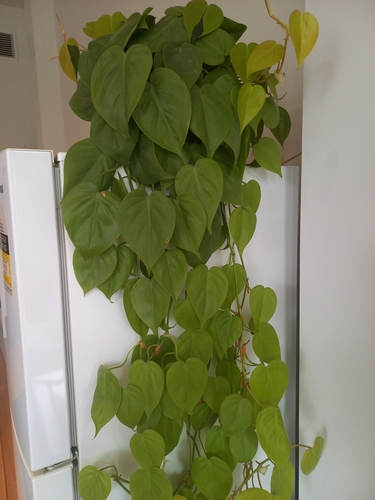
How to care for heart-leaf philodendron
Watering
Heart-leaf philodendron (Philodendron hederaceum) is a tough vining plant from humid tropical forest floors in Central America. Its thin, fleshy roots dislike sitting in soggy soil, so let the top portion of the mix dry out between drinks. Water thoroughly until it runs out of the drainage holes, then empty the saucer. In winter, when growth slows, stretch the gaps between waterings.
Does it need water today?
Push a finger about 3 cm into the mix. If it feels dry, water. If it is still cool and damp, wait a few days. You can also lift the pot: a thirsty pot feels noticeably light compared with one that was just watered. Limp, soft stems that bounce back after watering are another sign it needs a drink.
Water less rather than more. Heart-leaf philodendron tolerates a short dry spell far better than constantly wet soil, and yellowing leaves usually mean too much water rather than too little.
Overwatering
Heart-leaf philodendron has thin roots that rot quickly in waterlogged mix, and the soil stays wet for days after a drink. Its succulent-like stems store little water, so extra moisture quickly suffocates the root zone.
Symptoms: Yellowing lower leaves, leaves that drop while still green, a sour or musty smell from the soil, black mushy stem bases, and fungus gnats hovering around the pot.
Solutions: Stop watering and let the mix dry until the top 5 cm feel dry. Remove the plant, cut away any black or mushy roots with clean scissors, and repot into fresh, chunky, well-draining mix in a pot with drainage holes. Trim damaged stems back to healthy green tissue.
Underwatering
Heart-leaf philodendron is fairly forgiving, but its heart-shaped leaves are thin and lose water quickly in warm, dry rooms. When the root ball dries out completely, the plant wilts to protect itself.
Symptoms: Drooping, limp vines, leaves that curl or feel crisp at the edges, slow new growth, and soil pulling away from the pot sides.
Solutions: Water thoroughly using the bottom-watering method for 20 minutes so the dry root ball rehydrates evenly. Then resume a regular schedule. Mist the leaves lightly or place the plant in a humidity tray to reduce moisture loss while it recovers. Most vines bounce back within a week or two.
Sunlight
Heart-leaf philodendron grows naturally under the canopy of tall tropical trees, where light is bright but filtered. Indoors, bright indirect light gives the best leaf size and the richest variegation, if present. Direct midday sun can scorch the thin leaves, turning them pale or brown, so shield the plant with a sheer curtain in summer. It tolerates lower light, but growth becomes sparse and the stems stretch toward the light source.
- Ideal: Bright, indirect light · 6-8 hours of bright, filtered light per day
- Tolerates: Bright, indirect light, Partial sun, Shade
- Best spot in a room: At the window
- Artificial light: A full-spectrum LED grow light placed 30 to 45 cm above the foliage for 10 to 12 hours a day works well in dim rooms. Use a timer to keep the schedule consistent, and rotate the pot every couple of weeks so the vines grow evenly.
Too little light
Heart-leaf philodendron relies on steady light to produce chlorophyll and the energy for its climbing vines. In dim corners, it cannot make enough food to support new leaves, so it stretches and loses its compact shape.
Symptoms: Long, leggy stems with wide gaps between leaves, small new leaves, pale green or yellowing foliage, and slow growth overall.
Solutions: Move the plant closer to a bright east or north window, or to a spot near a west-facing window out of harsh afternoon sun. Add a grow light for 10 to 12 hours daily if the room stays dim. Prune leggy vines back to a node to encourage bushier growth.
Too much sun
Heart-leaf philodendron evolved under filtered forest canopy, so its thin, soft leaves are easily damaged by intense direct sun. Hot glass can magnify the heat and dry the leaves quickly.
Symptoms: Bleached, yellowish patches on leaves, crispy brown edges or spots, curling leaves, and faded variegation in new growth.
Solutions: Move the plant a metre or more back from a south or west window, or add a sheer curtain to filter the light. Water a little more often in strong sun, since the soil dries faster, and remove any badly scorched leaves so the plant can put energy into new growth.
Temperature
Heart-leaf philodendron (Philodendron hederaceum) is a tropical vine that grows best in warm, stable indoor conditions between about 18 and 27 °C. It tolerates ordinary room temperatures well but sulks when kept cold or exposed to sudden swings. Keep it away from drafts, heating vents, and cold window glass.
- Ideal: 18–27 °C
- Tolerates: 10–35 °C
- Hardiness zones: 10-12
Fertilizing
Heart-leaf philodendron is a fast-growing vine that uses nitrogen for its heart-shaped leaves and steady root development. It benefits from feeding during its active growing season, from spring through summer. Because it is often grown in small pots with limited soil, regular light feeding keeps it vigorous. Always water before feeding so the roots are not burned.
- Slow-release fertilizer: Once a year in early spring, when new growth begins, if you are not using liquid feed.
- Balanced liquid houseplant fertilizer (e.g., 20-20-20 or 10-10-10), Slow-release granular houseplant fertilizer with micronutrients, Diluted general-purpose liquid fertilizer for foliage plants
Soil
Heart-leaf philodendron (Philodendron hederaceum) grows best in a loose, airy mix that drains quickly but still holds some moisture between waterings. Its roots need oxygen, so dense garden soil or heavy clay should be avoided in containers.
- Aroid mix (recommended): Roughly 40% peat-free potting mix, 30% orchid bark, 20% perlite, and 10% coco coir or horticultural charcoal.
- Standard peat-based potting mix (acceptable alternative): Regular indoor potting mix blended with about one-third perlite to increase drainage. Water more carefully with this mix to avoid soggy roots.
- Semi-hydroponic or water culture (optional): Clay pebbles (LECA) or clean water in a clear container, with the water changed every 1-2 weeks and nutrients added at reduced strength.
- pH 5.5–7
Repotting
Use a pot with drainage holes, a well-draining aroid mix, and a clean knife or pruners. Heart-leaf philodendron (Philodendron hederaceum) is a vining aroid with fleshy roots that rot easily in soggy soil, so good drainage matters more than pot size.
- How often: Every 2-3 years, or when roots fill the pot
- New pot: Move up only one pot size (about 2-5 cm wider in diameter) each time, since heart-leaf philodendron prefers being slightly snug and wet soil in a too-large pot can cause root rot.
- Repotting season: Spring, Summer
How to repot
- Tip the pot on its side and gently squeeze the sides to loosen the root ball, then slide the plant out by its base.
- Gently tease away the outer roots with your fingers. Rinse off old, compacted soil if the roots are tightly packed.
- Trim any roots that are mushy, black, or smell sour, cutting cleanly back to firm, pale tissue.
- Set the plant in the new pot so the top of the root ball sits about 2 cm below the rim.
- Fill around the roots with fresh aroid mix, firming it lightly with your fingers to remove large air pockets.
- Water thoroughly until it drains from the holes, then let the top third of the soil dry before watering again.
- Wait a few days before feeding, and keep the plant out of direct sun while it settles.
Pruning
Cut just above a node, the point where a leaf or aerial root meets the stem. New growth usually sprouts from that node. Remove no more than about one third of the vine at a time, so the plant can keep feeding itself while it recovers.
Pruning season: Spring, Summer
How to prune
- Look over the vine and identify leggy stems, yellowed leaves, or sections that have grown past your desired shape.
- Cut each stem 1 cm above a healthy node, angling the cut slightly so water runs off.
- Remove any dead or yellow leaves at the base of the stem by cutting them off cleanly.
- Trim the longest trailing vines back to the length you want, keeping the cuts at nodes.
- Save the cut sections with at least two nodes and root them in water as described in the propagation section.
- Water the plant lightly after pruning and keep it out of direct afternoon sun for a few days while it adjusts.
Propagation
Stem cuttings in water · Spring, Summer
- Choose a healthy vine with at least two nodes, the small bumps on the stem where leaves and aerial roots emerge.
- Cut 5 to 10 cm below a node using clean, sharp scissors or a knife.
- Remove the lowest leaf so that the node sits just above the waterline.
- Place the cutting in a clear jar of room-temperature water, keeping the node submerged and the leaves above the surface.
- Set the jar in bright, indirect light and change the water every week or two.
- Expect roots to appear within two to four weeks. Plant the cutting in potting mix once the roots are about 3 to 5 cm long.
Stem cuttings in soil · Spring, Summer
- Take a 8 to 10 cm cutting with at least one node, as for water propagation.
- Dip the cut end in rooting hormone if you have it, though it is optional for this vine.
- Insert the node into moist, well-draining potting mix, such as a blend of peat-free compost and perlite.
- Cover the pot loosely with a clear plastic bag to hold humidity, and open it daily to let fresh air in.
- Keep the mix lightly moist and the cutting in bright, indirect light at 18 to 24 °C.
- Tug gently after about four weeks. Resistance means roots have formed.
Layering on the parent plant · Spring, Summer
- Pick a long, flexible vine that is still attached to the parent plant.
- Fill a small pot with moist potting mix and set it beside the parent plant.
- Pin a node on the vine into the soil with a bent wire hairpin, leaving the growing tip above the surface.
- Keep the soil moist and wait about three to four weeks for roots to form at the pinned node.
- Cut the vine free from the parent just below the new root system and pot it up on its own.
Take several cuttings at once. Heart-leaf philodendron roots reliably, but one or two cuttings sometimes fail, so extra cuttings give you a fuller new plant.
About heart-leaf philodendron
Also known as: Heartleaf philodendron, Sweetheart plant, Parlour ivy
- Plant type: climber, vine, epiphyte
- Lifespan: perennial
- Distribution: Native to tropical Central America and the Caribbean, from southern Mexico to Panama, and parts of northern South America.
- Mature height: Trailing vine, up to 3 m climbing when supported
- Bloom time: Rarely flowers indoors; outdoors it produces a spathe with a spadix when mature.
Pets · People
Pets: Toxic · People: Toxic. Contains calcium oxalate raphides in all parts. Chewing causes oral irritation, drooling, swelling of lips and tongue, and vomiting. Listed as toxic to dogs, cats and humans by the ASPCA.
Common problems
- Yellowing leaves: Often caused by overwatering or poor drainage, leading to root rot.
- Leggy growth: Stems stretch with weak, pale leaves when light is too low.
- Brown leaf tips: Usually caused by dry air, irregular watering or fertilizer salt buildup.
- Mealybugs: White cottony pests found in leaf joints and under leaves; treat with isopropyl alcohol or insecticidal soap.
- Spider mites: Fine webbing and stippled leaves in dry conditions; raise humidity and rinse foliage.
Uses
Mainly ornamental as a hanging or trailing houseplant and office plant. In its native range the leaves and stems are used in local folk remedies, though this is not a major commercial use.
Is it edible?
not edible
History & legends
The species was described in the nineteenth century from Central American material and spread through European glasshouse trade as a popular ornamental. Its heart-shaped leaves made it a common sentimental gift plant, and it became a staple of Victorian parlours.
Did you know?
Heart-leaf philodendron is often sold as a pothos, but it has smooth, heart-shaped leaves without the splashed variegation of Epipremnum, and its leaves are not slit.
Frequently asked questions
How often should I water heart-leaf philodendron?
every 7 days. Heart-leaf philodendron (Philodendron hederaceum) is a tough vining plant from humid tropical forest floors in Central America. Its thin, fleshy roots dislike sitting in soggy soil, so let the top portion of the mix dry out between drinks. Water thoroughly until it runs out of the drainage holes, then empty the saucer. In winter, when growth slows, stretch the gaps between waterings. Push a finger about 3 cm into the mix. If it feels dry, water. If it is still cool and damp, wait a few days. You can also lift the pot: a thirsty pot feels noticeably light compared with one that was just watered. Limp, soft stems that bounce back after watering are another sign it needs a drink.
How much light does heart-leaf philodendron need?
Bright, indirect light (6-8 hours of bright, filtered light per day). Heart-leaf philodendron grows naturally under the canopy of tall tropical trees, where light is bright but filtered. Indoors, bright indirect light gives the best leaf size and the richest variegation, if present. Direct midday sun can scorch the thin leaves, turning them pale or brown, so shield the plant with a sheer curtain in summer. It tolerates lower light, but growth becomes sparse and the stems stretch toward the light source.
What temperature does heart-leaf philodendron like?
18–27 °C. Heart-leaf philodendron (Philodendron hederaceum) is a tropical vine that grows best in warm, stable indoor conditions between about 18 and 27 °C. It tolerates ordinary room temperatures well but sulks when kept cold or exposed to sudden swings. Keep it away from drafts, heating vents, and cold window glass.
Is heart-leaf philodendron toxic to cats and dogs?
It is toxic to cats and dogs: keep it out of their reach. Contains calcium oxalate raphides in all parts. Chewing causes oral irritation, drooling, swelling of lips and tongue, and vomiting. Listed as toxic to dogs, cats and humans by the ASPCA.
What are the most common problems of heart-leaf philodendron?
Yellowing leaves: Often caused by overwatering or poor drainage, leading to root rot. Leggy growth: Stems stretch with weak, pale leaves when light is too low. Brown leaf tips: Usually caused by dry air, irregular watering or fertilizer salt buildup. Mealybugs: White cottony pests found in leaf joints and under leaves; treat with isopropyl alcohol or insecticidal soap. Spider mites: Fine webbing and stippled leaves in dry conditions; raise humidity and rinse foliage.
When should I repot heart-leaf philodendron?
Every 2-3 years, or when roots fill the pot. Use a pot with drainage holes, a well-draining aroid mix, and a clean knife or pruners. Heart-leaf philodendron (Philodendron hederaceum) is a vining aroid with fleshy roots that rot easily in soggy soil, so good drainage matters more than pot size.
How do I propagate heart-leaf philodendron?
Stem cuttings in water, Stem cuttings in soil, Layering on the parent plant. Choose a healthy vine with at least two nodes, the small bumps on the stem where leaves and aerial roots emerge. Cut 5 to 10 cm below a node using clean, sharp scissors or a knife. Remove the lowest leaf so that the node sits just above the waterline. Place the cutting in a clear jar of room-temperature water, keeping the node submerged and the leaves above the surface. Set the jar in bright, indirect light and change the water every week or two. Expect roots to appear within two to four weeks. Plant the cutting in potting mix once the roots are about 3 to 5 cm long.
How this guide was written
Verdiss writes each guide with AI from botanical references and checks the species against iNaturalist and Plants of the World Online (Kew). Readers can rate every guide in the app.
Sources
Verdiss's information is for general guidance. Never eat or use a plant as medicine based on an app: ask a professional.