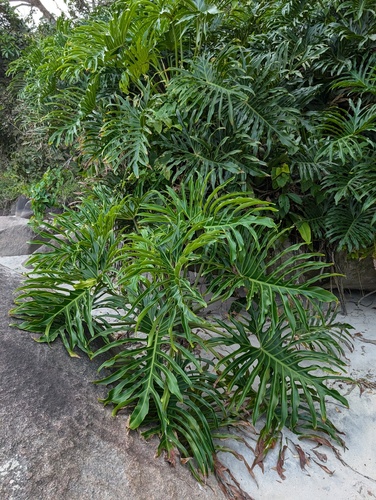
How to care for Philodendron bipinnatifidum
Watering
Philodendron bipinnatifidum, often called the split-leaf philodendron or tree philodendron, has thick aerial roots and fleshy stems that store some water, so it tolerates a short dry spell better than it tolerates soggy soil. Water thoroughly when the top part of the mix is dry, let excess drain away fully, and never leave it standing in a saucer. Use a chunky, well-draining aroid mix with perlite or orchid bark. Water less in winter, when growth slows and the soil stays wet much longer.
Does it need water today?
Push a finger about 3 to 5 cm (1 to 2 inches) into the mix. If it feels dry, water now. If it feels damp, wait. You can also lift the pot: a freshly watered pot feels heavy, and a dry one feels light. Droopy, limp leaves with dry soil mean it is thirsty, while yellowing lower leaves with wet soil mean it is getting too much water.
Water slowly until liquid runs out of the drainage holes, then empty the saucer after 15 minutes. Use room-temperature water, and let tap water sit overnight if your supply is chlorinated or very hard.
Overwatering
Philodendron bipinnatifidum has thick roots that rot easily in waterlogged, airless soil. Its large leaves also draw up a lot of water, so the mix can stay wet for days if the pot is too big or the soil too dense.
Symptoms: Yellowing lower leaves, soft or mushy stem bases, a sour smell from the soil, black or brown roots that feel slimy, and fungus gnats hovering around the pot.
Solutions: Stop watering and let the mix dry out for several days. Gently remove the plant, trim away any soft, black roots with clean scissors, and repot into fresh, chunky mix in a pot only 2 to 5 cm wider than the root ball. Make sure the pot has drainage holes.
Underwatering
Its aerial roots and stems store some water, but the large, thin-textured leaves lose moisture quickly in warm, bright rooms or in a heated home. When the root ball dries out completely, the plant cannot replace that water fast enough.
Symptoms: Drooping, limp leaves with brown, crispy edges, leaves that curl inward, dry and shrinking soil that pulls away from the pot wall, and slow or stalled new growth.
Solutions: Water thoroughly using the bottom-watering method for 20 to 30 minutes so the whole root ball rehydrates. Then top water as usual. Remove any badly crisped leaves at the base with clean scissors. Mist the leaves occasionally and keep the plant away from heater vents, which dry the air and the soil quickly.
Sunlight
Philodendron bipinnatifidum grows naturally on the forest floor and up tree trunks in tropical South America, where it receives dappled light through a canopy. Bright indirect light lets it develop its deeply lobed, split leaves. It can handle lower light but grows slower, with smaller leaves and fewer splits. Direct midday sun can scorch its large leaves, so filter strong sun with a sheer curtain.
- Ideal: Bright, indirect light · 6-8 hours of bright, filtered light daily
- Tolerates: Partial sun, Shade
- Best spot in a room: At the window
- Artificial light: If natural light is weak, use a full-spectrum LED grow light placed 30 to 45 cm (12 to 18 inches) above the plant, running 12 to 14 hours a day. Keep the lights on a timer so the plant gets a steady routine.
Too little light
Its large leaves need enough energy to produce splits and keep a healthy shape. In deep shade, the plant stretches toward any available light and invests less in new leaves.
Symptoms: Long, leggy stems with wide spacing between leaves, small new leaves with few or no splits, pale or dull green foliage, and slowed growth through the year.
Solutions: Move the plant closer to a bright east or west window, or a few steps back from a south window with a sheer curtain. Rotate the pot a quarter turn each week so growth stays even. Add a full-spectrum LED grow light during darker months.
Too much sun
The thin, large leaves of this species are not built for harsh direct sun. Strong midday rays overheat and dry the tissue quickly, especially in a sunny south or west window.
Symptoms: Pale, bleached patches on the leaves, brown or crispy scorched spots, leaves that curl or wilt during the hottest part of the day, and faded leaf color.
Solutions: Move the plant back from the glass or add a sheer curtain to diffuse direct sun. Place it where it gets bright light but no sunbeams fall directly on the leaves. Trim badly scorched leaves at the base, and the plant will produce new, better-adapted growth.
Temperature
Split-leaf philodendron (Thaumatophyllum bipinnatifidum, formerly Philodendron bipinnatifidum) is a warm-climate plant from the Brazilian Atlantic forest. Keep it between 18 and 29°C, away from cold drafts and direct blasts of heater or air conditioning. It handles brief dips near 15°C but suffers below 10°C, and it is killed by frost.
- Ideal: 18–29 °C
- Tolerates: 10–35 °C
- Hardiness zones: 10-12
Fertilizing
Split-leaf philodendron is a fast-growing aroid that uses a lot of nitrogen to build its large, deeply cut leaves. Feed it during its active growing season, from spring through early autumn, and stop when days get short and growth slows. A balanced fertilizer with trace minerals keeps the leaves dark green and well divided.
- Slow-release fertilizer: Apply once a year in early spring, just as new growth begins. Do not add slow-release fertilizer in autumn or winter.
- Balanced liquid houseplant fertilizer, such as 20-20-20 or 10-10-10, Slow-release granular fertilizer for houseplants or woody ornamentals, Liquid fertilizer with added micronutrients such as iron, magnesium, and manganese
Soil
Philodendron bipinnatifidum needs soil that drains quickly but still holds some moisture around its roots. Its natural habitat in tropical Brazil has humus-rich forest floors, so a light, chunky mix that stays airy is ideal. Avoid dense garden clay or heavy peat that compacts and keeps roots waterlogged.
- Aroid mix: Two parts peat-free potting mix, one part orchid bark, one part perlite or pumice
- Chunky houseplant mix: Peat-free potting mix blended with coco coir, perlite, and a handful of charcoal
- Outdoor garden bed mix: Two parts loamy garden soil, one part compost, one part coarse sand or grit, with added leaf mould
- pH 5.5–6.5
Repotting
Repot in spring or early summer, when the plant is putting out new leaves and can recover quickly. Use a pot with drainage holes and a fresh, well-draining aroid mix. Handle the roots gently, because the thick aerial roots of this plant break easily.
- How often: every 2-3 years, or when roots fill the pot
- New pot: Move up only one pot size (about 2-5 cm wider in diameter) each time, since Philodendron bipinnatifidum prefers snug roots and wet soil in a large pot stays soggy for too long.
- Repotting season: Spring, Summer
How to repot
- Lay the plant on its side and gently ease it out of the old pot, supporting the base of the stems.
- Loosen the outer roots with your fingers. Trim away any roots that are mushy, black, or smell bad.
- Place a layer of fresh mix in the new pot so the top of the root ball sits about 2 cm below the rim.
- Set the plant upright, keeping the crown at the same depth it was before, and fill the gaps with mix, pressing lightly.
- Leave space at the top of the pot for watering, then water thoroughly until it runs out of the drainage holes.
- Move the plant to bright, indirect light and keep it out of strong direct sun for the first week or two.
Pruning
Philodendron bipinnatifidum is a climbing aroid that grows from a thick, aerial-rooted stem and develops large, deeply lobed leaves. Prune with clean, sharp tools, cutting just above a node or leaf joint, and avoid removing more than about one third of the plant at once so it can recover.
Pruning season: Spring, Summer
How to prune
- Remove dead, brown, or yellowing leaves first by cutting the petiole close to the main stem.
- Trim leggy stems back to just above a node, where new growth and aerial roots are most likely to emerge.
- If the plant is climbing a moss pole or stake, tie stems loosely to the support as you prune, so the cuts do not pull on the plant.
- Cut back overly long aerial roots only if they are dry or in the way; otherwise, guide them into the soil or onto a moss pole.
- Wipe the pruners clean after each cut and dispose of removed material away from pets and children.
- Expect new leaves within a few weeks in warm conditions, roughly 18 to 27 °C, and feed lightly after pruning once new growth appears.
Propagation
Stem cutting in water · Spring, Summer
- Choose a healthy, mature stem with at least one node and one aerial root or leaf scar, cutting just below a node with clean, sharp pruners.
- Remove the lowest leaf so the node sits clear of the water line.
- Place the cutting in a clear jar of room-temperature water, keeping the node submerged and the leaves above the surface.
- Set the jar in bright, indirect light at about 21 to 27 °C and change the water every week.
- Once roots are 5 to 8 cm long, usually in 3 to 6 weeks, pot the cutting in a well-draining aroid mix.
Stem cutting in soil · Spring, Summer
- Take a cutting with one or two nodes, following the same clean cut as for water propagation.
- Dip the cut end in rooting hormone if you have it, then tap off the excess.
- Insert the node into a moist mix of peat or coco coir with perlite, burying it about 2 cm deep.
- Cover the pot loosely with a clear plastic bag to hold humidity, and vent it daily.
- Keep the mix barely moist and the cutting in bright, indirect light. New growth signals roots have formed.
Air layering · Spring, Summer
- Pick a long, leggy stem that has lost its lower leaves, and find a node about 30 cm below the growing tip.
- Make a shallow upward slit just below the node, then insert a small wedge of wood or a matchstick to keep it open.
- Pack damp sphagnum moss around the wounded area and wrap it in plastic, securing both ends with twist ties.
- Mist the moss when it dries, and keep the area warm and bright.
- After 6 to 10 weeks, when roots show through the moss, cut the stem below the new roots and pot it up.
Philodendron bipinnatifidum, often called the Split-leaf Philodendron, roots readily from nodes, so a single healthy stem with one node is enough to start a new plant. Water propagation is the easiest way to watch roots develop, and spring is the best time because the plant is actively growing.
About Philodendron bipinnatifidum
Also known as: Split-leaf philodendron, Horsehead philodendron, Tree philodendron
- Plant type: climber, aroid, evergreen foliage plant
- Lifespan: perennial
- Distribution: Native to southeastern Brazil, in Atlantic Forest vegetation.
- Mature height: Up to 3 m indoors; 3-5 m or more climbing in the wild
- Bloom time: Rarely flowers indoors; occasional blooms in warm conditions
Pets · People
Pets: Toxic · People: Toxic. Contains calcium oxalate crystals (raphides) in all parts. Chewing causes oral irritation, drooling, and swelling of the mouth; ingestion can cause vomiting. Keep away from cats, dogs, and children.
Common problems
- Brown leaf tips: Usually caused by low humidity, dry soil, or fertilizer buildup; trim and adjust watering.
- Root rot: Results from waterlogged soil or pots without drainage; fleshy roots decay quickly.
- Yellowing lower leaves: Normal aging when new growth emerges, but excessive yellowing signals overwatering.
- Spider mites: Fine webbing and stippled leaves in dry air; wipe leaves and increase humidity.
- Leggy growth: Weak growth in low light, with long gaps between leaves; move to brighter indirect light.
Uses
Primarily ornamental, grown as a houseplant, atrium specimen, and in warm-climate landscapes for its dramatic foliage. It is also valued in interior design for bold architectural form.
Is it edible?
not edible
History & legends
Described in the nineteenth century from Brazilian material and introduced to European glasshouses during the Victorian plant-collecting era. It became a popular conservatory and houseplant, prized for its striking leaves. Its name and popularity spread widely through the global houseplant trade.
Did you know?
In its native Brazilian forests, the plant often begins life as a hemiepiphyte, germinating on a host tree and sending roots down to the soil.
Frequently asked questions
How often should I water Philodendron bipinnatifidum?
every 8 days. Philodendron bipinnatifidum, often called the split-leaf philodendron or tree philodendron, has thick aerial roots and fleshy stems that store some water, so it tolerates a short dry spell better than it tolerates soggy soil. Water thoroughly when the top part of the mix is dry, let excess drain away fully, and never leave it standing in a saucer. Use a chunky, well-draining aroid mix with perlite or orchid bark. Water less in winter, when growth slows and the soil stays wet much longer. Push a finger about 3 to 5 cm (1 to 2 inches) into the mix. If it feels dry, water now. If it feels damp, wait. You can also lift the pot: a freshly watered pot feels heavy, and a dry one feels light. Droopy, limp leaves with dry soil mean it is thirsty, while yellowing lower leaves with wet soil mean it is getting too much water.
How much light does Philodendron bipinnatifidum need?
Bright, indirect light (6-8 hours of bright, filtered light daily). Philodendron bipinnatifidum grows naturally on the forest floor and up tree trunks in tropical South America, where it receives dappled light through a canopy. Bright indirect light lets it develop its deeply lobed, split leaves. It can handle lower light but grows slower, with smaller leaves and fewer splits. Direct midday sun can scorch its large leaves, so filter strong sun with a sheer curtain.
What temperature does Philodendron bipinnatifidum like?
18–29 °C. Split-leaf philodendron (Thaumatophyllum bipinnatifidum, formerly Philodendron bipinnatifidum) is a warm-climate plant from the Brazilian Atlantic forest. Keep it between 18 and 29°C, away from cold drafts and direct blasts of heater or air conditioning. It handles brief dips near 15°C but suffers below 10°C, and it is killed by frost.
Is Philodendron bipinnatifidum toxic to cats and dogs?
It is toxic to cats and dogs: keep it out of their reach. Contains calcium oxalate crystals (raphides) in all parts. Chewing causes oral irritation, drooling, and swelling of the mouth; ingestion can cause vomiting. Keep away from cats, dogs, and children.
What are the most common problems of Philodendron bipinnatifidum?
Brown leaf tips: Usually caused by low humidity, dry soil, or fertilizer buildup; trim and adjust watering. Root rot: Results from waterlogged soil or pots without drainage; fleshy roots decay quickly. Yellowing lower leaves: Normal aging when new growth emerges, but excessive yellowing signals overwatering. Spider mites: Fine webbing and stippled leaves in dry air; wipe leaves and increase humidity. Leggy growth: Weak growth in low light, with long gaps between leaves; move to brighter indirect light.
When should I repot Philodendron bipinnatifidum?
every 2-3 years, or when roots fill the pot. Repot in spring or early summer, when the plant is putting out new leaves and can recover quickly. Use a pot with drainage holes and a fresh, well-draining aroid mix. Handle the roots gently, because the thick aerial roots of this plant break easily.
How do I propagate Philodendron bipinnatifidum?
Stem cutting in water, Stem cutting in soil, Air layering. Choose a healthy, mature stem with at least one node and one aerial root or leaf scar, cutting just below a node with clean, sharp pruners. Remove the lowest leaf so the node sits clear of the water line. Place the cutting in a clear jar of room-temperature water, keeping the node submerged and the leaves above the surface. Set the jar in bright, indirect light at about 21 to 27 °C and change the water every week. Once roots are 5 to 8 cm long, usually in 3 to 6 weeks, pot the cutting in a well-draining aroid mix.
How this guide was written
Verdiss writes each guide with AI from botanical references and checks the species against iNaturalist and Plants of the World Online (Kew). Readers can rate every guide in the app.
Sources
Verdiss's information is for general guidance. Never eat or use a plant as medicine based on an app: ask a professional.