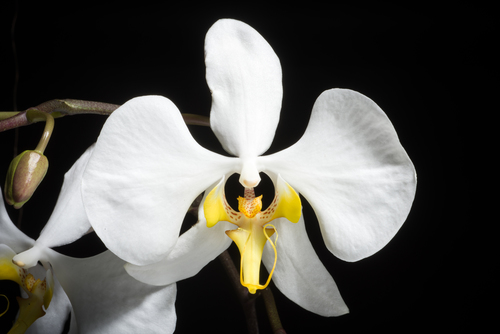
How to care for Moth Orchid
Watering
Phalaenopsis amabilis, the Moth Orchid, is an epiphyte from tropical Southeast Asia and the Pacific islands that grows on tree bark in the wild, so its roots are built to dry out between drinks. Water thoroughly, let the potting medium (usually bark) drain completely, and never leave the pot standing in water. Water in the morning so leaves and crown dry before night, and use room-temperature water, ideally rainwater or filtered water, since orchids dislike salt and lime buildup.
Does it need water today?
Lift the pot: a freshly watered pot feels heavy, while a dry one feels light. Also look at the roots in the pot. Silvery-green roots are dry and ready for water, while bright green roots mean the plant still has moisture. Water only when the bark is dry and the roots have turned silvery.
Water by soaking rather than by sprinkling. Place the pot in lukewarm water for about 10 to 15 minutes, let it drain fully, and return it to its cachepot or saucer only after the excess has run off. Watering in the morning lets the crown dry quickly, which prevents rot.
Overwatering
Phalaenopsis amabilis evolved on tree trunks where its roots dry quickly between rains, so soggy bark starves the roots of oxygen. Constantly wet medium causes the roots to rot, which quickly spreads to the crown of the plant.
Symptoms: Leaves turning yellow and soft, black or mushy roots, a limp plant, and a sour smell from the pot. In severe cases the crown turns brown and the central leaves rot.
Solutions: Remove the orchid from its pot and cut away all soft, brown, or hollow roots with sterilized scissors. Repot into fresh, fine orchid bark in a pot with drainage holes, and wait a week before watering so cut roots can heal. Adjust the schedule so the bark dries out fully between waterings.
Underwatering
Because its roots are adapted to dry air and short dry spells, Phalaenopsis amabilis tolerates brief dryness better than constant wetness. However, long dry periods are harmful because the leaves and roots lose water faster than they can take it up, particularly in heated rooms.
Symptoms: Wrinkled, limp leaves that lose their shine, and roots that stay silvery and shrivelled. Flowers may drop early, and new buds can fail to open.
Solutions: Soak the pot in lukewarm water for 10 to 15 minutes until the bark is evenly moist. Mist the air around the plant on warm days, and keep it away from radiators. Water a little more often for a few weeks until the leaves firm up again.
Sunlight
Phalaenopsis amabilis grows on the shaded side of trees in the wild, under a canopy that filters strong sunlight. Bright indirect light lets it build the leaf energy needed to produce flower spikes. Its leaves should be a healthy medium green; very dark leaves suggest too little light, while yellowish or reddish leaves suggest too much.
- Ideal: Bright, indirect light · 12 to 14 hours of bright, filtered light per day, with no harsh midday sun
- Tolerates: Partial sun, Bright, indirect light
- Best spot in a room: Near the window
- Artificial light: If natural light is weak, use a full-spectrum LED grow light placed about 30 to 50 cm above the leaves for 12 to 14 hours a day. Use a timer so the plant gets consistent light and rest.
Too little light
Phalaenopsis amabilis needs a steady supply of light to produce energy for leaves, roots, and flower spikes. In dim rooms, the plant grows slowly and stores less energy, so it often fails to rebloom.
Symptoms: Dark green, floppy leaves, leggy growth with long gaps between leaves, and no new flower spikes. Older leaves may slowly yellow and drop.
Solutions: Move the orchid to a brighter spot near an east or north-facing window, or to a bright position a short distance from a south or west window. Add a grow light if needed, and rotate the pot weekly so all sides receive light.
Too much sun
Phalaenopsis amabilis has thin leaves that burn easily, since in the wild it is shielded from direct sun by the canopy. Strong midday or summer sun through glass can quickly scorch its foliage.
Symptoms: Yellowish or reddish leaves, brown or bleached patches on the leaf surface, and wilted or shrivelled leaves in the sun-facing part of the plant.
Solutions: Move the orchid a metre or so back from a sunny window, or place a sheer curtain between the plant and the glass. Choose an east-facing window if possible, and check the leaves each week for color changes.
Temperature
Phalaenopsis amabilis, the Moth Orchid, is a warm-growing epiphyte from lowland tropical Asia and Malesia. It thrives in steady warmth, with daytime temperatures around 22 to 27°C and nights not much below 16 to 18°C. A drop of 5 to 6°C between day and night helps trigger flower spikes. Keep it away from drafts, heaters, and cold windows.
- Ideal: 18–27 °C
- Tolerates: 13–35 °C
- Hardiness zones: 10-12
Fertilizing
Feed Phalaenopsis amabilis lightly and consistently during active growth, which is typically spring through early autumn when new leaves and roots are forming. Pause feeding in the darker months from November to February, and especially after the plant has finished flowering and is resting. Always water the plant first with plain water so the roots are not fertilized when dry, and flush the pot with clear water every few months to remove salt buildup.
- Slow-release fertilizer: not needed; Phalaenopsis amabilis is usually grown in bark or sphagnum moss and benefits more from regular, light liquid feeding than from slow-release granules, which can build up salts in the potting medium.
- Balanced orchid fertilizer labelled 20-20-20 or 20-10-20, diluted to half or quarter strength, Orchid-specific fertilizer with micronutrients, Balanced houseplant liquid fertilizer, diluted to one quarter of the label rate
Soil
Phalaenopsis amabilis is an epiphyte in nature, growing on tree branches rather than in soil. Its roots need air as much as moisture, so the medium must be chunky, loose, and fast-draining rather than dense potting soil. Never use garden soil or regular houseplant potting mix, which will suffocate the roots.
- Medium-grade orchid bark mix: Pine or fir bark, sometimes mixed with charcoal or perlite, which allows fast drainage and airflow around the roots.
- Sphagnum moss mix: Long-fiber sphagnum moss, best for growers who tend to forget watering; it holds moisture longer and must be used with care to avoid soggy roots.
- Coco chip orchid mix: Coconut husk chips with small amounts of bark, a good option for humid growing rooms with steady watering.
- pH 5.5–6.5
Repotting
Repot Phalaenopsis amabilis only after flowering has finished, and only when the roots are growing into the bark or the potting mix has decomposed. Use fresh orchid bark mix, sterilized tools, and avoid packing the medium tightly around the roots.
- How often: every 1-2 years, or when the bark medium breaks down or the roots fill the pot
- New pot: Move up only one pot size, about 2-3 cm wider than the current pot, with plenty of drainage holes; clear plastic or slotted orchid pots suit Moth Orchid roots well
- Repotting season: Spring, Summer
How to repot
- Gently remove the plant from its old pot, loosening the sides with your fingers or by squeezing a flexible plastic pot.
- Shake off the old bark and rinse the roots under lukewarm water to remove old medium and debris.
- Trim any black, mushy, or papery roots with sterilized scissors, leaving firm green or silvery roots intact.
- Place the plant so the base of the leaves sits just below the pot rim and the oldest leaves face the same way as before.
- Fill the gaps with fresh bark, gently tapping the pot to settle it, and firm it lightly so the plant stands upright without crushing roots.
- Wait a few days before watering thoroughly, letting the new medium settle and the cut areas dry slightly.
Pruning
Use only sterilized, sharp scissors or a blade. Cut cleanly and avoid tearing the stem or leaf tissue.
Pruning season: Spring, Summer, Autumn
How to prune
- After the last flower on a spike falls, look for a green spike that is still firm. Cut it about 1 cm above a node (a small bump on the stem) that is still green.
- If the spike is brown and dry, cut it at the base, close to the leaves, without damaging the plant.
- Remove yellow or brown leaves by cutting them at the base, close to the stem, with a clean cut.
- Wipe the scissors with rubbing alcohol between plants to avoid spreading disease.
- Water the plant normally after pruning, and keep it in bright indirect light at around 18 to 24 °C while it recovers.
Propagation
Keiki (plantlet) from flower spike · Spring, Summer, Autumn
- Wait until a small keiki (baby plantlet) forms on an old flower spike, usually at a node on the spike, and grows at least 3 to 5 cm long with 2 or 3 leaves.
- Leave the keiki attached to the mother plant until it develops small aerial roots that are at least 3 to 5 cm long.
- Cut the flower spike about 1 cm above the keiki with clean, sterilized scissors.
- Pot the keiki in a small container with fine bark or sphagnum moss, keeping the roots partly exposed.
- Keep it warm, around 20 to 26 °C, in bright indirect light and water when the medium is nearly dry.
Division of a large plant · Spring
- Only divide a Moth Orchid that has at least four healthy leaves per division and a strong root system.
- Remove the plant from its pot and gently shake off the old bark.
- Use a sterilized blade to cut the rhizome between growth points, making sure each section has at least three healthy leaves and several firm roots.
- Repot each division into a small pot with fresh orchid bark, and firm it gently.
- Water lightly and keep in bright indirect light until new root growth appears.
Propagation from keikis is the easiest way to get a new Moth Orchid at home, and it is also the most reliable. Most keikis appear on spikes after flowering, so you can wait and not force it.
About Moth Orchid
Also known as: Moon Orchid, Moth Orchid, Pink Moth Orchid
- Plant type: orchid, epiphyte
- Lifespan: perennial
- Distribution: Native to tropical Southeast Asia, northern Australia and islands of the western Pacific, growing on trees in lowland rainforest.
- Mature height: 30-60 cm including flower spikes
- Bloom time: Late winter to spring, often lasting two to three months
Pets · People
Pets: Safe · People: Safe. Not listed as toxic to cats, dogs or children by the ASPCA; the plant is non-toxic, though chewing any plant can upset a pet's stomach.
Common problems
- Root rot: Overwatering or dense media keeps roots soggy, causing brown, mushy roots and wilting leaves.
- Bud blast: Sudden changes in temperature, light or watering cause buds to yellow and drop before opening.
- Sunburn: Direct sun bleaches or blackens leaves, leaving dry patches that do not recover.
- Mealybugs: White cottony pests hide in leaf axils and new growth, sucking sap and weakening the plant.
- Crown rot: Water trapped in the leaf crown causes the centre to rot, often fatal if not caught early.
Uses
Ornamental houseplant and popular cut or potted orchid in homes, offices and florists worldwide; plants are also bred extensively for hybrids and commercial production.
Is it edible?
not edible
History & legends
The species was described from Java and nearby islands in the early nineteenth century and became central to the European orchid trade of the Victorian era. Collectors prized its pale, moth-like flowers, and it became the parent of countless hybrids that now dominate the global orchid market.
Did you know?
Phalaenopsis amabilis was one of the first orchids to be grown and traded in large numbers in Europe, and its common name 'Moth Orchid' comes from the flowers' resemblance to moths in flight.
Frequently asked questions
How often should I water Moth Orchid?
every 7 days. Phalaenopsis amabilis, the Moth Orchid, is an epiphyte from tropical Southeast Asia and the Pacific islands that grows on tree bark in the wild, so its roots are built to dry out between drinks. Water thoroughly, let the potting medium (usually bark) drain completely, and never leave the pot standing in water. Water in the morning so leaves and crown dry before night, and use room-temperature water, ideally rainwater or filtered water, since orchids dislike salt and lime buildup. Lift the pot: a freshly watered pot feels heavy, while a dry one feels light. Also look at the roots in the pot. Silvery-green roots are dry and ready for water, while bright green roots mean the plant still has moisture. Water only when the bark is dry and the roots have turned silvery.
How much light does Moth Orchid need?
Bright, indirect light (12 to 14 hours of bright, filtered light per day, with no harsh midday sun). Phalaenopsis amabilis grows on the shaded side of trees in the wild, under a canopy that filters strong sunlight. Bright indirect light lets it build the leaf energy needed to produce flower spikes. Its leaves should be a healthy medium green; very dark leaves suggest too little light, while yellowish or reddish leaves suggest too much.
What temperature does Moth Orchid like?
18–27 °C. Phalaenopsis amabilis, the Moth Orchid, is a warm-growing epiphyte from lowland tropical Asia and Malesia. It thrives in steady warmth, with daytime temperatures around 22 to 27°C and nights not much below 16 to 18°C. A drop of 5 to 6°C between day and night helps trigger flower spikes. Keep it away from drafts, heaters, and cold windows.
Is Moth Orchid toxic to cats and dogs?
It is safe for cats and dogs. Not listed as toxic to cats, dogs or children by the ASPCA; the plant is non-toxic, though chewing any plant can upset a pet's stomach.
What are the most common problems of Moth Orchid?
Root rot: Overwatering or dense media keeps roots soggy, causing brown, mushy roots and wilting leaves. Bud blast: Sudden changes in temperature, light or watering cause buds to yellow and drop before opening. Sunburn: Direct sun bleaches or blackens leaves, leaving dry patches that do not recover. Mealybugs: White cottony pests hide in leaf axils and new growth, sucking sap and weakening the plant. Crown rot: Water trapped in the leaf crown causes the centre to rot, often fatal if not caught early.
When should I repot Moth Orchid?
every 1-2 years, or when the bark medium breaks down or the roots fill the pot. Repot Phalaenopsis amabilis only after flowering has finished, and only when the roots are growing into the bark or the potting mix has decomposed. Use fresh orchid bark mix, sterilized tools, and avoid packing the medium tightly around the roots.
How do I propagate Moth Orchid?
Keiki (plantlet) from flower spike, Division of a large plant. Wait until a small keiki (baby plantlet) forms on an old flower spike, usually at a node on the spike, and grows at least 3 to 5 cm long with 2 or 3 leaves. Leave the keiki attached to the mother plant until it develops small aerial roots that are at least 3 to 5 cm long. Cut the flower spike about 1 cm above the keiki with clean, sterilized scissors. Pot the keiki in a small container with fine bark or sphagnum moss, keeping the roots partly exposed. Keep it warm, around 20 to 26 °C, in bright indirect light and water when the medium is nearly dry.
How this guide was written
Verdiss writes each guide with AI from botanical references and checks the species against iNaturalist and Plants of the World Online (Kew). Readers can rate every guide in the app.
Sources
Verdiss's information is for general guidance. Never eat or use a plant as medicine based on an app: ask a professional.