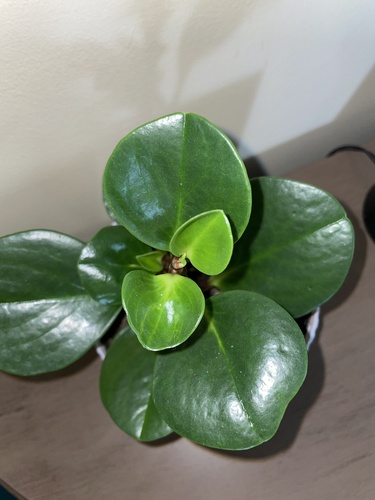
How to care for Baby Rubber Plant
Watering
Baby Rubber Plant (Peperomia obtusifolia) stores water in its thick, fleshy stems and leaves, so it handles dry spells far better than it handles soggy soil. Water thoroughly when the top half of the potting mix is dry, then let the excess drain away completely. Use a pot with drainage holes and a light, chunky mix such as orchid bark, perlite and peat-free potting soil. In winter, growth slows and the plant needs noticeably less water.
Does it need water today?
Push a finger about 4 cm (1.5 in) into the soil. If it feels dry, water the plant. If it feels cool and damp, wait a few more days. You can also lift the pot: a dry pot feels noticeably lighter than one that was just watered. Plump, firm leaves are a good sign, while leaves that look wrinkled or soft suggest the plant is thirsty.
Water less rather than more. Baby Rubber Plant rots quickly in wet soil, and most home plants die from too much water, not too little. Always empty the saucer within 15 minutes of watering.
Overwatering
Baby Rubber Plant has thick, water-storing stems and leaves that rot easily when the roots sit in wet mix. Its compact root system cannot cope with long periods of saturation, so excess water quickly leads to root damage.
Symptoms: Soft, mushy stems near the soil line, yellowing leaves that drop easily, a sour or musty smell from the pot, and dark, slimy roots.
Solutions: Stop watering and let the soil dry out fully. If rot is advanced, remove the plant from its pot, cut away any black or mushy roots and stems with clean scissors, and let the plant dry for a day. Repot into fresh, dry, well-draining mix in a pot with drainage holes.
Underwatering
Baby Rubber Plant can survive short dry periods because it stores water in its leaves and stems. Repeated drought, however, forces it to draw on these reserves until the leaves lose their firmness and shrivel.
Symptoms: Wrinkled, soft or limp leaves, leaves that curl or droop, and soil that pulls away from the pot edges and feels very dry.
Solutions: Water thoroughly, using bottom watering if the soil has become hard and dry. Plump leaves usually recover within a few days. If the plant has lost many leaves, trim only the dead stems and keep the remaining stems on a regular watering schedule.
Sunlight
Baby Rubber Plant grows best in bright, indirect light, similar to the dappled light under a tree. In its natural habitat it grows on the forest floor and in shaded areas, so strong midday sun can scorch its thin, glossy leaves. Keep it close enough to a bright window that you can read a book comfortably at midday, but out of direct rays.
- Ideal: Bright, indirect light · 4-6 hours of bright, filtered light each day
- Tolerates: Partial sun, Bright, indirect light
- Best spot in a room: At the window
- Artificial light: If natural light is weak, use a full-spectrum LED grow light placed 30 to 45 cm (12 to 18 in) above the plant for 10 to 12 hours a day. Plants in darker corners will grow leggy, with long gaps between leaves.
Too little light
Baby Rubber Plant needs enough light to make the energy for its thick stems and dense leaf growth. In low light, it stretches toward any available light and stores less energy for healthy growth.
Symptoms: Long, thin, leggy stems with wide gaps between leaves, smaller new leaves, paler green colour, and slower growth in spring and summer.
Solutions: Move the plant closer to a bright east or north-facing window, or add a full-spectrum LED grow light for 10 to 12 hours a day. Rotate the pot a quarter turn every week so the plant grows evenly.
Too much sun
Baby Rubber Plant's thin, glossy leaves are adapted to filtered forest light. Direct sun, especially through south or west-facing glass, can burn them quickly because the leaves have little protective pigment.
Symptoms: Bleached, yellow or pale patches on the leaves, brown crispy edges or spots, and leaves that look faded or washed out.
Solutions: Move the plant a metre or more back from the window, or place a sheer curtain between the plant and the glass. Damaged leaves will not recover their colour, so leave them on the plant until they fall or trim them off for appearance.
Temperature
Baby Rubber Plant (Peperomia obtusifolia) thrives in warm, steady indoor conditions between 18 and 24 °C. It is a tropical plant from the Caribbean and Central and South America, so it dislikes cold drafts and sudden swings in temperature. Keep it away from radiators, heating vents, and cold windowsills in winter.
- Ideal: 18–24 °C
- Tolerates: 10–30 °C
- Hardiness zones: 10-12
Fertilizing
Baby Rubber Plant is a slow-growing species that needs very little food. Feed it only during its active growth period, from spring through summer, and rest it over winter when light is low. Always water the soil before feeding so the roots do not get burned.
- Slow-release fertilizer: Once a year in early spring, if you use slow-release granules. Many growers skip it entirely because Baby Rubber Plant is a light feeder.
- Balanced liquid houseplant fertilizer, such as an all-purpose 10-10-10 or 20-20-20 formula, Diluted liquid foliar feed for quick green-up, Slow-release granular fertilizer for indoor plants, applied sparingly
Soil
Baby Rubber Plant (Peperomia obtusifolia) needs a fast-draining, airy mix that dries out between waterings. Its thick leaves and stems store water, so dense, wet soil is the main cause of root rot.
- Peat-free aroid or houseplant mix: About 50 percent peat-free potting compost, 25 percent perlite, and 25 percent orchid bark or coco chips.
- Cactus and succulent mix: Commercial cactus mix with added perlite, roughly two parts mix to one part perlite, suits Baby Rubber Plant well.
- Standard potting mix with added grit: Two parts all-purpose potting mix mixed with one part coarse sand or perlite.
- pH 5.5–6.5
Repotting
Use a pot with drainage holes, a loose well-draining mix, and a clean, sharp tool. Repot when the plant is actively growing so it recovers quickly.
- How often: every 2-3 years
- New pot: Move up only one pot size, about 2-3 cm wider in diameter, because Baby Rubber Plant (Peperomia obtusifolia) has a shallow, fleshy root system that sits in wet soil poorly in a large container.
- Repotting season: Spring, Summer
How to repot
- Gently tip the pot on its side and slide the plant out, supporting the stems at the base.
- Loosen the outer roots with your fingers. Trim any black, mushy roots with clean scissors.
- Place a 2-3 cm layer of fresh mix in the new pot so the top of the root ball sits about 2 cm below the rim.
- Set the plant in the center, fill around the root ball with mix, and firm lightly with your hands.
- Water thoroughly until it drains from the holes, then empty the saucer after 15 minutes.
Pruning
Use clean, sharp scissors and cut just above a leaf node or at the base of a stem. Pruning in active growth months lets the plant recover quickly. Do not remove more than about one third of the plant at once.
Pruning season: Spring, Summer
How to prune
- Remove any yellow, brown, or mushy leaves by cutting the petiole close to the stem.
- To control height, cut the stem just above a leaf node so the plant branches from that point.
- Trim leggy stems back to a healthy node, keeping at least two leaves on the remaining stem.
- Pinch soft growing tips between your fingers to encourage fuller growth on a young plant.
- Dispose of or isolate any cuttings showing pests or rot, and wipe your tools afterward.
- Water lightly after pruning and keep the plant in bright indirect light while it recovers.
Propagation
Stem cutting in water · Spring, Summer
- Choose a healthy stem with at least one leaf node, the small bump where a leaf joins the stem.
- Cut just below a node with clean, sharp scissors or a knife.
- Remove the lowest leaf so no foliage sits under the waterline.
- Place the cutting in a clear glass of room-temperature water so the node is submerged.
- Set the glass in bright, indirect light and change the water every few days.
- Once roots are 2 to 3 cm long, usually in 3 to 5 weeks, pot the cutting in well-draining soil.
Stem cutting in soil · Spring, Summer
- Take a stem cutting with at least one node, as for water rooting.
- Let the cut end dry for an hour so it forms a callus.
- Fill a small pot with a mix of peat-free potting compost and perlite or coarse sand.
- Insert the node about 1 cm deep and firm the soil gently around it.
- Keep the mix lightly moist, not wet, and cover loosely with a clear bag to hold humidity.
- Keep it at about 20 to 24 °C in bright indirect light and expect roots in 4 to 6 weeks. Gently tug to check for resistance before removing the bag.
Leaf cutting · Summer
- Select a firm, mature leaf with its petiole, the short stalk attached to the stem.
- Cut the petiole at the base, leaving about 2 cm of stalk attached.
- Insert the stalk into moist perlite or a peat-free compost mix, keeping the leaf blade above the surface.
- Maintain warmth around 22 °C and bright indirect light.
- Be patient: new roots can take 6 to 8 weeks, and a small baby plant may form at the base later.
- Leaf cuttings are less reliable than stem cuttings, so take several leaves at once.
Division of a mature plant · Spring
- Remove the plant from its pot in early spring as new growth begins.
- Gently separate the root ball into sections, each with roots and at least one stem.
- Pot each section in fresh, well-draining compost in a pot only slightly larger than its root mass.
- Water lightly and keep out of direct sun for a week while the roots recover.
Baby Rubber Plant is slow to root compared with many houseplants, so patience matters. Rooting is faster in warm, bright conditions, but avoid direct midday sun, which scorches the thick leaves. Stem cuttings with two or more nodes give the best success rate.
About Baby Rubber Plant
Also known as: Radiator Plant, Pepper Face, Desert Privet
- Plant type: herb, epiphyte, succulent-leaved perennial
- Lifespan: perennial
- Distribution: Native to the Caribbean, Central America, northern South America and southern Florida, growing epiphytically on trees and rocks.
- Mature height: 15-30 cm
- Bloom time: Rarely blooms indoors; occasionally in summer
Pets · People
Pets: Safe · People: Safe. Not listed as toxic to cats or dogs by the ASPCA. Its leaves contain no known irritating compounds at normal levels, though eating large amounts may upset the stomach.
Common problems
- Root rot: Caused by overwatering and soggy soil; leaves turn soft and yellow. Let soil dry and repot into fresh, free-draining mix if needed.
- Yellowing leaves: Often from too much water or cold drafts; remove affected leaves and adjust watering.
- Leaf drop: Sudden changes in light or temperature can cause older leaves to fall; keep conditions stable.
- Mealybugs: White cottony pests in leaf joints; wipe with alcohol on a cotton swab or use insecticidal soap.
- Leggy growth: Stretching toward weak light; move to brighter indirect light and pinch stem tips.
Uses
Mainly ornamental as a houseplant and in offices, valued for its neat form and glossy foliage. In its native range, local people have occasionally used the leaves in folk remedies, though this is not widely documented.
Is it edible?
not edible
History & legends
Peperomia obtusifolia was described in the eighteenth century and has long been grown in European glasshouses as a curiosity. It is widely known in homes as a tough, undemanding plant, and its common name 'Baby Rubber Plant' refers to its resemblance to the rubber plant, Ficus elastica, though the two are unrelated.
Did you know?
Its thick leaves store water, so it can go weeks without a drink; it is one of the few peperomias that grows happily in low light.
Frequently asked questions
How often should I water Baby Rubber Plant?
every 10 days. Baby Rubber Plant (Peperomia obtusifolia) stores water in its thick, fleshy stems and leaves, so it handles dry spells far better than it handles soggy soil. Water thoroughly when the top half of the potting mix is dry, then let the excess drain away completely. Use a pot with drainage holes and a light, chunky mix such as orchid bark, perlite and peat-free potting soil. In winter, growth slows and the plant needs noticeably less water. Push a finger about 4 cm (1.5 in) into the soil. If it feels dry, water the plant. If it feels cool and damp, wait a few more days. You can also lift the pot: a dry pot feels noticeably lighter than one that was just watered. Plump, firm leaves are a good sign, while leaves that look wrinkled or soft suggest the plant is thirsty.
How much light does Baby Rubber Plant need?
Bright, indirect light (4-6 hours of bright, filtered light each day). Baby Rubber Plant grows best in bright, indirect light, similar to the dappled light under a tree. In its natural habitat it grows on the forest floor and in shaded areas, so strong midday sun can scorch its thin, glossy leaves. Keep it close enough to a bright window that you can read a book comfortably at midday, but out of direct rays.
What temperature does Baby Rubber Plant like?
18–24 °C. Baby Rubber Plant (Peperomia obtusifolia) thrives in warm, steady indoor conditions between 18 and 24 °C. It is a tropical plant from the Caribbean and Central and South America, so it dislikes cold drafts and sudden swings in temperature. Keep it away from radiators, heating vents, and cold windowsills in winter.
Is Baby Rubber Plant toxic to cats and dogs?
It is safe for cats and dogs. Not listed as toxic to cats or dogs by the ASPCA. Its leaves contain no known irritating compounds at normal levels, though eating large amounts may upset the stomach.
What are the most common problems of Baby Rubber Plant?
Root rot: Caused by overwatering and soggy soil; leaves turn soft and yellow. Let soil dry and repot into fresh, free-draining mix if needed. Yellowing leaves: Often from too much water or cold drafts; remove affected leaves and adjust watering. Leaf drop: Sudden changes in light or temperature can cause older leaves to fall; keep conditions stable. Mealybugs: White cottony pests in leaf joints; wipe with alcohol on a cotton swab or use insecticidal soap. Leggy growth: Stretching toward weak light; move to brighter indirect light and pinch stem tips.
When should I repot Baby Rubber Plant?
every 2-3 years. Use a pot with drainage holes, a loose well-draining mix, and a clean, sharp tool. Repot when the plant is actively growing so it recovers quickly.
How do I propagate Baby Rubber Plant?
Stem cutting in water, Stem cutting in soil, Leaf cutting, Division of a mature plant. Choose a healthy stem with at least one leaf node, the small bump where a leaf joins the stem. Cut just below a node with clean, sharp scissors or a knife. Remove the lowest leaf so no foliage sits under the waterline. Place the cutting in a clear glass of room-temperature water so the node is submerged. Set the glass in bright, indirect light and change the water every few days. Once roots are 2 to 3 cm long, usually in 3 to 5 weeks, pot the cutting in well-draining soil.
How this guide was written
Verdiss writes each guide with AI from botanical references and checks the species against iNaturalist and Plants of the World Online (Kew). Readers can rate every guide in the app.
Sources
Verdiss's information is for general guidance. Never eat or use a plant as medicine based on an app: ask a professional.