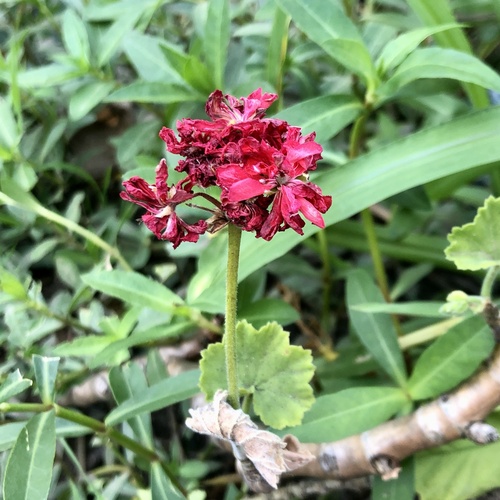
How to care for Pelargonium × hortorum
Watering
Zonal geraniums (Pelargonium × hortorum) store some water in their stems and thick leaves, so they prefer to dry out between drinks. Water deeply when the top few centimetres of compost are dry, letting excess drain away fully. Never leave the pot standing in water, because the roots rot quickly. In winter, when growth slows, water much less often.
Does it need water today?
Push a finger 3 cm into the compost. If it feels dry, water. If it is still damp, wait. Lift the pot too: a light pot means it is thirsty, a heavy pot means it is still wet. Limp, drooping leaves with dry soil confirm it needs water now.
Water at the soil level rather than over the leaves and flowers, which can develop grey mould and spots if they stay wet. Empty the saucer 15 minutes after watering.
Overwatering
Zonal geraniums come from South Africa, where they grow in well-drained, fairly dry soils. Their thick stems and roots are easily damaged by constant wetness, so too much water is the most common way they die indoors.
Symptoms: Yellowing lower leaves, a soft or blackened stem base, a sour smell from the compost, and wilting even though the soil is wet.
Solutions: Stop watering and let the compost dry out to a depth of 3 cm. Remove the plant, cut away any black or mushy roots with clean scissors, and repot into fresh, gritty compost in a pot with drainage holes. Water only when the surface is dry.
Underwatering
Because the plant holds some water in its tissues, it copes with short dry spells better than many houseplants. However, flowers and leaves dry out fast in heat, and a long drought stops flowering altogether.
Symptoms: Drooping leaves that feel soft and papery, crispy brown leaf edges, dropped buds, and compost pulling away from the pot edges.
Solutions: Water thoroughly until it runs from the base. If the compost has shrunk and become hydrophobic, stand the pot in water for 30 minutes to rehydrate it. Remove dead flowers and leaves so the plant can put energy into recovery.
Sunlight
Zonal geraniums flower most heavily in strong, direct sunlight. Plants grown in too little light become tall, leggy, and produce few flowers. Gradually harden off plants moved outdoors to avoid scorched leaves.
- Ideal: Full sun · 6-8 hours of direct sun
- Tolerates: Full sun, Partial sun, Bright, indirect light
- Best spot in a room: At the window
- Artificial light: Use a full-spectrum LED grow light 15 to 30 cm above the plant for 12 to 14 hours a day during winter or in dark rooms. Flowering improves noticeably under good light.
Too little light
Zonal geraniums need strong light to build the sturdy stems and energy needed for flowering. In dim rooms they stretch towards the light source and their blooms fade.
Symptoms: Long, weak stems with large gaps between leaves, pale green foliage, and few or no flowers.
Solutions: Move the plant to the brightest south- or west-facing window. Rotate the pot a quarter turn each week so growth stays even, and add a grow light if the room is dim.
Too much sun
Although they love sun, zonal geraniums can scorch in the intense midday sun of a hot greenhouse or a sudden move outdoors. Their leaves lose water faster than the roots can replace it.
Symptoms: Bleached or pale patches on the upper leaves, crispy brown edges, and wilting in the afternoon even when the soil is moist.
Solutions: Move the plant to a spot with light afternoon shade, such as behind a sheer curtain. Harden off new plants over 7 to 10 days, starting with an hour of morning sun.
Temperature
Zonal geranium (Pelargonium × hortorum) grows best in mild, sunny conditions between about 13°C and 24°C. It tolerates heat better than cold, but it stops flowering when nights stay warm or days become very hot. Keep it above 5°C at night, as frost kills it quickly.
- Ideal: 13–24 °C
- Tolerates: 2–35 °C
- Hardiness zones: 9-11
Fertilizing
Zonal geraniums feed heavily when in bloom, but they need less nitrogen than leafy plants. Choose a fertilizer with more phosphorus and potassium once flower buds appear, and cut back feeding in winter when growth slows.
- Slow-release fertilizer: Once a year in early spring, mix a light dose of slow-release granules into the top of the soil, following the package rate. Skip this if you already repotted with fresh potting mix that contains fertilizer.
- Balanced liquid fertilizer such as 10-10-10 or 15-15-15 for general growth, Tomato or flowering-plant fertilizer with a higher middle number (phosphorus) to encourage blooms, Slow-release granular fertilizer for containers or beds
Soil
Zonal geraniums (Pelargonium × hortorum) need a soil that drains quickly yet holds enough moisture between waterings. Heavy, waterlogged soil is the most common reason these plants rot at the base, so always choose a gritty, open mix over garden soil, which compacts in pots.
- Peat-free potting mix with added perlite: About 60-70% peat-free compost or coir, 30-40% perlite or coarse grit, with a little slow-release fertiliser for pelargoniums
- Loam-based potting mix: John Innes No. 2 style mix, or a blend of 2 parts loam, 1 part compost, and 1 part coarse grit, which suits larger pots and long-term growing
- Container mix for cuttings: Equal parts fine peat-free compost and perlite or vermiculite, used for rooting cuttings and seedlings
- pH 6–7
Repotting
Zonal geraniums (Pelargonium × hortorum) have fleshy, fibrous roots that rot quickly in wet, oversized pots, so use a pot with drainage holes and a loose, fast-draining mix. Repot in spring as new growth starts, or in early summer after the spring flush of flowers.
- How often: Every 2 years, or when roots fill the pot or grow out of the drainage holes
- New pot: Move up only 2-5 cm in diameter at a time; zonal geraniums bloom best when slightly snug in their pots
- Repotting season: Spring, Summer
How to repot
- Gently slide the plant out by tipping the pot on its side and tapping the rim, or by holding the base of the stem and easing the pot off
- Loosen the outer roots with your fingers, and tease apart any tightly circling roots, cutting away any that are brown, mushy, or smell sour
- Place a layer of fresh mix in the new pot so the top of the root ball sits about 2 cm below the rim
- Set the plant in the center, fill around the root ball with fresh mix, and firm it lightly with your hands to remove large air pockets
- Leave the crown of the stem at the same soil level as before, since burying it can cause stem rot
- Water thoroughly until water drains from the holes, then empty the saucer
Pruning
Pelargonium × hortorum flowers on new growth, so regular pruning and deadheading keep it producing blooms through the season. Hard pruning is best done in early spring, before the main growth flush.
Pruning season: Winter, Spring, Summer
How to prune
- In early spring, around March in the Northern Hemisphere, cut back leggy stems by about one-third to one-half, cutting just above a leaf node.
- Pinch out the growing tips of young plants when they are about 15 cm tall to encourage side branching.
- Remove faded flower heads regularly by snipping the stalk just above the next leaf or bud.
- Cut away yellowing or brown leaves at the base of the stem to improve airflow and reduce the risk of grey mold.
- Stop hard pruning in late summer so that the plant is not pushed into new growth just before cooler weather.
Propagation
Stem cutting · Spring, Summer
- Choose a healthy, non-flowering shoot about 8 to 10 cm long from a mature zonal geranium plant.
- Cut just below a leaf node with a clean, sharp knife or scissors.
- Remove the lower leaves so that at least two or three nodes are bare, and pinch off any flower buds.
- Let the cutting callus for one to two days in a dry, shaded spot so the cut end seals.
- Insert the cut end about 2 cm deep into moist, free-draining potting mix, or a mix of peat-free compost and perlite.
- Keep the pot in bright, indirect light at about 18 to 22 °C and water only when the surface feels dry.
- Roots usually form within three to four weeks; then pot the new plant into a small container.
Seed sowing from hybrid seed · Winter, Spring
- Note that Pelargonium × hortorum is a hybrid, so seed-grown plants often differ from the parent and may not match the colors you want.
- Sow fine seed on the surface of seed-starting mix in January to March, lightly covering with a thin layer of compost.
- Keep the tray warm at about 20 to 22 °C and evenly moist, covered with a clear lid until seedlings appear.
- Remove the cover once seedlings emerge and give them bright light.
- Prick out seedlings into individual pots when they have two or three true leaves.
Zonal geraniums root most reliably from cuttings taken in late spring or summer. Keep cuttings out of direct hot sun and avoid soggy compost, since wet stems rot quickly.
About Pelargonium × hortorum
Also known as: Zonal geranium, Bedding geranium, Garden geranium, Horseshoe geranium
- Plant type: shrub, herb, subshrub
- Lifespan: perennial (grown as a half-hardy perennial or annual)
- Distribution: Not native in the wild; a hybrid of South African Pelargonium species developed in European gardens.
- Mature height: 30-60 cm
- Bloom time: Late spring through autumn
Pets · People
Pets: Mildly toxic · People: Mildly toxic. Pelargonium species contain compounds that can cause mild stomach upset, vomiting or dermatitis in some people and animals if eaten or handled; the ASPCA lists the genus Pelargonium as toxic to dogs, cats and horses. Keep out of reach of pets and small children.
Common problems
- Grey mould (Botrytis): Fuzzy grey mould on flowers and stems in cool, damp, crowded conditions; remove affected parts and improve airflow.
- Pelargonium rust: Orange-brown pustules on lower leaf surfaces; remove infected leaves and avoid overhead watering.
- Root rot: Yellowing, collapse and blackened stems from waterlogged soil; use free-draining mix and pots with drainage holes.
- Geranium budworm and caterpillars: Chewed buds and flowers caused by caterpillars; pick off by hand or use a targeted biological control.
- Leaf yellowing from overwatering: Yellow lower leaves and weak growth when soil stays wet; let the surface dry between waterings.
Uses
Primarily ornamental, grown in bedding schemes, window boxes, hanging baskets and containers for long-lasting colour. Its leaves are sometimes used in potpourri and perfumery for their scent, though the species is not a major commercial source of essential oil.
Is it edible?
Not edible; flowers and leaves are not recommended for eating.
History & legends
Zonal geraniums were bred in Europe from the 1700s onward, and by the Victorian era they had become fashionable bedding plants in parks and gardens. Their popularity led to countless cultivars and to the practice of summer bedding displays that persists today.
Did you know?
Many zonal geraniums release a strong, pleasant scent when their leaves are crushed, and the horseshoe-shaped zone on the leaves gave the zonal group its name.
Frequently asked questions
How often should I water Pelargonium × hortorum?
every 7 days. Zonal geraniums (Pelargonium × hortorum) store some water in their stems and thick leaves, so they prefer to dry out between drinks. Water deeply when the top few centimetres of compost are dry, letting excess drain away fully. Never leave the pot standing in water, because the roots rot quickly. In winter, when growth slows, water much less often. Push a finger 3 cm into the compost. If it feels dry, water. If it is still damp, wait. Lift the pot too: a light pot means it is thirsty, a heavy pot means it is still wet. Limp, drooping leaves with dry soil confirm it needs water now.
How much light does Pelargonium × hortorum need?
Full sun (6-8 hours of direct sun). Zonal geraniums flower most heavily in strong, direct sunlight. Plants grown in too little light become tall, leggy, and produce few flowers. Gradually harden off plants moved outdoors to avoid scorched leaves.
What temperature does Pelargonium × hortorum like?
13–24 °C. Zonal geranium (Pelargonium × hortorum) grows best in mild, sunny conditions between about 13°C and 24°C. It tolerates heat better than cold, but it stops flowering when nights stay warm or days become very hot. Keep it above 5°C at night, as frost kills it quickly.
Is Pelargonium × hortorum toxic to cats and dogs?
It is mildly toxic to cats and dogs. Pelargonium species contain compounds that can cause mild stomach upset, vomiting or dermatitis in some people and animals if eaten or handled; the ASPCA lists the genus Pelargonium as toxic to dogs, cats and horses. Keep out of reach of pets and small children.
What are the most common problems of Pelargonium × hortorum?
Grey mould (Botrytis): Fuzzy grey mould on flowers and stems in cool, damp, crowded conditions; remove affected parts and improve airflow. Pelargonium rust: Orange-brown pustules on lower leaf surfaces; remove infected leaves and avoid overhead watering. Root rot: Yellowing, collapse and blackened stems from waterlogged soil; use free-draining mix and pots with drainage holes. Geranium budworm and caterpillars: Chewed buds and flowers caused by caterpillars; pick off by hand or use a targeted biological control. Leaf yellowing from overwatering: Yellow lower leaves and weak growth when soil stays wet; let the surface dry between waterings.
When should I repot Pelargonium × hortorum?
Every 2 years, or when roots fill the pot or grow out of the drainage holes. Zonal geraniums (Pelargonium × hortorum) have fleshy, fibrous roots that rot quickly in wet, oversized pots, so use a pot with drainage holes and a loose, fast-draining mix. Repot in spring as new growth starts, or in early summer after the spring flush of flowers.
How do I propagate Pelargonium × hortorum?
Stem cutting, Seed sowing from hybrid seed. Choose a healthy, non-flowering shoot about 8 to 10 cm long from a mature zonal geranium plant. Cut just below a leaf node with a clean, sharp knife or scissors. Remove the lower leaves so that at least two or three nodes are bare, and pinch off any flower buds. Let the cutting callus for one to two days in a dry, shaded spot so the cut end seals. Insert the cut end about 2 cm deep into moist, free-draining potting mix, or a mix of peat-free compost and perlite. Keep the pot in bright, indirect light at about 18 to 22 °C and water only when the surface feels dry. Roots usually form within three to four weeks; then pot the new plant into a small container.
How this guide was written
Verdiss writes each guide with AI from botanical references and checks the species against iNaturalist and Plants of the World Online (Kew). Readers can rate every guide in the app.
Sources
Verdiss's information is for general guidance. Never eat or use a plant as medicine based on an app: ask a professional.