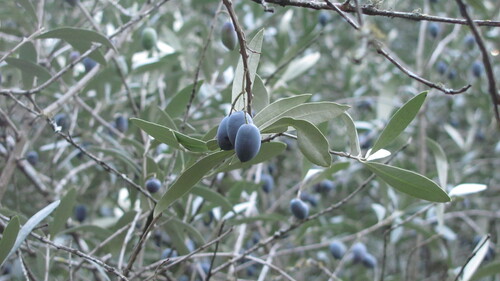
How to care for Olive
Watering
Olive trees (Olea europaea) are drought-adapted Mediterranean plants with silvery, leathery leaves that store water efficiently. Water deeply but infrequently, letting the top 5 to 7 cm of soil dry out between waterings. Their roots sit in soil that drains quickly, and they resent wet feet far more than dryness. Water more during active growth in late spring and summer, and cut back sharply from late autumn through winter when the tree is dormant. Established outdoor olives often need little or no supplemental water in a temperate climate with normal rainfall, so check the soil before watering.
Does it need water today?
Push a finger 5 to 7 cm into the soil near the root ball. If it feels dry, water thoroughly. If it feels cool and damp, wait. For containers, lift the pot: a light pot means it is dry and ready for water, while a heavy pot means it can wait. Leaves that look dull and slightly curled can signal thirst, but check the soil first, since overwatered olives can show the same signs.
Water slowly until it runs out of the drainage holes, then empty the saucer after 15 minutes. Olives standing in water are at high risk of root rot.
Overwatering
Olives evolved in rocky, well-drained Mediterranean hillsides where roots are rarely saturated for long. Their roots suffocate and rot quickly when soil stays waterlogged, especially in cool weather when the tree uses little water.
Symptoms: Yellowing leaves that drop, soft or blackened stems at the base, a sour smell from the soil, and wilting even though the soil is wet.
Solutions: Stop watering immediately and remove the tree from its pot if it is in a container. Trim away black, mushy roots with clean scissors, repot into fresh gritty mix with drainage holes, and wait until the soil is dry before watering again. For in-ground trees, improve drainage around the root zone.
Underwatering
Olive leaves are coated with a waxy, grey-green layer that reduces water loss, so they tolerate dry spells well. Long drought still stresses young trees and container olives, because their root systems are limited and cannot reach deep moisture.
Symptoms: Leaves that look grey, dull, or curled inward, leaf drop starting with older inner leaves, and dry, crumbly soil that pulls away from the pot edge.
Solutions: Water deeply until it drains from the base, then wait for the soil to dry as recommended. If the root ball has shrunk away from the pot, soak the whole pot in a tub of water for 30 minutes. Recovery usually takes a few weeks, so keep the schedule steady rather than overcorrecting.
Sunlight
Olive trees (Olea europaea) are sun-loving Mediterranean plants that need strong, direct light to set fruit, keep dense silvery foliage, and grow compact. Full sun on a south- or west-facing exposure gives the best results indoors or out. Partial sun still works outdoors, but growth becomes leggy and flowering and fruiting drop off. Olives are not suited to deep shade or dim rooms.
- Ideal: Full sun · 6-8 hours of direct sun per day
- Tolerates: Full sun, Partial sun
- Best spot in a room: At the window
- Artificial light: Indoors, a full-spectrum LED grow light placed 20 to 30 cm above the canopy for 10 to 12 hours a day can supplement a bright window. Use a timer so the tree gets consistent daily light.
Too little light
Olives need intense light to photosynthesize efficiently and to produce the flower buds that become fruit. In low light, the tree stretches toward whatever light it can find and stops developing its sturdy, compact form.
Symptoms: Long pale stems with widely spaced leaves, leaves that shrink or drop, no flowers or fruit, and a lean toward the window.
Solutions: Move the tree to the sunniest spot available, ideally a south-facing window, and rotate the pot a quarter turn every week for even growth. Add a full-spectrum grow light for supplemental hours. Outdoors, relocate it to a fully sunny area as soon as frost risk has passed.
Too much sun
Olives handle strong sun well once acclimated, but a sudden jump from shade to intense exposure can scorch leaves. Indoor or greenhouse-grown trees moved outdoors without a transition period are especially vulnerable to sunburn.
Symptoms: Bleached, papery patches on sun-facing leaves, browning leaf edges, and dry, crispy foliage during heat waves.
Solutions: Acclimate new or indoor trees over 7 to 10 days, starting with 1 to 2 hours of morning sun and gradually increasing. Provide light afternoon shade during extreme heat above about 35°C, and water on schedule to keep the tree resilient.
Temperature
Olive (Olea europaea) loves warm, sunny summers and mild winters. Mature trees in the ground can tolerate brief frosts down to about -10°C, but young trees and container plants are much more vulnerable. Keep it outdoors in a sunny spot where possible and bring potted olives under cover before hard freezes.
- Ideal: 10–30 °C
- Tolerates: -10–40 °C
- Hardiness zones: 8-10
Fertilizing
Olives grow well in lean soil and are prone to excess growth and poor fruiting if overfed, especially with nitrogen. Feed lightly during the active growing season from spring to early summer, then stop in late summer so the tree can harden off before winter. Container olives need more regular feeding than trees in the ground because nutrients wash out with each watering.
- Slow-release fertilizer: Once a year in early spring, just as new growth begins. Olives in the ground rarely need more than this.
- Balanced slow-release granular fertilizer for fruit trees or Mediterranean plants, Low-nitrogen liquid fertilizer with added phosphorus and potassium, such as a tomato or fruit-tree feed, Well-rotted compost or aged manure as a mulch in spring, Fertilizer with added magnesium or micronutrients if leaves show deficiency
Soil
Olives need soil that drains very quickly and never stays waterlogged, because their roots rot in wet, airless conditions. Slightly alkaline to neutral soil suits them best, and they tolerate limestone well.
- Mineral gritty mix: About 60% coarse grit or pumice, 25% good potting soil, and 15% coarse bark or horticultural sand.
- Mediterranean garden soil: Native topsoil mixed with about 30% coarse sand or gravel, with a little compost (under 10%) for structure.
- Commercial citrus or cactus mix: Ready-made mix to which you add an extra handful of perlite or grit per litre for better aeration.
- pH 6.5–8.5
Repotting
Use a pot with at least one large drainage hole, a well-draining mineral mix, and a clean, sharp pruning tool. Repot in early spring, just before new growth starts, when the tree is no longer dormant but has not yet flushed.
- How often: Every 2-3 years for young olive trees; every 3-5 years once mature, refreshing the top few centimetres of soil in between.
- New pot: Move up only one pot size (about 2-5 cm wider in diameter) at each repot. Olive roots are fine and spread slowly, and an oversized pot holds wet soil that rots them.
- Repotting season: Spring
How to repot
- Tip the tree out gently, supporting the trunk at the base. If it sticks, tap the pot sides rather than pulling the trunk.
- Loosen the outer roots with your fingers or a chopstick, and trim any black, mushy or broken roots with clean shears.
- Shave off about one-third of the old soil from the root ball, keeping the fine white roots intact.
- Set the tree in the new pot so the root collar sits 2-3 cm below the rim, then fill around it with the mix, tapping the pot to remove large air pockets.
- Firm the soil lightly with your hands, then water thoroughly until water drains freely from the holes.
- Move the pot to a sheltered spot out of direct midday sun for two weeks while the roots settle.
Pruning
Prune lightly and regularly rather than heavily in one year. Olive flowers form on last year's wood, so cutting too much in winter removes next season's crop. Always disinfect tools between trees and between cuts when you find diseased wood.
Pruning season: Spring, Summer
How to prune
- In late spring, after the risk of hard frost has passed, remove any dead, damaged, or diseased wood back to healthy tissue, cutting about 5 cm below the visible damage.
- Cut out suckers growing from the base or roots, since these compete with the main trunk.
- Thin the centre of the canopy by removing a few of the oldest, least productive branches, aiming to let light reach the inner branches.
- Shorten overly long shoots by cutting back to a healthy side branch or outward-facing bud to keep the tree compact.
- Remove crossing or rubbing branches so that the remaining limbs are well spaced.
- In summer, after harvest, lightly tip back any excessively vigorous, upright water shoots to control growth.
- Clean tools with 70 percent isopropyl alcohol after each diseased branch and dispose of prunings rather than composting them.
Propagation
Semi-hardwood cuttings · Summer
- Take 10 to 15 cm cuttings from the current season's semi-hardwood growth in early to mid summer, when the stem is green at the base but firm.
- Strip the leaves from the bottom half of each cutting and trim the base cleanly just below a node.
- Dip the cut end in a rooting hormone powder labelled for woody plants.
- Insert the cutting into a pot of moist, gritty mix such as equal parts perlite and peat-free compost.
- Cover loosely with a clear bag or place in a propagator at about 20 to 25 °C, out of direct sun.
- Keep the mix damp but never waterlogged, and check for roots after 8 to 12 weeks by gently tugging the cutting.
- Once rooted, pot on into a container with drainage holes and move to bright indirect light before hardening off.
Grafting onto rootstock · Spring
- Choose a healthy, vigorous rootstock seedling of Olea europaea about pencil thickness and a scion of a named cultivar with no signs of disease.
- In early spring, before buds swell, make a matching cut on both scion and rootstock, such as a whip or side-veneer graft.
- Join the cambium layers tightly so the green inner bark lines up on at least one side.
- Bind firmly with grafting tape and seal exposed cuts with grafting wax.
- Keep the graft in a warm, humid spot out of strong wind, and remove any shoots growing from below the union.
- Loosen the tape after about 6 weeks, once the scion has begun to swell and grow.
Sowing seed · Autumn, Winter
- Collect ripe, dark fruit in autumn, remove the flesh, and soak the stone for 24 hours in fresh water.
- Sow the stones about 2 cm deep in a pot of gritty compost in autumn.
- Keep the pot outdoors in a sheltered spot where temperatures stay around 15 to 20 °C, or in a cool greenhouse.
- Expect slow germination, often taking several months, and be aware that seedlings rarely match the parent fruit or oil quality.
- Pot seedlings on once they have several true leaves and grow them in bright light for their first year.
Semi-hardwood cuttings from summer are the most practical method for home gardeners. Olive seedlings grow slowly and may not produce fruit true to the parent, so use cuttings or grafted cultivars when you want a specific variety.
About Olive
Also known as: Common olive, Olive tree, European olive
- Plant type: tree, evergreen, shrub form when pruned
- Lifespan: perennial
- Distribution: Native to the Mediterranean basin, the Middle East, northeastern Africa and southwestern Asia.
- Mature height: 5-15 m in the wild, often 3-6 m in cultivation
- Bloom time: Late spring to early summer
Pets · People
Pets: Toxic · People: Toxic. Unripe fruit, leaves and the bark of Olea europaea contain oleuropein and other compounds that can cause vomiting, diarrhea and lethargy in cats and dogs; ripe cured olives are still salty and can cause stomach upset. Keep plant out of reach of pets and children, and contact a vet or poison control if ingestion occurs. Note: the fruit is not toxic to humans when properly cured.
Common problems
- Olive knot: Bacterial disease causing woody galls on branches; remove affected wood and disinfect tools.
- Root rot: Caused by waterlogged soil; ensure fast-draining mix and pot with drainage holes.
- Olive fruit fly: Larvae damage developing fruit; monitor and use traps where outdoor trees grow commercially.
- Scale insects: Sap-sucking pests that weaken branches; wipe with soapy water or use horticultural oil.
- Leaf drop from stress: Sudden leaf loss after moves or overwatering; keep conditions stable and water carefully.
Uses
Olive trees are widely grown as ornamentals in gardens and containers. Their fruit is cured for table olives, and the cold-pressed oil is central to Mediterranean cooking, cosmetics and soap making. The wood is prized for carving and fuel.
Is it edible?
Ripe fruit is edible only after curing or brining, which removes bitter oleuropein; the oil is edible. Unripe fruit and leaves are not eaten raw.
History & legends
Olives have been cultivated since at least 4000 BCE in the eastern Mediterranean. In Greek myth, Athena gifted the olive tree to Athens, and in Hebrew and Christian tradition the olive branch signals peace and renewal.
Did you know?
Some olive trees in the Mediterranean are believed to be over 2,000 years old, and they can resprout from their base even after severe damage.
Frequently asked questions
How often should I water Olive?
every 14 days. Olive trees (Olea europaea) are drought-adapted Mediterranean plants with silvery, leathery leaves that store water efficiently. Water deeply but infrequently, letting the top 5 to 7 cm of soil dry out between waterings. Their roots sit in soil that drains quickly, and they resent wet feet far more than dryness. Water more during active growth in late spring and summer, and cut back sharply from late autumn through winter when the tree is dormant. Established outdoor olives often need little or no supplemental water in a temperate climate with normal rainfall, so check the soil before watering. Push a finger 5 to 7 cm into the soil near the root ball. If it feels dry, water thoroughly. If it feels cool and damp, wait. For containers, lift the pot: a light pot means it is dry and ready for water, while a heavy pot means it can wait. Leaves that look dull and slightly curled can signal thirst, but check the soil first, since overwatered olives can show the same signs.
How much light does Olive need?
Full sun (6-8 hours of direct sun per day). Olive trees (Olea europaea) are sun-loving Mediterranean plants that need strong, direct light to set fruit, keep dense silvery foliage, and grow compact. Full sun on a south- or west-facing exposure gives the best results indoors or out. Partial sun still works outdoors, but growth becomes leggy and flowering and fruiting drop off. Olives are not suited to deep shade or dim rooms.
What temperature does Olive like?
10–30 °C. Olive (Olea europaea) loves warm, sunny summers and mild winters. Mature trees in the ground can tolerate brief frosts down to about -10°C, but young trees and container plants are much more vulnerable. Keep it outdoors in a sunny spot where possible and bring potted olives under cover before hard freezes.
Is Olive toxic to cats and dogs?
It is toxic to cats and dogs: keep it out of their reach. Unripe fruit, leaves and the bark of Olea europaea contain oleuropein and other compounds that can cause vomiting, diarrhea and lethargy in cats and dogs; ripe cured olives are still salty and can cause stomach upset. Keep plant out of reach of pets and children, and contact a vet or poison control if ingestion occurs. Note: the fruit is not toxic to humans when properly cured.
What are the most common problems of Olive?
Olive knot: Bacterial disease causing woody galls on branches; remove affected wood and disinfect tools. Root rot: Caused by waterlogged soil; ensure fast-draining mix and pot with drainage holes. Olive fruit fly: Larvae damage developing fruit; monitor and use traps where outdoor trees grow commercially. Scale insects: Sap-sucking pests that weaken branches; wipe with soapy water or use horticultural oil. Leaf drop from stress: Sudden leaf loss after moves or overwatering; keep conditions stable and water carefully.
When should I repot Olive?
Every 2-3 years for young olive trees; every 3-5 years once mature, refreshing the top few centimetres of soil in between.. Use a pot with at least one large drainage hole, a well-draining mineral mix, and a clean, sharp pruning tool. Repot in early spring, just before new growth starts, when the tree is no longer dormant but has not yet flushed.
How do I propagate Olive?
Semi-hardwood cuttings, Grafting onto rootstock, Sowing seed. Take 10 to 15 cm cuttings from the current season's semi-hardwood growth in early to mid summer, when the stem is green at the base but firm. Strip the leaves from the bottom half of each cutting and trim the base cleanly just below a node. Dip the cut end in a rooting hormone powder labelled for woody plants. Insert the cutting into a pot of moist, gritty mix such as equal parts perlite and peat-free compost. Cover loosely with a clear bag or place in a propagator at about 20 to 25 °C, out of direct sun. Keep the mix damp but never waterlogged, and check for roots after 8 to 12 weeks by gently tugging the cutting. Once rooted, pot on into a container with drainage holes and move to bright indirect light before hardening off.
How this guide was written
Verdiss writes each guide with AI from botanical references and checks the species against iNaturalist and Plants of the World Online (Kew). Readers can rate every guide in the app.
Sources
Verdiss's information is for general guidance. Never eat or use a plant as medicine based on an app: ask a professional.