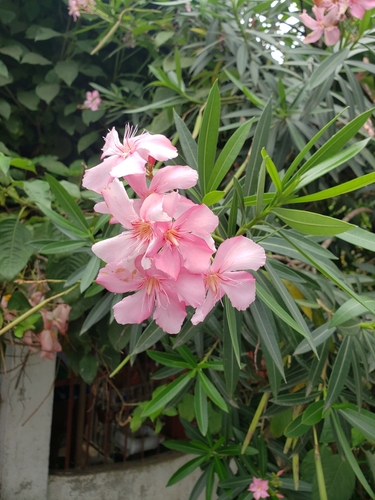
How to care for oleander
Watering
Oleander (Nerium oleander) is a drought-tolerant shrub that stores water in its woody stems and thick leaves, so it prefers to dry out between waterings. Water deeply when the soil is dry, then let the excess drain away. Keep the root ball from sitting in water, and water less in cool months when growth slows. Potted plants need the most attention because their soil dries faster in warm weather and in terra cotta pots.
Does it need water today?
Push a finger about 3-5 cm (1-2 inches) into the soil. If it feels dry, it is time to water. For a pot, lift it: a dry pot feels noticeably lighter than one that was just watered. Yellowing or drooping leaves with dry soil are also a sign that water is needed.
Water thoroughly until it runs out of the drainage holes, then empty the saucer after 15 minutes. In winter, when an indoor oleander is dormant, check the soil only every two to three weeks.
Overwatering
Oleander has thick, fleshy stems and roots that store water, so it tolerates drought far better than wet feet. Standing water deprives the roots of oxygen and encourages root rot, which is the most common way a container oleander dies. Soggy soil is much more dangerous than a short dry spell.
Symptoms: Leaves turn yellow and drop, especially the lower ones. Stems become soft or mushy at the base, and the soil stays wet for many days. A sour or musty smell can come from the pot.
Solutions: Stop watering and let the soil dry out. Check that the pot has drainage holes and empty the saucer after every watering. If the roots are brown and mushy, repot in fresh, well-draining soil, trim the damaged roots, and water lightly until new growth appears.
Underwatering
Oleander can survive a long dry period, but a plant grown in a pot or in a hot, sunny spot can run out of water. Dry soil becomes hydrophobic, so water runs down the sides of the pot without soaking in. Stress from drought also makes the plant more likely to drop buds and flowers.
Symptoms: Leaves wilt, curl at the edges, and turn dull or crispy, often starting with the older leaves. Flower buds may drop before opening, and growth stops. The soil pulls away from the pot edge and feels very light.
Solutions: Water deeply until it drains from the bottom, and repeat after 15-20 minutes if the soil is very dry. If the root ball has shrunk away from the pot, soak it in a bucket of water for 30 minutes. Move the plant to a cooler spot if it is in hot direct sun during a heat wave.
Sunlight
Oleander (Nerium oleander) is a sun-loving shrub that flowers most heavily when it gets full sun all day. In full sun it develops compact growth, strong stems, and abundant pink, white, or red blooms. In partial shade it grows more slowly and flowers less, but it stays healthy. Deep shade is not suitable for this plant.
- Ideal: Full sun · 6 or more hours of direct sun per day
- Tolerates: Full sun, Partial sun
- Best spot in a room: At the window
- Artificial light: If an oleander is indoors, use a full-spectrum grow light for 12-14 hours a day during the growing season. Place the light about 30-45 cm (12-18 inches) above the foliage and raise it as the plant grows. Indoor plants generally need the brightest south- or west-facing window available.
Too little light
Oleander needs a lot of light to grow dense foliage and produce flowers. Without enough sun, the plant stretches toward the light, becomes thin and weak, and often stops blooming. Low light also makes the plant more prone to pests and disease because it cannot build strong tissue.
Symptoms: Stems grow long and spindly with large gaps between leaves. Leaves are small and pale, and the plant produces few or no flowers. Lower leaves may yellow and drop.
Solutions: Move the plant outdoors into full sun gradually over one to two weeks to avoid leaf scorch. Indoors, place it in the sunniest window and rotate the pot a quarter turn every week. Use a grow light if the plant cannot get at least 6 hours of direct sun.
Too much sun
Oleander is native to hot, sunny regions and handles intense sun well once it is acclimated. Problems arise when a plant grown in shade or indoors is suddenly moved into strong midday sun, or when reflected heat from walls and pavement intensifies the light. Leaves can burn in these conditions.
Symptoms: Leaves develop pale, bleached patches or crispy brown edges, mostly on the side facing the sun. Leaves may curl or wilt during the hottest part of the day and recover in the evening. Flowers may fade quickly.
Solutions: Move the plant to a location with morning sun and light afternoon shade, or use a sheer curtain indoors during the hottest hours. Increase watering on very hot days, because sun-scorched leaves lose water faster. Leaves that are already damaged will not recover, but new growth will be healthy.
Temperature
Oleander (Nerium oleander) is a Mediterranean shrub that thrives in heat and sun. Mature plants tolerate brief frosts down to about -10°C, but young plants and new growth are damaged much sooner. Keep it warm, bright, and out of prolonged cold.
- Ideal: 10–30 °C
- Tolerates: -10–40 °C
- Hardiness zones: 8-11
Fertilizing
Oleander blooms best with steady moderate feeding. It is a heavy flowerer, so it benefits from a fertilizer that supports blooms, but too much nitrogen gives lush leaves and few flowers. Its leaves and stems are highly toxic, so wear gloves and wash hands after handling fertilizer and plant material.
- Slow-release fertilizer: Apply once a year in early spring, just as new growth begins, or use 'not needed' in rich garden soil with healthy growth.
- Balanced slow-release granular fertilizer (e.g. 10-10-10) for ground plants, Flowering-plant liquid fertilizer with moderate phosphorus for containers, Compost or well-rotted manure as a gentle annual top dressing
Soil
Oleander tolerates a wide range of soils, including poor, dry, and alkaline ground, but it dislikes waterlogged roots. Good drainage matters more than fertility, so always choose a mix that drains freely and does not compact over time.
- Sandy loam potting mix: About 50 percent good loam or garden topsoil, 30 percent coarse sand or perlite, and 20 percent compost or peat-free organic matter.
- Cactus and citrus mix: Commercial mix formulated for well-drained container plants, often with pumice, bark, and grit, which suits oleander's need for air around roots.
- In-ground garden soil with amendment: Native soil mixed with about one-third coarse sand or grit and some compost to improve drainage in heavy clay.
- pH 6–8.5
Repotting
Use a pot with drainage holes and a sturdy base, because mature oleander is top-heavy. Wait until the danger of frost has passed and new growth begins, usually in spring. Wear gloves and avoid touching your face: every part of oleander, including sap and dust from cut stems, is toxic if swallowed or irritating to skin.
- How often: Every 2-3 years, or when roots fill the pot
- New pot: Move up only one pot size (about 2-5 cm wider in diameter) each time, since oleander flowers best when slightly root-bound and sits in overly large pots can stay wet and sour.
- Repotting season: Spring
How to repot
- Lay the plant on its side on the tarp and gently ease it out, supporting the trunk with one hand.
- Loosen the outer roots with your fingers. Trim away any black, mushy, or dead roots with clean shears.
- Set the root ball in the new pot so the crown sits about 2 cm below the rim.
- Fill around the roots with fresh mix, firming gently as you go to remove large air pockets.
- Water thoroughly until it drains from the holes, then move the pot to a bright, sheltered spot out of strong wind.
- Wash your tools, gloves, and tarp afterwards, and keep children and pets away from the work area.
Pruning
Use sharp, clean secateurs or loppers and wear gloves and eye protection, because all parts of oleander are poisonous and the sap can irritate skin. Disinfect tools between plants, especially if you spot leaf spot or other disease. Remove no more than about one third of the plant's live growth in a single year.
Pruning season: Winter, Spring
How to prune
- In late winter or early spring, remove all dead, damaged, or diseased wood back to healthy tissue, cutting just above a healthy bud or side shoot.
- Cut out any branches that cross or rub against each other, and any weak, thin shoots growing inward.
- Shorten long, leggy branches by up to one third, cutting just above a leaf node or outward-facing bud so the new growth opens the centre of the plant.
- After the main flowering flush in summer, deadhead spent flower clusters by snapping or cutting them back to the first leaf node, which keeps the plant tidy and may encourage a second round of blooms.
- Thin the centre of dense shrubs by removing a few older stems at ground level, which lets light and air reach the inner branches.
- Clean up all fallen leaves, pruned material, and clippings, and dispose of them safely away from pets and children, since they are toxic.
Propagation
Softwood stem cuttings · Spring, Summer
- Choose healthy, non-flowering green shoots about 15 to 20 cm long from the current season's growth.
- Cut just below a leaf node with clean, sharp secateurs, then strip the lower leaves so two or three pairs remain at the top.
- Wear gloves and eye protection while working, because all parts of Nerium oleander are toxic and the sap can irritate skin.
- Dip the cut end in rooting hormone powder and tap off the excess.
- Insert the cutting about 5 cm deep into a pot of moist, free-draining mix made of equal parts perlite and peat or coir.
- Place the pot somewhere bright with no harsh midday sun, and keep the mix lightly moist but never soggy.
- Roots usually form within four to six weeks at warm temperatures of about 22 to 28 °C. Gently tug to test for resistance before moving the cutting on.
Rooting in water · Spring, Summer
- Take a 15 cm green cutting from a healthy shoot and remove the lower leaves.
- Wear gloves, since the milky sap is irritating to skin and harmful if ingested.
- Place the cut end in a clean glass or jar of fresh water, keeping the leaves above the waterline.
- Set the jar in bright indirect light at around 20 to 25 °C and change the water every few days.
- When roots reach about 3 to 5 cm long, pot the cutting into a free-draining mix. Water in well and keep it out of direct sun for a week or two while it adjusts.
Semi-hardwood cuttings · Summer, Autumn
- Select firm shoots from the current year's growth that have started to harden at the base but still bend slightly.
- Cut 15 to 20 cm lengths just below a node and remove the lower leaves.
- Wear gloves and keep pets and children away from the clippings, as the plant is poisonous.
- Dip the base in rooting hormone and insert it into a pot of gritty, free-draining mix.
- Cover loosely with a clear plastic bag held up on stakes to hold humidity, and open it briefly every few days to air the cutting.
- Keep the pot warm and bright, and expect roots in about six to eight weeks.
Air layering · Spring, Summer
- Choose a healthy, woody branch about pencil-thick and at least a year old.
- Make a 2 to 3 cm long upward cut through the bark into the wood, or remove a thin ring of bark about 2 cm wide, and wear gloves throughout.
- Dust the wound with rooting hormone and wrap it with a handful of damp sphagnum moss.
- Enclose the moss in clear plastic, tie both ends tightly, and keep the moss damp by checking it regularly.
- When roots show through the moss after several weeks, cut the branch below the roots and pot the new plant.
Seed · Spring
- Collect long, narrow seed pods in late autumn or winter once they have dried and split open on the plant.
- Remove the flat, papery seeds, which are toxic, and handle them with gloves.
- Soak the seeds in warm water for 12 to 24 hours to soften the coat.
- Sow them about 0.5 cm deep in a seed tray of moist, free-draining mix.
- Keep the tray warm at about 20 to 25 °C and bright, and expect germination within two to four weeks. Note that seedlings may not match the parent plant's flower colour.
Oleander roots readily from softwood cuttings in warm conditions, so late spring to early summer is the most reliable time. Cuttings taken in water can be easy to monitor, but they must still be potted into soil before the water-grown roots become stressed.
About oleander
Also known as: Rose bay, Sweet oleander, Nerium
- Plant type: shrub, small tree
- Lifespan: perennial
- Distribution: Native to the Mediterranean region, southwest Asia, the Indian subcontinent and southern China.
- Mature height: 2-6 m
- Bloom time: Late spring to autumn, mainly summer
Pets · People
Pets: Toxic · People: Toxic. All parts, including leaves, flowers, stems, sap and smoke from burning wood, contain cardiac glycosides (such as oleandrin) that can cause severe poisoning in people, dogs, cats, horses and livestock; even small amounts can be fatal. Sap can irritate skin and eyes.
Common problems
- Oleander aphids: Clusters of black aphids on new shoots and flower buds, which can distort growth; a strong water spray or insecticidal soap usually controls them.
- Oleander caterpillar: Larvae of the moth Syntomeida epilais skeletonise leaves in warm regions; remove them by hand, wearing gloves, or use Bacillus thuringiensis.
- Bacterial leaf scorch: Caused by Xylella fastidiosa, it causes leaf edges to brown and the plant to decline; there is no cure, so infected plants should be removed.
- Root rot: Waterlogged or poorly drained soil leads to root rot and yellowing leaves; improve drainage and water less often.
- Oleander leaf scorch from salt: Leaves may brown at the edges after heavy wind or salt exposure; trim damaged leaves and rinse foliage with fresh water.
Uses
Widely planted as an ornamental hedge, screen and container shrub in gardens, parks and roadsides because of its showy flowers and tolerance of harsh conditions. Historically its wood and leaves were used in some traditional medicines, though these uses are dangerous; today it is valued almost entirely for landscape planting.
Is it edible?
not edible
History & legends
Oleander has been known since antiquity and is mentioned by Greek and Roman writers, who noted its poisonous nature. In folklore it was linked to protection and misfortune alike, and in some traditions its branches were used to ward off evil, while in others it was associated with death and danger.
Did you know?
Oleander is so tolerant of pollution and drought that it is often planted along highways and in city centres, and it is one of the few shrubs that keeps flowering in the hottest months.
Frequently asked questions
How often should I water oleander?
every 10 days. Oleander (Nerium oleander) is a drought-tolerant shrub that stores water in its woody stems and thick leaves, so it prefers to dry out between waterings. Water deeply when the soil is dry, then let the excess drain away. Keep the root ball from sitting in water, and water less in cool months when growth slows. Potted plants need the most attention because their soil dries faster in warm weather and in terra cotta pots. Push a finger about 3-5 cm (1-2 inches) into the soil. If it feels dry, it is time to water. For a pot, lift it: a dry pot feels noticeably lighter than one that was just watered. Yellowing or drooping leaves with dry soil are also a sign that water is needed.
How much light does oleander need?
Full sun (6 or more hours of direct sun per day). Oleander (Nerium oleander) is a sun-loving shrub that flowers most heavily when it gets full sun all day. In full sun it develops compact growth, strong stems, and abundant pink, white, or red blooms. In partial shade it grows more slowly and flowers less, but it stays healthy. Deep shade is not suitable for this plant.
What temperature does oleander like?
10–30 °C. Oleander (Nerium oleander) is a Mediterranean shrub that thrives in heat and sun. Mature plants tolerate brief frosts down to about -10°C, but young plants and new growth are damaged much sooner. Keep it warm, bright, and out of prolonged cold.
Is oleander toxic to cats and dogs?
It is toxic to cats and dogs: keep it out of their reach. All parts, including leaves, flowers, stems, sap and smoke from burning wood, contain cardiac glycosides (such as oleandrin) that can cause severe poisoning in people, dogs, cats, horses and livestock; even small amounts can be fatal. Sap can irritate skin and eyes.
What are the most common problems of oleander?
Oleander aphids: Clusters of black aphids on new shoots and flower buds, which can distort growth; a strong water spray or insecticidal soap usually controls them. Oleander caterpillar: Larvae of the moth Syntomeida epilais skeletonise leaves in warm regions; remove them by hand, wearing gloves, or use Bacillus thuringiensis. Bacterial leaf scorch: Caused by Xylella fastidiosa, it causes leaf edges to brown and the plant to decline; there is no cure, so infected plants should be removed. Root rot: Waterlogged or poorly drained soil leads to root rot and yellowing leaves; improve drainage and water less often. Oleander leaf scorch from salt: Leaves may brown at the edges after heavy wind or salt exposure; trim damaged leaves and rinse foliage with fresh water.
When should I repot oleander?
Every 2-3 years, or when roots fill the pot. Use a pot with drainage holes and a sturdy base, because mature oleander is top-heavy. Wait until the danger of frost has passed and new growth begins, usually in spring. Wear gloves and avoid touching your face: every part of oleander, including sap and dust from cut stems, is toxic if swallowed or irritating to skin.
How do I propagate oleander?
Softwood stem cuttings, Rooting in water, Semi-hardwood cuttings, Air layering, Seed. Choose healthy, non-flowering green shoots about 15 to 20 cm long from the current season's growth. Cut just below a leaf node with clean, sharp secateurs, then strip the lower leaves so two or three pairs remain at the top. Wear gloves and eye protection while working, because all parts of Nerium oleander are toxic and the sap can irritate skin. Dip the cut end in rooting hormone powder and tap off the excess. Insert the cutting about 5 cm deep into a pot of moist, free-draining mix made of equal parts perlite and peat or coir. Place the pot somewhere bright with no harsh midday sun, and keep the mix lightly moist but never soggy. Roots usually form within four to six weeks at warm temperatures of about 22 to 28 °C. Gently tug to test for resistance before moving the cutting on.
How this guide was written
Verdiss writes each guide with AI from botanical references and checks the species against iNaturalist and Plants of the World Online (Kew). Readers can rate every guide in the app.
Sources
Verdiss's information is for general guidance. Never eat or use a plant as medicine based on an app: ask a professional.