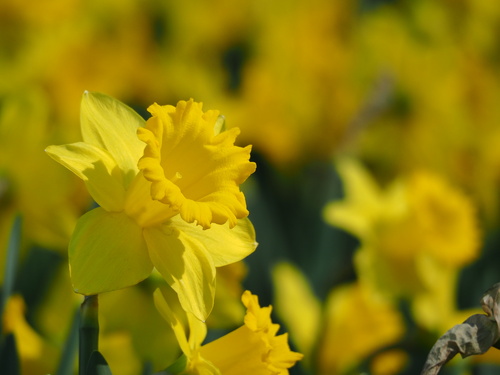
How to care for wild daffodil
Watering
Wild daffodil (Narcissus pseudonarcissus) grows from a bulb and is naturally adapted to damp spring meadows that dry out in early summer. Keep the soil lightly moist while leaves and flowers are growing, usually from late winter to late spring. Once the foliage yellows after flowering, water much less, and keep the bulb nearly dry during summer dormancy. Indoors, the pot needs good drainage and should never sit in water.
Does it need water today?
Push a finger 3 cm into the compost. If it feels dry, water thoroughly. If it feels damp, wait. A pot that feels very light when lifted is also thirsty. For a bulb in summer dormancy, the soil should feel dry to the touch, and you should not water at all.
Water at the base of the pot, not over the leaves, and empty the saucer within 30 minutes so the bulb does not rot. Good drainage matters more than the exact schedule.
Overwatering
Wild daffodil bulbs store their own water and rot quickly in waterlogged soil, especially when they are dormant. Soggy compost cuts off oxygen to the roots and invites Fusarium and other bulb rots. This species is far more likely to die from too much water than too little.
Symptoms: Yellow, mushy leaves that collapse at the base, a soft or smelly bulb, black or brown rot at the neck, and no flowers the following spring.
Solutions: Stop watering and let the compost dry out. Tip the bulb out, cut away soft or dark tissue with a clean knife, and dust the cut with sulphur powder. Let it dry for a few days, then repot in fresh, gritty compost in a pot with drainage holes.
Underwatering
During active growth, wild daffodil needs steady moisture to build leaves and flower buds. Prolonged drought stops the bulb from storing energy for next year. Bulbs that dry out before flowering can produce small or no blooms.
Symptoms: Limp, wrinkled leaves that stay curled, shorter stems, small flowers that fade quickly, or buds that drop before opening.
Solutions: Water thoroughly once the top of the compost is dry during active growth. Soak the pot in a basin for 20 minutes if the compost has pulled away from the sides. Keep the bulb dry only after the leaves have yellowed naturally.
Sunlight
Wild daffodil grows in open woodland edges and meadows, where it gets strong spring sun before trees leaf out. Bright light is needed for the bulb to store energy for next year's flowers. Leaves should stay upright and green during growth, with the bulb receiving sun until the foliage yellows.
- Ideal: Partial sun · 4-6 hours of direct sun daily during spring, with bright light the rest of the day
- Tolerates: Full sun, Partial sun, Bright, indirect light
- Best spot in a room: At the window
- Artificial light: During winter indoors, use a full-spectrum LED grow light 15 to 20 cm above the foliage for 12 to 14 hours a day. This helps forced bulbs develop strong stems and healthy leaves.
Too little light
Low light makes wild daffodil stretch toward any available light, producing weak, pale stems that bend over. Without enough sun the bulb cannot store enough reserves to flower well the next season.
Symptoms: Long, floppy stems, pale yellow-green leaves, leaning flowers, and small or missing blooms the following year.
Solutions: Move the pot to the brightest south or west window available, or outdoors to a spot with morning sun. Add a grow light if needed, and rotate the pot weekly so all sides receive light.
Too much sun
Wild daffodil tolerates strong sun in spring, but intense heat and glare through glass can scorch leaves and dry the compost quickly. In summer the dormant bulb is safest in cool, shaded conditions.
Symptoms: Brown or bleached leaf tips, crispy edges, faded flower colour, and very fast soil drying.
Solutions: Move the pot to a bright spot out of direct afternoon sun, or shade it with a sheer curtain. After flowering, keep it in a cool, shaded place until the foliage yellows naturally.
Temperature
Wild daffodil (Narcissus pseudonarcissus) is a hardy bulb from the cool, moist meadows and woodland edges of western Europe. It needs a real winter chill to bloom well and prefers cool spring weather, with flowers lasting longest when days stay around 10 to 15°C. Hot summers are the main threat once the leaves have faded.
- Ideal: 5–15 °C
- Tolerates: -20–30 °C
- Hardiness zones: 5-8
Fertilizing
Wild daffodil feeds on nutrients stored in its bulb, and phosphorus and potassium help build those reserves for next year's flowers. Too much nitrogen encourages leafy growth at the expense of blooms. Feed while the leaves are still green, and stop once they yellow.
- Slow-release fertilizer: Once a year in early autumn, when planting or before bulbs go into the ground, or in early spring as shoots appear.
- Bulb fertilizer with higher phosphorus and potassium, low nitrogen, Slow-release granular fertilizer for bulbs, such as bone meal or a balanced bulb food, Well-rotted compost or leaf mould as a gentle organic option
Soil
Wild daffodil grows best in fertile, humus-rich soil that drains well yet holds some moisture in spring. Waterlogged or compacted ground causes bulb rot, so drainage matters more than richness.
- Gritty loam-based bulb compost: Loam, horticultural grit or perlite, and a little organic matter
- Garden loam with added grit: Two parts garden loam, one part sharp sand or grit, and a small amount of leaf mould
- Woodland-style humus soil: Leaf mould, well-rotted compost, and sharp sand, suited to naturalising under deciduous trees
- pH 6–7.5
Repotting
Wild daffodil (Narcissus pseudonarcissus) is a bulb, so repotting is really about lifting, dividing, and replanting bulbs at the right depth. Plant in autumn so the bulbs can root before winter and bloom in spring.
- How often: Every 3-5 years, or when clumps become crowded and flowering declines
- New pot: Use a container 5-10 cm wider than the bulb cluster, with drainage holes; a 15-20 cm pot suits 4-6 bulbs
- Repotting season: Autumn
How to repot
- Gently loosen the soil around the clump with a hand fork and lift the bulbs carefully
- Brush off old soil and separate offsets (small bulblets) from the parent bulbs
- Discard any bulbs that are soft, mushy, or badly damaged
- Set the bulbs pointed end up, with the tip about twice the bulb's height below the soil surface
- Space bulbs about 5 cm apart and water lightly to settle the soil
- Keep the pot in a cool, sheltered spot outdoors, or plant directly into the garden border
Pruning
Wild daffodil does not need pruning in the usual sense. The only cutting it needs is removing spent flower stems and, later, the dying leaves once they have fully yellowed. Never tie, braid, or cut the green leaves while they are still green, because they supply the food that the bulb stores for next season.
Pruning season: Spring, Summer
How to prune
- Once each flower has faded, cut the flower stalk off at its base, close to the leaves, to stop seed production.
- Leave all the foliage in place through spring and early summer, even if it looks untidy.
- When the leaves have turned fully yellow and come away easily, gently tug them free or cut them at soil level.
- Dispose of the cut stems and leaves in the garden waste bin rather than the compost, since the plant is toxic.
- Wash your tools and your hands after the job is finished.
Propagation
Offsets (bulblet division) · Summer
- Wait until the foliage has yellowed and died back naturally, usually late spring to early summer in the Northern Hemisphere.
- Gently lift the clump of Narcissus pseudonarcissus bulbs with a garden fork, working well outside the root zone to avoid cutting the bulbs.
- Brush off the soil and separate the small offset bulblets that cluster around the larger parent bulb.
- Let the bulbs dry in a shaded, airy spot for a few days until the outer skins feel papery.
- Replant the mature bulbs and the offsets at a depth of about two to three times the bulb's height, pointed end up, in well-drained soil.
Seed sowing · Summer, Autumn
- Collect seed capsules once they turn brown and split, usually early summer.
- Extract the black seeds and sow them fresh in a pot or seed tray filled with gritty, free-draining compost.
- Cover the seeds lightly with grit and place the container outdoors in a sheltered spot where it stays cool.
- Keep the compost barely moist and protect it from squirrels and mice that may dig up the seeds.
- Expect flowering only after four to six years, since seedlings take a long time to grow into blooming bulbs.
Divide wild daffodil clumps only every three to five years. Overcrowded bulbs produce many small offsets and fewer flowers, so division actually helps the flowering display.
About wild daffodil
Also known as: Lent lily, wild daffodil, daffodil, Welsh daffodil
- Plant type: herb, bulbous perennial
- Lifespan: perennial
- Distribution: Native to western and central Europe, from the British Isles and northern France to Spain and the Pyrenees.
- Mature height: 15-30 cm
- Bloom time: Late winter to early spring
Pets · People
Pets: Toxic · People: Toxic. All parts contain lycorine and other Amaryllidaceae alkaloids; bulbs are the most toxic part. Contact can irritate skin, and ingestion causes vomiting, diarrhoea and abdominal pain (ASPCA lists daffodils as toxic to dogs, cats and horses).
Common problems
- Bulb rot: Waterlogged soil causes soft, rotting bulbs; plant in free-draining soil and avoid overwatering.
- Narcissus bulb fly: The larva of Merodon equestris hollows out bulbs; discard infested bulbs and check when buying.
- Failure to flower: Bulbs that are too shaded, overcrowded or lack a cool rest period often produce only leaves; divide and feed after flowering.
- Basal rot fungus: Fusarium infection causes yellowing and collapse; remove affected bulbs and avoid planting in infected soil.
- Narcissus eelworm: Stem nematodes cause distorted, swollen leaves and bulbs; destroy infested plants and do not replant the site with bulbs for several years.
Uses
Ornamental in borders, rock gardens, woodland edges and naturalised lawns, and a parent of many hybrid daffodils bred for cut flowers and forcing. Historically used in traditional medicine, though its alkaloids make it unsafe for home use.
Is it edible?
not edible
History & legends
Narcissus is named after the youth in Greek myth who fell in love with his reflection, and the flower was linked to the underworld and to rebirth in classical tradition. In Wales the daffodil became a national emblem, and wild daffodils were long gathered as early signs of spring in folk custom.
Did you know?
Wild daffodils were once so widespread in English meadows that William Wordsworth's famous poem about a host of golden daffodils was inspired by a field of them near Ullswater.
Frequently asked questions
How often should I water wild daffodil?
every 14 days. Wild daffodil (Narcissus pseudonarcissus) grows from a bulb and is naturally adapted to damp spring meadows that dry out in early summer. Keep the soil lightly moist while leaves and flowers are growing, usually from late winter to late spring. Once the foliage yellows after flowering, water much less, and keep the bulb nearly dry during summer dormancy. Indoors, the pot needs good drainage and should never sit in water. Push a finger 3 cm into the compost. If it feels dry, water thoroughly. If it feels damp, wait. A pot that feels very light when lifted is also thirsty. For a bulb in summer dormancy, the soil should feel dry to the touch, and you should not water at all.
How much light does wild daffodil need?
Partial sun (4-6 hours of direct sun daily during spring, with bright light the rest of the day). Wild daffodil grows in open woodland edges and meadows, where it gets strong spring sun before trees leaf out. Bright light is needed for the bulb to store energy for next year's flowers. Leaves should stay upright and green during growth, with the bulb receiving sun until the foliage yellows.
What temperature does wild daffodil like?
5–15 °C. Wild daffodil (Narcissus pseudonarcissus) is a hardy bulb from the cool, moist meadows and woodland edges of western Europe. It needs a real winter chill to bloom well and prefers cool spring weather, with flowers lasting longest when days stay around 10 to 15°C. Hot summers are the main threat once the leaves have faded.
Is wild daffodil toxic to cats and dogs?
It is toxic to cats and dogs: keep it out of their reach. All parts contain lycorine and other Amaryllidaceae alkaloids; bulbs are the most toxic part. Contact can irritate skin, and ingestion causes vomiting, diarrhoea and abdominal pain (ASPCA lists daffodils as toxic to dogs, cats and horses).
What are the most common problems of wild daffodil?
Bulb rot: Waterlogged soil causes soft, rotting bulbs; plant in free-draining soil and avoid overwatering. Narcissus bulb fly: The larva of Merodon equestris hollows out bulbs; discard infested bulbs and check when buying. Failure to flower: Bulbs that are too shaded, overcrowded or lack a cool rest period often produce only leaves; divide and feed after flowering. Basal rot fungus: Fusarium infection causes yellowing and collapse; remove affected bulbs and avoid planting in infected soil. Narcissus eelworm: Stem nematodes cause distorted, swollen leaves and bulbs; destroy infested plants and do not replant the site with bulbs for several years.
When should I repot wild daffodil?
Every 3-5 years, or when clumps become crowded and flowering declines. Wild daffodil (Narcissus pseudonarcissus) is a bulb, so repotting is really about lifting, dividing, and replanting bulbs at the right depth. Plant in autumn so the bulbs can root before winter and bloom in spring.
How do I propagate wild daffodil?
Offsets (bulblet division), Seed sowing. Wait until the foliage has yellowed and died back naturally, usually late spring to early summer in the Northern Hemisphere. Gently lift the clump of Narcissus pseudonarcissus bulbs with a garden fork, working well outside the root zone to avoid cutting the bulbs. Brush off the soil and separate the small offset bulblets that cluster around the larger parent bulb. Let the bulbs dry in a shaded, airy spot for a few days until the outer skins feel papery. Replant the mature bulbs and the offsets at a depth of about two to three times the bulb's height, pointed end up, in well-drained soil.
How this guide was written
Verdiss writes each guide with AI from botanical references and checks the species against iNaturalist and Plants of the World Online (Kew). Readers can rate every guide in the app.
Sources
Verdiss's information is for general guidance. Never eat or use a plant as medicine based on an app: ask a professional.