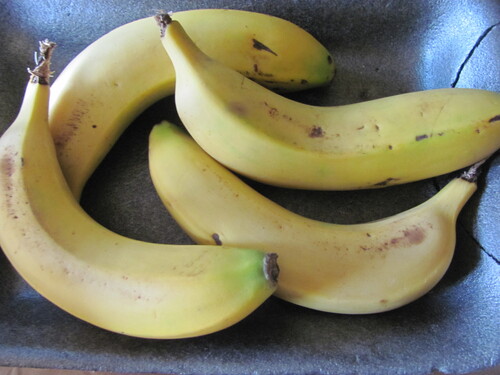
How to care for Cavendish banana
Watering
Cavendish banana (Musa acuminata) is a thirsty, fast-growing herb-like plant with a shallow root system, so it needs consistently moist soil during its growing season. Water deeply whenever the top 3–5 cm of soil feels dry, and let excess drain freely, because standing water quickly rots the corm. Keep the soil evenly damp rather than swinging between soggy and bone dry, which can split the leaves. Indoors, reduce watering noticeably in winter when growth slows.
Does it need water today?
Push a finger 3–5 cm into the soil. If it feels dry, water thoroughly until it runs out of the drainage holes. If it feels moist, wait a day or two. A pot that feels light when you lift it is also a sign it needs water. Leaves that curl and look limp in the afternoon suggest thirst.
Banana plants are roughly 90% water in their leaves and stems, so they dry out faster than most houseplants in warm, bright spots. Use a pot with drainage holes and a loose, peat-free potting mix enriched with compost.
Overwatering
Cavendish banana roots need oxygen as well as water, and its large soft stem and corm are prone to rot when the soil stays saturated. Overwatering is one of the most common reasons container bananas decline, especially in winter when growth is slow and the soil dries much more slowly.
Symptoms: Yellowing leaves that collapse from the base, a soft or mushy stem near the soil line, a sour smell from the soil, fungus gnats, and new leaves that emerge stunted or rotten at the center.
Solutions: Stop watering and let the top 5 cm dry out. Check the base of the stem; if it is soft, cut away rotten tissue and repot into fresh, well-draining mix in a pot with drainage holes. Reduce the watering frequency and make sure the pot never sits in water.
Underwatering
Cavendish banana has large leaves that lose water rapidly through transpiration, and its shallow roots cannot reach deep moisture. Even a few dry days in summer can cause visible stress, and prolonged drought can stop new leaf production.
Symptoms: Leaves that curl inward, wrinkle, or turn crisp and brown at the edges, drooping leaves that do not recover after watering, soil pulling away from the pot sides, and slowed growth.
Solutions: Water thoroughly and slowly until water drains out the bottom. If the soil is dry and hydrophobic, soak the pot in a tub of water for 30 minutes. Trim badly damaged leaves at the base, and increase watering frequency during hot weather or when the plant is in full sun.
Sunlight
Cavendish banana is a tropical plant that grows fastest in intense, direct light, which fuels the large leaves and fruit production. Outdoors, give it a fully sunny, sheltered site. Indoors, it needs the brightest location you have, since it will become leggy and produce small, weak leaves in dim rooms.
- Ideal: Full sun · 6-8 hours of direct sun per day
- Tolerates: Full sun, Partial sun, Bright, indirect light
- Best spot in a room: At the window
- Artificial light: If natural light is limited, use a full-spectrum LED grow light placed 30–60 cm above the canopy for 12–14 hours a day. Rotate the plant weekly so it grows evenly and does not lean toward the light source.
Too little light
Cavendish banana depends on strong light to build the energy needed for large, fast-growing leaves. In low light its growth slows, leaves become thin and pale, and the plant stretches toward any available light source.
Symptoms: Long, thin petioles, small pale leaves, leaves that fail to unfurl fully, slowed growth, and a leaning plant that bends toward the window.
Solutions: Move the plant closer to the brightest window, ideally a south-facing one in the Northern Hemisphere. Supplement with a grow light for 12–14 hours daily during the darker months, and rotate the pot regularly.
Too much sun
Although Cavendish banana loves sun, leaves that have grown indoors or in shade can scorch when suddenly moved into intense midday sun, especially behind glass. Its large, thin leaves lose moisture quickly under strong light and heat.
Symptoms: Bleached, yellowish, or brown scorched patches on the leaves, crispy edges, leaves that tear along the midrib in wind, and faster soil drying.
Solutions: Acclimatize the plant over 1–2 weeks by gradually increasing its time in strong sun. Provide light afternoon shade during heat waves, water more frequently, and remove badly scorched leaves at the base once they are fully brown.
Temperature
Cavendish banana (Musa acuminata) is a tropical herb that grows best between 18 and 32°C. Growth slows sharply below about 15°C, and temperatures near freezing will damage or kill the leaves and pseudostem. Keep it warm, bright, and sheltered from cold draughts all year.
- Ideal: 18–32 °C
- Tolerates: 10–40 °C
- Hardiness zones: 10-12
Fertilizing
Cavendish banana is a very heavy feeder. It uses large amounts of nitrogen for leaf and pseudostem growth and a lot of potassium for fruit development, so it needs frequent feeding during the growing season. Apply fertilizer only to moist soil or damp compost, and water first if the soil is dry.
- Slow-release fertilizer: Apply a balanced slow-release granular fertilizer once a year in early spring, and repeat once more in midsummer for plants in the ground. Potted plants need slow-release feed only at the start of the growing season.
- Balanced liquid feed such as 10-10-10 or 20-20-20 for regular feeding, High-potassium liquid feed such as tomato feed (for example 5-5-10 or 6-4-12) for fruiting and flowering, Balanced slow-release granular fertilizer for banana plants, Well-rotted manure or compost as an organic top dressing, Seaweed extract as a supplementary feed
Soil
Cavendish bananas are very heavy feeders that need deep, fertile, moisture-retentive soil with excellent drainage. Their roots are shallow and sensitive to waterlogging, so the soil must stay evenly moist but never soggy.
- Rich loamy potting mix: Two parts quality potting mix, one part compost or well-rotted manure, and one part perlite or coarse sand for drainage.
- Garden bed amended soil: Native loam mixed with 30% well-rotted compost or manure, with coarse sand added if the site drains poorly.
- Heavy-feeder mulch layer: A 5-8 cm layer of shredded leaf mulch or composted wood chips kept a hand's width away from the pseudostem.
- pH 5.5–7
Repotting
Cavendish banana (Musa acuminata) is a fast-growing herbaceous giant with a shallow, dense, fleshy root mass called a rhizome-and-root ball. It resents being over-potted, so only increase pot size gradually and always use a container with several drainage holes.
- How often: Every 1-2 years, or when roots fill the pot or emerge from the drainage holes
- New pot: Move up only 5-7 cm in diameter at a time; a large, deep container (40-60 cm wide for a mature Cavendish banana) is needed once the plant is established
- Repotting season: Spring, Summer
How to repot
- Tip the pot on its side and gently ease the root ball out, supporting the pseudostem so it does not snap.
- Loosen the outer roots with your fingers and trim any brown, mushy, or rotten roots with clean shears.
- If the plant has pups, separate them from the mother rhizome only if you want more plants; otherwise leave them in place.
- Place a 5 cm layer of fresh mix in the new pot, set the root ball so the top sits 2-3 cm below the rim, and fill around it.
- Firm the soil lightly, then water thoroughly until it drains from the holes.
Pruning
Use only clean, sharp secateurs or a knife, sterilised with bleach solution between plants. Remove leaves and stems only when they are dead or clearly damaged, and never strip more than a few green leaves at once, because the leaves feed the plant.
Pruning season: Spring, Summer, Autumn
How to prune
- Look for leaves that are fully brown, shredded by wind, or spotted with disease, and follow each leaf stalk back to where it joins the pseudostem.
- Cut the leaf stalk about 5 cm from the pseudostem, angling the cut so water runs off.
- After the bunch has been harvested, cut the fruited pseudostem down to the ground at its base, since it will not fruit again.
- Leave one or two of the strongest pups in place to replace it, and remove any extra pups that crowd the clump.
- Dispose of cut material away from the garden or compost it hot, and wash your tools afterwards.
Propagation
Sucker separation · Spring, Summer
- Wait until the Cavendish banana mother plant is flowering or has just finished fruiting, when healthy pups (suckers) are about 60 cm tall with their own leaves.
- Use a sharp spade to cut the pup from the mother clump, keeping as much of the underground corm and root mass attached to it as possible.
- Trim the pup's leaves back to a few young ones to reduce water loss while it establishes.
- Pot the pup in a container about 30 cm wide with free-draining, loamy potting mix, and water it thoroughly.
- Keep it in bright, warm conditions above 18°C and out of cold draughts until new leaves appear.
Tissue culture plantlets · Spring
- Buy certified, disease-free Musa acuminata tissue-culture plantlets from a reputable nursery rather than attempting lab propagation at home.
- Harden off the plantlet over about two weeks by moving it from a humid indoor tray to a sheltered spot with gradually more light and air.
- Plant it in a pot or garden bed with rich, moisture-retentive soil and water consistently.
- Protect it from temperatures below 10°C until it has grown several true leaves.
Choose the strongest pup with a fan of leaves rather than a thin, spiky sucker, since it will establish faster and fruit sooner.
About Cavendish banana
Also known as: wild banana, Cavendish banana, dwarf banana, Pisang
- Plant type: herb, perennial giant herb
- Lifespan: perennial
- Distribution: Native to tropical Southeast Asia, from the Malay Peninsula through Indonesia to the Philippines and New Guinea.
- Mature height: 2 to 4 m (cultivated forms up to 6 m)
- Bloom time: Irregular, usually in warm months in cultivation
Pets · People
Pets: Safe · People: Safe. Musa acuminata is not listed as toxic to cats, dogs or children by ASPCA; its fruit is edible and the leaves and sap are considered non-toxic, though the sap can irritate sensitive skin.
Common problems
- Leaf splitting: Wind or handling tears the broad leaves along their veins; trim torn leaves and place the plant out of drafts.
- Yellowing leaves from overwatering: Soggy soil causes root rot and yellowing lower leaves; let the top layer dry and check drainage holes.
- Spider mites: Dry indoor air encourages fine webbing and speckled leaves; raise humidity and rinse the foliage regularly.
- Brown leaf edges: Low humidity or dry soil causes crispy margins; mist more often and keep the soil evenly moist.
- Stunted growth in low light: Insufficient light produces weak, pale growth; move the plant to a brighter location.
Uses
Musa acuminata is grown as an ornamental tropical foliage plant in gardens and conservatories, and its wild and cultivated forms supply the ancestral genome of most edible bananas grown commercially. Leaves are used as wrapping and plates in Southeast Asian cooking and in traditional ceremonies, and fibre from the pseudostem is used locally for rope and crafts.
Is it edible?
The fruit is edible when ripe; the flesh of cultivated forms like Cavendish is eaten raw, cooked or fried, while wild forms have seeds and are less palatable. Unripe fruit is also cooked as a vegetable, and the heart (inflorescence) is eaten in some cuisines.
History & legends
Bananas have been cultivated in Southeast Asia for thousands of years, and early farmers selected Musa acuminata forms with fewer seeds and sweeter flesh. Many folk traditions in the region associate the banana with fertility and abundance, and the plant appears in Buddhist and Hindu art as a symbol of plenty.
Did you know?
Each banana pseudostem flowers only once and then dies, but it is replaced by suckers from the same underground corm, so one plant can keep producing for decades.
Frequently asked questions
How often should I water Cavendish banana?
every 3 days. Cavendish banana (Musa acuminata) is a thirsty, fast-growing herb-like plant with a shallow root system, so it needs consistently moist soil during its growing season. Water deeply whenever the top 3–5 cm of soil feels dry, and let excess drain freely, because standing water quickly rots the corm. Keep the soil evenly damp rather than swinging between soggy and bone dry, which can split the leaves. Indoors, reduce watering noticeably in winter when growth slows. Push a finger 3–5 cm into the soil. If it feels dry, water thoroughly until it runs out of the drainage holes. If it feels moist, wait a day or two. A pot that feels light when you lift it is also a sign it needs water. Leaves that curl and look limp in the afternoon suggest thirst.
How much light does Cavendish banana need?
Full sun (6-8 hours of direct sun per day). Cavendish banana is a tropical plant that grows fastest in intense, direct light, which fuels the large leaves and fruit production. Outdoors, give it a fully sunny, sheltered site. Indoors, it needs the brightest location you have, since it will become leggy and produce small, weak leaves in dim rooms.
What temperature does Cavendish banana like?
18–32 °C. Cavendish banana (Musa acuminata) is a tropical herb that grows best between 18 and 32°C. Growth slows sharply below about 15°C, and temperatures near freezing will damage or kill the leaves and pseudostem. Keep it warm, bright, and sheltered from cold draughts all year.
Is Cavendish banana toxic to cats and dogs?
It is safe for cats and dogs. Musa acuminata is not listed as toxic to cats, dogs or children by ASPCA; its fruit is edible and the leaves and sap are considered non-toxic, though the sap can irritate sensitive skin.
What are the most common problems of Cavendish banana?
Leaf splitting: Wind or handling tears the broad leaves along their veins; trim torn leaves and place the plant out of drafts. Yellowing leaves from overwatering: Soggy soil causes root rot and yellowing lower leaves; let the top layer dry and check drainage holes. Spider mites: Dry indoor air encourages fine webbing and speckled leaves; raise humidity and rinse the foliage regularly. Brown leaf edges: Low humidity or dry soil causes crispy margins; mist more often and keep the soil evenly moist. Stunted growth in low light: Insufficient light produces weak, pale growth; move the plant to a brighter location.
When should I repot Cavendish banana?
Every 1-2 years, or when roots fill the pot or emerge from the drainage holes. Cavendish banana (Musa acuminata) is a fast-growing herbaceous giant with a shallow, dense, fleshy root mass called a rhizome-and-root ball. It resents being over-potted, so only increase pot size gradually and always use a container with several drainage holes.
How do I propagate Cavendish banana?
Sucker separation, Tissue culture plantlets. Wait until the Cavendish banana mother plant is flowering or has just finished fruiting, when healthy pups (suckers) are about 60 cm tall with their own leaves. Use a sharp spade to cut the pup from the mother clump, keeping as much of the underground corm and root mass attached to it as possible. Trim the pup's leaves back to a few young ones to reduce water loss while it establishes. Pot the pup in a container about 30 cm wide with free-draining, loamy potting mix, and water it thoroughly. Keep it in bright, warm conditions above 18°C and out of cold draughts until new leaves appear.
How this guide was written
Verdiss writes each guide with AI from botanical references and checks the species against iNaturalist and Plants of the World Online (Kew). Readers can rate every guide in the app.
Sources
Verdiss's information is for general guidance. Never eat or use a plant as medicine based on an app: ask a professional.