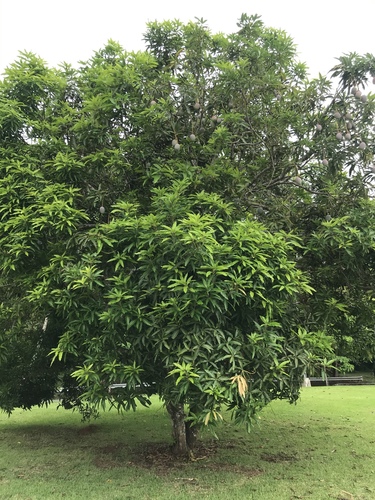
How to care for Indian mango
Watering
Indian mango (Mangifera indica) likes evenly moist soil while it is young and actively growing, but it hates sitting in water. Let the top 3-5 cm of the potting mix dry out between waterings, then water thoroughly until it drains from the bottom holes. Water less in winter, when growth slows and the roots use far less moisture. Mature trees in the ground need deep, infrequent watering during dry spells rather than daily sprinkling.
Does it need water today?
Push a finger 3-5 cm into the soil. If it feels dry, water. If it is still damp, wait a few days. Lift the pot too: a dry pot feels noticeably light, while a freshly watered one feels heavy. Check for yellowing lower leaves, which can mean too much water.
Mango roots need oxygen as much as water. Use a fast-draining mix, such as potting soil blended with perlite or coarse bark, and empty the saucer within 15 minutes of watering.
Overwatering
Indian mango roots are prone to rot in waterlogged soil because they need steady oxygen to grow. Constant wet conditions quickly damage the fine feeder roots that the tree depends on for water and nutrients.
Symptoms: Yellowing older leaves, leaf drop, wilting even though the soil is wet, a sour or musty smell from the soil, and dark, mushy roots.
Solutions: Stop watering and let the soil dry for several days. Remove the tree from the pot, trim any soft, brown roots with clean scissors, and repot into fresh, fast-draining mix in a pot with drainage holes. Reduce watering frequency until new growth appears.
Underwatering
Young mango trees have shallow roots and large leaves that lose water quickly in warm air. When the soil dries out completely, the tree cannot move water to its leaves, and the plant responds by shedding foliage to conserve moisture.
Symptoms: Drooping, limp leaves, crisp brown leaf edges, leaves dropping from the tips of branches, and soil that pulls away from the pot edge.
Solutions: Water slowly and thoroughly until water drains out, then wait a few minutes and water again if the soil repels water. Mist the leaves lightly in very dry indoor air. Once the soil is evenly moist, the plant usually recovers within a week or two, but the damaged leaves will not regrow.
Sunlight
Indian mango (Mangifera indica) is a tropical tree that evolved under intense, long-day sunlight. It needs as much direct sun as you can give it to flower and fruit well, and it grows lankier and produces fewer leaves in shade. Young plants can tolerate bright indirect light indoors, but they will grow slowly and rarely bloom.
- Ideal: Full sun · 6-8 hours of direct sun daily
- Tolerates: Full sun, Bright, indirect light
- Best spot in a room: At the window
- Artificial light: In homes with limited daylight, use a full-spectrum LED grow light placed 30-45 cm above the canopy for 12-14 hours a day. Rotate the pot weekly so all sides receive light and the tree grows evenly.
Too little light
Mango trees depend on strong sunlight to make the sugars that fuel flowering and fruit set. In low light, the tree stretches toward any available light, and its energy goes into leaves rather than flowers.
Symptoms: Long, weak stems with large gaps between leaves, pale or dark-green foliage that lacks vigor, leaves that are smaller than normal, and no flowers or fruit.
Solutions: Move the tree to the sunniest window or outdoors in full sun, increasing exposure gradually over two weeks to avoid leaf scorch. Supplement with a grow light during short winter days, and prune leggy shoots to encourage bushier growth.
Too much sun
Indian mango handles strong sun well once acclimated, but young trees moved abruptly from shade or indoors into intense midday sun can be scorched. Pale, thin leaves are especially vulnerable because they have not built up protective tissue.
Symptoms: Bleached or yellow patches on leaves, brown crispy spots, leaf edges that curl or burn, and soil that dries out extremely fast.
Solutions: Move the plant to a spot with afternoon shade, such as behind a sheer curtain or under a taller tree, during the hottest hours. Increase sun exposure slowly over 10-14 days. Water more often during heat waves, since high light increases water loss.
Temperature
Indian mango thrives in warm, tropical-to-subtropical conditions and grows best between 18 and 35 °C. Young trees are damaged by frost, and flowering and fruit set suffer when nights stay cool. Keep it outdoors only where winters stay above about 4 °C, or grow it in a large container that can be moved indoors.
- Ideal: 18–35 °C
- Tolerates: 4–45 °C
- Hardiness zones: 10-12
Fertilizing
Indian mango needs steady nutrition while it grows, but too much nitrogen produces lush leaves and few flowers. Keep feeding light in winter and stop feeding in late autumn so new growth does not get damaged by frost.
- Slow-release fertilizer: Apply a slow-release, balanced fertilizer once a year in early spring, just before new growth starts, and a second light feeding after the fruit has set in early summer if the tree is growing vigorously.
- Balanced slow-release granular fertilizer (such as 10-10-10 or 13-13-13) for in-ground trees, Water-soluble balanced fruit tree fertilizer for container plants, Compost or well-rotted manure as a gentle organic supplement, Potassium-rich fertilizer (e.g. sulfate of potash) for fruiting trees in late summer
Soil
Indian mango trees need soil that drains quickly so their roots get air and water does not pool around them. Heavy clay or soggy mixes lead to root rot, which is the most common cause of decline in this species. A slightly acidic to neutral pH suits the tree best.
- Loamy potting mix for container trees: Two parts high-quality potting mix, one part coarse perlite or pumice, and one part composted bark or coir
- Sandy loam for garden planting: Mostly sandy loam with added compost, aiming for at least 30% sand or grit to keep the root zone open
- Free-draining mango blend: Equal parts coarse sand, compost, and loamy topsoil, with a little bark added for aeration
- pH 5.5–7.5
Repotting
Use a deep, free-draining pot with at least one large drainage hole. A sturdy pot with a wide base helps support the tall, heavy top growth of an Indian mango tree.
- How often: Every 2-3 years for young trees; container-grown mango trees often need root pruning or repotting every 2-4 years once they are established
- New pot: Move up only 2-5 cm in pot diameter at each step, since Mangifera indica roots are sensitive to waterlogged, oversized pots
- Repotting season: Spring
How to repot
- Tip the pot on its side and gently ease the tree out, supporting the trunk with one hand
- Loosen the outer roots with your fingers and trim away any dead, black, or mushy roots with clean shears
- Shave off about one third of the old soil from the sides and bottom of the root ball, and cut back any tightly circling roots
- Place a layer of fresh mix in the new pot so the top of the root ball sits about 2-3 cm below the rim
- Set the tree in the center, fill in around the roots with mix, and firm gently to remove large air pockets without compacting the soil
- Water thoroughly until it drains from the holes, then top up the surface with mix if it has settled
Pruning
Prune Indian mango lightly and at the right time. Heavy cutting in cool, wet weather invites disease, and cutting off the flowering wood before it sets fruit removes next year's harvest. Make each cut just outside the branch collar, never flush with the trunk.
Pruning season: Spring, Summer
How to prune
- Remove dead, damaged, or diseased branches first, cutting back to healthy wood.
- Thin out crossing or inward-growing branches so that each limb has clear space around it.
- For a young tree, select three to five strong scaffold branches spaced around the trunk and shorten the leader to shape a broad crown.
- To control height on a mature tree, shorten long upright shoots by about a third just after harvest, cutting to a side bud or lateral branch.
- Remove water sprouts (vigorous vertical shoots from the trunk and main limbs) unless you need them to fill a gap.
- Step back often to check balance, and never remove more than about a quarter of the canopy in one year.
Propagation
Grafting (veneer or side-veneer graft onto a seedling rootstock) · Spring, Summer
- Grow a rootstock from a fresh mango seed or use a healthy one-year-old Mangifera indica seedling about pencil-thick at the base.
- Choose a scion stick of the desired Indian mango cultivar with several plump, dormant buds, and keep it cool and moist until use.
- Make a matching thin slice of bark and cambium on both the rootstock and the scion, aligning the green layers exactly.
- Bind the union firmly with grafting tape and seal any exposed cut with grafting wax to prevent drying.
- Keep the graft in bright, humid shade, then remove the tape once the scion sprouts and the union has healed, usually within three to six weeks.
Air layering (marcotting) on a branch · Spring, Summer
- Pick a healthy, pencil-thick branch of a fruiting Indian mango tree that is at least one year old.
- Remove a ring of bark about 2 to 3 cm wide, scrape off the green cambium beneath, and dust the wound with rooting hormone.
- Wrap the wound in moist sphagnum moss and cover it with clear plastic, sealing both ends with tape.
- Keep the moss damp and wait about two to four months for roots to show through the moss.
- Cut the branch just below the new roots and pot it up in a well-draining mix, keeping it shaded for several weeks.
Growing from seed (seedling) · Spring
- Clean a fresh mango stone, removing as much pulp as possible, since the pulp can rot and invite fungus.
- Plant the stone with the flatter, fatter side down in a 20 to 25 cm pot of free-draining potting mix, leaving the top half exposed.
- Keep the mix lightly moist and the temperature around 24 to 30°C, and place the pot in bright light.
- Expect sprouting in one to four weeks; seedlings grown this way are true to the species but often do not produce fruit identical to the parent.
Seed-grown Indian mangoes are the easiest route, but they can take 5 to 8 years to fruit. For reliable fruit quality of a named cultivar, grafting or air layering is the better choice for home gardeners. Keep young plants out of frost, since they cannot tolerate temperatures near 0°C.
About Indian mango
Also known as: Indian mango, Mango tree, Aam
- Plant type: tree, evergreen fruit tree
- Lifespan: perennial
- Distribution: Native to the Indo-Burma region of South and Southeast Asia, including northeast India, Myanmar and southern China.
- Mature height: 10-30 m
- Bloom time: Late winter to spring in the Northern Hemisphere subtropics
Pets · People
Pets: Mildly toxic · People: Mildly toxic. The sap and skin of the fruit, along with the leaves and bark, contain urushiol-like compounds that can cause contact dermatitis in sensitive people, and the mango kernel is toxic if eaten raw in quantity. The ripe flesh is safe for most people, but the skin and sap can irritate skin and mouth; keep pets away from the seed and leaves.
Common problems
- Mango anthracnose: Fungal disease causing black spots on leaves, flowers and fruit, worst in humid, wet weather.
- Powdery mildew: White powdery growth on flower panicles during cool, humid conditions, which can reduce fruit set.
- Mealybugs: Sap-sucking pests that cluster on new growth and leave sticky honeydew.
- Leaf tip burn: Brown leaf edges caused by dry air, salt build-up or inconsistent watering.
- Failure to flower: Indoor trees often fail to bloom without a cool dry rest period and strong light.
Uses
Mango is grown mainly for its fruit, eaten fresh, dried, pickled or made into juice, chutney and desserts. The wood is used for furniture and construction, and the leaves appear in Hindu and Buddhist ceremonies and as traditional decorations for doorways.
Is it edible?
The ripe fruit flesh is edible raw or cooked; unripe fruit is used in pickles and chutneys. The seed kernel is eaten in parts of India after cooking, while the skin and sap can irritate sensitive people.
History & legends
Mango has been cultivated in the Indian subcontinent for thousands of years and is mentioned in ancient Sanskrit texts. Buddhist tradition records mango groves offered as gifts to the Buddha, and the Mughal emperor Akbar is said to have planted a large grove of 100,000 trees in Bihar.
Did you know?
Mango trees can live and bear fruit for over 300 years, and some old orchard trees in India are still productive after centuries.
Frequently asked questions
How often should I water Indian mango?
every 7 days. Indian mango (Mangifera indica) likes evenly moist soil while it is young and actively growing, but it hates sitting in water. Let the top 3-5 cm of the potting mix dry out between waterings, then water thoroughly until it drains from the bottom holes. Water less in winter, when growth slows and the roots use far less moisture. Mature trees in the ground need deep, infrequent watering during dry spells rather than daily sprinkling. Push a finger 3-5 cm into the soil. If it feels dry, water. If it is still damp, wait a few days. Lift the pot too: a dry pot feels noticeably light, while a freshly watered one feels heavy. Check for yellowing lower leaves, which can mean too much water.
How much light does Indian mango need?
Full sun (6-8 hours of direct sun daily). Indian mango (Mangifera indica) is a tropical tree that evolved under intense, long-day sunlight. It needs as much direct sun as you can give it to flower and fruit well, and it grows lankier and produces fewer leaves in shade. Young plants can tolerate bright indirect light indoors, but they will grow slowly and rarely bloom.
What temperature does Indian mango like?
18–35 °C. Indian mango thrives in warm, tropical-to-subtropical conditions and grows best between 18 and 35 °C. Young trees are damaged by frost, and flowering and fruit set suffer when nights stay cool. Keep it outdoors only where winters stay above about 4 °C, or grow it in a large container that can be moved indoors.
Is Indian mango toxic to cats and dogs?
It is mildly toxic to cats and dogs. The sap and skin of the fruit, along with the leaves and bark, contain urushiol-like compounds that can cause contact dermatitis in sensitive people, and the mango kernel is toxic if eaten raw in quantity. The ripe flesh is safe for most people, but the skin and sap can irritate skin and mouth; keep pets away from the seed and leaves.
What are the most common problems of Indian mango?
Mango anthracnose: Fungal disease causing black spots on leaves, flowers and fruit, worst in humid, wet weather. Powdery mildew: White powdery growth on flower panicles during cool, humid conditions, which can reduce fruit set. Mealybugs: Sap-sucking pests that cluster on new growth and leave sticky honeydew. Leaf tip burn: Brown leaf edges caused by dry air, salt build-up or inconsistent watering. Failure to flower: Indoor trees often fail to bloom without a cool dry rest period and strong light.
When should I repot Indian mango?
Every 2-3 years for young trees; container-grown mango trees often need root pruning or repotting every 2-4 years once they are established. Use a deep, free-draining pot with at least one large drainage hole. A sturdy pot with a wide base helps support the tall, heavy top growth of an Indian mango tree.
How do I propagate Indian mango?
Grafting (veneer or side-veneer graft onto a seedling rootstock), Air layering (marcotting) on a branch, Growing from seed (seedling). Grow a rootstock from a fresh mango seed or use a healthy one-year-old Mangifera indica seedling about pencil-thick at the base. Choose a scion stick of the desired Indian mango cultivar with several plump, dormant buds, and keep it cool and moist until use. Make a matching thin slice of bark and cambium on both the rootstock and the scion, aligning the green layers exactly. Bind the union firmly with grafting tape and seal any exposed cut with grafting wax to prevent drying. Keep the graft in bright, humid shade, then remove the tape once the scion sprouts and the union has healed, usually within three to six weeks.
How this guide was written
Verdiss writes each guide with AI from botanical references and checks the species against iNaturalist and Plants of the World Online (Kew). Readers can rate every guide in the app.
Sources
Verdiss's information is for general guidance. Never eat or use a plant as medicine based on an app: ask a professional.