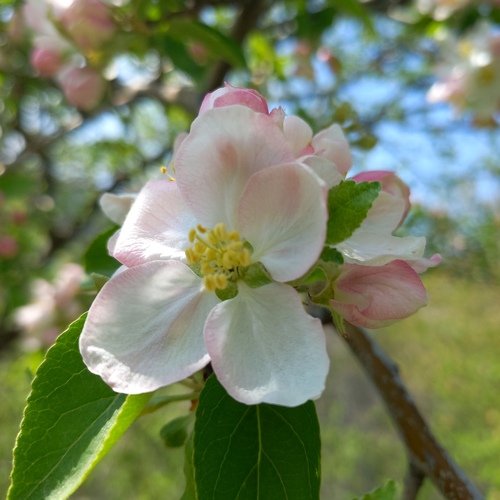
How to care for apple
Watering
Apple trees (Malus domestica) need deep, regular moisture rather than frequent sips. Container-grown dwarf apples in a home or patio setting should be watered thoroughly until water runs out of the drainage holes, then left to dry slightly at the top before the next watering. Keep the root zone evenly moist during flowering and fruit sizing in spring and early summer, since irregular water causes fruit splitting and bitter pit. Reduce watering in late autumn and winter when growth slows, and never let the pot sit in standing water.
Does it need water today?
Push a finger 5 cm into the soil near the rim of the pot. If it feels dry, water now. You can also lift the pot: a dry pot feels noticeably light compared with one that was just watered. For a tree in the ground, dig down about 20 cm; water if the soil is dry there.
Mulch the soil surface with 5 to 8 cm of wood chips or straw, keeping it a hand's width away from the trunk. Mulch slows evaporation and keeps the shallow feeder roots of your apple tree cooler and more evenly moist.
Overwatering
Apple roots need oxygen as well as water, and they are prone to rot when the soil stays waterlogged. Dwarf rootstocks such as M.9 are especially sensitive because their root systems are shallow and compact, so a soggy pot quickly leads to root damage.
Symptoms: Yellowing leaves that drop early, wilting even when the soil is wet, a sour or musty smell from the soil, dark soft roots, and fungal growth at the base of the trunk.
Solutions: Stop watering and let the soil dry out to the depth of your finger. Make sure the pot has drainage holes and is not sitting in a saucer of water. If root rot is suspected, slide the root ball out, trim away black or mushy roots with clean secateurs, and repot into fresh, well-drained compost in a pot only slightly larger than before.
Underwatering
Apple trees produce a lot of leaf area and fruit, which draws heavily on water in summer. Container apples dry out faster than trees in the ground, and drought during fruit development causes small, poorly coloured apples and early leaf drop.
Symptoms: Leaves that curl, wilt or turn crisp at the edges, fruit that shrinks or drops early, soil that pulls away from the pot edge, and a root ball that feels light and dry.
Solutions: Water deeply and slowly until moisture reaches the bottom of the pot. If the compost has shrunk away from the sides, soak the whole pot in a basin of water for about 30 minutes. Then reduce the wind and heat exposure around the plant and mulch the surface to hold moisture.
Sunlight
Apple trees (Malus domestica) need full sun to flower reliably, set fruit, and ripen apples with good sugar and colour. Fruiting is noticeably reduced with less than about 6 hours of direct sun, and the wood ripens poorly, making the tree more vulnerable to winter damage. A tree in partial shade will still grow, but expect fewer and smaller apples.
- Ideal: Full sun · 6-8 hours of direct sun per day
- Tolerates: Full sun, Partial sun
- Best spot in a room: At the window
- Artificial light: Indoor apple trees rarely fruit well without help. Use a full-spectrum LED grow light set about 30 to 50 cm above the canopy for 10 to 12 hours a day during the growing season. Keep the light on a timer and move the plant closer to the window or outdoors on mild days whenever possible.
Too little light
Apple trees need strong light to make the sugars that become fruit and to build up flower buds for next season. In low light the tree stretches with weak, leggy growth, and its leaves stay thin and pale, so it cannot support a good crop.
Symptoms: Long, thin shoots with wide gaps between leaves, pale or yellowish-green leaves, few or no flowers, small fruit that drops early, and a generally weak, floppy plant.
Solutions: Move the tree to the sunniest spot available, ideally a south- or west-facing position outdoors or by a bright window. Prune to open up the canopy so light reaches the inner branches, and add a grow light if it stays indoors.
Too much sun
Apple trees tolerate plenty of sun in temperate climates, but intense midday sun combined with heat and dry air can scorch leaves and fruit, especially on young trees and freshly moved plants in pots.
Symptoms: Brown, papery patches on sun-facing leaves, scorched or sunburnt skin on exposed apples, leaves wilting in the afternoon, and faster drying of the soil.
Solutions: Shade the plant with a light shade cloth during the hottest part of the day in mid-summer, or move the pot to a spot with morning sun and afternoon shade. Water consistently, as a well-watered tree handles strong sun much better, and gradually acclimatise any tree moved from indoors to full sun.
Temperature
Apple trees need a real winter chill to set fruit well. Most cultivars need roughly 800 to 1,000 hours below about 7°C during dormancy. Dormant trees handle deep cold easily, but spring frost after bud break can destroy blossoms and young fruit.
- Ideal: -30–30 °C
- Tolerates: -40–38 °C
- Hardiness zones: 3-8
Fertilizing
Apple trees need steady nitrogen, not heavy feeding. Too much nitrogen gives lush shoot growth, fewer flowers, more pest and disease problems, and poor fruit storage. A soil test every few years is the best guide. Feed the root zone out to the drip line, not against the trunk.
- Slow-release fertilizer: Once a year in early spring, just before bud break, for established trees. Young trees in their first two years usually need little or none.
- Balanced slow-release granular fertilizer for fruit trees (for example 10-10-10 or a fruit-tree formula with added micronutrients), Compost or well-rotted manure as a soil amendment, Calcium nitrate or gypsum only if a soil test shows calcium deficiency, Fertilizer with added boron or zinc only if a soil test shows those deficiencies
Soil
Apple trees (Malus domestica) grow best in slightly acidic to neutral soil, around pH 6.0 to 7.0, and they must have free-draining conditions. Their roots need oxygen, so soil that stays waterlogged or compacted will quickly lead to root rot and poor fruiting.
- Loam-based potting mix for fruit trees: Roughly 40% good-quality loam or topsoil, 30% coarse composted bark or pine bark fines, and 30% perlite or grit for drainage.
- Garden soil for in-ground trees: Well-drained loam with plenty of organic matter, ideally enriched with 5-10 cm of well-rotted compost worked into the top 30 cm before planting.
- Sandy loam mix for raised beds or heavy ground: Mostly sandy loam blended with compost and a small amount of grit, which suits apples on heavy clay sites when planted on a mound.
- pH 6–7
Repotting
Apple trees (Malus domestica) have a fine, fibrous root system that is sensitive to disturbance, so repot during early spring while the tree is dormant or just beginning to break bud. Choose a pot with several drainage holes, because waterlogged roots are the most common cause of decline in potted apples.
- How often: Every 2-3 years for container-grown apple trees; young trees in pots may need it annually while they establish.
- New pot: Move up only one pot size (about 5-7 cm wider in diameter) each time. Dwarf and semi-dwarf apple trees in containers usually need a pot of 40-60 litres or more once mature, and an oversized pot holds wet soil that rots roots.
- Repotting season: Spring
How to repot
- Tip the pot on its side and gently ease the tree out, supporting the trunk with one hand.
- Loosen the outer roots with your fingers. Trim any dead, black, or mushy roots with clean shears.
- Gently tease apart circling roots so they point outward into the new soil.
- Set the tree in the new pot so the graft union (the knobby swelling near the base) sits about 2-3 cm above the soil line.
- Fill around the root ball with the new mix, firming lightly as you go to remove large air pockets.
- Water thoroughly until water runs out of the drainage holes, then top up the soil level if it has settled.
Pruning
Prune young apple trees in late winter while they are dormant, when the wood is easy to read and wounds heal well. Make light summer cuts to control vigor and remove water sprouts. Keep the central leader or open-center shape your cultivar and rootstock suit, and avoid removing more than a quarter of the canopy in a single year.
Pruning season: Winter, Summer
How to prune
- In late winter, remove any dead, broken, or diseased branches back to healthy wood, cutting just beyond the collar without leaving stubs.
- Cut out water sprouts, the vigorous upright shoots growing from the trunk and main limbs, as they rarely bear fruit.
- Thin crossing or rubbing branches so that the remaining limbs are spaced about 15 to 20 cm apart along the trunk.
- Shorten overly long leaders by cutting to an outward-facing bud, which directs new growth away from the center.
- In mid summer, remove a few vigorous shoots that shade the center of the tree, and pinch back excessively long new growth to slow it down.
- Prune apple trees hard only in their first few years to build the framework; mature trees need only light annual maintenance.
Propagation
Grafting (whip-and-tongue or cleft graft) · Winter, Spring
- In late winter, cut dormant scion wood (one-year-old shoots, about pencil thick) from a named apple cultivar and wrap it in damp paper inside a plastic bag, then refrigerate it.
- Pick a rootstock of similar thickness, such as a dwarfing M9 or M26 rootstock for small trees, or a seedling Malus domestica rootstock for large trees.
- Make a matching slanting cut on both the scion and the rootstock, then fit them so the green cambium layers touch on at least one side.
- Wrap the joint firmly with grafting tape or stretchy budding tape, sealing the top with grafting wax to stop drying.
- Keep the graft in a sheltered spot. Remove the tape once the scion has joined and started growing, usually within a few weeks to a couple of months.
Budding (T-budding) · Summer, Autumn
- In mid to late summer, when the bark slips easily, choose a healthy bud from current-season growth on the desired apple cultivar.
- Make a T-shaped cut in the bark of the rootstock about 15 cm above the soil, then gently lift the flaps.
- Slide a bud shield cut from the scion into the T, so the bud sits under the bark.
- Bind the wound with budding tape, leaving the bud eye exposed.
- In late winter or early spring, cut the rootstock just above the bud. The bud will sprout the following growing season.
Layering (ground layering) · Spring
- In early spring, choose a flexible low branch of an established apple tree, ideally a dwarf or semi-dwarf rootstock form.
- Scrape a shallow patch of bark, about 2 cm long, on the underside of the branch where it will touch the soil.
- Pin the branch into a shallow trench with a bent wire or stake, keeping the wounded part in contact with moist soil.
- Cover the pinned section with 10 cm of soil, and keep it consistently moist through the growing season.
- By autumn or the next spring, check for roots. Once well rooted, sever the new plant from the parent and transplant it.
Take scion wood from healthy, disease-free trees only, since fire blight and canker can spread through cuttings. Clean your knife with alcohol between cuts. Many apple cultivars grow on dwarfing rootstocks such as M9 or M26, which keep trees small and bear fruit sooner, so choosing the right rootstock matters as much as the cultivar.
About apple
Also known as: Common apple, Orchard apple, Cultivated apple, Pomme
- Plant type: tree, fruit tree
- Lifespan: perennial
- Distribution: Native to the mountains of Central Asia (Tian Shan and Kazakhstan), where its wild ancestor Malus sieversii grows.
- Mature height: 3-10 m depending on rootstock
- Bloom time: Spring, April to May in the Northern Hemisphere
Pets · People
Pets: Mildly toxic · People: Mildly toxic. Seeds contain amygdalin, which releases cyanide when crushed or chewed; the flesh and skin are harmless. Eating a few crushed seeds is unlikely to harm an adult, but large amounts or seeds in pets or children should be avoided. The ASPCA lists apple as toxic to dogs, cats and horses mainly from seeds, core and leaves.
Common problems
- Apple scab: Fungal disease (Venturia inaequalis) causing olive-green spots on leaves and fruit; control with resistant cultivars, sanitation and early fungicide.
- Fire blight: Bacterial infection (Erwinia amylovora) that blackens and wilts shoot tips; prune infected wood well below the canker in dry weather.
- Codling moth: Caterpillars tunnel into fruit causing wormy apples; use pheromone traps and timed sprays or bagging.
- Powdery mildew: White powdery growth on young leaves and shoots; improve airflow through pruning.
- Lack of fruit set: Often caused by insufficient pollination or too little winter chill; plant a compatible pollinator cultivar nearby.
Uses
Apples are eaten fresh, dried, pressed into juice, cooked into sauces, pies and jams, and fermented into cider. Apple wood is prized by woodworkers and smokers for flavour, and the fruit is used in many traditional remedies, though its medicinal value is modest.
Is it edible?
Fruit flesh and skin are edible raw or cooked; the seeds and core should be discarded because seeds contain amygdalin.
History & legends
Wild Malus sieversii forests in Central Asia were the source of apples carried westward along the Silk Road and spread to Europe by the Romans and later settlers. In Norse and Celtic tradition apples were linked with immortality and otherworldly orchards, such as Avalon in Arthurian legend. Johnny Appleseed, an American nurseryman, planted apple nurseries across the Midwest in the early 19th century.
Did you know?
Apple trees grown from seed rarely produce fruit like their parent, so every named apple variety is propagated by grafting onto rootstock.
Frequently asked questions
How often should I water apple?
every 7 days. Apple trees (Malus domestica) need deep, regular moisture rather than frequent sips. Container-grown dwarf apples in a home or patio setting should be watered thoroughly until water runs out of the drainage holes, then left to dry slightly at the top before the next watering. Keep the root zone evenly moist during flowering and fruit sizing in spring and early summer, since irregular water causes fruit splitting and bitter pit. Reduce watering in late autumn and winter when growth slows, and never let the pot sit in standing water. Push a finger 5 cm into the soil near the rim of the pot. If it feels dry, water now. You can also lift the pot: a dry pot feels noticeably light compared with one that was just watered. For a tree in the ground, dig down about 20 cm; water if the soil is dry there.
How much light does apple need?
Full sun (6-8 hours of direct sun per day). Apple trees (Malus domestica) need full sun to flower reliably, set fruit, and ripen apples with good sugar and colour. Fruiting is noticeably reduced with less than about 6 hours of direct sun, and the wood ripens poorly, making the tree more vulnerable to winter damage. A tree in partial shade will still grow, but expect fewer and smaller apples.
What temperature does apple like?
-30–30 °C. Apple trees need a real winter chill to set fruit well. Most cultivars need roughly 800 to 1,000 hours below about 7°C during dormancy. Dormant trees handle deep cold easily, but spring frost after bud break can destroy blossoms and young fruit.
Is apple toxic to cats and dogs?
It is mildly toxic to cats and dogs. Seeds contain amygdalin, which releases cyanide when crushed or chewed; the flesh and skin are harmless. Eating a few crushed seeds is unlikely to harm an adult, but large amounts or seeds in pets or children should be avoided. The ASPCA lists apple as toxic to dogs, cats and horses mainly from seeds, core and leaves.
What are the most common problems of apple?
Apple scab: Fungal disease (Venturia inaequalis) causing olive-green spots on leaves and fruit; control with resistant cultivars, sanitation and early fungicide. Fire blight: Bacterial infection (Erwinia amylovora) that blackens and wilts shoot tips; prune infected wood well below the canker in dry weather. Codling moth: Caterpillars tunnel into fruit causing wormy apples; use pheromone traps and timed sprays or bagging. Powdery mildew: White powdery growth on young leaves and shoots; improve airflow through pruning. Lack of fruit set: Often caused by insufficient pollination or too little winter chill; plant a compatible pollinator cultivar nearby.
When should I repot apple?
Every 2-3 years for container-grown apple trees; young trees in pots may need it annually while they establish.. Apple trees (Malus domestica) have a fine, fibrous root system that is sensitive to disturbance, so repot during early spring while the tree is dormant or just beginning to break bud. Choose a pot with several drainage holes, because waterlogged roots are the most common cause of decline in potted apples.
How do I propagate apple?
Grafting (whip-and-tongue or cleft graft), Budding (T-budding), Layering (ground layering). In late winter, cut dormant scion wood (one-year-old shoots, about pencil thick) from a named apple cultivar and wrap it in damp paper inside a plastic bag, then refrigerate it. Pick a rootstock of similar thickness, such as a dwarfing M9 or M26 rootstock for small trees, or a seedling Malus domestica rootstock for large trees. Make a matching slanting cut on both the scion and the rootstock, then fit them so the green cambium layers touch on at least one side. Wrap the joint firmly with grafting tape or stretchy budding tape, sealing the top with grafting wax to stop drying. Keep the graft in a sheltered spot. Remove the tape once the scion has joined and started growing, usually within a few weeks to a couple of months.
How this guide was written
Verdiss writes each guide with AI from botanical references and checks the species against iNaturalist and Plants of the World Online (Kew). Readers can rate every guide in the app.
Sources
Verdiss's information is for general guidance. Never eat or use a plant as medicine based on an app: ask a professional.