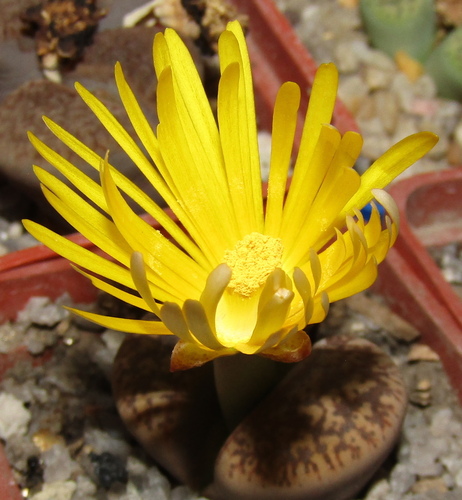
How to care for Lithops lesliei
Watering
Lithops lesliei, the Leslie's living stone, is a South African succulent from the arid Karoo and Namaqualand regions. It stores water in its two fused leaves and needs very little. Water only during its active growing period, and let the soil dry out completely between waterings. In winter the plant is dormant and needs almost no water at all.
Does it need water today?
Push a finger about 2 cm into the soil, or lift the pot. If the soil is bone dry and the pot feels light, it is ready for water. If the leaves look wrinkled and shriveled, the plant may be thirsty, but a healthy Lithops lesliei should look plump and firm, with only a gentle split between the leaves.
Water the Leslie's living stone in the morning on a sunny day so any drops on the leaves can evaporate quickly. Never let water sit in the cracks between the leaves, as it can cause rot in the center.
Overwatering
Lithops lesliei is adapted to very dry desert conditions, and its thick leaves store water that it rarely gets. Extra water makes the roots and the central cleft rot quickly, because the plant cannot use or release the moisture fast enough.
Symptoms: Soft, mushy, or translucent leaves, a dark or brown center, a foul smell from the soil, and leaves that split open or collapse.
Solutions: Stop watering immediately and let the soil dry out fully. If the rot is at the base, gently lift the plant, cut away soft tissue with a sterilized blade, let the cut dry for several days, and repot into dry, gritty cactus mix.
Underwatering
Because Lithops lesliei lives in a dry region, it can survive long droughts, but it still needs a small amount of water during its growing season to refill its leaves and grow new ones.
Symptoms: Leaves that look shrunken, wrinkled, or flat, a very wide gap between the two leaves, and slow or no new growth during the active season.
Solutions: During spring and autumn, water thoroughly once the soil is dry, then wait again. Keep the plant in bright light so it can use the water well, and avoid long dry spells during active growth.
Sunlight
Lithops lesliei needs strong, direct light to keep its compact shape and colour. In low light the leaves stretch, become pale, and lose their natural camouflage markings. Bright conditions also help the plant stay in its proper growth rhythm.
- Ideal: Full sun · 4-6 hours of direct sun per day
- Tolerates: Full sun, Partial sun, Bright, indirect light
- Best spot in a room: At the window
- Artificial light: If natural light is weak, use a full-spectrum LED grow light placed about 15-30 cm above the plant for 10-12 hours a day during the growing season. Keep the light close enough to avoid stretching.
Too little light
Lithops lesliei grows in open, sunny habitats in South Africa, so it depends on intense light to keep its leaves short and firm. Without enough light, it becomes weak and etiolated.
Symptoms: Leaves that become tall, pale, and elongated, a loose open split that looks stretched, and loss of the typical stone-like patterning.
Solutions: Move the plant to the brightest south- or west-facing window, or add a grow light. Rotate the pot every week so all sides receive light evenly.
Too much sun
Lithops lesliei is well adapted to strong sun, but a sudden change from shade to intense midday sun, or sun through hot glass, can scorch its leaf surfaces.
Symptoms: Bleached, yellowish, or brown patches on the leaf surfaces, dry crispy spots, and a flattened look with little new growth.
Solutions: Acclimatize the plant gradually over one to two weeks. Provide light shade through hot afternoons if the room is very warm, and keep it away from reflective surfaces.
Temperature
Living stones are adapted to the arid winter-rainfall and summer-dry climate of southern Africa. Keep them bright and warm during their autumn-to-spring growth period, and keep them cool, dry, and sheltered from midday summer heat during their summer dormancy, when the Lithops lesliei leaf pairs are shriveling and splitting for the new pair to emerge.
- Ideal: 10–25 °C
- Tolerates: 0–40 °C
- Hardiness zones: 10-11
Fertilizing
Lithops lesliei needs very little feeding. It grows slowly in lean, gritty desert-style soil, and too much nutrition causes soft, overgrown leaves that lose their characteristic shape. Feed only during the active growth season in autumn and spring, and never while the plant is dormant or the soil is cold and wet.
- Slow-release fertilizer: not needed
- Balanced cactus and succulent fertilizer at half strength, Low-nitrogen liquid succulent feed, Dilute, mineral-based fertilizer with trace elements
Soil
Lithops lesliei comes from dry, rocky ground in southern Africa, where soil drains almost instantly after rain. Its soil must be mineral-heavy and allow water to pass through quickly, because waterlogged soil is the most common reason this plant dies.
- Cactus and succulent mix: Roughly 50-60% mineral grit such as pumice, perlite, or coarse sand, with 40-50% peat-free potting soil or coir
- Pumice-based mineral mix: Around 70% pumice or lava rock with 30% coarse sand and a small amount of organic compost
- Lithops-specific mix: Mostly crushed rock or granite grit with a small amount of sifted, sandy loam, kept almost entirely mineral
- pH 6–7.5
Repotting
Lithops lesliei, the Leslie's living stone, is a South African succulent that rots quickly if its soil stays wet, so repot only into dry, fast-draining mix and wait before watering.
- How often: Every 2-3 years, or when the pot is crowded with split leaves or roots fill the pot
- New pot: A shallow pot only 1-2 cm wider than the plant, with at least one drainage hole; Lithops lesliei has a small, shallow root system and sits in a pot far too deep for it wet
- Repotting season: Spring, Autumn
How to repot
- Tip the pot on its side and gently ease the root ball out, shaking off loose old soil without pulling the leaves
- Brush away dried or compacted soil from the roots and remove any dead or mushy roots with clean scissors
- Look for the old, papery leaf pairs; these are shedding and can be pulled away gently if they come off easily
- Place a layer of fresh gritty mix in the new pot, set the plant so the top of the leaves sits just above the rim, and fill around the roots
- Firm the soil lightly so the plant stands upright, then leave the surface bare or add a thin layer of fine grit
- Do not water for at least 5-7 days after repotting so cut or disturbed roots can heal
Pruning
Lithops lesliei does not need regular pruning. Its old leaves are replaced naturally: the older pair shrivels and splits as a new pair grows from the centre. Only remove dried, papery leaves that have fully separated, and never trim living leaves.
Pruning season: Spring, Summer, Autumn
How to prune
- Look at the clump and identify any leaf pair that is papery, brown, and clearly separated from the new pair.
- Grip the dry leaves gently at the base and lift them away; if they resist, leave them for another week.
- If a dry leaf is still attached, cut it at soil level with a clean, sharp knife, not with scissors that can crush tissue.
- Remove any mushy or rotting tissue entirely and let the cut area dry in the air for a day.
- Reduce watering for about a week after pruning, then resume normal dry-period watering.
Propagation
Seed sowing · Spring, Summer
- Fill a shallow pot with a gritty cactus or succulent mix, topped with a thin layer of fine grit.
- Scatter Lithops lesliei seeds thinly on the surface; do not cover them, as they need light to germinate.
- Mist the surface lightly and cover the pot with a clear lid or plastic bag to hold humidity.
- Keep the pot in bright, indirect light at about 20 to 25°C and mist again whenever the surface dries.
- Remove the cover once seedlings appear, usually within a few weeks, and move the pot into full sun gradually.
- Wait until the seedlings have formed their first true leaf pairs before potting them individually; this usually takes one to two years.
Division of mature clumps · Spring, Summer
- Wait until a clump has at least two or three pairs of leaves per head and the old leaf pair has fully dried and split.
- Gently loosen the clump from its pot and pull apart the separate heads, keeping any roots attached to each.
- Let the separated heads dry in a shaded spot for two to three days so the cut ends callous over.
- Pot each head in dry gritty cactus mix and wait about a week before the first light watering.
Lithops lesliei seedlings are very small and slow. Keep them in full sun once they emerge, and water only when the surface is dry, as overwatering is the most common reason young plants are lost.
About Lithops lesliei
Also known as: Leslie's living stone, Namaqua living stone, Leslie's pebble plant
- Plant type: succulent, stone plant
- Lifespan: perennial
- Distribution: Native to the arid Northern Cape of South Africa and adjacent southern Namibia.
- Mature height: 1-3 cm above ground
- Bloom time: autumn, typically March to May in the southern hemisphere
Pets · People
Pets: Safe · People: Safe. Lithops is not listed as toxic by the ASPCA; it is non-toxic to cats, dogs and children, though it is not meant to be eaten.
Common problems
- Root and leaf rot: Overwatering, especially in winter or in heavy soil, causes the leaf pair to turn soft and translucent and then collapse.
- Stretching: Too little light makes the plant elongate and lose its compact stone shape.
- Shrivelling: Water stress or prolonged dryness during active growth causes the leaves to wrinkle and sink.
- Mealybugs: These pests hide in the cracks between the leaf pair and can be wiped off with alcohol on a cotton swab.
- Failure to flower: Insufficient sun and a lack of the natural dry rest period in winter prevent flowering.
Uses
Ornamental only; prized by collectors and in succulent gardens as a miniature living-stone display plant. It has no notable medicinal, culinary or industrial use.
Is it edible?
not edible
History & legends
Lithops were first brought to scientific attention in the nineteenth and early twentieth centuries as collectors explored the arid regions of southern Africa. Lithops lesliei is named after the Leslie family, who were involved in collecting early specimens of the genus. Living stones became prized among collectors in Europe and North America, and wild populations have suffered from over-collection.
Did you know?
Lithops lesliei can look like a pebble so convincingly that grazing animals in its native range often overlook it.
Frequently asked questions
How often should I water Lithops lesliei?
every 30 days. Lithops lesliei, the Leslie's living stone, is a South African succulent from the arid Karoo and Namaqualand regions. It stores water in its two fused leaves and needs very little. Water only during its active growing period, and let the soil dry out completely between waterings. In winter the plant is dormant and needs almost no water at all. Push a finger about 2 cm into the soil, or lift the pot. If the soil is bone dry and the pot feels light, it is ready for water. If the leaves look wrinkled and shriveled, the plant may be thirsty, but a healthy Lithops lesliei should look plump and firm, with only a gentle split between the leaves.
How much light does Lithops lesliei need?
Full sun (4-6 hours of direct sun per day). Lithops lesliei needs strong, direct light to keep its compact shape and colour. In low light the leaves stretch, become pale, and lose their natural camouflage markings. Bright conditions also help the plant stay in its proper growth rhythm.
What temperature does Lithops lesliei like?
10–25 °C. Living stones are adapted to the arid winter-rainfall and summer-dry climate of southern Africa. Keep them bright and warm during their autumn-to-spring growth period, and keep them cool, dry, and sheltered from midday summer heat during their summer dormancy, when the Lithops lesliei leaf pairs are shriveling and splitting for the new pair to emerge.
Is Lithops lesliei toxic to cats and dogs?
It is safe for cats and dogs. Lithops is not listed as toxic by the ASPCA; it is non-toxic to cats, dogs and children, though it is not meant to be eaten.
What are the most common problems of Lithops lesliei?
Root and leaf rot: Overwatering, especially in winter or in heavy soil, causes the leaf pair to turn soft and translucent and then collapse. Stretching: Too little light makes the plant elongate and lose its compact stone shape. Shrivelling: Water stress or prolonged dryness during active growth causes the leaves to wrinkle and sink. Mealybugs: These pests hide in the cracks between the leaf pair and can be wiped off with alcohol on a cotton swab. Failure to flower: Insufficient sun and a lack of the natural dry rest period in winter prevent flowering.
When should I repot Lithops lesliei?
Every 2-3 years, or when the pot is crowded with split leaves or roots fill the pot. Lithops lesliei, the Leslie's living stone, is a South African succulent that rots quickly if its soil stays wet, so repot only into dry, fast-draining mix and wait before watering.
How do I propagate Lithops lesliei?
Seed sowing, Division of mature clumps. Fill a shallow pot with a gritty cactus or succulent mix, topped with a thin layer of fine grit. Scatter Lithops lesliei seeds thinly on the surface; do not cover them, as they need light to germinate. Mist the surface lightly and cover the pot with a clear lid or plastic bag to hold humidity. Keep the pot in bright, indirect light at about 20 to 25°C and mist again whenever the surface dries. Remove the cover once seedlings appear, usually within a few weeks, and move the pot into full sun gradually. Wait until the seedlings have formed their first true leaf pairs before potting them individually; this usually takes one to two years.
How this guide was written
Verdiss writes each guide with AI from botanical references and checks the species against iNaturalist and Plants of the World Online (Kew). Readers can rate every guide in the app.
Sources
Verdiss's information is for general guidance. Never eat or use a plant as medicine based on an app: ask a professional.