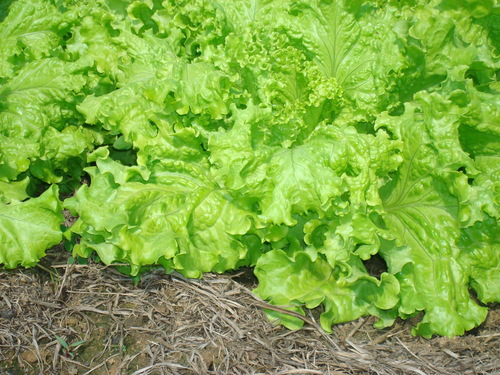
How to care for lettuce
Watering
Lettuce (Lactuca sativa) has shallow roots and a high water content in its leaves, so it needs steady, even moisture rather than deep, occasional soaking. Keep the soil evenly damp but never soggy, and water at the base of the plant to keep leaves dry and reduce rot. Plants grown in containers dry out faster than those in the ground and may need water daily in hot weather. Consistent watering also prevents bitterness and early bolting, the stage when the plant sends up a flower stalk.
Does it need water today?
Push a finger about 2 cm (1 inch) into the soil next to the plant. If it feels dry at that depth, water now. If it feels cool and moist, wait a day. For containers, lift the pot: a light pot needs water, a heavy one does not. Limp, slightly wilted leaves in the afternoon also signal thirst, though they should recover by evening.
Water in the early morning so the surface dries during the day. Mulch around the plants with straw or shredded leaves to hold moisture and keep the soil cool, which slows bolting in warm weather.
Overwatering
Lettuce roots need oxygen, and its thin, tender stems and crowns are easily damaged by waterlogged soil. Lettuce kept too wet is prone to rot and fungal disease, especially in cool, cloudy weather when soil dries slowly.
Symptoms: Yellowing lower leaves, soft or mushy stems near the soil line, a sour or rotten smell from the soil, and seedlings that collapse at the base. Fuzzy grey mould on leaves can also appear in wet conditions.
Solutions: Stop watering and let the top few centimetres of soil dry out before watering again. Improve drainage by loosening the soil or using a pot with holes. Remove any rotting leaves promptly, and thin crowded plants so air can move between them.
Underwatering
Lettuce has shallow roots and a large leaf area that loses water quickly, so it wilts fast when the soil dries. Dry spells also make the leaves taste bitter and push the plant to bolt early.
Symptoms: Wilted, droopy leaves, crisp or brown leaf edges, bitter taste, and a tall flower stalk forming before the head or leaves are full-sized. Growth stops and leaves may turn papery.
Solutions: Water deeply and slowly until the soil is evenly damp to a depth of about 10 cm (4 inches). Water again when the top 2 cm (1 inch) of soil is dry. Add mulch to slow evaporation and water more often during heat waves, when young plants may need water every day.
Sunlight
Lettuce (Lactuca sativa) is a cool-season crop that grows best in bright light without intense heat. Morning sun and afternoon shade suit it well in summer. Full sun is fine in spring and autumn when temperatures stay below about 24 °C (75 °F). Too much heat and light together drive the plant to bolt and turn leaves bitter, while too little light makes plants leggy with pale, thin leaves.
- Ideal: Partial sun · 4-6 hours of direct sun, or 6-8 hours of bright, filtered light
- Tolerates: Full sun, Bright, indirect light, Shade
- Best spot in a room: At the window
- Artificial light: Grow lettuce indoors under a full-spectrum LED or fluorescent grow light for 12 to 16 hours a day, placed about 15 to 30 cm (6 to 12 inches) above the plants. Raise the light as the plants grow. Use a timer to keep the schedule consistent.
Too little light
Lettuce needs a good amount of light to build leaf mass and sugars. Without enough light, its stems stretch toward the source and the leaves stay small and weak, which makes them more prone to disease.
Symptoms: Tall, leggy stems, small pale leaves, widely spaced leaves along the stem, and slow growth. Heads of loose lettuce may not form at all.
Solutions: Move the plant to a brighter, south- or west-facing window, or to a sunnier part of the garden. Thin crowded seedlings so the remaining plants receive more light. Add a grow light for indoor plants if natural light stays weak.
Too much sun
Lettuce grows best in cool conditions, and intense sun combined with heat stresses the plant. Strong light and high temperatures cause the leaves to scorch and trigger bolting, which makes the leaves bitter.
Symptoms: Bleached or white patches on leaves, crisp brown edges, wilting during the day, leaves turning bitter, and a flower stalk forming quickly.
Solutions: Provide afternoon shade with shade cloth or by placing plants behind taller crops. Keep soil moist and mulched to cool the roots. Move container plants to a spot with morning sun only during hot periods, and harvest outer leaves regularly.
Temperature
Lettuce is a cool-season crop. Lactuca sativa grows best when air stays between about 7 and 24 °C. Warm weather makes it bolt (flower and turn bitter), so plan sowing around the cooler months.
- Ideal: 7–24 °C
- Tolerates: -3–30 °C
- Hardiness zones: 2-11
Fertilizing
Lettuce has shallow roots and grows fast, so it needs steady nitrogen for leafy growth. Feed lightly and regularly rather than all at once, and keep the soil moist.
- Slow-release fertilizer: Once at planting time in spring, mixed into the top 5 cm of soil. Not needed again for a short crop.
- Balanced organic compost, Fish emulsion (5-1-1), Balanced granular fertilizer (10-10-10), Well-rotted manure
Soil
Lettuce needs rich, moisture-retentive soil that drains freely, because its shallow roots dry out fast and waterlogged soil rots the crown. Keep the soil evenly moist, and avoid compacted or heavy clay ground that stays cold and soggy in spring.
- Light potting mix with added compost: Peat-free potting mix blended with about 25 percent well-rotted compost, plus a handful of perlite for drainage
- Garden loam enriched with compost: Topsoil mixed with 3 to 5 cm of well-rotted compost dug in to a depth of 20 cm before planting
- Sandy loam for early sowing: Loam blended with coarse sand and compost, useful in cold, wet springs when clay soils stay cold
- pH 6–7
Repotting
Lettuce has a shallow, fibrous root system that stays near the surface, so choose a wide, shallow pot with drainage holes. Transplant only when seedlings are sturdy, and handle them by the leaves rather than the stem to avoid crushing the tender tissue.
- How often: Lettuce is an annual grown from seed or transplant, so it is not repotted over multiple years; move seedlings into their final container or bed once every few weeks of growth is complete, typically at 4 to 6 true leaves
- New pot: At least 15 to 20 cm wide and 20 cm deep for a single head of loose-leaf or butterhead lettuce; shallow containers 10 to 15 cm deep work for compact cultivars such as Lactuca sativa 'Tom Thumb'
- Repotting season: Spring, Autumn
How to repot
- Dig a hole in the new container or bed slightly wider and no deeper than the root ball
- Gently slide the seedling out of its cell or pot, supporting it by a leaf
- Set the seedling at the same depth it grew before, with the crown just above the soil line
- Firm the soil lightly around the roots so there are no air pockets
- Space plants 20 to 30 cm apart for full heads, or 10 to 15 cm apart for baby leaf harvests
- Water thoroughly to settle the soil around the roots
Pruning
Lettuce is an annual, so pruning is about harvesting and managing growth rather than shaping a woody plant. Use clean, sharp scissors or a knife, and work on dry days to limit the spread of disease.
Pruning season: Spring, Summer, Autumn
How to prune
- Harvest outer leaves first once they are about 10 cm long, cutting them at the base with a clean knife and leaving the young inner leaves to keep growing.
- Remove any yellow, brown, or slimy leaves right away and drop them away from the bed.
- For head lettuce, cut the whole head at soil level once it is firm, or leave it for a second flush of small leaves from the base.
- When a flower stalk appears, snap or cut it out at the base as soon as you see it, before it lengthens and branches.
- In hot weather, water in the morning and avoid pruning during the hottest part of the day, so cut surfaces do not dry out or scorch.
Propagation
Direct sowing from seed · Spring, Autumn
- Sow lettuce seed thinly on the surface of loose, well-drained soil in full sun or light shade, as soon as the soil can be worked in spring.
- Press the seed gently into the soil; lettuce seed needs light to germinate, so cover it only very lightly, about 3 mm or less.
- Keep the soil evenly moist until seedlings appear, usually within 7 to 10 days when temperatures are around 15 to 20 °C.
- Thin seedlings to about 20 to 30 cm apart for head types, or 10 to 15 cm for loose-leaf types, once they have two or three true leaves.
- Sow a new small batch every two to three weeks for a steady harvest.
Transplanting raised seedlings · Spring, Autumn
- Sow seed indoors in trays about 4 to 6 weeks before your last spring frost date.
- Keep trays at about 15 to 18 °C; very warm conditions above roughly 25 °C can cause seed dormancy.
- Harden seedlings off over 7 to 10 days by setting them outdoors for a few hours each day, increasing the time gradually.
- Transplant on a cloudy, cool day, setting plants at the same depth they grew in their trays and spacing them as for direct sowing.
Division of Lactuca sativa · Summer
- Lettuce is an annual and does not regrow from divisions in a useful way, so this method is not recommended.
- Instead, let a healthy plant bolt and save seed from mature, dry seed heads in late summer.
Lettuce seed loses viability quickly, so use seed within two to three years and store it cool and dry. If you want to save your own seed, let one plant bolt fully, then harvest the dry seed heads before they scatter.
About lettuce
Also known as: Garden lettuce, Salad lettuce, Head lettuce
- Plant type: herb, vegetable
- Lifespan: annual
- Distribution: Cultivated form originated in the Mediterranean and western Asia from wild Lactuca serriola; no single wild native range exists for the cultivated type.
- Mature height: 15-30 cm for leaf types; flowering stalks can reach 1-1.5 m
- Bloom time: Mid to late summer, when plants bolt
Pets · People
Pets: Safe · People: Safe. Lettuce is non-toxic to cats, dogs and children according to ASPCA; wild relatives produce a bitter milky latex, but cultivated lettuce is harmless and widely eaten.
Common problems
- Bolting: Heat or long days trigger early flowering, making leaves bitter; grow in cool seasons or choose slow-bolt varieties.
- Downy mildew: Grey-white fuzzy patches on leaf undersides in wet, humid weather; improve airflow and water at the base.
- Aphids: Colonies cluster on new growth and flower stalks, causing distortion; wash off with water or use insecticidal soap.
- Slugs and snails: Chew ragged holes in tender leaves, especially in damp conditions; use barriers or traps.
- Tipburn: Brown leaf margins on inner leaves caused by calcium deficiency or irregular watering; keep soil evenly moist.
Uses
Lettuce is primarily a salad vegetable, eaten raw in mixed greens, wraps and sandwiches, and occasionally cooked in soups or stir-fries. Cultivars are classed as crisphead, butterhead, romaine and loose-leaf, each with different textures and flavors. Leaves also appear in decorative mixed containers and in some traditional herbal preparations as a mild sedative.
Is it edible?
Leaves, young stems and the hearts of heading types are edible raw or cooked; seeds can be pressed for oil.
History & legends
Ancient Egyptians cultivated lettuce for its thick stems and seed oil, and depicted it in tomb art associated with the fertility god Min. Greek and Roman writers praised it as a salad green and a dessert course, and it spread through medieval Europe as a garden staple.
Did you know?
Lettuce seeds need light to germinate, and in very hot conditions they enter a dormancy called thermoinhibition, so many gardeners sow them in cooler weather.
Frequently asked questions
How often should I water lettuce?
every 2 days. Lettuce (Lactuca sativa) has shallow roots and a high water content in its leaves, so it needs steady, even moisture rather than deep, occasional soaking. Keep the soil evenly damp but never soggy, and water at the base of the plant to keep leaves dry and reduce rot. Plants grown in containers dry out faster than those in the ground and may need water daily in hot weather. Consistent watering also prevents bitterness and early bolting, the stage when the plant sends up a flower stalk. Push a finger about 2 cm (1 inch) into the soil next to the plant. If it feels dry at that depth, water now. If it feels cool and moist, wait a day. For containers, lift the pot: a light pot needs water, a heavy one does not. Limp, slightly wilted leaves in the afternoon also signal thirst, though they should recover by evening.
How much light does lettuce need?
Partial sun (4-6 hours of direct sun, or 6-8 hours of bright, filtered light). Lettuce (Lactuca sativa) is a cool-season crop that grows best in bright light without intense heat. Morning sun and afternoon shade suit it well in summer. Full sun is fine in spring and autumn when temperatures stay below about 24 °C (75 °F). Too much heat and light together drive the plant to bolt and turn leaves bitter, while too little light makes plants leggy with pale, thin leaves.
What temperature does lettuce like?
7–24 °C. Lettuce is a cool-season crop. Lactuca sativa grows best when air stays between about 7 and 24 °C. Warm weather makes it bolt (flower and turn bitter), so plan sowing around the cooler months.
Is lettuce toxic to cats and dogs?
It is safe for cats and dogs. Lettuce is non-toxic to cats, dogs and children according to ASPCA; wild relatives produce a bitter milky latex, but cultivated lettuce is harmless and widely eaten.
What are the most common problems of lettuce?
Bolting: Heat or long days trigger early flowering, making leaves bitter; grow in cool seasons or choose slow-bolt varieties. Downy mildew: Grey-white fuzzy patches on leaf undersides in wet, humid weather; improve airflow and water at the base. Aphids: Colonies cluster on new growth and flower stalks, causing distortion; wash off with water or use insecticidal soap. Slugs and snails: Chew ragged holes in tender leaves, especially in damp conditions; use barriers or traps. Tipburn: Brown leaf margins on inner leaves caused by calcium deficiency or irregular watering; keep soil evenly moist.
When should I repot lettuce?
Lettuce is an annual grown from seed or transplant, so it is not repotted over multiple years; move seedlings into their final container or bed once every few weeks of growth is complete, typically at 4 to 6 true leaves. Lettuce has a shallow, fibrous root system that stays near the surface, so choose a wide, shallow pot with drainage holes. Transplant only when seedlings are sturdy, and handle them by the leaves rather than the stem to avoid crushing the tender tissue.
How do I propagate lettuce?
Direct sowing from seed, Transplanting raised seedlings, Division of Lactuca sativa. Sow lettuce seed thinly on the surface of loose, well-drained soil in full sun or light shade, as soon as the soil can be worked in spring. Press the seed gently into the soil; lettuce seed needs light to germinate, so cover it only very lightly, about 3 mm or less. Keep the soil evenly moist until seedlings appear, usually within 7 to 10 days when temperatures are around 15 to 20 °C. Thin seedlings to about 20 to 30 cm apart for head types, or 10 to 15 cm for loose-leaf types, once they have two or three true leaves. Sow a new small batch every two to three weeks for a steady harvest.
How this guide was written
Verdiss writes each guide with AI from botanical references and checks the species against iNaturalist and Plants of the World Online (Kew). Readers can rate every guide in the app.
Sources
Verdiss's information is for general guidance. Never eat or use a plant as medicine based on an app: ask a professional.