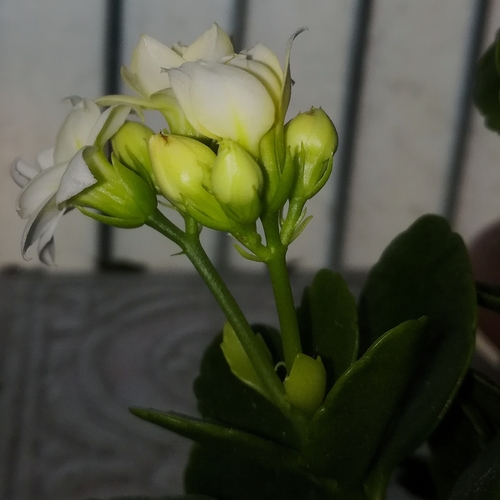
How to care for Flaming Katy
Watering
Flaming Katy (Kalanchoe blossfeldiana) is a succulent that stores water in its thick, fleshy leaves, so it prefers to dry out between drinks. Water deeply when the top half of the potted soil is dry, then empty any water left in the saucer after 15 minutes. Water less in winter, when growth slows and the soil stays wet longer. Use a pot with drainage holes and a fast-draining cactus or succulent mix.
Does it need water today?
Push a finger into the soil up to your second knuckle. If it feels dry and crumbly, water now. If it feels cool or damp, wait a few days. You can also lift the pot: a light pot means the soil is dry, while a heavy pot means it still holds water.
Water at the soil level, not over the leaves. Wet leaves that stay damp can develop rot, especially in cool rooms. Flaming Katy blooms best when it is kept on a steady, not too wet, schedule.
Overwatering
Flaming Katy is native to Madagascar, where it grows in well-drained rocky soils and rarely stands in water. Its fleshy stems and leaves store moisture, so soggy roots cannot be relieved quickly and rot sets in fast.
Symptoms: Soft, translucent, yellowing lower leaves that drop easily, a mushy stem base, dark or black roots, and a sour smell from the soil.
Solutions: Stop watering right away and let the soil dry out. Remove the plant from its pot, cut away any black or mushy roots with clean scissors, and let the root ball dry for a day or two. Repot into fresh, dry succulent mix in a pot with drainage holes. Water only once the soil is fully dry.
Underwatering
Flaming Katy stores water in its leaves, so it handles short dry spells well. Its thick leaves are a reserve, but a long drought will wear the plant down, and the blooms it is famous for need steady moisture to form.
Symptoms: Wrinkled or puckered leaves, leaves that feel thin and soft instead of plump, dry and crispy leaf edges, buds that drop before opening, and soil that pulls away from the pot edges.
Solutions: Give the plant a thorough soak using bottom watering for 20 minutes so the dry root ball can rehydrate. Let excess water drain fully. Increase watering slightly during warm spring and summer months, and check the soil every few days until the leaves plump up again.
Sunlight
Flaming Katy grows best in bright light that is not harsh. Strong midday sun through glass can scorch its leaves, while too little light makes the stems stretch and the plant refuse to flower. In its native Madagascar it grows in open, sunny habitats, so it appreciates plenty of light as long as it is eased into it. Keep it near a bright window and turn the pot every week so all sides grow evenly.
- Ideal: Bright, indirect light · 4-6 hours of bright light daily, with some direct morning sun if possible
- Tolerates: Full sun, Partial sun
- Best spot in a room: At the window
- Artificial light: If natural light is weak, use a full-spectrum LED grow light placed 15-30 cm above the plant for 10-12 hours a day. This helps the plant keep its compact shape and set flower buds, especially in winter.
Too little light
Flaming Katy needs strong light to build compact growth and to form flower buds. Without enough light, it stretches toward the nearest window, and the flowers that make it popular will not develop.
Symptoms: Tall, leggy stems with wide gaps between leaves, pale green or yellowish new leaves, weak drooping growth, and few or no flower buds.
Solutions: Move the plant to the brightest window you have, ideally a south- or west-facing one, and rotate it weekly. Add a full-spectrum LED grow light for 10-12 hours daily if needed. Pinch back long stems to encourage a bushier shape once the plant is in better light.
Too much sun
Although Flaming Katy likes bright light, its leaves can burn when exposed to intense midday sun behind glass or outdoors in summer heat. Sudden exposure is the main risk, since the plant has not adapted to it.
Symptoms: Bleached, pale, or brownish patches on the leaves that look dry and papery, leaves that curl or turn reddish-brown on the sunny side, and wilting during the hottest part of the day.
Solutions: Move the plant a little farther from the window or filter the sun with a sheer curtain during midday. If it has been outdoors, reintroduce it to sun gradually over one to two weeks. Keep temperatures between 15 and 24°C, and remove badly scorched leaves with clean scissors.
Temperature
Flaming Katy (Kalanchoe blossfeldiana) is a succulent from Madagascar that thrives in warm, bright rooms. Keep it between 15 and 24°C, away from drafts, and avoid sudden swings in temperature.
- Ideal: 15–24 °C
- Tolerates: 7–35 °C
- Hardiness zones: 10-12
Fertilizing
Flaming Katy needs modest feeding. Fertilize during active growth in spring and summer, and cut back in winter when the plant rests. For flowering, a fertilizer slightly higher in phosphorus helps buds form, but too much feeding produces leggy plants with few blooms.
- Slow-release fertilizer: Once a year in early spring, if the plant is in fresh potting mix, or not needed if you repot it in fresh mix that already contains slow-release fertilizer.
- Balanced liquid houseplant fertilizer (such as 10-10-10 or 20-20-20), Cactus and succulent fertilizer with a moderate nitrogen level, Slow-release granular fertilizer formulated for flowering houseplants
Soil
Kalanchoe blossfeldiana grows in a mildly acidic to neutral mix that drains quickly and dries between waterings. Avoid heavy garden soil or dense, moisture-retaining potting mixes, which keep the roots wet and invite rot.
- Cactus and succulent mix: Commercial cactus mix with about one-third added perlite or coarse sand to keep air in the root zone
- Homemade succulent blend: Two parts potting soil, one part perlite, and one part pumice or horticultural grit
- Peat-free cactus compost: Peat-free compost mixed with about 30 percent coarse grit to replace the drainage of peat
- pH 6–7
Repotting
Use a pot with drainage holes and a fast-draining mix. Flaming Katy stores water in its thick leaves, so soggy roots are the main cause of rot.
- How often: every 1-2 years, or when roots fill the pot
- New pot: Move up only one pot size, about 2-3 cm wider than the current pot. Kalanchoe blossfeldiana (Flaming Katy) blooms best when slightly pot-bound and dislikes wet, oversized pots.
- Repotting season: Spring, Summer
How to repot
- Gently tip the plant out of its pot, supporting the stem at the base
- Loosen the outer roots with your fingers and trim any black, mushy, or dead roots
- Place a layer of fresh mix in the new pot, then set the plant so the root ball sits at the same depth as before
- Fill around the roots with mix, tapping the pot lightly to settle it without packing it hard
- Leave the top of the root ball about 1 cm below the rim to make watering easier
- Wait 5-7 days before watering so any cut roots can heal
Pruning
Prune Flaming Katy after the main flowering flush has faded, typically in late spring or early summer. Use clean, sharp pruners and remove only what is needed to shape the plant, usually no more than about a third of its height at one time.
Pruning season: Spring, Summer
How to prune
- Remove faded flower heads by cutting the flower stalk back to the nearest leaf node or to the base of the stem.
- Pinch or cut the growing tips of long, leggy stems just above a leaf pair to encourage branching.
- Remove any yellow, brown, or mushy leaves at the base of the plant to reduce rot risk.
- Cut out crossing or crowded stems so light and air can reach the center of the plant.
- Make each cut just above a leaf node at a slight angle so water does not sit on the cut surface.
- After pruning, keep the plant in bright light and water lightly until new growth starts. Avoid heavy feeding for two to three weeks.
Propagation
Leaf cuttings · Spring, Summer
- Choose a healthy, fully expanded leaf from a mature Flaming Katy plant, avoiding damaged or yellowing leaves.
- Twist the leaf gently from the stem so the base comes away cleanly, or cut it with a sterile knife.
- Let the cut end dry for two to three days in a shaded spot until a light callus forms.
- Lay the leaf flat or insert the base about 1 cm deep into moist, well-draining cactus or succulent mix.
- Keep the mix barely moist and place the pot in bright, indirect light at about 18 to 24 °C.
- Small plantlets usually appear along the leaf margin within several weeks. Once they have roots and a few leaves, separate and pot them individually.
Stem tip cuttings · Spring, Summer
- Use clean, sharp pruners to cut a 7 to 10 cm stem tip just below a leaf node.
- Remove the lower leaves so that about two to three nodes are bare.
- Allow the cut end to callus for one to two days in a dry, shaded place.
- Plant the cutting in a small pot of moist, well-draining succulent mix, burying the bare nodes.
- Water lightly and keep the cutting in bright, indirect light at about 18 to 24 °C until new growth appears, which typically takes two to four weeks.
- Pinch the tip of the new growth once it is established to encourage a bushier plant.
Seed sowing · Winter, Spring
- Sow the very fine seeds on the surface of a sterile, fine seed-starting mix; do not cover them.
- Mist the surface gently or set the tray in a shallow pan of water so seeds are not washed away.
- Cover the tray with clear plastic to keep humidity high and place it in bright light at about 20 to 22 °C.
- Seedlings typically emerge in one to three weeks. Remove the cover gradually as they grow.
- Transplant seedlings into individual pots once they have several true leaves. Seed-grown plants may take many months to flower.
Water sparingly. Overwatering is the most common cause of failure with Flaming Katy cuttings, so let the mix dry slightly between light waterings and never let cuttings sit in standing water.
About Flaming Katy
Also known as: Flaming Katy, Christmas kalanchoe, Florist's kalanchoe, Flammendes Käthchen
- Plant type: succulent, herb
- Lifespan: perennial
- Distribution: Native to Madagascar, where it grows on rocky slopes and in dry woodland.
- Mature height: 15-45 cm as a pot plant
- Bloom time: Mainly winter to spring in the Northern Hemisphere when grown indoors
Pets · People
Pets: Toxic · People: Toxic. Contains bufadienolide cardiac glycosides, which can cause vomiting, diarrhoea, abdominal pain, and irregular heartbeat if eaten; the sap may irritate skin. Keep away from cats, dogs, and children.
Common problems
- Root rot: Caused by overwatering and poorly draining soil; leaves turn soft and mushy and the base blackens.
- Etiolation: Stretched, pale growth with widely spaced leaves when light is too weak.
- Failure to rebloom: Usually because the plant received light at night during the autumn short-day period.
- Mealybugs: White cottony pests that hide in leaf axils; wipe off with alcohol on a cotton swab.
- Leaf edge scorch: Brown crispy margins caused by intense direct sun, especially through glass in summer.
Uses
Ornamental pot plant grown worldwide for seasonal decoration, especially at Christmas and Easter; it is mainly used indoors and on patios, and is valued by the florist and horticultural trade for its long-lasting flowers.
Is it edible?
not edible
History & legends
Described from specimens collected in Madagascar and named in honour of the German botanist Carl Blossfeld, who collected plants in the region. Breeders in Europe developed the modern compact, many-flowered forms during the twentieth century, which became popular Christmas gifts.
Did you know?
Its common name Flaming Katy is a nickname that reflects the flower colour and the florist trade; in Germany it is known as Flammendes Käthchen, and it was bred extensively in the Netherlands and Germany for the pot-plant market.
Frequently asked questions
How often should I water Flaming Katy?
every 14 days. Flaming Katy (Kalanchoe blossfeldiana) is a succulent that stores water in its thick, fleshy leaves, so it prefers to dry out between drinks. Water deeply when the top half of the potted soil is dry, then empty any water left in the saucer after 15 minutes. Water less in winter, when growth slows and the soil stays wet longer. Use a pot with drainage holes and a fast-draining cactus or succulent mix. Push a finger into the soil up to your second knuckle. If it feels dry and crumbly, water now. If it feels cool or damp, wait a few days. You can also lift the pot: a light pot means the soil is dry, while a heavy pot means it still holds water.
How much light does Flaming Katy need?
Bright, indirect light (4-6 hours of bright light daily, with some direct morning sun if possible). Flaming Katy grows best in bright light that is not harsh. Strong midday sun through glass can scorch its leaves, while too little light makes the stems stretch and the plant refuse to flower. In its native Madagascar it grows in open, sunny habitats, so it appreciates plenty of light as long as it is eased into it. Keep it near a bright window and turn the pot every week so all sides grow evenly.
What temperature does Flaming Katy like?
15–24 °C. Flaming Katy (Kalanchoe blossfeldiana) is a succulent from Madagascar that thrives in warm, bright rooms. Keep it between 15 and 24°C, away from drafts, and avoid sudden swings in temperature.
Is Flaming Katy toxic to cats and dogs?
It is toxic to cats and dogs: keep it out of their reach. Contains bufadienolide cardiac glycosides, which can cause vomiting, diarrhoea, abdominal pain, and irregular heartbeat if eaten; the sap may irritate skin. Keep away from cats, dogs, and children.
What are the most common problems of Flaming Katy?
Root rot: Caused by overwatering and poorly draining soil; leaves turn soft and mushy and the base blackens. Etiolation: Stretched, pale growth with widely spaced leaves when light is too weak. Failure to rebloom: Usually because the plant received light at night during the autumn short-day period. Mealybugs: White cottony pests that hide in leaf axils; wipe off with alcohol on a cotton swab. Leaf edge scorch: Brown crispy margins caused by intense direct sun, especially through glass in summer.
When should I repot Flaming Katy?
every 1-2 years, or when roots fill the pot. Use a pot with drainage holes and a fast-draining mix. Flaming Katy stores water in its thick leaves, so soggy roots are the main cause of rot.
How do I propagate Flaming Katy?
Leaf cuttings, Stem tip cuttings, Seed sowing. Choose a healthy, fully expanded leaf from a mature Flaming Katy plant, avoiding damaged or yellowing leaves. Twist the leaf gently from the stem so the base comes away cleanly, or cut it with a sterile knife. Let the cut end dry for two to three days in a shaded spot until a light callus forms. Lay the leaf flat or insert the base about 1 cm deep into moist, well-draining cactus or succulent mix. Keep the mix barely moist and place the pot in bright, indirect light at about 18 to 24 °C. Small plantlets usually appear along the leaf margin within several weeks. Once they have roots and a few leaves, separate and pot them individually.
How this guide was written
Verdiss writes each guide with AI from botanical references and checks the species against iNaturalist and Plants of the World Online (Kew). Readers can rate every guide in the app.
Sources
Verdiss's information is for general guidance. Never eat or use a plant as medicine based on an app: ask a professional.