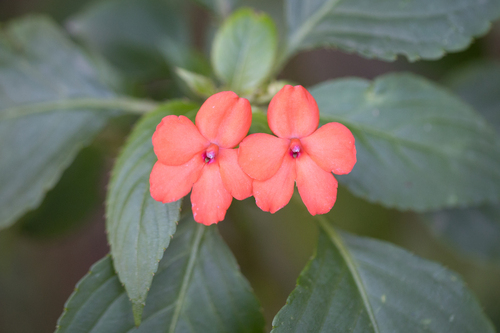
How to care for Busy Lizzie
Watering
Busy Lizzie (Impatiens walleriana) has thin, soft stems and shallow roots, and it wilts dramatically when dry. Keep the compost evenly moist but never soggy. Water when the top few centimetres feel dry, and empty any saucer within 30 minutes so the roots do not sit in water. In summer, indoor plants often need water every 2 to 3 days, while in winter they need much less.
Does it need water today?
Push a finger 2 to 3 cm into the compost. If it feels dry, water now. You can also lift the pot: a light pot means it is thirsty. Busy Lizzie gives an early warning by drooping slightly, so check it before the leaves go limp.
Water at the base of the plant in the morning, aiming for the soil and not the flowers or leaves. Wet foliage encourages grey mould (Botrytis) in the cool, humid conditions these plants like.
Overwatering
Busy Lizzie has fleshy, succulent-like stems that store some water, but its fine roots rot quickly in waterlogged compost. Constant wet soil makes it especially prone to root rot and stem collapse, and it drops buds and leaves when stressed.
Symptoms: Yellowing lower leaves, soft or blackened stem bases, a sour smell from the compost, fungus gnats, and sudden wilting even though the soil is wet.
Solutions: Stop watering and let the top 5 cm dry out. Check the roots: cut away brown, mushy ones and repot into fresh, free-draining compost in a pot with drainage holes. Reduce watering frequency, especially in winter.
Underwatering
Busy Lizzie has shallow roots and thin leaves with little reserve, so it wilts within hours of drying out. Repeated drought stops flowering and can kill the plant, though it usually recovers quickly if watered soon after the first droop.
Symptoms: Limp, drooping leaves, dry and crispy edges, dropped buds and flowers, and compost that pulls away from the pot sides.
Solutions: Water thoroughly until it drains from the base. If the compost is very dry, stand the pot in water for 20 minutes to rehydrate it. Leaves usually perk up within a few hours. Trim any badly damaged stems.
Sunlight
Busy Lizzie is one of the best shade-tolerant bedding plants. In too much hot midday sun its leaves scorch and it sulks, while in deep shade it becomes leggy and flowers poorly. Bright, indirect light gives the best display of blooms all season long.
- Ideal: Partial sun · 2-4 hours of gentle morning or late afternoon sun, with bright shade for the rest of the day
- Tolerates: Shade, Bright, indirect light, Partial sun
- Best spot in a room: Near the window
- Artificial light: A full-spectrum LED grow light for 10 to 12 hours a day can keep it flowering indoors through winter. Place the light about 30 cm above the plants.
Too little light
Busy Lizzie needs enough light to produce its continuous flush of flowers, and its stems stretch toward any available light when it is short on energy. Low light makes plants weak and stops them from blooming.
Symptoms: Long, pale, stretched stems, small leaves spaced far apart, few or no flowers, and a plant leaning toward the window.
Solutions: Move it to a brighter spot, ideally a bright window with filtered light. Rotate the pot weekly so growth stays even, and add a grow light in winter. Pinch back leggy stems to encourage bushier growth.
Too much sun
Busy Lizzie has thin, delicate leaves that lose water quickly in strong direct sun. Hot afternoon light, especially through glass, scorches its foliage and dries the compost very fast.
Symptoms: Bleached or brown scorched patches on leaves, crispy edges, wilting in the afternoon even when the soil is moist, and flowers fading quickly.
Solutions: Move it out of direct midday and afternoon sun, or pull it back from a south or west-facing window with a sheer curtain. Outdoors, choose a spot with morning sun and afternoon shade, and water more often in hot weather.
Temperature
Busy Lizzie (Impatiens walleriana) is a tender perennial grown as an annual in most gardens. It thrives in warm, humid conditions around 15 to 24°C and stops flowering well when nights drop below about 10°C or days climb above about 30°C. Keep it indoors or planted out only after the last frost has passed.
- Ideal: 15–24 °C
- Tolerates: 5–30 °C
- Hardiness zones: 10-12
Fertilizing
Busy Lizzie is a heavy, fast-growing bloomer that needs steady feeding to keep producing flowers through summer. Feed lightly and regularly rather than heavily, because strong doses can make it leafy with few blooms. Stop feeding in autumn when growth and flowering slow down.
- Slow-release fertilizer: Once at planting time in late spring, mixing a balanced slow-release granule into the compost. Repeat only if the plant is grown in the same container for a full season.
- Balanced liquid houseplant or bedding plant feed (for example 7-7-7 or 10-10-10), Slow-release granular fertilizer for bedding plants, Tomato feed diluted to half strength as a substitute for bedding feed, Well-rotted garden compost as a gentle soil conditioner
Soil
Impatiens walleriana grows best in a slightly acidic, humus-rich mix that drains quickly but never dries out completely. Heavy garden clay or dense, soggy compost invites root and stem rot.
- Peat-free multipurpose compost with added perlite: Roughly 70 percent peat-free compost, 20 percent perlite or grit, and 10 percent coir or fine bark for structure
- Commercial bedding plant mix: Peat-free bedding or container mix, sold for annuals, which usually contains added slow-release feed
- Free-draining container mix for shade plants: Equal parts loam-free compost and fine bark, with a handful of perlite per litre to keep air in the root zone
- pH 5.5–6.5
Repotting
Impatiens walleriana has fine, shallow roots and fleshy stems that rot easily in cold, wet compost. Use a pot with drainage holes and fresh, loose potting mix.
- How often: Every year, as busy lizzies are short-lived and grow quickly; a fresh pot each spring keeps them vigorous.
- New pot: Move up only one size, about 2-5 cm wider than the current pot, to avoid waterlogged soil around the roots.
- Repotting season: Spring, Summer
How to repot
- Turn the pot on its side and gently tap the edges until the root ball slides out
- Tease the outer roots loose with your fingers; trim any brown, mushy roots with clean scissors
- Place the plant in the new pot at the same depth it grew before, keeping the stems clear of the soil line
- Fill around the root ball with mix and firm it gently with your fingertips, not by pressing hard
- Water thoroughly until it drains from the holes, then leave it in bright, indirect light
Pruning
Use clean, sharp secateurs and cut just above a leaf node or pair of leaves. Impatiens walleriana has soft, brittle stems that bruise easily, so avoid crushing them. Regular light pinching is more effective than occasional hard cutting.
Pruning season: Spring, Summer, Autumn
How to prune
- Pinch out the growing tips of young plants when they are about 10 cm tall to encourage side branching.
- Deadhead regularly by removing faded flowers and their small seed pods just above the next leaf node.
- Cut back leggy stems by up to one third in late spring or early summer, cutting just above a leaf node so new shoots form from that point.
- Remove any stems that are damaged, weak, or touching the soil, which can rot.
- In autumn, before bringing container plants indoors, trim them back lightly to a manageable size and remove any tired growth.
Propagation
Stem cuttings in water or moist media · Spring, Summer
- Take a 8 to 10 cm tip cutting from a healthy, non-flowering shoot of Impatiens walleriana, cutting just below a leaf node.
- Strip the lowest pair of leaves so that at least two nodes sit free of foliage.
- Place the cutting in a glass of room-temperature water or push it into moist seed-starting mix, keeping it out of direct midday sun.
- Keep the cutting at about 18 to 24 °C. Roots typically form within 7 to 14 days in water.
- Pot the rooted cutting into a small container of peat-free potting mix once roots are 2 to 3 cm long, and keep it lightly moist for the next two weeks.
Seed sowing indoors · Winter, Spring
- Sow fine seed in a tray of seed-starting mix about 8 to 10 weeks before your last spring frost date.
- Lightly press the seed onto the surface without covering it, as light helps germination.
- Cover the tray with a clear lid or plastic wrap and keep it at 21 to 24 °C.
- Seedlings usually appear within 7 to 14 days. Remove the cover once they emerge and keep the soil evenly moist.
- Prick out seedlings into individual cells when they have two true leaves, then harden them off before planting outdoors after frost danger has passed.
Division of established clumps · Spring
- Lift an established plant of Impatiens walleriana carefully from its pot or garden bed in early spring.
- Gently tease the root ball apart into two or three sections, each with some stems and roots attached.
- Replant each section at the same depth it was growing before, and water thoroughly.
- Keep divisions in partial shade for about a week while they recover from root disturbance.
Cuttings root most reliably when taken from young, vigorous shoots in late spring or summer. Keep the water clean by changing it every few days, since stagnant water is the main cause of rot in these cuttings.
About Busy Lizzie
Also known as: Busy Lizzie, Sultana, Sultana balsam, Patience plant
- Plant type: herb, succulent-stemmed annual bedding plant
- Lifespan: perennial in its native range, usually grown as an annual or tender perennial elsewhere
- Distribution: Native to eastern Africa, from Kenya and Tanzania south to Mozambique.
- Mature height: 30-60 cm
- Bloom time: Late spring to autumn, continuous in mild conditions
Pets · People
Pets: Safe · People: Safe. Listed as non-toxic to cats, dogs and children by the ASPCA; the sap can irritate sensitive skin.
Common problems
- Downy mildew: Grey-white fuzz on leaf undersides and yellow spots; caused by Plasmopara obducens, worst in cool, humid, crowded conditions. Improve airflow and avoid wet foliage.
- Impatiens necrotic spot virus: Ring spots and distorted growth spread by thrips; there is no cure, so remove and discard affected plants.
- Spider mites: Fine webbing and stippled leaves in dry air; rinse foliage and increase humidity.
- Stem rot and botrytis: Soft, grey mould on stems and flowers in wet, poorly ventilated spots; water the soil, not the leaves.
Uses
Mainly ornamental, prized as a bedding and container plant for shady borders, hanging baskets and window boxes. It is also widely used in horticultural trade and breeding for its reliable flowering in low light.
Is it edible?
Flowers and young leaves are sometimes used as edible garnish in small amounts, but they are not widely consumed; wash thoroughly before use.
History & legends
Introduced to European gardens in the 1890s by Eduard Ludwig Walleri, a missionary and botanist working in East Africa, after whom it was named. Victorian gardeners quickly adopted it, and it became a staple of bedding displays across Europe and North America.
Did you know?
Its seed capsules burst explosively when touched, flinging seeds several metres away; the genus name Impatiens refers to this impatience to release seed.
Frequently asked questions
How often should I water Busy Lizzie?
every 3 days. Busy Lizzie (Impatiens walleriana) has thin, soft stems and shallow roots, and it wilts dramatically when dry. Keep the compost evenly moist but never soggy. Water when the top few centimetres feel dry, and empty any saucer within 30 minutes so the roots do not sit in water. In summer, indoor plants often need water every 2 to 3 days, while in winter they need much less. Push a finger 2 to 3 cm into the compost. If it feels dry, water now. You can also lift the pot: a light pot means it is thirsty. Busy Lizzie gives an early warning by drooping slightly, so check it before the leaves go limp.
How much light does Busy Lizzie need?
Partial sun (2-4 hours of gentle morning or late afternoon sun, with bright shade for the rest of the day). Busy Lizzie is one of the best shade-tolerant bedding plants. In too much hot midday sun its leaves scorch and it sulks, while in deep shade it becomes leggy and flowers poorly. Bright, indirect light gives the best display of blooms all season long.
What temperature does Busy Lizzie like?
15–24 °C. Busy Lizzie (Impatiens walleriana) is a tender perennial grown as an annual in most gardens. It thrives in warm, humid conditions around 15 to 24°C and stops flowering well when nights drop below about 10°C or days climb above about 30°C. Keep it indoors or planted out only after the last frost has passed.
Is Busy Lizzie toxic to cats and dogs?
It is safe for cats and dogs. Listed as non-toxic to cats, dogs and children by the ASPCA; the sap can irritate sensitive skin.
What are the most common problems of Busy Lizzie?
Downy mildew: Grey-white fuzz on leaf undersides and yellow spots; caused by Plasmopara obducens, worst in cool, humid, crowded conditions. Improve airflow and avoid wet foliage. Impatiens necrotic spot virus: Ring spots and distorted growth spread by thrips; there is no cure, so remove and discard affected plants. Spider mites: Fine webbing and stippled leaves in dry air; rinse foliage and increase humidity. Stem rot and botrytis: Soft, grey mould on stems and flowers in wet, poorly ventilated spots; water the soil, not the leaves.
When should I repot Busy Lizzie?
Every year, as busy lizzies are short-lived and grow quickly; a fresh pot each spring keeps them vigorous.. Impatiens walleriana has fine, shallow roots and fleshy stems that rot easily in cold, wet compost. Use a pot with drainage holes and fresh, loose potting mix.
How do I propagate Busy Lizzie?
Stem cuttings in water or moist media, Seed sowing indoors, Division of established clumps. Take a 8 to 10 cm tip cutting from a healthy, non-flowering shoot of Impatiens walleriana, cutting just below a leaf node. Strip the lowest pair of leaves so that at least two nodes sit free of foliage. Place the cutting in a glass of room-temperature water or push it into moist seed-starting mix, keeping it out of direct midday sun. Keep the cutting at about 18 to 24 °C. Roots typically form within 7 to 14 days in water. Pot the rooted cutting into a small container of peat-free potting mix once roots are 2 to 3 cm long, and keep it lightly moist for the next two weeks.
How this guide was written
Verdiss writes each guide with AI from botanical references and checks the species against iNaturalist and Plants of the World Online (Kew). Readers can rate every guide in the app.
Sources
Verdiss's information is for general guidance. Never eat or use a plant as medicine based on an app: ask a professional.