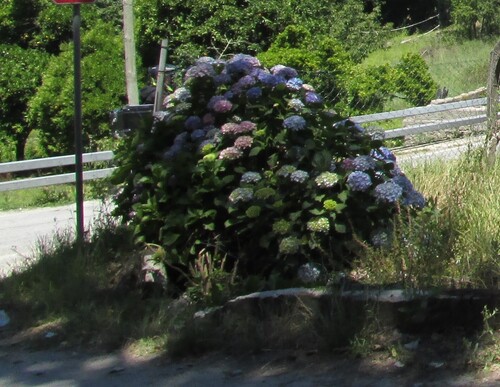
How to care for mophead hydrangea
Watering
Mophead hydrangea (Hydrangea macrophylla) is a thirsty plant with large leaves that lose a lot of water through them, so it wilts quickly when dry. Keep the soil evenly moist but never soggy. In summer, plants in containers may need water every day in hot weather. Water at the base of the plant in the morning, and use rainwater or tap water left to stand overnight if your water is very hard. Flower colour on many cultivars is affected by soil acidity and aluminium availability, so consistent watering helps keep blooms healthy and stable.
Does it need water today?
Push a finger 3-5 cm into the soil. If it feels dry at that depth, water thoroughly. For pots, lift the container: a light pot needs water, a heavy one does not. Leaves that droop in the afternoon but recover by evening are a sign of thirst; leaves that stay limp in the morning need water now.
Mulch around the base with 5-7 cm of bark or leaf mould to keep roots cool and moist, which greatly reduces how often you need to water.
Overwatering
Mophead hydrangea has fleshy roots that need air as well as moisture, so waterlogged soil quickly leads to root rot. Its large leaves also keep transpiring, which hides the early signs of a drowning root system until damage is serious.
Symptoms: Yellowing lower leaves, soft brown or black stems near the soil, a sour smell from the compost, and sudden wilting even when the soil is wet.
Solutions: Stop watering and let the soil dry to the top few centimetres. Check the roots: healthy ones are white or pale, rotten ones are brown and mushy. Trim away rot with clean secateurs, repot into fresh well-drained compost in a pot with drainage holes, and water sparingly until new growth appears.
Underwatering
Mophead hydrangea wilts visibly when short of water, and its flower buds are very sensitive to drought. Its large leaves lose water quickly in warm weather, so dry spells cause fast damage.
Symptoms: Crisp brown leaf edges, limp drooping leaves, dry compost pulling away from the pot, and buds that fail to open or dry out on the stem.
Solutions: Water deeply and slowly until the root ball is evenly moist. For very dry compost, soak the pot in a basin of water for 30 minutes. Move the plant to a cooler, shadier spot during heat waves and mulch the soil to slow moisture loss.
Sunlight
Mophead hydrangea grows best with gentle morning sun and protection from strong afternoon sun, which can scorch its large leaves and dry out the flowers. In shadier spots it still grows well but flowers less. Full sun is only suitable in cool, moist climates with consistent watering. Indoors, it needs a very bright spot to stay healthy.
- Ideal: Partial sun · 2-4 hours of direct morning sun, with light shade during the hottest part of the afternoon
- Tolerates: Partial sun, Bright, indirect light, Shade
- Best spot in a room: At the window
- Artificial light: If grown indoors in a dim room, use a full-spectrum LED grow light for 10-12 hours a day, placed 30-45 cm above the foliage. Plants indoors usually need to be moved outside once the risk of frost has passed.
Too little light
Mophead hydrangea needs plenty of light to produce strong stems and buds. Without enough light it stretches and stores little energy, so flowering suffers badly the following season.
Symptoms: Long, weak, leggy stems leaning towards the light, small pale leaves spaced far apart, and few or no flower buds.
Solutions: Move the plant closer to a bright east or north-facing window, or outdoors to a spot with morning sun. Prune lightly in late winter to encourage bushier growth and add a grow light during dark months.
Too much sun
Strong, hot sun causes stress for mophead hydrangea because its thin, broad leaves lose water faster than the roots can replace it. Intense afternoon light is the main cause of scorched foliage and faded flowers.
Symptoms: Brown, papery patches on leaves facing the sun, wilting in the middle of the day, and flowers that fade or dry quickly.
Solutions: Move the plant to a spot with shade from midday to late afternoon, such as beneath a tree or behind a taller shrub. Increase mulch and water more often during heat, and provide shade cloth if the plant is in a sunny container.
Temperature
Mophead hydrangea (Hydrangea macrophylla) grows best in mild, moist summers and cool winters, with about 10 to 24°C being comfortable. Flower buds for next summer form in late summer and fall, and they can be killed by hard frost, so protecting the plant through winter is key to good blooms.
- Ideal: 10–24 °C
- Tolerates: -15–35 °C
- Hardiness zones: 6-9
Fertilizing
Mophead hydrangea prefers rich, moisture-retentive soil with organic matter. Too much nitrogen produces lush leaves with few flowers, so choose a fertilizer with moderate nitrogen and higher phosphorus or potassium for better blooms.
- Slow-release fertilizer: Apply once a year in early spring, as new growth begins, using a balanced slow-release granular fertilizer.
- Balanced slow-release granular fertilizer (such as 10-10-10), Acid-leaning fertilizer formulated for azaleas, camellias, or hydrangeas, Well-rotted compost or leaf mold, Liquid seaweed or fish emulsion for gentle feeding
Soil
Mophead hydrangea (Hydrangea macrophylla) needs rich, consistently moist, well-draining soil. Its roots are shallow and sensitive to both drought and waterlogging, so the mix should hold water while still letting excess drain away. Soil pH strongly influences flower colour: acidic soil (below about 6) tends to produce blue flowers, while neutral to alkaline soil (above about 7) produces pink or red.
- Peat-free potting compost with added bark: Peat-free multipurpose compost mixed with about 20-30% composted bark or coir, plus a handful of perlite for drainage
- Ericaceous compost: Ericaceous compost is useful for blue flowers on acid-leaning soils, but it can be mixed with standard compost to adjust acidity gradually
- Garden loam enriched with leaf mould: Topsoil mixed with well-rotted leaf mould or compost at roughly one part organic matter to two parts soil, ideal for planting in the ground
- pH 5–6.5
Repotting
Mophead hydrangea (Hydrangea macrophylla) has fleshy, fine roots that dislike disturbance and soggy conditions. Use a pot with several drainage holes and a fresh, moisture-retentive but well-draining mix.
- How often: Every 2-3 years, or when roots fill the pot or emerge from drainage holes
- New pot: Move up only one pot size (about 3-5 cm wider in diameter). Oversized pots hold wet soil around the roots and invite rot.
- Repotting season: Spring, Autumn
How to repot
- Gently tip the pot on its side and ease the plant out, supporting the stems at the base
- Loosen the outer roots with your fingers. Trim any black, mushy, or dead roots with clean secateurs.
- Place a layer of fresh mix in the new pot so the top of the root ball sits about 2-3 cm below the rim
- Set the plant in the centre, fill around the sides with mix, and firm gently to remove large air pockets
- Water slowly until it drains from the holes, then top up the soil if it settles
- Keep the plant in partial shade for a week or two while it recovers
Pruning
Mophead hydrangeas bloom on old wood, meaning flower buds form on stems grown the previous year. Pruning in late winter or early spring removes these buds, so the main pruning window is right after flowering in summer. Use sharp, clean tools and cut just above a healthy bud or pair of leaves.
Pruning season: Spring, Summer, Autumn
How to prune
- Right after the flowers fade in mid to late summer, cut each spent flower head back to the first pair of healthy buds below it.
- Remove any stems that are dead, brittle, or crossing through the centre of the plant, cutting them at the base.
- Thin out about one in every four or five of the oldest stems at ground level to renew the plant over several years.
- In late autumn, lightly tidy the plant only to remove damaged growth; leave the remaining stems for winter protection of next year's buds.
- In early spring, only remove dead wood, since cutting living stems now removes the flower buds for that season.
Propagation
Softwood stem cuttings · Spring, Summer
- In late spring or early summer, take 10 cm cuttings from healthy new shoots of the mophead hydrangea that are firm but not woody.
- Strip the lower leaves and cut each leaf in half to reduce moisture loss.
- Dip the cut end in rooting hormone and insert it into a pot of moist, equal parts perlite and peat or coir.
- Cover the pot with a clear plastic bag or dome to hold humidity, and keep it in bright, indirect light at about 18 to 24 °C.
- Check for roots after 4 to 6 weeks by giving a gentle tug; then pot up into individual containers.
Layering · Spring, Summer
- Choose a flexible, low-growing stem of the mophead hydrangea in spring.
- Scrape a small patch of bark off the underside of the stem where it touches the soil.
- Bend the stem down, pin it into a shallow trench with a bent wire or stone, and bury the wounded section.
- Keep the soil moist throughout the growing season.
- The following autumn or spring, cut the rooted stem free from the parent plant and transplant it.
Division of suckering clumps · Spring, Autumn
- In early spring, before new leaves unfurl, dig up an established clump carefully.
- Use a sharp spade or knife to split the root mass into sections, each with several strong shoots and healthy roots.
- Replant the divisions at the same depth they grew before, and water them thoroughly.
- Keep the new divisions shaded from hot afternoon sun for the first few weeks.
Mophead hydrangeas root most reliably from softwood cuttings taken from non-flowering shoots, since flowering stems tend to wilt. Keep cuttings humid but never soggy, as rot is the most common cause of failure.
About mophead hydrangea
Also known as: Bigleaf hydrangea, French hydrangea, Lacecap hydrangea
- Plant type: shrub
- Lifespan: perennial
- Distribution: Native to Japan, Korea and southern China, where it grows in woodland margins and mountain slopes.
- Mature height: 1-2 m
- Bloom time: Mid to late summer
Pets · People
Pets: Toxic · People: Toxic. All parts contain cyanogenic glycosides (amygdalin/prunasin) that release hydrogen cyanide when chewed or digested, causing vomiting, diarrhoea and in larger amounts weakness or breathing difficulty. The ASPCA lists hydrangea as toxic to dogs, cats and horses. Keep plants out of reach of children and pets.
Common problems
- Leaf scorch: Brown, crispy leaf edges from hot afternoon sun or dry soil; move to shade and water deeply.
- No flowers: Caused by pruning in late winter or spring, which removes the flower buds; prune only after flowering.
- Powdery mildew: White powdery coating on leaves in humid, crowded conditions; improve airflow and avoid evening watering.
- Aphids: Clusters on soft new shoots and buds; wash off with water or use insecticidal soap.
- Colour fading to dull: Pale or muddy flowers from soil pH near neutral or low aluminium; adjust soil acidity for stronger colour.
Uses
Mainly ornamental, grown as a garden shrub, hedge and container plant, and widely used in cut flower arrangements and as dried flowers. In Japan the leaves and flowers have been used in traditional tea-like preparations, but it has no major medicinal role in Western practice.
Is it edible?
not edible
History & legends
In Japan the plant was long admired in gardens and temples, and the flowers appear in traditional Japanese art. Plant collectors carried it to Europe in the 1700s, where French horticulturists developed the mophead forms that remain popular today.
Did you know?
The flower colour of this species is controlled by soil aluminium: plants take up aluminium more readily in acidic soil, and it binds to the blue pigment molecules, so the same bush can be pink in one garden and blue in another.
Frequently asked questions
How often should I water mophead hydrangea?
every 3 days. Mophead hydrangea (Hydrangea macrophylla) is a thirsty plant with large leaves that lose a lot of water through them, so it wilts quickly when dry. Keep the soil evenly moist but never soggy. In summer, plants in containers may need water every day in hot weather. Water at the base of the plant in the morning, and use rainwater or tap water left to stand overnight if your water is very hard. Flower colour on many cultivars is affected by soil acidity and aluminium availability, so consistent watering helps keep blooms healthy and stable. Push a finger 3-5 cm into the soil. If it feels dry at that depth, water thoroughly. For pots, lift the container: a light pot needs water, a heavy one does not. Leaves that droop in the afternoon but recover by evening are a sign of thirst; leaves that stay limp in the morning need water now.
How much light does mophead hydrangea need?
Partial sun (2-4 hours of direct morning sun, with light shade during the hottest part of the afternoon). Mophead hydrangea grows best with gentle morning sun and protection from strong afternoon sun, which can scorch its large leaves and dry out the flowers. In shadier spots it still grows well but flowers less. Full sun is only suitable in cool, moist climates with consistent watering. Indoors, it needs a very bright spot to stay healthy.
What temperature does mophead hydrangea like?
10–24 °C. Mophead hydrangea (Hydrangea macrophylla) grows best in mild, moist summers and cool winters, with about 10 to 24°C being comfortable. Flower buds for next summer form in late summer and fall, and they can be killed by hard frost, so protecting the plant through winter is key to good blooms.
Is mophead hydrangea toxic to cats and dogs?
It is toxic to cats and dogs: keep it out of their reach. All parts contain cyanogenic glycosides (amygdalin/prunasin) that release hydrogen cyanide when chewed or digested, causing vomiting, diarrhoea and in larger amounts weakness or breathing difficulty. The ASPCA lists hydrangea as toxic to dogs, cats and horses. Keep plants out of reach of children and pets.
What are the most common problems of mophead hydrangea?
Leaf scorch: Brown, crispy leaf edges from hot afternoon sun or dry soil; move to shade and water deeply. No flowers: Caused by pruning in late winter or spring, which removes the flower buds; prune only after flowering. Powdery mildew: White powdery coating on leaves in humid, crowded conditions; improve airflow and avoid evening watering. Aphids: Clusters on soft new shoots and buds; wash off with water or use insecticidal soap. Colour fading to dull: Pale or muddy flowers from soil pH near neutral or low aluminium; adjust soil acidity for stronger colour.
When should I repot mophead hydrangea?
Every 2-3 years, or when roots fill the pot or emerge from drainage holes. Mophead hydrangea (Hydrangea macrophylla) has fleshy, fine roots that dislike disturbance and soggy conditions. Use a pot with several drainage holes and a fresh, moisture-retentive but well-draining mix.
How do I propagate mophead hydrangea?
Softwood stem cuttings, Layering, Division of suckering clumps. In late spring or early summer, take 10 cm cuttings from healthy new shoots of the mophead hydrangea that are firm but not woody. Strip the lower leaves and cut each leaf in half to reduce moisture loss. Dip the cut end in rooting hormone and insert it into a pot of moist, equal parts perlite and peat or coir. Cover the pot with a clear plastic bag or dome to hold humidity, and keep it in bright, indirect light at about 18 to 24 °C. Check for roots after 4 to 6 weeks by giving a gentle tug; then pot up into individual containers.
How this guide was written
Verdiss writes each guide with AI from botanical references and checks the species against iNaturalist and Plants of the World Online (Kew). Readers can rate every guide in the app.
Sources
Verdiss's information is for general guidance. Never eat or use a plant as medicine based on an app: ask a professional.