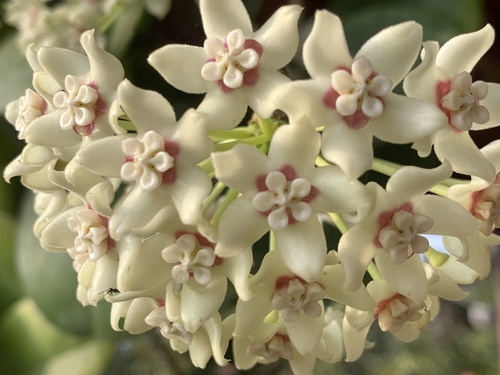
How to care for wax plant
Watering
Wax plant (Hoya carnosa) stores water in its thick, waxy leaves and fleshy stems, so it handles drought far better than it handles soggy soil. Let the top half of the potting mix dry out completely between waterings, then water thoroughly until it drains from the pot. Empty the saucer after 15 minutes so the roots never sit in water. In winter, when growth slows, water much less often. Hoya roots rot quickly in cold, wet mix.
Does it need water today?
Push a finger into the mix up to the second knuckle. If it feels dry and crumbly, water it. If it feels cool or damp, wait. You can also lift the pot: a dry pot feels noticeably lighter than one that was just watered. Wrinkled or limp leaves signal thirst, but a wax plant can go a little dry without serious harm.
Water less rather than more. Most wax plants die from overwatering, not drought. Hoya carnosa often flowers best when it is slightly root-bound and kept on the drier side in winter.
Overwatering
Hoya carnosa has thick, water-storing tissue, so its roots need air as much as moisture. When the mix stays wet, roots cannot breathe and begin to rot, and the plant cannot take up water even though the soil is soaked. Cold rooms in winter make this worse because the mix dries very slowly.
Symptoms: Yellowing leaves that drop easily, soft or mushy stems near the soil, a sour or musty smell from the pot, black or brown roots, and leaves that look plump but wilt anyway.
Solutions: Stop watering immediately. Tip the plant out, cut away any black, mushy roots with clean scissors, and let the root ball dry for a day or two. Repot into fresh, fast-draining mix in a pot with drainage holes. Resume watering only when the mix is dry to the second knuckle.
Underwatering
Thanks to its waxy leaves, a wax plant tolerates dry spells well, but it still needs enough water to support flowering and new growth. Long periods without water in summer, when it is actively growing, cause stress that the plant shows quickly in its leaves.
Symptoms: Wrinkled, soft or leathery leaves, leaves curling inward, slowed growth, dropped leaves, and a dry, shrinking potting mix that pulls away from the pot edge.
Solutions: Water thoroughly until it drains from the pot. If the mix is hard and dry, soak the pot in a tray for 30 minutes. Leaves usually plump up within a day or two. Increase watering slightly during spring and summer, and check the mix more often if the plant sits near a heater or sunny window.
Sunlight
Wax plant (Hoya carnosa) grows best in bright light that is not harsh. In its native Asian forest habitat it climbs through trees and receives dappled sun. Indoors, bright indirect light gives the most reliable growth and the best chance of flowering. It can take a few hours of gentle morning or late afternoon sun, but strong midday sun through glass can scorch the leaves. In low light it survives but grows slowly and rarely flowers.
- Ideal: Bright, indirect light · 4-6 hours of bright, filtered light per day
- Tolerates: Partial sun, Full sun, Shade
- Best spot in a room: At the window
- Artificial light: If natural light is weak, use a full-spectrum LED grow light placed 30 to 45 cm above the plant for 12 to 14 hours per day. Keep the lamp on a timer to maintain a steady schedule. Rotate the plant every few weeks so growth stays even.
Too little light
Hoya carnosa uses light to build the energy needed for new leaves, stems, and flower buds. In dim rooms the vine stretches toward any light source and stores less energy, so it grows sparsely and often skips blooming altogether.
Symptoms: Long, leggy stems with wide gaps between leaves, small new leaves, pale green foliage, no flower clusters after the usual season, and leaves that slowly drop from the lower stem.
Solutions: Move the plant closer to an east- or north-facing window, or a few steps back from a south- or west-facing one. Add a grow light for 12 to 14 hours daily. Avoid moving it into a dark corner, and stop feeding during winter low light to prevent weak growth.
Too much sun
Although wax plant tolerates some direct sun, its thin top layer of leaf tissue can be damaged by intense, unfiltered sun. Hot glass windows can magnify the heat, and the leaves cannot repair scorched tissue, so the damage stays visible.
Symptoms: Pale, bleached or yellowish patches on the sun-facing leaves, crisp brown or black spots, dry leaf edges, and leaves that look faded or washed out.
Solutions: Move the plant a metre back from a south or west window, or add a sheer curtain to filter the light. Do not move it straight from low light into strong sun. Acclimatize it over one to two weeks. Cut off badly scorched leaves so the plant can put energy into healthy growth.
Temperature
Wax plant (Hoya carnosa) grows best in warm, stable indoor or patio conditions between 18 and 27 °C. It tolerates short dips to about 10 °C but stops growing below 15 °C and can be damaged by frost. Keep it away from cold drafts, heating vents and blazing afternoon sun through glass.
- Ideal: 18–27 °C
- Tolerates: 10–35 °C
- Hardiness zones: 10-12
Fertilizing
Wax plant feeds lightly. It grows slowly and produces its fragrant flower clusters on old stems, so too much fertilizer, especially nitrogen, gives lush leaves but few or no flowers. Feed during the active growing season and rest it in winter.
- Slow-release fertilizer: Once a year in early spring, as new growth begins, if you are not using liquid feed all year.
- Balanced liquid houseplant fertilizer (e.g. 10-10-10 or 20-20-20) diluted to half strength, Bloom-boosting liquid fertilizer with a higher middle number (e.g. 10-30-10) for encouraging flower clusters in summer, Slow-release granular houseplant fertilizer with balanced nutrients
Soil
Wax plants need a well-draining, airy mix that dries out between waterings. Their thick, fleshy leaves store water, so dense soil that stays wet can quickly cause root rot.
- Chunky orchid-style mix: Equal parts standard potting mix, perlite, and orchid bark or coarse pumice
- Cactus and succulent mix: Commercial cactus mix amended with extra perlite for better aeration
- Light peat-based houseplant mix: Peat or coco coir with perlite, about 3:1 ratio, with a little bark for airflow
- pH 6–7
Repotting
Wax plants (Hoya carnosa) bloom best when slightly root-bound, so repot only when the roots are crowded, not on a fixed schedule. Choose a pot with drainage holes.
- How often: every 2-3 years, or when roots fill the pot
- New pot: Move up only one pot size (2-5 cm wider) so the soil stays dry long enough between waterings.
- Repotting season: Spring, Summer
How to repot
- Gently slide the plant out by pressing on the sides of the pot and supporting the stems
- Loosen the outer roots with your fingers and trim any brown, mushy roots
- Place a layer of fresh mix in the new pot so the root ball sits at the same depth as before
- Set the plant in the center, fill around the roots, and firm the soil lightly
- Water thoroughly until it drains out the bottom, then let excess drain away
- Avoid feeding for 4-6 weeks while the roots settle
Pruning
Prune lightly and selectively. Wax plant (Hoya carnosa) blooms on old flower spurs that persist on the stems, so cutting them off removes next season's flowers. Only trim these spurs if they are dead or dried out.
Pruning season: Spring, Summer
How to prune
- Look over the vines and identify any stems that are brown, mushy, shriveled, or clearly dead.
- Cut those stems back to healthy green tissue or to the base, using clean scissors.
- To shape a leggy plant, trim long trailing stems just above a leaf node, which encourages two new shoots to grow from that point.
- Leave the flower spurs intact unless they are dead, because blooms form on these year after year.
- Remove any spent, yellowed leaves at the base of the stem, and dispose of trimmings away from pets, since wax plant sap can irritate skin.
- After pruning, reduce watering slightly for a week or two while the plant recovers, then return to your normal schedule.
Propagation
Stem cutting in water · Spring, Summer
- Choose a healthy stem of your wax plant (Hoya carnosa) that has at least two or three leaf nodes, which are the small bumps where leaves and aerial roots emerge.
- Using clean, sharp scissors or a knife, cut just below a node so the cutting is about 8 to 12 cm long.
- Remove the lowest leaf or two so the bare node sits in the water, but leave the upper leaves in place.
- Place the cutting in a clear jar of room-temperature water so that at least one node is submerged, and keep it in bright, indirect light.
- Change the water every few days to keep it fresh, and watch for pale roots to form over two to four weeks.
- Once roots are about 3 to 5 cm long, pot the cutting in a small pot of well-draining potting mix.
Stem cutting in potting mix · Spring, Summer
- Take a cutting with two or three nodes, as for water propagation, and let the cut end dry for an hour so it forms a light callus.
- Dip the cut end in rooting hormone if you have it, though wax plants root without it.
- Fill a small pot with a mix of perlite and peat-based potting mix, and moisten it lightly.
- Insert one or two nodes into the mix and firm it gently around the stem.
- Cover the pot loosely with a clear plastic bag to hold humidity, and keep it at about 21 to 24 °C in bright, indirect light.
- Open the bag for a few minutes every couple of days, and expect roots in roughly four to six weeks. Gently tug after that to check for resistance.
Layering · Spring, Summer
- Pick a long, flexible trailing stem on the mature plant that is close to the soil or to a pot of potting mix placed beside it.
- Make a small nick on the underside of a node on that stem, and dust the spot lightly with rooting hormone if available.
- Pin the nicked node into the potting mix with a bent wire hairpin, keeping the tip of the stem above the surface.
- Keep the mix lightly moist and in bright, indirect light.
- After roots form, usually within a few weeks to two months, cut the stem free from the parent plant and let the new plant grow on in its own pot.
Wax plant cuttings are slow to root compared with many houseplants, so be patient. Do not let the cutting sit in cold water, and never cut off the flower spurs, which are the short, stubby stems where blooms form, since they will flower again from the same spot.
About wax plant
Also known as: Wax plant, Honeyplant, Porcelain flower, Hindu rope plant
- Plant type: climber, epiphyte, succulent-leaved vine
- Lifespan: perennial
- Distribution: Native to southern China, Japan, the Himalayan region, Southeast Asia and northern Australia.
- Mature height: Up to 6 m climbing or trailing when supported
- Bloom time: Late spring to summer, indoors often in warm months
Pets · People
Pets: Toxic · People: Toxic. Contains cardiac glycosides and milky sap that can irritate skin and cause vomiting or diarrhea if eaten; ASPCA lists it as toxic to dogs, cats and horses.
Common problems
- Mealybugs: White cottony clusters in leaf joints and under leaves; wipe with alcohol on a cotton swab and treat with insecticidal soap.
- Root rot: Yellowing leaves and mushy stems from overwatering or dense soil; repot in fast-draining mix and water less.
- No flowers: Often caused by too little light, over-pruning of flower spurs, or lack of a cooler winter rest period.
- Leaf scorch: Brown patches from direct midday sun through glass; move to bright indirect light.
- Sticky leaves: Honeydew from scale or mealybugs, often mistaken for sap; check undersides and treat pests.
Uses
Primarily ornamental as a houseplant, hanging basket and greenhouse climber; in parts of Asia it is valued in traditional medicine for treating skin complaints, though evidence is limited.
Is it edible?
not edible
History & legends
Hoya carnosa was introduced to European gardens in the late 1700s and became a Victorian parlour favourite, prized for its wax-like flowers. In Chinese culture, the flowers are associated with lasting love and fidelity, and the plant was commonly given as a gift for marriages.
Did you know?
Hoya carnosa flower spurs are permanent: the same stalk can produce new flower clusters for many years, which is why gardeners are told never to remove them.
Frequently asked questions
How often should I water wax plant?
every 10 days. Wax plant (Hoya carnosa) stores water in its thick, waxy leaves and fleshy stems, so it handles drought far better than it handles soggy soil. Let the top half of the potting mix dry out completely between waterings, then water thoroughly until it drains from the pot. Empty the saucer after 15 minutes so the roots never sit in water. In winter, when growth slows, water much less often. Hoya roots rot quickly in cold, wet mix. Push a finger into the mix up to the second knuckle. If it feels dry and crumbly, water it. If it feels cool or damp, wait. You can also lift the pot: a dry pot feels noticeably lighter than one that was just watered. Wrinkled or limp leaves signal thirst, but a wax plant can go a little dry without serious harm.
How much light does wax plant need?
Bright, indirect light (4-6 hours of bright, filtered light per day). Wax plant (Hoya carnosa) grows best in bright light that is not harsh. In its native Asian forest habitat it climbs through trees and receives dappled sun. Indoors, bright indirect light gives the most reliable growth and the best chance of flowering. It can take a few hours of gentle morning or late afternoon sun, but strong midday sun through glass can scorch the leaves. In low light it survives but grows slowly and rarely flowers.
What temperature does wax plant like?
18–27 °C. Wax plant (Hoya carnosa) grows best in warm, stable indoor or patio conditions between 18 and 27 °C. It tolerates short dips to about 10 °C but stops growing below 15 °C and can be damaged by frost. Keep it away from cold drafts, heating vents and blazing afternoon sun through glass.
Is wax plant toxic to cats and dogs?
It is toxic to cats and dogs: keep it out of their reach. Contains cardiac glycosides and milky sap that can irritate skin and cause vomiting or diarrhea if eaten; ASPCA lists it as toxic to dogs, cats and horses.
What are the most common problems of wax plant?
Mealybugs: White cottony clusters in leaf joints and under leaves; wipe with alcohol on a cotton swab and treat with insecticidal soap. Root rot: Yellowing leaves and mushy stems from overwatering or dense soil; repot in fast-draining mix and water less. No flowers: Often caused by too little light, over-pruning of flower spurs, or lack of a cooler winter rest period. Leaf scorch: Brown patches from direct midday sun through glass; move to bright indirect light. Sticky leaves: Honeydew from scale or mealybugs, often mistaken for sap; check undersides and treat pests.
When should I repot wax plant?
every 2-3 years, or when roots fill the pot. Wax plants (Hoya carnosa) bloom best when slightly root-bound, so repot only when the roots are crowded, not on a fixed schedule. Choose a pot with drainage holes.
How do I propagate wax plant?
Stem cutting in water, Stem cutting in potting mix, Layering. Choose a healthy stem of your wax plant (Hoya carnosa) that has at least two or three leaf nodes, which are the small bumps where leaves and aerial roots emerge. Using clean, sharp scissors or a knife, cut just below a node so the cutting is about 8 to 12 cm long. Remove the lowest leaf or two so the bare node sits in the water, but leave the upper leaves in place. Place the cutting in a clear jar of room-temperature water so that at least one node is submerged, and keep it in bright, indirect light. Change the water every few days to keep it fresh, and watch for pale roots to form over two to four weeks. Once roots are about 3 to 5 cm long, pot the cutting in a small pot of well-draining potting mix.
How this guide was written
Verdiss writes each guide with AI from botanical references and checks the species against iNaturalist and Plants of the World Online (Kew). Readers can rate every guide in the app.
Sources
Verdiss's information is for general guidance. Never eat or use a plant as medicine based on an app: ask a professional.