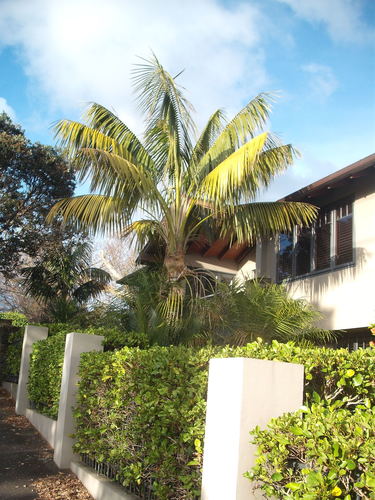
How to care for Kentia palm
Watering
The Kentia palm (Howea forsteriana) likes evenly moist soil during spring and summer, then needs noticeably less water in winter when growth slows. Let the top 3-5 cm of the potting mix dry out between waterings, and never let the pot sit in standing water, since soggy roots are the main way this palm is lost. Indoors, use room-temperature water and empty the saucer within 15 minutes. Outdoors in a temperate climate, it is best kept as a summer patio plant and brought inside before nights drop below about 10°C.
Does it need water today?
Push a finger 3-5 cm into the soil near the edge of the pot. If it feels dry, water thoroughly. If it still feels damp, wait a few days. You can also lift the pot: a light pot means it is dry and ready for water, while a heavy pot means it can wait.
Kentia palms have slow, dense roots and dislike disturbance, so water deeply and then let the excess drain fully. Consistent moderate watering matters far more than a fixed schedule.
Overwatering
The Kentia palm grows in the wet understory of Lord Howe Island but its roots still need air to function. Constantly soggy soil quickly rots the fine roots, which then cannot take up water or nutrients, even though the soil looks wet.
Symptoms: Yellowing lower fronds, brown or mushy leaf bases, a sour smell from the soil, fungus gnats, and new fronds that stay small or fail to open.
Solutions: Stop watering and let the soil dry to the top 5 cm. Remove the palm from its pot, trim any black or mushy roots with clean scissors, and repot into a fresh well-draining mix in a pot with drainage holes. Water only when the soil is dry again.
Underwatering
Kentia palms tolerate short dry spells better than many palms, but their large fronds lose water quickly in warm rooms and heating. Prolonged dryness stops the palm from sending up new growth and eventually damages the root ball.
Symptoms: Brown leaf tips that spread along the frond edges, drooping or limp fronds, dry soil pulling away from the pot edge, and slow or stalled new growth.
Solutions: Water thoroughly using the top watering method until water flows freely from the base. If the root ball has shrunk away from the pot, soak the whole pot in a tub for 30 minutes. Then mist the foliage occasionally and keep the palm away from heater vents.
Sunlight
The Kentia palm (Howea forsteriana) is one of the most shade-tolerant palms, which is why it became a classic indoor plant. In its native Lord Howe Island forest it grows under a canopy, so it prefers bright light filtered through a sheer curtain or a few metres from a window. Direct midday sun can scorch the fronds, leaving pale or brown patches. Rotate the pot every few months so the palm grows evenly.
- Ideal: Bright, indirect light · Bright indirect light for most of the day, with 1-3 hours of gentle morning or late afternoon sun
- Tolerates: Bright, indirect light, Partial sun, Shade
- Best spot in a room: Near the window
- Artificial light: A full-spectrum LED grow light placed 30-60 cm above the fronds for 10-12 hours a day can keep a Kentia palm healthy in a dim room. Use a timer so the light runs on a steady daily schedule.
Too little light
The Kentia palm grows slowly in low light, but it still needs enough energy to produce new fronds. In a dim corner for long periods, it stops growing and gradually loses its older leaves.
Symptoms: Pale or dull green fronds, long thin leaf stalks that lean toward the light, very slow or no new growth, and older fronds yellowing and dropping.
Solutions: Move the palm closer to a bright window, ideally an east or north-facing one with filtered light, or add a full-spectrum LED grow light for 10-12 hours a day. Increase light gradually over two weeks to avoid shock.
Too much sun
Kentia palms are adapted to forest shade and their leaves are relatively thin. Hot direct sun through glass or outdoors in full sun can overheat and bleach the fronds faster than the palm can recover.
Symptoms: Bleached yellow or white patches on the fronds, crispy brown edges, leaf tips that dry out first, and fronds that look faded and lifeless.
Solutions: Move the palm a metre or more back from a south or west window, or add a sheer curtain to diffuse the light. Outdoors, place it in dappled shade under a tree or on a shaded patio, and avoid full afternoon sun all summer.
Temperature
Kentia palm (Howea forsteriana) grows best in warm, steady indoor or sheltered outdoor conditions between 18 and 24 °C. It tolerates short dips to about 10 °C but suffers lasting damage below that, and it should be kept out of hot, dry blasts above 35 °C. Keep it away from cold drafts, heating vents and air conditioners, which cause more trouble than gradual seasonal change.
- Ideal: 18–24 °C
- Tolerates: 10–35 °C
- Hardiness zones: 10-11
Fertilizing
Kentia palm is a slow grower that needs only modest feeding. It is especially prone to magnesium and manganese deficiencies in pale, sandy or peat-heavy mixes, so choose a feed that includes micronutrients. Always fertilize moist soil, never dry soil, to protect the roots.
- Slow-release fertilizer: Once a year in early spring, just as new growth begins, unless the palm is in fresh potting mix that already contains slow-release feed.
- Balanced liquid palm or houseplant fertilizer with equal N-P-K, such as 10-10-10 or 20-20-20, Slow-release granular fertilizer formulated for palms or foliage plants, with micronutrients, Magnesium-containing feed, such as Epsom salt solution, only if leaves show yellowing between veins
Soil
Kentia palms (Howea forsteriana) grow naturally on the well-drained, slightly acidic to neutral soils of Lord Howe Island. They need a loose, airy mix that holds some moisture without ever becoming soggy, since their roots rot easily in dense, waterlogged soil.
- Peat-based potting mix: Sphagnum peat or coir mixed with perlite and a little composted bark for structure and drainage.
- Palm or cactus-blend mix: Standard potting mix with added coarse sand, perlite, or pumice to speed drainage and reduce waterlogging.
- Loam-based mix for outdoor planting: Garden loam blended with compost and coarse sand or grit to prevent compaction and standing water.
- pH 6–7.5
Repotting
Kentia palms (Howea forsteriana) have a sensitive, fleshy root system that resents disturbance. Repot gently, keep the root ball largely intact, and choose a pot with good drainage holes.
- How often: Every 3-4 years for a young Kentia palm; older, slow-growing specimens may only need repotting every 5 years or more.
- New pot: Move up only one pot size (about 2-5 cm wider in diameter) each time. Kentia palms dislike oversized pots, where wet soil can sour the roots.
- Repotting season: Spring, Summer
How to repot
- Gently tip the pot on its side and ease the palm out, supporting the base of the trunk with one hand.
- Loosen the outer edge of the root ball with your fingers. Trim only dead, brown, or mushy roots with clean scissors.
- Set the palm in the new pot at the same depth it grew before, so the crown sits level with the old soil line.
- Fill around the root ball with fresh mix, firming it lightly with your hands to remove large air pockets without compacting it.
- Water thoroughly until it drains from the holes, then empty the saucer so the roots do not sit in standing water.
- Avoid fertilizing for at least 6-8 weeks to let the roots recover.
Pruning
Kentia palm rarely needs pruning. Only remove fronds that are completely brown or dried out. Leave any fronds that are still green or partly green, because they still help feed the plant. Never cut into the central growing point at the top of the palm, as this can kill the plant.
Pruning season: Spring, Summer
How to prune
- Clean sharp pruning shears or a pruning saw with rubbing alcohol.
- Hold the dead frond firmly and follow it down to where it joins the trunk.
- Cut the frond stalk close to the trunk, leaving a small stub of about 1 to 2 cm so you do not damage the trunk.
- Remove only one frond at a time, then wait a few weeks before deciding whether another needs removal.
- Dispose of the cut fronds, and wipe the tool clean again before using it on another plant.
- Step back and check the palm's shape, then leave it alone until the next season if no other fronds are dead.
Propagation
Seed sowing · Spring, Summer
- Collect fresh Howea forsteriana seeds from a ripe fruit or buy seeds from a reputable supplier, and sow them as soon as possible because Kentia palm seed loses viability quickly once dried.
- Soak the seeds in warm water for 24 to 48 hours, then rub off any remaining fleshy outer layer so the seed is clean.
- Fill a pot with a well-draining mix of peat-free potting compost and perlite or coarse sand.
- Plant each seed about 1 to 2 cm deep with the pointed end facing down, and water until the mix is evenly damp.
- Place the pot somewhere warm, around 25 to 30°C, such as on a heated propagator mat, and keep it out of direct harsh sun.
- Keep the mix moist but never soggy, and check it every week so the seed does not rot.
- Be patient: germination is slow and uneven and can take several months, sometimes longer than six months.
- Once the seedling develops its first true leaf, move it into a small pot with fresh mix and keep it in bright, indirect light.
Label each pot with the sowing date, since Kentia palm seedlings can take a long time to appear and it is easy to forget when you planted them. Avoid digging the seed up to check on it; a steady, warm, moist environment works better than frequent disturbance.
About Kentia palm
Also known as: Kentia palm, Sentry palm, Thatch palm
- Plant type: palm, tree
- Lifespan: perennial
- Distribution: Endemic to Lord Howe Island in the Tasman Sea, Australia.
- Mature height: 6-15 m in the wild; 1.5-2.5 m indoors
- Bloom time: Late spring to summer
Pets · People
Pets: Safe · People: Safe. Listed as non-toxic to cats, dogs and humans by the ASPCA; the fruit is not considered poisonous, though it is not meant to be eaten in quantity.
Common problems
- Brown leaf tips: Usually caused by dry indoor air, low humidity or salt buildup from tap water and fertilizer; flush the soil and raise humidity.
- Overwatering and root rot: Soggy soil leads to yellowing fronds and rot; let the soil dry between waterings and use a pot with drainage.
- Yellowing lower fronds: Normal aging of older fronds, but rapid yellowing can signal nutrient shortage or overwatering.
- Spider mites: Common on indoor palms in dry air; check the undersides of fronds and wipe with water or insecticidal soap.
- Scale insects: Brown bumps on stems and fronds that suck sap; remove by hand or treat with horticultural oil.
Uses
Grown mainly as an ornamental houseplant, in offices, atriums and as a landscape palm in mild climates, valued for its tolerance of shade and indoor conditions. On Lord Howe Island its leaves were once used for thatching and the palm was harvested for seed.
Is it edible?
Not edible in any meaningful way; the fruit is not used as food.
History & legends
Discovered on Lord Howe Island in the 19th century, the palm was introduced to European gardens and became a fashionable Victorian conservatory plant. Its popularity made the species a major horticultural export, and seed collection has been regulated on the island to protect wild populations.
Did you know?
Kentia palms were once so popular in Victorian Europe that Lord Howe Island seed was a major export, and seed from the island was harvested in large quantities for the palm trade.
Frequently asked questions
How often should I water Kentia palm?
every 10 days. The Kentia palm (Howea forsteriana) likes evenly moist soil during spring and summer, then needs noticeably less water in winter when growth slows. Let the top 3-5 cm of the potting mix dry out between waterings, and never let the pot sit in standing water, since soggy roots are the main way this palm is lost. Indoors, use room-temperature water and empty the saucer within 15 minutes. Outdoors in a temperate climate, it is best kept as a summer patio plant and brought inside before nights drop below about 10°C. Push a finger 3-5 cm into the soil near the edge of the pot. If it feels dry, water thoroughly. If it still feels damp, wait a few days. You can also lift the pot: a light pot means it is dry and ready for water, while a heavy pot means it can wait.
How much light does Kentia palm need?
Bright, indirect light (Bright indirect light for most of the day, with 1-3 hours of gentle morning or late afternoon sun). The Kentia palm (Howea forsteriana) is one of the most shade-tolerant palms, which is why it became a classic indoor plant. In its native Lord Howe Island forest it grows under a canopy, so it prefers bright light filtered through a sheer curtain or a few metres from a window. Direct midday sun can scorch the fronds, leaving pale or brown patches. Rotate the pot every few months so the palm grows evenly.
What temperature does Kentia palm like?
18–24 °C. Kentia palm (Howea forsteriana) grows best in warm, steady indoor or sheltered outdoor conditions between 18 and 24 °C. It tolerates short dips to about 10 °C but suffers lasting damage below that, and it should be kept out of hot, dry blasts above 35 °C. Keep it away from cold drafts, heating vents and air conditioners, which cause more trouble than gradual seasonal change.
Is Kentia palm toxic to cats and dogs?
It is safe for cats and dogs. Listed as non-toxic to cats, dogs and humans by the ASPCA; the fruit is not considered poisonous, though it is not meant to be eaten in quantity.
What are the most common problems of Kentia palm?
Brown leaf tips: Usually caused by dry indoor air, low humidity or salt buildup from tap water and fertilizer; flush the soil and raise humidity. Overwatering and root rot: Soggy soil leads to yellowing fronds and rot; let the soil dry between waterings and use a pot with drainage. Yellowing lower fronds: Normal aging of older fronds, but rapid yellowing can signal nutrient shortage or overwatering. Spider mites: Common on indoor palms in dry air; check the undersides of fronds and wipe with water or insecticidal soap. Scale insects: Brown bumps on stems and fronds that suck sap; remove by hand or treat with horticultural oil.
When should I repot Kentia palm?
Every 3-4 years for a young Kentia palm; older, slow-growing specimens may only need repotting every 5 years or more.. Kentia palms (Howea forsteriana) have a sensitive, fleshy root system that resents disturbance. Repot gently, keep the root ball largely intact, and choose a pot with good drainage holes.
How do I propagate Kentia palm?
Seed sowing. Collect fresh Howea forsteriana seeds from a ripe fruit or buy seeds from a reputable supplier, and sow them as soon as possible because Kentia palm seed loses viability quickly once dried. Soak the seeds in warm water for 24 to 48 hours, then rub off any remaining fleshy outer layer so the seed is clean. Fill a pot with a well-draining mix of peat-free potting compost and perlite or coarse sand. Plant each seed about 1 to 2 cm deep with the pointed end facing down, and water until the mix is evenly damp. Place the pot somewhere warm, around 25 to 30°C, such as on a heated propagator mat, and keep it out of direct harsh sun. Keep the mix moist but never soggy, and check it every week so the seed does not rot. Be patient: germination is slow and uneven and can take several months, sometimes longer than six months. Once the seedling develops its first true leaf, move it into a small pot with fresh mix and keep it in bright, indirect light.
How this guide was written
Verdiss writes each guide with AI from botanical references and checks the species against iNaturalist and Plants of the World Online (Kew). Readers can rate every guide in the app.
Sources
Verdiss's information is for general guidance. Never eat or use a plant as medicine based on an app: ask a professional.