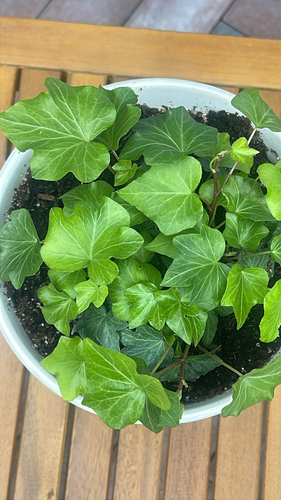
How to care for common ivy
Watering
Common ivy (Hedera helix) likes evenly moist soil that is never soggy. Let the top 2-3 cm of compost dry out between waterings, then water thoroughly until it drains from the pot. In winter, when growth slows and indoor air is warm and dry from heating, water less often. Ivy roots rot quickly in waterlogged soil, so always empty the saucer after watering. Mature plants growing in the ground need water mainly during dry spells in their first two summers.
Does it need water today?
Push a finger 2-3 cm into the compost. If it feels dry, water now. If it feels cool and damp, wait a few days. Lift the pot too: a light pot means the soil is dry, a heavy pot means it is still wet. Leaves that droop slightly and then perk up after watering are another sign.
Ivy is forgiving about drought once established, but it dislikes swings between bone dry and soaking wet. Aim for steady, moderate moisture rather than a fixed calendar.
Overwatering
Common ivy grows from fine, shallow roots that cannot tolerate sitting in water for long. Waterlogged compost cuts off oxygen to the roots, and they begin to rot, which the plant cannot recover from quickly. Ivy growing in dim rooms uses less water, so excess is especially harmful there.
Symptoms: Yellowing lower leaves that feel soft, leaves dropping while the compost is still wet, a sour or musty smell from the pot, and dark, mushy stem bases.
Solutions: Stop watering and remove the plant from its pot. Cut away any black or mushy roots with clean scissors, and repot into fresh, free-draining compost in a container with drainage holes. Water only once the top few centimetres are dry.
Underwatering
Ivy wilts quickly when its compost dries because its leaves lose water faster than thin roots in dry soil can replace it. Repeated drying causes leaf edges to brown and the plant to lose vigour. Plants in hot, sunny rooms or in small pots dry out fastest.
Symptoms: Drooping leaves that feel thin and papery, brown crispy leaf edges, leaves dropping from the base of the stems, and compost that has shrunk away from the sides of the pot.
Solutions: Water thoroughly using the bottom watering method for 30 minutes, then let it drain. Mist the leaves in dry indoor air, and move the plant away from radiators. Once it recovers, return to regular checks and water when the top 2-3 cm of compost is dry.
Sunlight
Common ivy grows naturally on woodland edges and shaded walls, so it prefers bright but gentle light. Variegated cultivars need more light to keep their cream or yellow markings, while plain green ivy copes well in shade. Direct summer sun through glass can scorch the leaves, leaving pale or brown patches. Ivy grown outdoors does well on north or east-facing walls.
- Ideal: Bright, indirect light · 3-6 hours of bright, filtered light a day, or bright light without direct midday sun
- Tolerates: Partial sun, Shade
- Best spot in a room: Near the window
- Artificial light: If natural light is weak, use a full-spectrum LED grow light placed 30-45 cm above the plant for 10-12 hours a day in winter. Variegated ivy benefits most from this, because low light makes its leaves revert to plain green.
Too little light
Ivy needs enough light to make the energy for steady new growth. In deep shade, stems become long and sparse with large gaps between leaves, and the plant gradually loses its colour pattern. Variegated forms are especially sensitive to dim spots.
Symptoms: Long, leggy stems reaching toward the light, small pale leaves spaced far apart, variegated leaves turning plain green, and slow or no new growth through spring.
Solutions: Move the plant closer to a bright window, ideally an east or west window, or into a bright room with indirect light. Prune leggy stems back to healthy buds to encourage bushier growth. Add a grow light if you cannot improve the spot.
Too much sun
Ivy leaves are thin and can be damaged by strong, direct sun, especially through a glass window that magnifies heat. Scorching destroys leaf tissue, and the plant then needs time to produce new leaves. Ivy grown in full sun outdoors may also need extra water to cope.
Symptoms: Pale, bleached patches on the leaves, brown or crispy scorched edges, leaves curling or looking dry on the sunniest side, and faded variegation in leaves facing the glass.
Solutions: Move the plant a metre or so back from the window or behind a sheer curtain during the brightest months. Outdoors, shift it to a partly shaded position out of the afternoon sun. Remove badly scorched leaves so the plant can put its energy into new growth.
Temperature
Common ivy (Hedera helix) is a hardy, cool-loving climber that thrives in mild conditions between about 10 and 24 °C. Outdoor plants tolerate frost well once established, but indoor plants struggle in hot, dry rooms and near heating vents.
- Ideal: 10–24 °C
- Tolerates: -20–35 °C
- Hardiness zones: 5-9
Fertilizing
Common ivy grows well with modest feeding. It needs more nitrogen for lush leaf growth in spring and early summer, then less during autumn and winter. Feed only when the plant is actively growing and the soil is moist.
- Slow-release fertilizer: Once a year in early spring for container ivy; outdoor ivy in the ground usually needs no slow-release fertilizer.
- Balanced liquid fertilizer, such as a 10-10-10 or 20-20-20 formula, Slow-release granular fertilizer with balanced nutrients, Well-rotted compost or leaf mould as a gentle organic option
Soil
Common ivy (Hedera helix) prefers slightly acidic to neutral soil that stays evenly moist but never waterlogged. Its roots rot quickly in heavy, airless ground, so good drainage matters as much as moisture.
- Peat-free all-purpose potting mix: Coir or composted bark with perlite and a little loam, giving good structure for container ivy.
- Loam-based John Innes No. 2 mix: Sterilised loam, peat or coir, sand, and added fertiliser; suited to larger or long-term container plants.
- Garden soil for outdoor ivy: Common ivy tolerates most soils but grows best in fertile, moist, well-drained ground, and can be improved with well-rotted compost.
- pH 6–7.5
Repotting
Common ivy grows fast and produces many fine, shallow roots that clasp the pot wall. Repot in active growth so the plant recovers quickly, and always use a container with drainage holes.
- How often: every 2-3 years, or when roots fill the pot
- New pot: Move up only one pot size (2-5 cm wider) each time, since common ivy (Hedera helix) dislikes sitting in overly wet soil in a large pot.
- Repotting season: Spring, Summer
How to repot
- Tip the pot on its side and gently ease the root ball out, tapping the base if needed
- Tease apart the outer roots with your fingers and trim any dead, black, or mushy roots
- Cut away any long, leggy stems that have become bare, to keep the plant compact
- Place a 2-3 cm layer of fresh mix in the new pot, set the root ball on top so the soil level matches the old one, and fill the gaps around it
- Firm the soil gently with your hands, leaving 2 cm of space below the rim for watering
- Water thoroughly until it drains from the holes, then move the plant to a bright spot out of direct sun
Pruning
Common ivy tolerates hard pruning and regrows well from older wood, so you can shorten or cut back stems without serious harm. Always wear gloves, as the sap can irritate the skin. Avoid pruning during deep frost, and do not leave cut stems on the ground, where they can root into unwanted places.
Pruning season: Spring, Summer, Autumn
How to prune
- Start by removing any dead, brown, or diseased stems at the base, cutting back to healthy tissue.
- Cut back stems that are growing where you do not want them, such as into windows or under roof tiles, cutting close to the base of the stem.
- If ivy is climbing a wall, cut the aerial rootlets away from the surface only if you plan to remove the plant; otherwise leave them, since they hold to the wall but will not damage sound masonry.
- Shorten long trailing stems by about one third to encourage bushier growth, cutting just above a leaf node.
- For indoor or container plants, pinch back growing tips regularly to keep the plant compact.
- Remove cuttings from the site, and bag any diseased material instead of composting it.
Propagation
Stem cuttings in water · Spring, Summer
- Cut a 10 to 15 cm piece of non-flowering stem from a healthy common ivy plant, just below a leaf node.
- Strip the leaves from the bottom third of the cutting.
- Place the cut end in a glass of room-temperature water so that at least two nodes are submerged.
- Set the glass in bright, indirect light and change the water every few days.
- Once roots are 2 to 3 cm long, pot the cutting into moist, well-draining potting mix.
Stem cuttings in soil · Spring, Summer, Autumn
- Take a 10 to 15 cm non-flowering stem cutting with at least three leaves.
- Remove the lowest leaves and optionally dip the cut end in rooting hormone.
- Insert the cutting two to three nodes deep into a pot of moist potting mix.
- Cover loosely with a clear plastic bag to hold humidity, and keep it out of direct sun.
- Keep the mix lightly moist; new growth signals that roots have formed, usually within four to six weeks.
Layering · Spring, Summer
- Choose a long, flexible trailing stem that is still attached to the parent plant.
- Pin a section of stem against the soil in a pot or the ground with a bent wire hairpin, leaving the tip exposed.
- Lightly scrape the underside of the stem where it touches the soil to encourage rooting.
- Keep the pinned area moist until roots form, which often takes several weeks.
- Cut the stem from the parent plant only after the new plant is well rooted and growing.
Division of rooted clumps · Spring
- In early spring, check an established plant growing in a container that has become crowded.
- Gently remove the plant from its pot and shake off loose soil so the root mass is visible.
- Use a clean knife to split the root ball into sections, each with healthy stems and roots.
- Pot each section separately in fresh potting mix and water well.
- Keep the new plants in partial shade for two to three weeks while they recover.
Common ivy roots easily along its stems wherever they touch moist soil, so cuttings often root within a few weeks. Spring and early summer are the most reliable seasons, when temperatures stay between about 15 and 22 °C.
About common ivy
Also known as: English ivy, Bento, Common ivy
- Plant type: climber, evergreen shrub, groundcover
- Lifespan: perennial
- Distribution: Native to most of Europe, western Asia and northwest Africa.
- Mature height: up to 20-30 m when climbing; 0.3-0.5 m as groundcover
- Bloom time: late summer to early winter, typically September to November
Pets · People
Pets: Toxic · People: Toxic. Leaves and berries contain triterpenoid saponins (hederin) that can cause vomiting, diarrhea, abdominal pain and, rarely, breathing difficulty if large amounts are eaten; sap may irritate skin. Seek veterinary or medical advice after ingestion.
Common problems
- Spider mites: Fine webbing and stippled leaves, most common in hot, dry indoor air; rinse plants and raise humidity.
- Root rot: Yellowing and mushy roots from waterlogged soil; improve drainage and water less often.
- Scale insects: Brown bumps on stems and leaf undersides that suck sap; scrape off or treat with horticultural oil.
- Leaf spot: Brown spots with yellow halos from fungal or bacterial infection, often after wet foliage; remove affected leaves.
- Leaf drop from low light or dry air: Sudden leaf loss when moved to a dim or overheated spot; adjust light and humidity gradually.
Uses
Widely grown as an ornamental climber, groundcover and hedge plant, and used in traditional European herbal medicine for respiratory complaints, with extracts from its leaves still used in cough remedies. It is also a valued wildlife plant and has long been used in wreaths and garden decoration.
Is it edible?
Not edible; leaves and berries contain saponins and are toxic if eaten.
History & legends
Ivy has been associated with Dionysus in Greek myth, where wreaths of it were worn at festivals, and it appears in Roman and medieval traditions as a symbol of fidelity and eternal life. In Britain it was long linked with pubs, and its evergreen habit made it a winter emblem across Europe.
Did you know?
A single common ivy plant can cover an entire wall, and in old woodlands some plants have been recorded with stems thicker than a person's leg, showing how long ivy can live once it has a secure hold.
Frequently asked questions
How often should I water common ivy?
every 10 days. Common ivy (Hedera helix) likes evenly moist soil that is never soggy. Let the top 2-3 cm of compost dry out between waterings, then water thoroughly until it drains from the pot. In winter, when growth slows and indoor air is warm and dry from heating, water less often. Ivy roots rot quickly in waterlogged soil, so always empty the saucer after watering. Mature plants growing in the ground need water mainly during dry spells in their first two summers. Push a finger 2-3 cm into the compost. If it feels dry, water now. If it feels cool and damp, wait a few days. Lift the pot too: a light pot means the soil is dry, a heavy pot means it is still wet. Leaves that droop slightly and then perk up after watering are another sign.
How much light does common ivy need?
Bright, indirect light (3-6 hours of bright, filtered light a day, or bright light without direct midday sun). Common ivy grows naturally on woodland edges and shaded walls, so it prefers bright but gentle light. Variegated cultivars need more light to keep their cream or yellow markings, while plain green ivy copes well in shade. Direct summer sun through glass can scorch the leaves, leaving pale or brown patches. Ivy grown outdoors does well on north or east-facing walls.
What temperature does common ivy like?
10–24 °C. Common ivy (Hedera helix) is a hardy, cool-loving climber that thrives in mild conditions between about 10 and 24 °C. Outdoor plants tolerate frost well once established, but indoor plants struggle in hot, dry rooms and near heating vents.
Is common ivy toxic to cats and dogs?
It is toxic to cats and dogs: keep it out of their reach. Leaves and berries contain triterpenoid saponins (hederin) that can cause vomiting, diarrhea, abdominal pain and, rarely, breathing difficulty if large amounts are eaten; sap may irritate skin. Seek veterinary or medical advice after ingestion.
What are the most common problems of common ivy?
Spider mites: Fine webbing and stippled leaves, most common in hot, dry indoor air; rinse plants and raise humidity. Root rot: Yellowing and mushy roots from waterlogged soil; improve drainage and water less often. Scale insects: Brown bumps on stems and leaf undersides that suck sap; scrape off or treat with horticultural oil. Leaf spot: Brown spots with yellow halos from fungal or bacterial infection, often after wet foliage; remove affected leaves. Leaf drop from low light or dry air: Sudden leaf loss when moved to a dim or overheated spot; adjust light and humidity gradually.
When should I repot common ivy?
every 2-3 years, or when roots fill the pot. Common ivy grows fast and produces many fine, shallow roots that clasp the pot wall. Repot in active growth so the plant recovers quickly, and always use a container with drainage holes.
How do I propagate common ivy?
Stem cuttings in water, Stem cuttings in soil, Layering, Division of rooted clumps. Cut a 10 to 15 cm piece of non-flowering stem from a healthy common ivy plant, just below a leaf node. Strip the leaves from the bottom third of the cutting. Place the cut end in a glass of room-temperature water so that at least two nodes are submerged. Set the glass in bright, indirect light and change the water every few days. Once roots are 2 to 3 cm long, pot the cutting into moist, well-draining potting mix.
How this guide was written
Verdiss writes each guide with AI from botanical references and checks the species against iNaturalist and Plants of the World Online (Kew). Readers can rate every guide in the app.
Sources
Verdiss's information is for general guidance. Never eat or use a plant as medicine based on an app: ask a professional.