How to care for Peacock Plant
Watering
Peacock Plant (Goeppertia makoyana) likes evenly moist soil that never dries out completely, yet it hates sitting in water. Its fine, fleshy roots rot quickly in soggy mix. Use a well-draining, peat-based potting mix with some perlite or orchid bark, and a pot with drainage holes. Water when the top layer feels slightly dry, and empty any saucer within 30 minutes. Soft, low-mineral water such as rainwater or filtered water suits it best, because tap water high in salts can cause brown leaf edges. Humidity above 50 percent also reduces how often it needs water.
Does it need water today?
Push a finger about 2 cm (roughly an inch) into the soil. If it feels barely damp and crumbly, wait a day or two. If it feels cool and clammy, or the pot feels heavy when you lift it, hold off watering. If the soil is dry and pulls away from the pot edge, and the leaves look limp, water now. Lifting the pot is a good habit: a dry pot feels noticeably lighter.
Water thoroughly until it drains freely from the bottom, then discard the excess. Don't let the pot sit in a puddle. Because the leaves dislike cold water, use room-temperature water.
Overwatering
Peacock Plant comes from the humid, shaded understorey of Brazilian rainforests, where its roots are used to airy, moist soil. Constantly wet mix suffocates the roots and invites root rot, so overwatering is the most common way indoor plants of this species decline.
Symptoms: Yellowing lower leaves, soft or mushy stems near the soil, a sour or musty smell from the pot, black or brown roots that come away easily, and sudden leaf drop even though the plant still looks fairly full.
Solutions: Stop watering and let the top 5 cm dry out. Remove the plant from its pot, trim off any soft, black roots with clean scissors, and repot into fresh, dry-ish, well-draining mix in a pot with drainage holes. Water lightly afterward, and only when the soil is partly dry again.
Underwatering
Its thin, shallow roots cannot store much water, and the large, thin leaves lose moisture quickly in warm, dry indoor air. Peacock Plant wilts visibly long before it is in real danger, so it is quite easy to notice and correct.
Symptoms: Curled, drooping leaves that hang downwards, crisp brown leaf edges, dry, compacted soil that shrinks from the pot wall, and the stems losing their upright posture.
Solutions: Water thoroughly until it drains from the base. If the mix has become hydrophobic, soak the pot in a basin of water for 20 minutes. Afterward, mist the leaves or move the plant away from heaters and draughts to slow future moisture loss. New leaves should recover within a week or two.
Sunlight
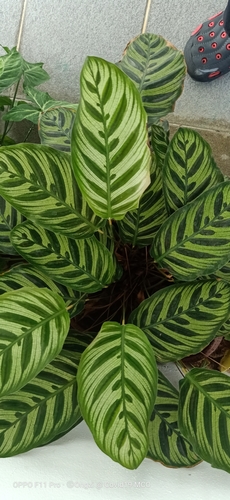
Peacock Plant (Goeppertia makoyana) grows under the canopy of tall trees in nature, so it prefers bright, indirect light. The beautiful patterned leaves, with dark green feathering over silver-green and purplish undersides, are best shown in filtered light. Direct sun, especially afternoon sun through glass, bleaches the leaves, scorches them into brown patches, and fades the pattern. Deep shade, however, makes the plant leggy and dulls its colour. Rotate the pot a quarter turn every week or two so all sides receive even light and the plant grows upright rather than leaning.
- Ideal: Bright, indirect light · 6-8 hours of bright, filtered light daily, with no direct midday sun
- Tolerates: Partial sun, Shade
- Best spot in a room: Near the window
- Artificial light: If natural light is weak, especially in winter, use a full-spectrum LED grow light about 30 to 45 cm above the foliage for 10 to 12 hours a day. Standard ceiling bulbs alone are usually not enough to maintain the leaf pattern.
Too little light
Its colourful leaves are adapted to filtered forest light, but they still need enough brightness to photosynthesise and keep their patterns. In dim corners the foliage loses its markings and the plant slowly exhausts its energy reserves.
Symptoms: Stretched, leggy growth with long gaps between leaves, leaves that turn a plain dark green and lose their patterning, slow growth, and older leaves dropping.
Solutions: Move the plant closer to a bright window, ideally an east or north-facing one, or add a full-spectrum LED grow light. Increase light gradually over two weeks to avoid shock, and avoid moving it into direct sun all at once.
Too much sun
Peacock Plant has thin, delicate leaves with little protection from strong sun, so intense direct light quickly damages the tissue. Its natural habitat is shaded, which means it lacks the adaptations that let sun-loving plants tolerate bright, direct rays.
Symptoms: Pale, bleached patches on the leaves, crispy brown scorch marks, curling or rolled leaves, and the pattern fading into washed-out tones.
Solutions: Move the plant a metre or more away from the window, or behind a sheer curtain, and use a bright shade screen during midday. Trim badly scorched leaves at the base with clean scissors. New growth will show the correct colours once it adapts to the lighter, filtered conditions.
Temperature
Peacock Plant (Goeppertia makoyana) is a tropical understory plant from Brazil that grows best in warm, steady, humid conditions. Keep it away from cold drafts, heating vents and hot windows, and aim for a room that stays between 18 and 24°C through the year.
- Ideal: 18–24 °C
- Tolerates: 12–32 °C
- Hardiness zones: 10-12
Fertilizing
Peacock Plant is a light feeder. It is grown for its patterned leaves, which need steady nitrogen and micronutrients, but too much fertilizer burns its thin roots and causes salt build-up. Feed only while it is actively growing, and always water the soil before applying fertilizer.
- Slow-release fertilizer: Once a year in early spring, if you prefer slow-release granules instead of liquid feed. Skip it if you are already feeding with liquid fertilizer during the growing season.
- Balanced liquid houseplant fertilizer (e.g. 10-10-10 or 20-20-20), Liquid fertilizer for foliage plants with trace elements, Slow-release balanced houseplant granules
Soil
Goeppertia makoyana (Peacock Plant) grows in the understory of tropical forests, where soil is rich, loose, and never waterlogged. A well-aerated mix that stays evenly moist is the key to healthy, colourful leaves.
- Peat-free houseplant mix with perlite: About 60% peat-free compost, 25% perlite, and 15% coconut coir or fine bark
- Aroid-style mix: Equal parts peat-free compost, orchid bark, and perlite
- pH 5.5–6.5
Repotting
Goeppertia makoyana (Peacock Plant) has shallow, fleshy roots and dislikes disturbance, so repot gently and only when needed.
- How often: every 1-2 years, when roots fill the pot
- New pot: Move up only 2-5 cm in diameter at a time; a pot that is too large holds wet soil and invites root rot.
- Repotting season: Spring, Summer
How to repot
- Tip the pot on its side and gently ease the root ball out, tapping the sides if it sticks
- Loosen the outer roots with your fingers and trim any brown, mushy ones with clean scissors
- Place a 2-3 cm layer of fresh mix in the new pot and set the plant so the top of the root ball sits about 2 cm below the rim
- Fill around the roots with mix, firm it lightly with your fingertips, and leave a small gap at the top for watering
- Water thoroughly until it drains out the bottom, then set the pot in bright, indirect light
Pruning
Prune with clean, sharp tools and trim only what is needed. Peacock plants rarely need heavy cutting; most of the care is removing individual leaves and keeping the plant's size manageable.
Pruning season: Spring, Summer
How to prune
- Inspect the plant and identify leaves that are yellow, crispy at the edges, or badly marked, along with any leggy or overcrowded stems.
- Cut each unwanted leaf stalk off at its base, close to the soil line, rather than leaving a short stub that can rot.
- Trim stems that have become too tall or sparse by cutting just above a leaf node, which encourages new side shoots.
- Remove any dead plant material from the pot surface, then wipe the cutting tools with rubbing alcohol before using them on another plant.
Propagation
Division at repotting · Spring
- In spring, when the plant is outgrowing its pot, slide the Goeppertia makoyana out of its container and check the root ball for natural clumps.
- Gently pull or cut the rhizome-like root mass into two or three sections, making sure each piece has several leaf shoots and healthy roots.
- Pot each division into a container only slightly larger than its root ball, using a light, peat-based mix with added perlite.
- Water lightly, then keep the pots warm and humid, around 20 to 24 °C, away from direct sun while they settle in.
Stem cutting in water · Spring, Summer
- Choose a healthy stem with at least two or three leaves and cut just below a leaf node using clean, sharp scissors.
- Remove the lowest leaves so that one or two nodes sit below the waterline, and place the cutting in a glass of room-temperature water.
- Set the glass in bright, indirect light and keep it at about 21 to 24 °C, changing the water every few days to prevent rot.
- When roots are a few centimetres long, usually within several weeks, transfer the cutting to moist potting mix and keep it humid until new growth appears.
Peacock plant cuttings root more slowly than many houseplants, so be patient. Keep the leaves misted or covered with a loose plastic bag to hold humidity, but remove the cover for an hour a day to prevent mold.
About Peacock Plant
Also known as: Peacock plant, Cathedral plant, Rattlesnake plant
- Plant type: herb, rhizomatous perennial
- Lifespan: perennial
- Distribution: Native to the Atlantic Forest of southeastern Brazil.
- Mature height: 30-60 cm indoors
- Bloom time: Rarely blooms indoors
Pets · People
Pets: Safe · People: Safe. Non-toxic to cats, dogs and children according to the ASPCA; the plant is not known to cause poisoning, though eating large amounts of any plant may cause mild stomach upset.
Common problems
- Brown leaf edges: Caused by low humidity or tap water salts and fluoride; switch to filtered water and raise humidity.
- Scorched leaves: Direct sun bleaches and burns the patterned foliage; move to bright indirect light.
- Root rot: Waterlogged soil from overwatering leads to yellowing and mushy roots; let the soil dry more between waterings.
- Spider mites: Fine webbing and stippled leaves appear in dry air; wipe leaves and increase humidity.
- Faded pattern: Too little light makes the leaf markings dull; increase bright indirect light.
Uses
Grown worldwide as an ornamental houseplant and in interior landscaping for its decorative foliage; it is valued in offices and shaded indoor spaces.
Is it edible?
not edible
History & legends
Introduced to European horticulture in the 19th century through Brazilian plant collectors and nurseries, where it became a fashionable greenhouse plant. Its common name refers to the feathered leaf pattern resembling a peacock's tail.
Did you know?
The leaves move daily in a process called nyctinasty: they rise up at dusk and lower again at dawn, which is why the family is called prayer plants.
Frequently asked questions
How often should I water Peacock Plant?
every 7 days. Peacock Plant (Goeppertia makoyana) likes evenly moist soil that never dries out completely, yet it hates sitting in water. Its fine, fleshy roots rot quickly in soggy mix. Use a well-draining, peat-based potting mix with some perlite or orchid bark, and a pot with drainage holes. Water when the top layer feels slightly dry, and empty any saucer within 30 minutes. Soft, low-mineral water such as rainwater or filtered water suits it best, because tap water high in salts can cause brown leaf edges. Humidity above 50 percent also reduces how often it needs water. Push a finger about 2 cm (roughly an inch) into the soil. If it feels barely damp and crumbly, wait a day or two. If it feels cool and clammy, or the pot feels heavy when you lift it, hold off watering. If the soil is dry and pulls away from the pot edge, and the leaves look limp, water now. Lifting the pot is a good habit: a dry pot feels noticeably lighter.
How much light does Peacock Plant need?
Bright, indirect light (6-8 hours of bright, filtered light daily, with no direct midday sun). Peacock Plant (Goeppertia makoyana) grows under the canopy of tall trees in nature, so it prefers bright, indirect light. The beautiful patterned leaves, with dark green feathering over silver-green and purplish undersides, are best shown in filtered light. Direct sun, especially afternoon sun through glass, bleaches the leaves, scorches them into brown patches, and fades the pattern. Deep shade, however, makes the plant leggy and dulls its colour. Rotate the pot a quarter turn every week or two so all sides receive even light and the plant grows upright rather than leaning.
What temperature does Peacock Plant like?
18–24 °C. Peacock Plant (Goeppertia makoyana) is a tropical understory plant from Brazil that grows best in warm, steady, humid conditions. Keep it away from cold drafts, heating vents and hot windows, and aim for a room that stays between 18 and 24°C through the year.
Is Peacock Plant toxic to cats and dogs?
It is safe for cats and dogs. Non-toxic to cats, dogs and children according to the ASPCA; the plant is not known to cause poisoning, though eating large amounts of any plant may cause mild stomach upset.
What are the most common problems of Peacock Plant?
Brown leaf edges: Caused by low humidity or tap water salts and fluoride; switch to filtered water and raise humidity. Scorched leaves: Direct sun bleaches and burns the patterned foliage; move to bright indirect light. Root rot: Waterlogged soil from overwatering leads to yellowing and mushy roots; let the soil dry more between waterings. Spider mites: Fine webbing and stippled leaves appear in dry air; wipe leaves and increase humidity. Faded pattern: Too little light makes the leaf markings dull; increase bright indirect light.
When should I repot Peacock Plant?
every 1-2 years, when roots fill the pot. Goeppertia makoyana (Peacock Plant) has shallow, fleshy roots and dislikes disturbance, so repot gently and only when needed.
How do I propagate Peacock Plant?
Division at repotting, Stem cutting in water. In spring, when the plant is outgrowing its pot, slide the Goeppertia makoyana out of its container and check the root ball for natural clumps. Gently pull or cut the rhizome-like root mass into two or three sections, making sure each piece has several leaf shoots and healthy roots. Pot each division into a container only slightly larger than its root ball, using a light, peat-based mix with added perlite. Water lightly, then keep the pots warm and humid, around 20 to 24 °C, away from direct sun while they settle in.
How this guide was written
Verdiss writes each guide with AI from botanical references and checks the species against iNaturalist and Plants of the World Online (Kew). Readers can rate every guide in the app.
Sources
Verdiss's information is for general guidance. Never eat or use a plant as medicine based on an app: ask a professional.