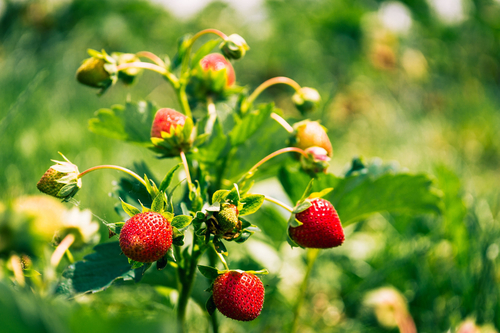
How to care for garden strawberry
Watering
Garden strawberry (Fragaria × ananassa) has shallow roots and large, thin-skinned leaves that lose water fast, so it needs steady moisture rather than occasional deep soaks. Keep the soil evenly damp, never soggy. Water at the base of the plant in the morning so leaves dry before evening, and increase frequency when fruit is forming in late spring and early summer, since the berries are mostly water and swell quickly. Reduce watering slightly in winter when growth stops.
Does it need water today?
Push a finger 2 cm into the soil next to the plant. If it feels dry, water now. If it feels cool and damp, wait a day. For containers, lift the pot: a light pot means it is thirsty. Wilting leaves in the afternoon that recover by morning are a sign of dry soil, while leaves that stay limp in the morning point to a root problem.
Mulch around the plants with straw or pine needles to keep the shallow roots cool and the soil moist between waterings. Keep the crown, the thick central point where leaves meet roots, above soil level, since buried crowns rot.
Overwatering
Garden strawberry roots need oxygen as well as water, and their shallow root system sits close to the surface where waterlogging is most damaging. Soggy soil quickly leads to root rot, especially in heavy clay or pots without drainage holes.
Symptoms: Yellowing older leaves, a limp plant despite wet soil, a sour smell from the soil, dark mushy crowns, and fruit that rots on the plant before ripening.
Solutions: Stop watering and let the top few centimetres dry out. Improve drainage by raking in compost or grit, or move containers to a sheltered spot. Remove rotting fruit and dead leaves, and cut back on watering until the plant recovers.
Underwatering
Strawberry plants have shallow roots and many leaves that transpire heavily, so they dry out faster than most garden plants. Lack of water during flowering and fruiting causes small, misshapen berries and weakens the plant for the next season.
Symptoms: Leaves that wilt in the afternoon and curl or turn crisp at the edges, small hard berries, fruit that drops early, and dry, pale soil pulling away from the pot edges.
Solutions: Water deeply and slowly until the soil is evenly moist to a depth of 10 cm. Mulch to slow evaporation, and water more often during hot weather and fruiting. Containers may need watering daily in summer heat.
Sunlight
Garden strawberry (Fragaria × ananassa) produces the most fruit in full sun. Plants grown in too much shade set few flowers, and the berries are smaller, paler, and less sweet. Partial sun, with at least 4 to 6 hours of direct light, still gives a reasonable harvest, especially in hot climates where a little afternoon shade protects the leaves.
- Ideal: Full sun · 6-8 hours of direct sun per day
- Tolerates: Full sun, Partial sun
- Best spot in a room: At the window
- Artificial light: Indoors, a south-facing window is best. If daylight is weak in winter, use a full-spectrum LED grow light set about 15 to 30 cm above the plants for 12 to 14 hours a day. Rotate pots every few days so all sides grow evenly.
Too little light
Strawberry plants need strong light to make the sugars that fill their berries. Weak light makes the plant stretch toward the source and produces fewer flowers, so the harvest drops sharply.
Symptoms: Long, pale, floppy stems leaning toward the light, small leaves spaced far apart, few or no flowers, and berries that stay pale and sour.
Solutions: Move the plant to the sunniest spot available, or add a grow light for 12 to 14 hours a day. Remove any leaves that are dying in the shade so the plant puts its energy into new growth.
Too much sun
In hot, dry weather and in very intense sun, the thin leaves of garden strawberry can overheat and scorch. Plants moved suddenly from shade to full midday sun are most at risk.
Symptoms: Brown, crispy patches on leaf edges or between veins, bleached or pale leaves, and berries that sunburn with white or tan spots and dry out.
Solutions: Provide light afternoon shade with a shade cloth when temperatures rise above about 30°C. Move plants gradually into stronger light over a week, and keep the soil moist so the plant can cool itself through its leaves.
Temperature
Garden strawberry grows best in mild days of 15 to 25 °C with cool nights. Dormant plants tolerate hard frost down to about -30 °C when they are mulched, but flowers and young fruit are damaged by a light frost of about -2 °C. Above about 30 °C the plants slow down, stop setting fruit, and need shade and water.
- Ideal: 15–25 °C
- Tolerates: -30–35 °C
- Hardiness zones: 5-9
Fertilizing
Garden strawberry is a heavy feeder for its size because it fruits for several weeks from a small root zone. It needs steady potassium for good berry size and sweetness, and moderate nitrogen. Too much nitrogen gives lush leaves and few berries.
- Slow-release fertilizer: Apply once a year in early spring, just as new leaves start to grow, when the plant is not yet flowering.
- Balanced slow-release granular fertilizer such as 10-10-10 or a general-purpose 5-5-5 blend, Compost or well-rotted manure, Liquid tomato or berry fertilizer with a moderate nitrogen content, Seaweed extract as a mild supplement
Soil
Garden strawberries grow best in fertile, well-drained soil with plenty of organic matter. Their shallow roots need air as well as moisture, so heavy clay that stays wet around the crown invites rot and poor fruit. Aim for a slightly acidic to neutral soil in the pH range shown above.
- Loamy garden soil amended with compost: About 60 percent good topsoil, 30 percent well-rotted compost, and 10 percent coarse sand or perlite
- Raised bed mix: Equal parts topsoil and compost with a little aged manure, topped with a mulch layer
- Container potting mix: Peat-free or peat-based potting mix with roughly 20 percent perlite or pumice added
- pH 5.5–6.8
Repotting
Garden strawberry plants have shallow, fibrous roots and a crown that must sit at soil level. Burying the crown causes rot, and a pot that is too large holds wet soil that the roots cannot use. Use a container with drainage holes and a wide mouth.
- How often: Every 1-2 years, or when plants are root-bound or the crown is crowded
- New pot: Move up only 2-5 cm in diameter at a time; a 20-25 cm pot suits 2-3 plants in a container, and a 30 cm pot can hold 3-4 plants of a runner-free everbearing variety
- Repotting season: Spring, Autumn
How to repot
- Tip the pot on its side and gently ease the plant out, supporting the crown with your hand.
- Loosen the outer roots with your fingers. Trim away any brown, mushy, or hollow roots with clean shears.
- Remove old, dead, or yellowing leaves and any runners you do not want to keep.
- Place a layer of fresh soil in the new pot so the crown will sit just at the soil surface, with the heart of the plant above the soil line.
- Set the plant in, spread the roots outward, and fill around them with soil, firming gently with your hands.
- Check that the crown is level with the soil surface, not buried and not perched above it.
- Water slowly until it runs out the drainage holes, then keep the plant in partial shade for about a week.
Pruning
Garden strawberry produces fruit on short stems from the crown, and the crown must stay alive to keep fruiting. Prune to remove foliage and runners, never the crown itself. Use clean, sharp tools and disinfect them between plants to avoid spreading disease.
Pruning season: Winter, Spring, Summer, Autumn
How to prune
- In late winter or early spring, before new growth begins, remove all dead, brown, or ragged leaves by cutting each stalk at its base close to the crown.
- After harvest in summer, cut back old, tired leaves to about 5 cm above the crown, leaving the youngest inner leaves intact. This refreshes the plant for next season.
- Remove runners as they appear unless you want new plants. Snip each runner close to the parent plant, or cut it just beyond the first daughter plant if you are propagating.
- Pull off any blossoms that appear in the first year of planting so the plant puts energy into root and crown development.
- Remove fruit that is rotten, moldy, or shriveled promptly, so disease does not spread to healthy berries.
- In late autumn, once the plant is dormant, remove the remaining damaged leaves and mulch lightly with straw to protect the crown from frost.
Propagation
Runners (stolon layering) · Summer, Autumn
- Choose a healthy, vigorous mother plant at least one year old that produces many runners.
- In mid to late summer, watch for long runners with a small plantlet (daughter plant) at each node.
- Fill a small pot (about 9 cm) with moist potting mix and set it beside the mother plant.
- Pin the plantlet's crown gently into the soil with a bent wire hairpin, leaving the runner attached.
- Keep the soil evenly moist for two to three weeks until new roots form.
- Once the daughter plant has a healthy root system and new leaves, cut the runner about 5 cm from the plantlet and move it to its final spot.
Bare-root crown division · Spring, Autumn
- Lift an established plant in early spring or early autumn, when it is not flowering or fruiting heavily.
- Gently shake off soil and examine the crown, the thick central stem at soil level.
- Split the crown into sections with a clean, sharp knife, making sure each piece has several healthy roots and at least two or three leaves.
- Replant each section so the crown sits level with the soil surface, not buried.
- Water well and keep moist for the first few weeks.
Seed sowing · Winter, Spring
- Sow seeds indoors in late winter, about 8 to 10 weeks before the last frost, since garden strawberry seed is slow and often does not come true from hybrid parents.
- Press the tiny seeds onto the surface of moist seed compost without covering them, because they need light to germinate.
- Keep the tray at about 20 to 22 °C and mist regularly.
- Germination takes two to four weeks; expect variable plants that may differ in flavor and fruit size from the parent.
Runner plantlets root most reliably when you leave them attached to the mother plant until they are established. Replace your strawberry bed every three to four years with new runner plants, since older plants lose vigor and fruit quality.
About garden strawberry
Also known as: Garden strawberry, Pineapple strawberry, Cultivated strawberry, Strawberry
- Plant type: herb, perennial groundcover
- Lifespan: perennial, though usually grown as an annual or short-lived perennial for best yields
- Distribution: A hybrid of cultivated origin with no true wild native range; its parents are native to North and South America.
- Mature height: 10-25 cm
- Bloom time: Spring to early summer
Pets · People
Pets: Safe · People: Safe. Non-toxic to cats, dogs and children according to ASPCA; the fruit is safe to eat, though some pets may react to high sugar or to the fruit's seeds in large amounts.
Common problems
- Gray mold (Botrytis cinerea): Fuzzy gray rot on fruit and flowers, worst in wet, humid, crowded conditions; remove affected fruit and improve airflow.
- Powdery mildew: White powdery coating on leaves and fruit in warm, dry-humid weather; choose resistant cultivars and avoid overhead watering.
- Vine weevil larvae: Root-feeding grubs that cause sudden wilting in pots; check roots and use nematodes or repot.
- Slugs and snails: Chew fruit and young leaves, especially in damp mulch; use traps or barriers.
- Strawberry crown rot: Rot at the crown causing plant collapse, often from waterlogged soil; plant high and drain well.
Uses
Grown mainly for fresh eating, jams, desserts, juices and frozen fruit; ornamental cultivars are used in borders, hanging baskets and as groundcover. Commercially it is one of the most valuable soft-fruit crops globally.
Is it edible?
The red fruit is edible raw or cooked; the leaves can be brewed into a mild tea, and the fruit is eaten fresh, dried, preserved or frozen.
History & legends
Wild strawberries were eaten since antiquity and were admired in medieval Europe, where they appeared in art as symbols of perfection. The modern garden strawberry was created in France in the 1750s by crossing the large Chilean species with the North American Virginia strawberry, a cross that followed the arrival of Chilean plants in Europe.
Did you know?
The strawberry's 'seeds' are actually achenes, individual dry fruits, each containing one true seed, and a single berry can carry about 200 of them.
Frequently asked questions
How often should I water garden strawberry?
every 3 days. Garden strawberry (Fragaria × ananassa) has shallow roots and large, thin-skinned leaves that lose water fast, so it needs steady moisture rather than occasional deep soaks. Keep the soil evenly damp, never soggy. Water at the base of the plant in the morning so leaves dry before evening, and increase frequency when fruit is forming in late spring and early summer, since the berries are mostly water and swell quickly. Reduce watering slightly in winter when growth stops. Push a finger 2 cm into the soil next to the plant. If it feels dry, water now. If it feels cool and damp, wait a day. For containers, lift the pot: a light pot means it is thirsty. Wilting leaves in the afternoon that recover by morning are a sign of dry soil, while leaves that stay limp in the morning point to a root problem.
How much light does garden strawberry need?
Full sun (6-8 hours of direct sun per day). Garden strawberry (Fragaria × ananassa) produces the most fruit in full sun. Plants grown in too much shade set few flowers, and the berries are smaller, paler, and less sweet. Partial sun, with at least 4 to 6 hours of direct light, still gives a reasonable harvest, especially in hot climates where a little afternoon shade protects the leaves.
What temperature does garden strawberry like?
15–25 °C. Garden strawberry grows best in mild days of 15 to 25 °C with cool nights. Dormant plants tolerate hard frost down to about -30 °C when they are mulched, but flowers and young fruit are damaged by a light frost of about -2 °C. Above about 30 °C the plants slow down, stop setting fruit, and need shade and water.
Is garden strawberry toxic to cats and dogs?
It is safe for cats and dogs. Non-toxic to cats, dogs and children according to ASPCA; the fruit is safe to eat, though some pets may react to high sugar or to the fruit's seeds in large amounts.
What are the most common problems of garden strawberry?
Gray mold (Botrytis cinerea): Fuzzy gray rot on fruit and flowers, worst in wet, humid, crowded conditions; remove affected fruit and improve airflow. Powdery mildew: White powdery coating on leaves and fruit in warm, dry-humid weather; choose resistant cultivars and avoid overhead watering. Vine weevil larvae: Root-feeding grubs that cause sudden wilting in pots; check roots and use nematodes or repot. Slugs and snails: Chew fruit and young leaves, especially in damp mulch; use traps or barriers. Strawberry crown rot: Rot at the crown causing plant collapse, often from waterlogged soil; plant high and drain well.
When should I repot garden strawberry?
Every 1-2 years, or when plants are root-bound or the crown is crowded. Garden strawberry plants have shallow, fibrous roots and a crown that must sit at soil level. Burying the crown causes rot, and a pot that is too large holds wet soil that the roots cannot use. Use a container with drainage holes and a wide mouth.
How do I propagate garden strawberry?
Runners (stolon layering), Bare-root crown division, Seed sowing. Choose a healthy, vigorous mother plant at least one year old that produces many runners. In mid to late summer, watch for long runners with a small plantlet (daughter plant) at each node. Fill a small pot (about 9 cm) with moist potting mix and set it beside the mother plant. Pin the plantlet's crown gently into the soil with a bent wire hairpin, leaving the runner attached. Keep the soil evenly moist for two to three weeks until new roots form. Once the daughter plant has a healthy root system and new leaves, cut the runner about 5 cm from the plantlet and move it to its final spot.
How this guide was written
Verdiss writes each guide with AI from botanical references and checks the species against iNaturalist and Plants of the World Online (Kew). Readers can rate every guide in the app.
Sources
Verdiss's information is for general guidance. Never eat or use a plant as medicine based on an app: ask a professional.