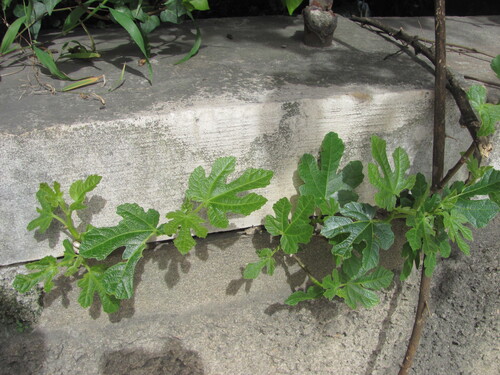
How to care for common fig
Watering
Common fig (Ficus carica) likes deep, infrequent drinks followed by a real drying-out period. Its fleshy roots rot quickly in soggy soil, but a potted fig in full growth in summer can dry out fast and needs steady moisture to ripen its fruit. Use a pot with drainage holes and a fast-draining mix of potting soil, perlite, and some grit. Water thoroughly until it runs out the bottom, then empty the saucer. In winter, when the plant is dormant or leafless, water only very lightly.
Does it need water today?
Push a finger 3-5 cm into the soil. If it feels dry at that depth, water now. If it is still damp, wait. You can also lift the pot: a dry fig pot feels noticeably light compared with one that was just watered. Dropping leaves in summer usually means the soil has dried out too far.
Water in the morning so the leaves dry before evening. Fig trees rarely need more than a thorough soak every one to two weeks in summer, so it is better to water deeply and wait than to add small splashes every day.
Overwatering
Common fig roots need oxygen, and they suffocate and rot in waterlogged soil. Because the plant stores little water in its leaves and stems, prolonged wet conditions quickly lead to root damage and loss of leaves.
Symptoms: Yellowing leaves that drop while the soil is still wet, soft or blackened trunk at the soil line, a sour smell from the soil, and fungus gnats hovering around the pot.
Solutions: Stop watering and let the soil dry out. Check the roots: cut away any brown, mushy ones with clean scissors, repot into fresh, fast-draining mix in a pot with drainage holes, and water only when the top layer is dry.
Underwatering
Figs grow large leaves that lose a lot of water through transpiration, especially in summer heat or in pots with limited soil. Long dry spells stop fruit from swelling and make the tree drop leaves to conserve water.
Symptoms: Crispy brown leaf edges, wilting leaves that look limp in the afternoon, dry and shrinking figs that drop early, and soil pulling away from the pot sides.
Solutions: Give a deep, thorough soak until water runs freely from the drainage holes. If the root ball is very dry, soak the whole pot in a tub of water for 30 minutes. Then water more regularly during fruiting and hot weather, and mulch the soil surface to reduce evaporation.
Sunlight
Common fig (Ficus carica) is a sun-loving tree that grows its best leaves and sweetest fruit when it gets strong, direct sun for most of the day. Fruit ripening, especially in cooler climates, depends on sun and heat, so a shaded fig tends to produce few or small figs. It can tolerate some afternoon shade in hot climates, but deep shade will weaken it.
- Ideal: Full sun · 6-8 hours of direct sun per day
- Tolerates: Full sun, Partial sun, Bright, indirect light
- Best spot in a room: At the window
- Artificial light: Indoors, a fig needs a very bright south- or west-facing window or a full-spectrum LED grow light set about 30 cm above the canopy for 12-14 hours a day. Rotate the pot every week so all sides get light and the tree grows straight instead of leaning toward the window.
Too little light
Figs rely on strong sunlight to make the sugars that feed fruit and new growth. Too little light makes the tree stretch weakly toward any light source and drop its figs before they ripen.
Symptoms: Long, pale, weak stems with large gaps between leaves, small leaves, leaves that yellow and fall, and figs that stop growing or drop before ripening.
Solutions: Move the pot to the sunniest spot available, such as a south-facing window or a sunny patio. Add a full-spectrum LED grow light if daylight is limited, and prune any weak, leggy shoots in late winter to encourage bushier growth.
Too much sun
Common fig tolerates full sun well in most climates, but in very hot, dry conditions or when a plant is moved suddenly from shade to strong sun, its leaves can burn. Pots also heat up quickly, which stresses the roots.
Symptoms: Bleached, papery patches on leaves facing the sun, brown scorched edges, wilting in the afternoon even when the soil is moist, and figs that shrivel or crack.
Solutions: Move the plant to a spot with bright light and some afternoon shade, especially during heatwaves. When moving it into full sun, acclimatize it over 1-2 weeks. Keep the pot well watered and shade the pot itself with a light cover or by grouping it with other plants.
Temperature
Common fig thrives in warm, sunny conditions and benefits from a Mediterranean-style summer. Mature trees of hardy cultivars can survive winter lows near -12°C when dormant, but young plants and fruit crops need protection. Keep the root zone from freezing in containers.
- Ideal: 15–30 °C
- Tolerates: -12–40 °C
- Hardiness zones: 7-10
Fertilizing
Common fig needs moderate feeding. Too much nitrogen produces large leaves and few figs, so favor potassium and keep nitrogen modest. Stop feeding by late summer so new growth can harden off before winter.
- Slow-release fertilizer: Once a year in early spring, just as buds begin to swell. Not needed for figs in rich garden soil with healthy growth.
- Balanced liquid fertilizer such as 10-10-10 for young trees, Low-nitrogen fruit or tomato fertilizer with higher potassium for mature trees bearing figs, Well-rotted compost or aged manure as a slow organic option, Slow-release granular fertilizer formulated for fruit trees
Soil
Common figs need soil that drains freely yet holds enough moisture between waterings. Heavy clay that stays wet causes root rot, while pure sand dries out too quickly and starves the tree. Aim for a slightly acidic to neutral pH, roughly 6.0 to 7.5.
- Loam-based potting mix with added grit: About 60 percent loam-based potting mix, 25 percent perlite or pumice, and 15 percent coarse bark or compost.
- Garden loam for in-ground planting: Well-drained loam with some sand or gravel added to improve drainage, and organic matter such as aged compost worked into the top 30 cm.
- Cactus or succulent mix blended with compost: One part commercial cactus mix to one part compost, lightened with extra perlite. This suits drought-tolerant fig varieties in very hot climates.
- pH 6–7.5
Repotting
Use a pot with drainage holes, a sharp draining mix, and root-pruning tools. Repot in spring just as the tree breaks dormancy and new leaf buds begin to swell, not when it is fully leafed out or in fruit.
- How often: Every 2-3 years for container-grown common figs; young plants may need repotting yearly while they establish.
- New pot: Move up only one pot size (about 5 cm wider in diameter) at each repotting. Figs have a fairly vigorous root system but become stressed and slow to fruit in oversized pots full of wet soil.
- Repotting season: Spring
How to repot
- Lay the pot on its side and gently tap the sides until the root ball slides out. Avoid pulling on the trunk.
- Tease away the outer layer of compacted or circling roots with your fingers. Trim any black, mushy, or dead roots with clean shears.
- Shave about 2 to 3 cm off the outer edge of the root ball and remove a few old soil layers, leaving the healthy inner roots intact.
- Add a 3 to 5 cm layer of fresh mix to the bottom of the new pot so the crown will sit at the same level it was before.
- Center the fig in the pot, fill the gaps around the root ball with fresh mix, and firm it gently with your hands.
- Water thoroughly until water runs out of the drainage holes, then allow excess to drain completely.
- Keep the tree in bright indirect light and avoid fertilizing for four to six weeks while the roots recover.
Pruning
Fig fruits form mainly on the previous season's wood and on new shoots of the current year, depending on the cultivar. Prune mostly in late winter while the plant is dormant, and do light summer shaping only. Avoid heavy pruning in autumn, which can stimulate tender growth that is damaged by frost.
Pruning season: Winter, Summer
How to prune
- In late winter, when the common fig is leafless and dormant, remove all dead, diseased, or damaged wood first, cutting back to healthy tissue.
- Cut out any branches that cross or rub against each other, and thin out crowded inner growth so light reaches the center of the plant.
- Shorten long, vigorous shoots by about one-third to keep the plant compact, cutting just above an outward-facing bud.
- Remove suckers from the base of the trunk as they appear, cutting them flush with the base.
- In mid to late summer, pinch back very long green shoots to encourage fruiting on the remaining growth. Do not prune heavily in late summer or autumn.
- Dispose of any diseased prunings in the trash or by burning where allowed, rather than composting them.
Propagation
Hardwood cuttings · Winter
- In late winter, while the common fig is dormant, cut 20 to 30 cm lengths of pencil-thick, one-year-old wood from a healthy, disease-free plant.
- Make a clean angled cut at the bottom just below a node and a straight cut at the top above a bud.
- Remove leaves, then push the cuttings about two-thirds of their length into moist sand, perlite, or a pot of gritty compost in a sheltered spot.
- Keep the medium barely moist and at about 15 to 20 °C; roots usually form within several weeks to a few months.
- Pot up the rooted cutting in spring once new leaves appear, and move it outdoors after the last frost.
Softwood cuttings · Summer
- In early to mid summer, take 10 to 15 cm tip cuttings of current-season green growth that has begun to firm up at the base.
- Strip the lower leaves and, if the leaves are large, cut each remaining leaf in half to reduce water loss.
- Dip the cut end in rooting hormone if you have it, then insert it into a bright, humid propagator with a free-draining mix.
- Keep the temperature around 20 to 25 °C and mist lightly; avoid direct hot sun.
- Expect roots in about four to six weeks. Harden the young plant off gradually before planting it out.
Air layering · Spring, Summer
- Choose a healthy branch about pencil-thick that grows near the ground or can be bent toward a pot.
- Make a 2 to 3 cm upward-angled cut or remove a thin ring of bark on the branch, then dust the wound with rooting hormone.
- Wrap damp sphagnum moss around the wound and cover it with plastic, tying both ends to keep moisture in.
- Keep the moss damp; roots typically appear within six to eight weeks.
- Once roots are visible through the moss, cut the branch just below the rooted section and pot it up.
Ground layering · Spring, Autumn
- Bend a low, flexible branch down to the soil in spring or early autumn.
- Bury the middle section in a shallow trench about 10 cm deep, leaving the tip above the soil.
- Anchor the buried part with a peg or stone and water it regularly.
- After one growing season, check for roots. When the new plant is well rooted, sever it from the parent and transplant it.
Fig cuttings root readily, so water is the main risk; keep the medium damp but never soggy, because wet, cold conditions cause rot. Label each cutting with its cultivar name and date.
About common fig
Also known as: Common fig, Edible fig, Fig tree
- Plant type: tree, shrub
- Lifespan: perennial
- Distribution: Native to the eastern Mediterranean, Western Asia and the southern Caucasus, from Turkey and the Levant eastward.
- Mature height: 3 to 10 m
- Bloom time: Flowers develop inside the fruit in late spring to summer
Pets · People
Pets: Toxic · People: Toxic. Per ASPCA, the milky latex in stems, leaves and unripe fruit contains ficin and psoralens that irritate skin and mouth and can cause vomiting and diarrhea in pets and children. Ripe figs are generally safe to eat, but handling the sap can cause dermatitis, especially with sun exposure.
Common problems
- Fig rust: Orange pustules on the undersides of leaves that cause early leaf drop; remove affected leaves and improve airflow.
- Souring of fruit: Ripe figs ferment and drop after heavy rain or humidity; harvest promptly and avoid overwatering near fruiting.
- Root-knot nematodes: Galls on roots that stunt growth; use resistant rootstock or solarize the soil before planting.
- Fig mosaic virus: Mottled, distorted leaves spread by mites; remove and destroy infected plants and buy certified stock.
- Splitting fruit: Figs crack after drought followed by heavy watering; keep watering consistent during fruit development.
Uses
Cultivated primarily for its edible fruit, fresh or dried, and used in jams, breads and confections. The fig is also prized as an ornamental tree for its bold foliage and as a shade tree in Mediterranean gardens. Historically its dried fruit served as an important energy source and trade commodity across the ancient Mediterranean world.
Is it edible?
The ripe fruit (syconium) is edible raw or dried; the leaves are not eaten, and unripe fruit and sap should be avoided because of latex irritation.
History & legends
Fig cultivation dates back more than 11,000 years, with archaeological finds in the Jordan Valley suggesting early domestication. In ancient Greece figs were a common food and were associated with Dionysus, while in Egyptian and Biblical tradition the fig tree symbolized peace, prosperity and abundance.
Did you know?
Each fig is actually an inverted flower cluster, and the tiny flowers inside are pollinated only by a specific fig wasp, Blastophaga psenes, in the wild.
Frequently asked questions
How often should I water common fig?
every 7 days. Common fig (Ficus carica) likes deep, infrequent drinks followed by a real drying-out period. Its fleshy roots rot quickly in soggy soil, but a potted fig in full growth in summer can dry out fast and needs steady moisture to ripen its fruit. Use a pot with drainage holes and a fast-draining mix of potting soil, perlite, and some grit. Water thoroughly until it runs out the bottom, then empty the saucer. In winter, when the plant is dormant or leafless, water only very lightly. Push a finger 3-5 cm into the soil. If it feels dry at that depth, water now. If it is still damp, wait. You can also lift the pot: a dry fig pot feels noticeably light compared with one that was just watered. Dropping leaves in summer usually means the soil has dried out too far.
How much light does common fig need?
Full sun (6-8 hours of direct sun per day). Common fig (Ficus carica) is a sun-loving tree that grows its best leaves and sweetest fruit when it gets strong, direct sun for most of the day. Fruit ripening, especially in cooler climates, depends on sun and heat, so a shaded fig tends to produce few or small figs. It can tolerate some afternoon shade in hot climates, but deep shade will weaken it.
What temperature does common fig like?
15–30 °C. Common fig thrives in warm, sunny conditions and benefits from a Mediterranean-style summer. Mature trees of hardy cultivars can survive winter lows near -12°C when dormant, but young plants and fruit crops need protection. Keep the root zone from freezing in containers.
Is common fig toxic to cats and dogs?
It is toxic to cats and dogs: keep it out of their reach. Per ASPCA, the milky latex in stems, leaves and unripe fruit contains ficin and psoralens that irritate skin and mouth and can cause vomiting and diarrhea in pets and children. Ripe figs are generally safe to eat, but handling the sap can cause dermatitis, especially with sun exposure.
What are the most common problems of common fig?
Fig rust: Orange pustules on the undersides of leaves that cause early leaf drop; remove affected leaves and improve airflow. Souring of fruit: Ripe figs ferment and drop after heavy rain or humidity; harvest promptly and avoid overwatering near fruiting. Root-knot nematodes: Galls on roots that stunt growth; use resistant rootstock or solarize the soil before planting. Fig mosaic virus: Mottled, distorted leaves spread by mites; remove and destroy infected plants and buy certified stock. Splitting fruit: Figs crack after drought followed by heavy watering; keep watering consistent during fruit development.
When should I repot common fig?
Every 2-3 years for container-grown common figs; young plants may need repotting yearly while they establish.. Use a pot with drainage holes, a sharp draining mix, and root-pruning tools. Repot in spring just as the tree breaks dormancy and new leaf buds begin to swell, not when it is fully leafed out or in fruit.
How do I propagate common fig?
Hardwood cuttings, Softwood cuttings, Air layering, Ground layering. In late winter, while the common fig is dormant, cut 20 to 30 cm lengths of pencil-thick, one-year-old wood from a healthy, disease-free plant. Make a clean angled cut at the bottom just below a node and a straight cut at the top above a bud. Remove leaves, then push the cuttings about two-thirds of their length into moist sand, perlite, or a pot of gritty compost in a sheltered spot. Keep the medium barely moist and at about 15 to 20 °C; roots usually form within several weeks to a few months. Pot up the rooted cutting in spring once new leaves appear, and move it outdoors after the last frost.
How this guide was written
Verdiss writes each guide with AI from botanical references and checks the species against iNaturalist and Plants of the World Online (Kew). Readers can rate every guide in the app.
Sources
Verdiss's information is for general guidance. Never eat or use a plant as medicine based on an app: ask a professional.