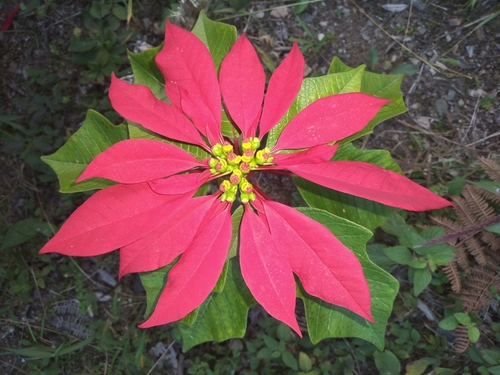
How to care for Poinsettia
Watering
Poinsettia (Euphorbia pulcherrima) prefers evenly moist soil that is allowed to dry out slightly between waterings. Its roots sit in the top layer of a pot, so water when the surface of the potting mix feels dry, then pour until water runs out of the drainage holes. Always empty the saucer after 15 minutes so the roots never sit in water. Use room-temperature water and a pot with drainage holes. Water less often in winter, when the plant grows slowly and uses less moisture.
Does it need water today?
Push your finger about 2 cm (1 inch) into the potting mix. If it feels dry, water now. If it still feels damp, wait a day or two. You can also lift the pot: a dry pot feels noticeably lighter than one that was just watered. Wilting leaves with dry soil mean the plant is thirsty, but do not wait for the leaves to droop, since repeated drying stresses the plant.
Poinsettias are sensitive to both extremes. Overwatering causes more deaths than forgetting to water, so when in doubt, wait one more day. Keep the plant away from cold draughts, which also dry the soil unevenly.
Overwatering
Poinsettia roots need oxygen, and the soil must dry slightly between waterings. Its fleshy stems and roots rot quickly in soggy mix, especially in the cool conditions it prefers, so too much water is the most common cause of decline.
Symptoms: Yellowing lower leaves that feel soft, a sour or musty smell from the soil, black or brown mushy stems at the soil line, and leaves dropping despite moist soil.
Solutions: Stop watering and let the top 5 cm (2 inches) of soil dry out. Empty the saucer and check that the pot drains freely. If roots are brown and mushy, remove the plant, cut away the rotten parts with clean scissors, and repot into fresh, well-draining mix in a pot one size larger at most.
Underwatering
Poinsettia has thin leaves and shallow roots, so the potting mix dries out quickly, especially near heaters and in warm, bright rooms. Repeated drying causes leaf loss and can shorten the colourful bract display.
Symptoms: Drooping leaves that feel limp, dry soil that pulls away from the pot edge, crispy leaf edges, and bracts that fall early.
Solutions: Water thoroughly using the bottom watering method for 20 to 30 minutes. Then water more often for a week, checking the soil daily. Move the plant away from heating vents. Leaves usually recover within a few days if the stems are still firm.
Sunlight
Poinsettia (Euphorbia pulcherrima) needs bright light to keep its leaves full and its coloured bracts (the red, pink, or white parts often mistaken for flowers) vivid. Direct midday sun can scorch the leaves, while deep shade causes weak, leggy growth and pale bracts. Keep the plant in the brightest spot that stays between 15 and 21 °C (60 to 70 °F), and rotate the pot a quarter turn each week so all sides grow evenly.
- Ideal: Bright, indirect light · 6 hours of bright, indirect light per day, with a few hours of direct morning sun if possible
- Tolerates: Bright, indirect light, Partial sun
- Best spot in a room: Near the window
- Artificial light: If natural light is weak, especially in winter, place the plant under a full-spectrum LED grow light about 30 cm (12 inches) above the top of the plant for 10 to 12 hours a day. Use a timer to keep the schedule consistent.
Too little light
Poinsettia is a short-day plant, meaning it needs long periods of uninterrupted darkness to colour its bracts. Insufficient light also weakens its stems, making the plant lean toward the window and drop leaves.
Symptoms: Leggy stems with long gaps between leaves, pale green leaves instead of deep green, bracts that stay green or fade, and leaves dropping from the lower stem.
Solutions: Move the plant to a brighter window, preferably one facing south or west in the Northern Hemisphere. Add an LED grow light as described above. Avoid placing the plant in a dark cupboard, which blocks the light it needs for colour.
Too much sun
Poinsettia leaves are thin and easily damaged by strong, direct sun, especially through glass, which can intensify heat and burn tissue. Overheating also dries the soil quickly and stresses the plant.
Symptoms: Pale, bleached, or brown scorched patches on the upper leaves, bracts that look faded or crispy at the edges, and leaves that curl or drop after a hot, sunny day.
Solutions: Move the plant a metre or so back from a south- or west-facing window, or place a sheer curtain between the glass and the plant. Keep it away from radiators and hot appliances. Once the scorched leaves are damaged, they will not recover, but new growth will be healthy in better light.
Temperature
Poinsettia (Euphorbia pulcherrima) is a tropical shrub that grows best in warm, steady indoor conditions. Keep it away from cold drafts, heating vents, and sudden temperature swings, which cause most of the leaf drop people see after buying one.
- Ideal: 15–21 °C
- Tolerates: 10–27 °C
- Hardiness zones: 10-11
Fertilizing
Poinsettia feeds lightly. Fertilize only while it is actively growing, from spring through summer, and pause in fall and winter when it rests and sets its colored bracts. Always water before feeding so the roots are not burned.
- Slow-release fertilizer: Once a year in early spring, if the plant is kept growing outdoors or for several seasons indoors. Not needed for a poinsettia treated as a single-season holiday plant.
- Balanced liquid houseplant fertilizer (such as 20-20-20), Slow-release granular fertilizer for container plants, Low-nitrogen fertilizer for flowering plants, used in spring
Soil
Poinsettia grows best in slightly acidic, loose, well-draining soil that stays evenly moist but never waterlogged. Its roots need air as much as water, so a dense or compacted mix will cause problems quickly.
- Peat-free potting mix with added perlite: About 60-70% peat-free compost or coco coir, 30-40% perlite or pumice. This holds moisture while still draining freely.
- Standard houseplant mix amended with bark: Two parts all-purpose potting mix to one part orchid bark or fine pine bark. Good for pots with larger root balls and quick drainage.
- Garden soil for outdoor planting: Loam or sandy loam improved with 20-30% compost. Plant only in frost-free climates, where poinsettias grow as shrubs, and avoid heavy clay.
- pH 5.5–6.5
Repotting
Poinsettia (Euphorbia pulcherrima) has fleshy, brittle roots that dislike disturbance and soggy soil. Use a well-draining mix and a pot with a hole in the base. Wear gloves or wash hands afterward, because the milky sap can irritate skin and eyes.
- How often: Every 1-2 years, or when roots fill the pot; poinsettias are usually sold in small pots and grow quickly in their first year.
- New pot: Move up only one size, about 2-5 cm wider in diameter, with drainage holes. Oversized pots hold wet soil around the roots and invite rot.
- Repotting season: Spring
How to repot
- Turn the pot on its side and gently ease the root ball out, supporting the stem at the base.
- Loosen any tightly wound roots with your fingers. Trim only dead or mushy roots with clean scissors.
- Place a 2-3 cm layer of fresh mix in the new pot, then set the plant so the root ball sits about 2 cm below the rim.
- Fill around the roots with mix, firm gently with your hands, and leave a small gap at the top for watering.
- Water thoroughly until it drains from the holes, then empty the saucer.
- Wash your hands and tools with soap after handling the sap.
Pruning
Prune Euphorbia pulcherrima in spring, after the colored bracts have faded and the risk of cold drafts has passed. Cut back the stems to about 10 to 15 cm above the soil, or to two or three nodes, leaving a few healthy leaves on each stem. Always wear gloves and wash your hands afterward, because the milky sap can irritate skin.
Pruning season: Spring, Summer
How to prune
- Remove dead, yellowing, or damaged leaves and stems first, cutting back to healthy tissue.
- Cut each main stem just above a leaf node, using a clean diagonal cut so water runs off.
- Remove any thin, crossing branches that rub together or grow toward the center of the plant.
- Pinch soft growth tips with your fingers once new shoots are about 10 cm long to encourage side branching.
- Stop pruning by midsummer so the plant has time to set buds for the next winter display.
- Rinse the cut stems or dab the cut ends with a little flour or cloth if sap keeps oozing, then water lightly.
Propagation
Stem tip cuttings · Spring, Summer
- Choose a healthy, non-flowering shoot about 8 to 10 cm long from a mature Euphorbia pulcherrima plant.
- Cut just below a leaf node with a clean, sharp knife or pruners.
- Let the cut end dry for a few minutes until the milky white sap stops flowing.
- Dip the cut end in rooting hormone powder if you have it.
- Insert the cutting into moist perlite or a 50/50 mix of perlite and peat, burying at least two nodes.
- Cover loosely with a clear plastic bag to hold humidity and keep it in bright, indirect light at about 21 to 24 °C.
- Keep the medium barely moist. Roots usually form in 3 to 5 weeks; then remove the bag and gradually acclimate the young plant.
Leaf bract and stem cuttings from cut stems · Spring
- Use stems that have been cut from a plant in late winter, since these are often the most vigorous.
- Trim the stem to about 10 cm and remove the lower leaves.
- Rinse the cut end under running water for a minute to wash away sap that blocks rooting.
- Allow the stem to callus for one to two days in a dry, shaded spot.
- Plant in a well-draining mix and keep warm and lightly moist until new growth appears.
Seed · Spring
- Collect seeds from a mature, dried seed capsule on the plant, which splits and releases three seeds.
- Sow the seeds on the surface of a light seed-starting mix and press them in lightly.
- Keep the soil evenly moist and the temperature around 21 °C.
- Germination is slow and uneven, so be patient and expect seedlings to take several weeks to appear.
- Seedlings grown this way may not match the parent plant's flower color.
Poinsettias are easiest to propagate from stem tip cuttings in spring or early summer, when the plant is in active growth. Cuttings taken in winter, when the plant is flowering, root much less reliably.
About Poinsettia
Also known as: Christmas star, Flame leaf flower, Lobster plant, Noche buena
- Plant type: shrub, succulent-stemmed perennial
- Lifespan: perennial
- Distribution: Native to southern Mexico and northern Central America, in tropical deciduous forest.
- Mature height: 1-4 m wild; 30-60 cm as pot plants
- Bloom time: Late autumn to early winter in the Northern Hemisphere
Pets · People
Pets: Mildly toxic · People: Mildly toxic. The milky latex can irritate skin and eyes and causes vomiting, drooling and mouth irritation if chewed. Serious poisoning is rare; the ASPCA lists it as mildly toxic to cats and dogs. Wear gloves when pruning and wash hands after handling.
Common problems
- Leaf drop: Sudden loss of leaves usually follows cold drafts, chilling below 13 °C, or uneven watering.
- Root rot: Waterlogged soil and pots without drainage cause black, mushy roots and wilting.
- Bract fading or no colour: Insufficient bright light or lack of the long dark period needed for rebloom leaves plants green.
- Powdery mildew: White powdery patches appear on leaves in crowded, humid, poorly ventilated spaces.
- Whitefly and mealybugs: Sap-sucking pests cluster on the undersides of leaves and along stems indoors.
Uses
Ornamental plant grown worldwide as a seasonal potted plant, especially for Christmas and winter holiday decoration. In Mexico, it has long been used in traditional Christmas celebrations, and it is also cultivated commercially as a cut flower and for cultivar breeding. Its bracts are used as a natural red dye in some crafts.
Is it edible?
Not edible; the latex and foliage can cause irritation and gastrointestinal upset.
History & legends
The Aztecs called the plant cuetlaxochitl and used its bracts as a red dye and to make a medicinal preparation for fevers. Spanish friars in Mexico are said to have used it in Christmas processions, linking it to the Nativity and to the legend of the Star of Bethlehem. Joel Poinsett brought it to the United States in the 1820s, and it became a commercial holiday staple.
Did you know?
The poinsettia is named after Joel Roberts Poinsett, the first United States minister to Mexico, who introduced it to American gardens in 1828.
Frequently asked questions
How often should I water Poinsettia?
every 7 days. Poinsettia (Euphorbia pulcherrima) prefers evenly moist soil that is allowed to dry out slightly between waterings. Its roots sit in the top layer of a pot, so water when the surface of the potting mix feels dry, then pour until water runs out of the drainage holes. Always empty the saucer after 15 minutes so the roots never sit in water. Use room-temperature water and a pot with drainage holes. Water less often in winter, when the plant grows slowly and uses less moisture. Push your finger about 2 cm (1 inch) into the potting mix. If it feels dry, water now. If it still feels damp, wait a day or two. You can also lift the pot: a dry pot feels noticeably lighter than one that was just watered. Wilting leaves with dry soil mean the plant is thirsty, but do not wait for the leaves to droop, since repeated drying stresses the plant.
How much light does Poinsettia need?
Bright, indirect light (6 hours of bright, indirect light per day, with a few hours of direct morning sun if possible). Poinsettia (Euphorbia pulcherrima) needs bright light to keep its leaves full and its coloured bracts (the red, pink, or white parts often mistaken for flowers) vivid. Direct midday sun can scorch the leaves, while deep shade causes weak, leggy growth and pale bracts. Keep the plant in the brightest spot that stays between 15 and 21 °C (60 to 70 °F), and rotate the pot a quarter turn each week so all sides grow evenly.
What temperature does Poinsettia like?
15–21 °C. Poinsettia (Euphorbia pulcherrima) is a tropical shrub that grows best in warm, steady indoor conditions. Keep it away from cold drafts, heating vents, and sudden temperature swings, which cause most of the leaf drop people see after buying one.
Is Poinsettia toxic to cats and dogs?
It is mildly toxic to cats and dogs. The milky latex can irritate skin and eyes and causes vomiting, drooling and mouth irritation if chewed. Serious poisoning is rare; the ASPCA lists it as mildly toxic to cats and dogs. Wear gloves when pruning and wash hands after handling.
What are the most common problems of Poinsettia?
Leaf drop: Sudden loss of leaves usually follows cold drafts, chilling below 13 °C, or uneven watering. Root rot: Waterlogged soil and pots without drainage cause black, mushy roots and wilting. Bract fading or no colour: Insufficient bright light or lack of the long dark period needed for rebloom leaves plants green. Powdery mildew: White powdery patches appear on leaves in crowded, humid, poorly ventilated spaces. Whitefly and mealybugs: Sap-sucking pests cluster on the undersides of leaves and along stems indoors.
When should I repot Poinsettia?
Every 1-2 years, or when roots fill the pot; poinsettias are usually sold in small pots and grow quickly in their first year.. Poinsettia (Euphorbia pulcherrima) has fleshy, brittle roots that dislike disturbance and soggy soil. Use a well-draining mix and a pot with a hole in the base. Wear gloves or wash hands afterward, because the milky sap can irritate skin and eyes.
How do I propagate Poinsettia?
Stem tip cuttings, Leaf bract and stem cuttings from cut stems, Seed. Choose a healthy, non-flowering shoot about 8 to 10 cm long from a mature Euphorbia pulcherrima plant. Cut just below a leaf node with a clean, sharp knife or pruners. Let the cut end dry for a few minutes until the milky white sap stops flowing. Dip the cut end in rooting hormone powder if you have it. Insert the cutting into moist perlite or a 50/50 mix of perlite and peat, burying at least two nodes. Cover loosely with a clear plastic bag to hold humidity and keep it in bright, indirect light at about 21 to 24 °C. Keep the medium barely moist. Roots usually form in 3 to 5 weeks; then remove the bag and gradually acclimate the young plant.
How this guide was written
Verdiss writes each guide with AI from botanical references and checks the species against iNaturalist and Plants of the World Online (Kew). Readers can rate every guide in the app.
Sources
Verdiss's information is for general guidance. Never eat or use a plant as medicine based on an app: ask a professional.