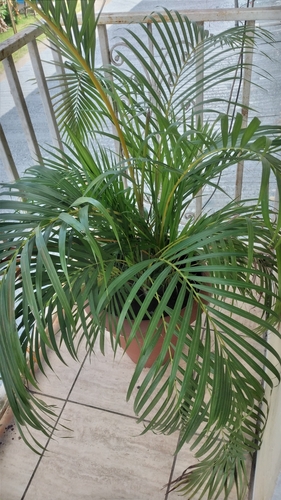
How to care for Dypsis lutescens
Watering
Areca palm (Dypsis lutescens) likes evenly moist soil during the growing season, but its roots rot quickly if the pot stays soggy. Water thoroughly until it runs out of the drainage holes, then let the top few centimetres of mix dry before watering again. Reduce watering noticeably in winter, when growth slows. Use filtered or rainwater if your tap water is very hard or high in salts, since the fronds show brown leaf tips when salts build up.
Does it need water today?
Push a finger 3-4 cm into the mix. If it feels dry, water. If it feels damp, wait. Lift the pot too: a light pot means it is dry, a heavy pot means it is still wet. Check the drainage holes so the pot never sits in standing water.
Areca palms are often overwatered by beginners. When in doubt, wait one more day, since the plant tolerates mild dryness far better than constantly wet roots.
Overwatering
Areca palm has fine, fibrous roots that need oxygen in the soil. Constantly wet mix suffocates them, and fungal root rot spreads quickly in warm rooms, so the fronds fail before the roots are obviously damaged.
Symptoms: Yellowing lower fronds that collapse, soft or blackened stem bases, a sour smell from the mix, and fungus gnats hovering around the pot.
Solutions: Stop watering and let the mix dry out for several days. Remove the plant, trim any mushy or brown roots with clean scissors, and repot into fresh, well-draining palm or peat-perlite mix in a pot with drainage holes. Water only once the top layer is dry again.
Underwatering
Areca palm sheds fronds when the root ball dries out completely. Its many thin, fast-drying roots in small containers cannot hold much moisture between waterings, so long dry spells damage the leaves quickly.
Symptoms: Fronds turn pale yellow or straw-coloured, leaflet tips brown and crisp, the mix pulls away from the pot edge, and the whole plant looks droopy.
Solutions: Soak the root ball by bottom watering for 30 minutes, then let it drain. Trim fully dead fronds at the base only. Set a regular reminder for the check-today test, and move the plant away from heating vents or radiators, which dry the air and soil fast.
Sunlight
Areca palm grows naturally under the canopy of taller trees in Madagascar, so it prefers bright, filtered light. Direct midday sun can scorch the fronds, turning them pale or bleached, while deep shade causes thin growth and fronds that lean toward the light. Turn the pot a quarter turn every few weeks so the crown grows evenly. Indoors, rotate it occasionally and dust the leaves so they can absorb light efficiently.
- Ideal: Bright, indirect light · 4-6 hours of bright, filtered light daily
- Tolerates: Bright, indirect light, Partial sun
- Best spot in a room: Near the window
- Artificial light: If natural light is weak, use a full-spectrum LED grow light about 30-45 cm above the crown for 10-12 hours a day. Keep the light on a timer so the plant gets a steady rhythm of light and dark.
Too little light
Areca palm needs enough light to keep producing new fronds. In dim corners it slows down, stretches weakly and stops making its characteristic arching, feathery crown, which makes it more prone to overwatering because it uses less water.
Symptoms: Slow or no new growth, thin and elongated fronds, pale green colour, and older fronds dropping while new ones stay small.
Solutions: Move the palm to a brighter spot near an east or west window, or set it near a bright north window. Add an LED grow light if the room is dim, and clean the leaves so dust does not block light.
Too much sun
Areca palm leaflets are relatively thin and tender compared with hardier palms. Hot, direct sun through glass heats the fronds quickly, which dries them out and bleaches the tissue before the roots can supply enough water.
Symptoms: Pale yellow or bleached patches on leaflets, crisp brown edges, and fronds that look scorched or papery on the side facing the window.
Solutions: Move the plant a metre or more back from the window or add a sheer curtain during the strongest midday sun. Cut badly scorched fronds at the base, and keep watering consistent while the palm recovers.
Temperature
Areca palm (Dypsis lutescens) thrives in bright, warm rooms and outdoor spots that stay above about 10°C. It tolerates short cool spells but suffers lasting cold and dry heat. Keep it away from drafts, radiators, and cold windows in winter.
- Ideal: 18–27 °C
- Tolerates: 7–35 °C
- Hardiness zones: 10-11
Fertilizing
Areca palm is a fairly heavy feeder during its active growing season and benefits from magnesium and micronutrients, which are often lacking in potting mixes. Feed lightly and consistently rather than heavily, since its roots are sensitive to fertilizer burn. Do not feed a palm that is resting in winter or one that is stressed by cold or overwatering.
- Slow-release fertilizer: Once a year in spring, when new growth begins, for plants in pots or in the ground.
- Balanced liquid houseplant fertilizer (such as 20-20-20), Palm-specific fertilizer with magnesium and micronutrients, Slow-release granular fertilizer formulated for palms
Soil
Areca palms need a loose, moisture-retentive yet fast-draining mix. Standing water quickly causes root rot, so drainage matters more than richness. The mix should feel light and spongy, not heavy or clay-like.
- Peat-free palm and houseplant mix: Coir or peat-free substitute, perlite, and composted bark in roughly equal parts, with a small handful of slow-release palm fertilizer added.
- Loam-based potting mix with added grit: Standard potting soil mixed with one-third coarse perlite or pumice for drainage, suited to larger floor-standing specimens.
- Outdoor garden soil with sand: Garden loam blended with coarse sand and leaf mould, suitable only where the palm is planted in the ground in mild, frost-free climates.
- pH 6–7
Repotting
Areca palms have a fibrous root system that is easily damaged, so disturb the root ball as little as possible. Repot when roots are circling the pot or pushing out of the drainage holes, not on a fixed calendar alone.
- How often: every 2-3 years
- New pot: Move up only one pot size (about 2-5 cm wider in diameter) each time, since areca palms (Dypsis lutescens) dislike wet, oversized pots.
- Repotting season: Spring, Summer
How to repot
- Tip the plant on its side and gently ease the root ball out, supporting the base of the stems with one hand.
- Loosen the outer roots with your fingers. Only trim roots that are dead, black, or mushy, using clean cuts.
- Set a layer of fresh mix in the new pot so the top of the root ball sits about 2 cm below the rim.
- Position the palm so the stems rise straight up, fill around the root ball with mix, and firm it gently without compacting it.
- Water thoroughly until it runs out of the drainage holes, then empty the saucer so the roots are not left sitting in water.
Pruning
Only remove fronds that are fully brown or dead, cutting them close to the stem without damaging the trunk. Leave green fronds in place, because they still feed the plant. Never remove more than a few fronds at once.
Pruning season: Spring, Summer
How to prune
- Identify the frond you want to remove and confirm it is fully brown or dried out.
- Sterilize your pruning shears with rubbing alcohol.
- Cut the frond at its base, close to the trunk, making a clean, angled cut.
- Do not pull or tear fronds off, as this can injure the trunk and open wounds.
- Dispose of the removed fronds and wipe the shears again after finishing.
Propagation
Seed sowing · Spring
- Collect fresh seeds from ripe, dark purple-to-black fruits, since Dypsis lutescens seeds lose viability quickly once dried.
- Remove the fleshy outer pulp by soaking the seeds in water for a day, then rubbing them clean.
- Sow the seeds about 1 cm deep in a well-draining mix of peat and perlite, keeping the medium evenly moist.
- Maintain a warm temperature of about 25 to 30 °C; germination can take anywhere from 1 to 4 months.
- Transplant seedlings into individual pots once they develop their first true leaf and roots fill the starter container.
Division of clumps · Spring, Summer
- Wait until the plant forms multiple stems, known as a clustering habit, at the base of the palm.
- Water the plant the day before so the root ball is moist and easier to separate.
- Dig up the clump and gently cut through the root mass with a clean, sharp knife, making sure each division keeps several stems and healthy roots.
- Pot each division into a container one size larger than its root ball, using a loose, well-draining palm mix.
- Keep the new divisions in bright, indirect light and water lightly until new growth appears.
Sow the seeds as soon as possible after harvest, because areca palm seeds rarely stay viable for long. Division is faster and gives you a mature-looking plant sooner.
About Dypsis lutescens
Also known as: Areca palm, Butterfly palm, Golden cane palm, Yellow palm
- Plant type: palm, clumping palm, tree-like palm
- Lifespan: perennial
- Distribution: Endemic to eastern Madagascar, where it grows in humid lowland and mid-altitude forest.
- Mature height: 1.5-2 m indoors, up to 8 m in the wild
- Bloom time: Spring to summer, rarely indoors
Pets · People
Pets: Safe · People: Safe. Listed by the ASPCA as non-toxic to cats, dogs and horses. Keep it out of reach of pets that chew plants, as large amounts of plant material can still upset the stomach.
Common problems
- Brown leaf tips: Usually caused by dry air, underwatering or salts and fluoride in tap water. Raise humidity and use filtered or rainwater where possible.
- Root rot: Overwatering or pots without drainage lead to yellowing fronds and a soft, dark base. Let the mix dry between waterings and repot into fresh, airy mix if roots are rotting.
- Spider mites: Fine webbing and speckled yellow leaflets appear in warm, dry conditions. Rinse the fronds regularly and treat with insecticidal soap.
- Scale insects: Brown bumps on stems and the undersides of fronds that suck sap. Wipe them off with a cloth dipped in soapy water.
- Mealybugs: White cottony clusters in leaf joints and stem bases. Dab them with alcohol on a cotton swab and isolate the plant.
Uses
Widely grown as an ornamental houseplant, in conservatories and as a landscape palm in frost-free gardens, where it makes an informal screen or clump. It is a popular choice in offices and hotel lobbies because it tolerates indoor light and is easy to keep full.
Is it edible?
Not edible. The fruit is not known as a food source.
History & legends
Dypsis lutescens was described from Madagascar in the nineteenth century and was introduced to European glasshouses in the 1800s. It became a fashionable Victorian conservatory palm and later a mass-market houseplant in the twentieth century, spreading to warm regions around the world.
Did you know?
The common name butterfly palm comes from the way its fronds open outward like the wings of a butterfly, and it is one of the few palms that thrives in a dim living room.
Frequently asked questions
How often should I water Dypsis lutescens?
every 7 days. Areca palm (Dypsis lutescens) likes evenly moist soil during the growing season, but its roots rot quickly if the pot stays soggy. Water thoroughly until it runs out of the drainage holes, then let the top few centimetres of mix dry before watering again. Reduce watering noticeably in winter, when growth slows. Use filtered or rainwater if your tap water is very hard or high in salts, since the fronds show brown leaf tips when salts build up. Push a finger 3-4 cm into the mix. If it feels dry, water. If it feels damp, wait. Lift the pot too: a light pot means it is dry, a heavy pot means it is still wet. Check the drainage holes so the pot never sits in standing water.
How much light does Dypsis lutescens need?
Bright, indirect light (4-6 hours of bright, filtered light daily). Areca palm grows naturally under the canopy of taller trees in Madagascar, so it prefers bright, filtered light. Direct midday sun can scorch the fronds, turning them pale or bleached, while deep shade causes thin growth and fronds that lean toward the light. Turn the pot a quarter turn every few weeks so the crown grows evenly. Indoors, rotate it occasionally and dust the leaves so they can absorb light efficiently.
What temperature does Dypsis lutescens like?
18–27 °C. Areca palm (Dypsis lutescens) thrives in bright, warm rooms and outdoor spots that stay above about 10°C. It tolerates short cool spells but suffers lasting cold and dry heat. Keep it away from drafts, radiators, and cold windows in winter.
Is Dypsis lutescens toxic to cats and dogs?
It is safe for cats and dogs. Listed by the ASPCA as non-toxic to cats, dogs and horses. Keep it out of reach of pets that chew plants, as large amounts of plant material can still upset the stomach.
What are the most common problems of Dypsis lutescens?
Brown leaf tips: Usually caused by dry air, underwatering or salts and fluoride in tap water. Raise humidity and use filtered or rainwater where possible. Root rot: Overwatering or pots without drainage lead to yellowing fronds and a soft, dark base. Let the mix dry between waterings and repot into fresh, airy mix if roots are rotting. Spider mites: Fine webbing and speckled yellow leaflets appear in warm, dry conditions. Rinse the fronds regularly and treat with insecticidal soap. Scale insects: Brown bumps on stems and the undersides of fronds that suck sap. Wipe them off with a cloth dipped in soapy water. Mealybugs: White cottony clusters in leaf joints and stem bases. Dab them with alcohol on a cotton swab and isolate the plant.
When should I repot Dypsis lutescens?
every 2-3 years. Areca palms have a fibrous root system that is easily damaged, so disturb the root ball as little as possible. Repot when roots are circling the pot or pushing out of the drainage holes, not on a fixed calendar alone.
How do I propagate Dypsis lutescens?
Seed sowing, Division of clumps. Collect fresh seeds from ripe, dark purple-to-black fruits, since Dypsis lutescens seeds lose viability quickly once dried. Remove the fleshy outer pulp by soaking the seeds in water for a day, then rubbing them clean. Sow the seeds about 1 cm deep in a well-draining mix of peat and perlite, keeping the medium evenly moist. Maintain a warm temperature of about 25 to 30 °C; germination can take anywhere from 1 to 4 months. Transplant seedlings into individual pots once they develop their first true leaf and roots fill the starter container.
How this guide was written
Verdiss writes each guide with AI from botanical references and checks the species against iNaturalist and Plants of the World Online (Kew). Readers can rate every guide in the app.
Sources
Verdiss's information is for general guidance. Never eat or use a plant as medicine based on an app: ask a professional.